Showing posts with label DNA. Show all posts

Thursday, October 24, 2024

Cold cases

 Michael - Alternate Thursdays

Why are cold cases so fascinating? Look at the popularity of all the fact-based TV series complete with interviews with the actual investigators and witnesses. One obvious reason is that because the cases take so long to solve, they tend to be twisty and surprising. Otherwise they wouldn’t be cold cases in the first place. Maybe the fact that the detectives are initially baffled and only new evidence or new technology allows them to make a breakthrough adds to the interest. Whatever the reasons, cold cases grab attention. And there are plenty of them in plenty of varieties. For a selection take a look at Wikipedia.

Mystery Fanfare's take on cold cases...

It’s conventional wisdom that a case that’s going to be solved at all is usually solved in two days. Actually, investigators say that more accurately a person of interest is identified in that time period, and a couple of weeks is all that’s required to gather enough evidence so that the person can be arrested. (Generally, Forensics needs longer than a few days to process all the evidence, and DNA may take longer still.) A Washington Post examination of 8,000 homicide arrests across 25 major U.S. cities since 2007 found that in half of the cases an arrest was made in ten days or less.

Still, in a murder case, the police would expect the case to stay “warm” for about a year before it gets relegated to the cold-case division. That would be another group of detectives (maybe just one) who will go over the casefile again in detail and try to see the evidence from a different perspective and throw a wider net to pick up suspects. Unsolved murder cases never close, but their probability of being solved rapidly decreases. Given the amount of effort that has already been put into the case while it's "warm", it’s rather surprising that around 30% of cold cases are actually solved in a year. However, the number of cold cases keeps growing.


The driving force behind solving cold cases may well be a new technology rather than a new pair of eyes. The common use of DNA testing was a huge boon and became standard at crime scenes around 2000, making the early 2000s the heyday of cold-case units. There was a huge amount of stored evidence, some of which could be DNA tested leading to connections with existing suspects or introducing new ones. However, of course, the DNA requires something to match to. If the murderer had left a DNA signature (more likely in those days before killers regarded CSI as required viewing for Murder101), then it didn’t help unless Forensics had a matching sample from an identified person. In fact, DNA was often more helpful in eliminating suspects than it was in identifying new ones. DNA analysis was (and still is) a huge boon for exonerating innocent people.

Joseph DeAngelo, the Golden State Killer
This charming old gentlemen murdered and raped at least 65 people

More recently the internet and people’s love of using it has offered a rather different sort of database – a sort of “volunteer” DNA databank. One of these is GEDmatch. Started by one man to help people find lost family members and ancestors, it allows you to upload your DNA markers, and then you can search it for various types of matches. It can identify quite distant or close relatives. So one can find a lost third cousin or perhaps fill gaps in a family tree. In the wide open world of social media, there’s no downside. But there is one of course. Other people can also search and discover you as a relation. Even the police can search by uploading the DNA of an unknown suspect. Zoe Sharp explained how it was used to catch the Golden State Killer in 2018 in one of her blogs.

At the time the owner of GEDmatch was furious that his site had been used in that way, fearing he’d lose many of his clients because of the feeling that they were being analyzed in some way by the police. Big Brother is watching your DNA. However, he was wrong. The reaction of his clients was overwhelmingly positive. Now you can opt out of being visible to law enforcement agencies, but most people don’t seem to mind. Perhaps discovering that your cousin is a murderer is not only worth a viral Facebook post, but may be a useful safety feature! Then again, perhaps people just like the idea of helping the police.

The AI detective
Yes, it does exist. No, it doesn't look like this.

So where will the next cold case breakthrough technology come from? The AI detective? I wrote a science fiction short story along those lines fifty years ago, maybe I should dust it off…

Thursday, November 4, 2021

The unknown revealed

 Stanley - Thursday

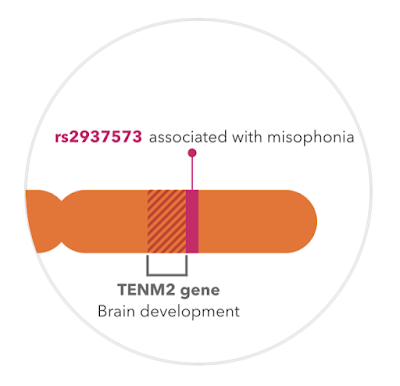
Late last week, I received an email telling me something I didn't know and, quite frankly, had never thought about. To make a short story long, researchers at 23andme, one of the companies to which you can send a sample of your DNA for analysis, had tested my rs2937573 marker, which is located close to the TENM2 gene, which in turn is related to brain development. I was found to be a AA genotype. 

Translated into language I can understand, this means that I have slightly lower than normal odds of suffering from misophonia (a good word for you, Zoë!), which is a condition in which a person experiences intense anger and disgust at the sound of someone else chewing!

Good to know.

This got me to think about a related issue I have often wondered about.

A good friend of mine was given a DNA test kit as a present by his son, who had already sent his sample in. A couple of years later, the son, call him Peter, was contacted by someone, call him John, claiming to be a close relative - a half cousin, in fact. That is, Peter and John shared one grandparent.


After speaking to John, my friend concluded that John's claim was likely true and that my friend's father must have had a fling which resulted in a son - my friend's half brother, a person he never knew existed. 
Needless to say, my friend was surprised, perhaps shocked, at the revelation, because he'd always regarded his father as a man of integrity. My friend believes it is likely that his father never knew of the child he'd sired out of wedlock.

In this case, everyone lived happily ever after. My friend and his family accepted the reality of a new relative. John has never laid any claim against the estate of his grandfather or against his grandfather's heirs. As far as I know, the two families have gone back to leading their separate lives with no acrimony or anger. Perhaps part of the reason for the outcome being so benign is that the infidelity happened a long time ago, and the persons involved is no longer alive.

It is useful to know some of the facts about DNA testing - particularly when our world seems to respect facts less and less.


If you are told that you are related to someone with any of the following relationships, you can be confident that you are closely related. The only exception to this is if the DNA samples were switched, inadvertently or advertently.

Parents, children, siblings

There is an anomaly in the case of the children of identical twins. We know them as cousins, but a DNA analysis will report them as half-siblings, and both twins will be shown as parents to both sets of kids.

Second cousins or closer

There is an anomaly here too. If someone shows up as your first cousin, they could be your first cousin, but they could also be your great-grandparent or great-grandchild, half-aunt or half-uncle, half-niece or half-nephew. So, if it is important to know how someone in the first cousin category is related, a little research should sort that out.

I didn't know until researching this blog that an important word to know is centimorgan (cM) (another one for Zoë!), which is just the word that geneticists use to describe the length of DNA segments – specifically, the difference between chromosome positions.  

Every person has approximately 6800 centimorgans of DNA. This number includes both copies of each numbered chromosome, or approximately 3400 centimorgans inherited from each parent. However, siblings are likely to inherit different sets of centimorgans from their parents, because sets of centimorgans are passed down randomly from one generation to the next. This is the reason siblings are usually different. 

Here is a brief explanation of this diagram which I took from whoyouaremadeof.com. It explains how segments may be passed down.


Mike inherited an entire green segment from Grandpa. Mike's daughter still has part of the segment. Notice that Nicole's cousin, James, has no green segment.

Sam inherited light blue from Grandma and passed it to James. Mike also inherited some blue, but passed none to Nicole.

Ancestry.com also has a very useful discussion of how genes are passed down from one generation to the next, and how this frequently leads to unexpected outcomes. You can read that discussion here. 

DNA analysis is helpful to the police and to those of us who write mysteries. However, it doesn't take much of an imagination to conjure up heart-wrenching or traumatic situations that could be revealed by these DNA tests - issues of family, heredity, or race, not to mention likelihood of disease. I often wonder whether people sending off their DNA kits have thought of the possible implications.

A quick search of the internet reveals many stories of unexpected results, some causing great trauma, some not. Since tens of millions of tests have been performed, it is not surprising that so many people end up surprised. A good article in The Atlantic from three years ago shows some of the issues that surface. You can read it here.

I was surprised at how few reports I found of unexpected matches resulting in lawsuits, although my writer's mind came up with many.


Given the number of unexpected matches, it is not surprising that an industry has grown up to provide support. It dispenses good advice on how to handle these surprises, from preparing yourself to sharing the information with others.

Of course, people submitting their DNA have control over the extent they want the results revealed or shared. However, I suspect that most people who have paid money for the information want at least some of the information for themselves, even if they don't want anyone else to see it.

What should you know before deciding to send in a sample of your DNA?

The best advice is to read the small print from whatever company you are thinking of using for a DNA test, then decide if you are ready to handle something that could shake your views of your family. You never know what may show up. Here's a good article on how to select a company.

You should also be aware of the limitations of testing; for example of why the analysis of twin can yield different results, particularly with respect to heritage. This is a very good article on that subject.

Having your DNA tested is very appealing. However, you should be prepared for unexpected information. 

On a personal note, it was through Ancestry.com that I found out that my British-Army-Sergeant-Major grandfather, whom we all loved and admired, was likely not married to my grandmother when he had five children. If he was married to her, it is almost certain that he wasn't divorced from his first wife. When we learnt of this, my cousins and I roared with laughter and wished that he were still alive to clarify the situation! Note: this information surfaced, not through DNA testing, but because a relative of my grandfather's first wife contacted me with the 'good' news.


Tuesday, November 13, 2018

Visit to the police laboratoire - it's all in the DNA. Not.

Last week in Paris I got ahead of myself. I was so excited after my visit - the second one! - to the Police laboratoire and frustrated that I couldn't upload these photos from the cafe where I'd get WiFi or weefee as the waiter said. Or explain why I can NOW commit crime in Paris!


 While I was on the tour with C. the head biologist and expert trial witness she insisted my visit follow the route of evidence. Which is how the lab works; first the police evidence arrives comme ça.
 Under seals
 Then the scientific technicians do their thing. Which includes striking a pose - did I forget to say they're a lot of fun?
 On the tour where we're heading to the blood analysis lab to pull DNA out of blood samples that arrived in those evidence envelopes above. C. showed me the police report; a headless, armless, male torso had been discovered outside Rouen and their remit is to help identify the torso victim via DNA.

Part of the process to obtain DNA from the blood - this was much more involved than I'm showing. It's an involved process with different labs and super high tech machines whose names I can't pronounce.
 Tools of the trade.

We followed through the whole process on each floor.  C. took my DNA, which will rest in the French database for eighteen months. Why? In case I contaminated anything on my visit to the lab ie involving their work or this headless, armless torso.  When I was de-robing I joked to C. that I needed to be on good behavior and couldn't commit any crime or I'd be a suspect, right?
Au contraire, she said, once I register your DNA 
Your sample exonerates you for eighteen months. She winked. Now you can plan your perfect murder and get away with it legally.
I like how she thinks. Here's an update she sent me on the headless, armless male torso from le Parisien. The lab helped ID him via DNA. The investigation now has four suspects in his murder - all women.

 This is translated from le Parisien sent to me by my new BFF, my scientific contact at the lab. "The girlfriend of the homeless found dead a week earlier and the mother of the latter are among the suspects.
The investigation of the case of the body found dismembered and decapitated Monday, November 4 near Rouen progresses. According to information from France Bleu Normandie, four women were placed in custody Saturday and indicted.
They all knew the 45-year-old homeless man whose body without a head, feet or hands was found wrapped in a tarpaulin and covered with cellophane at Amfreville-la-Mivoie (Seine-Maritime). It is about the companion of the victim, two friends of this companion and the mother of this one.
Two of the indictments were "for murder and damage to the integrity of the body, and two others, for voluntary abstention to prevent a crime or an offense against the integrity of a person" "said Saturday evening in a statement the public prosecutor of Rouen, Pascal Prache.
The circumstances of the murder remain unknown, as is the potential motive of the suspects. It would nevertheless be a "premeditated" act, ensures the local radio.
On Wednesday, legs and arms that may belong to the body discovered were also found in the area of ​​Pont-de-l'Arche, south of Rouen. "It is possible that this is related to the dismembered corpse and beheaded," said a judicial source."
Cara - Tuesday


Wednesday, July 22, 2015

The murder of Kristin

by Jorn Lier Horst, Norway


News coverage from 1999
"Girl (12) mysterious dead"
I've had some very special days. One of my Cold Cases from the time I worked as a police investigator might got a solution.

At half past six in the evening on the 5th of August 1999, twelve year old Kristin Juel Johannessen went for a ride on her bike. She never returned.

Over the next few hours a search crew spread out in the terrain around the small village Mork, outside Larvik. Neighbors, friends, family. It was searching paths and meadows, ravines and streams. Just before midnight she was found murdered in a roadside. I spent almost all my working time for the next tree years in an attempt to find the perpetrator. Kristin and what had happened to her, was always on my mind.

Kristin and her dogs
Suspicion was first directed to a retarded and silent man who had driven through the village on a small motorcycle, but as the details fell into place, the investigation changed direction. I was given the responsibility to follow an alternative tack that ended in the arrest of a 24 year old man in Stockholm. He was prosecuted, but the evidence did not hold in court. He was acquitted.

The murder of Kristin is an investigation that has given me long, sleepless nights. It is a case of the kind that you go through time and time again, to scrutinize every detail in search of something that could take it further. It's the type of case that creates a mental scar in you as an investigator. The type of scar that does not heal properly, but which becomes inflamed.

Me and Kristins father to the left
Just before noon, Wednesday last week, I received a call from Kristins father, Roar. We have kept in touch in the years that have passed since the murder, even after I left the police. He has never given up on finding out who killed his daughter and has operated his own investigation. I have given him advice and we have listened together to the clairvoyant and others who believe they have tips and information. Now he called to say he had just been informed that the police had arrested a man for the murder of his daughter. New analysis methods made it possible to find a DNA profile on Kristins nails, which had been kept all these years. The man who was arrested was the same man I apprehended 15 years earlier. The new investigation has just started, but hopefully we're all about to get answers to what really happened back then in 1999.

Last week news coverage:
2001: Guilty
2002: Acquitted
2015: Arrested again
Roar and I have not just been talking about the case over the years that have passed, but also about literature. He is an avid mystery reader. I must admit that I found it strange that he that had experienced brutal crime in reality, read this type of literature. He explained, however, like many others, that he read crime novels to unwind and relax. And when he opens a crime novel he is well aware that here will justice be served. He will meet a protagonist who helps us to understand the incomprehensible. The investigator will restore an order that has been disturbed, and I think that such a restoration of law and order has an appeal to the reader in our chaotic world. 

Jorn Lier Horst