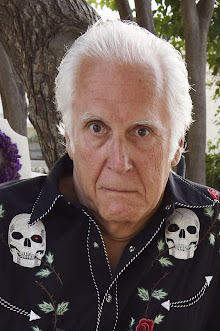
Last month, a friend sent me an interesting
article entitled How
To Take A Great Author Photo. It shows various examples of what makes a
good or bad publicity pic, including some Before and After shots of the same
people in different poses. And if it doesn’t exactly tell you how to take a photo, that’s a minor
quibble.
The reason I’ve been looking at this again
recently is that it’s time for a new author pic for myself. Never something I
look forward to – after all, I spent 25 years on the other side of the camera
partly to avoid appearing in pictures myself.
But sometimes you can’t get round it, so
you have to run straight at it, yelling a war cry.
At the moment, if someone asks me to send
an author pic, I tend to send out a couple, labelled Serious and Not-So Serious.
 |
| My serious pose |
 |
| My slightly less than serious pose |
 |
| This says 'I don't write cosy crime ...' |
 |
| A politician, on the phone |
 |
| Ayn Rand at her typewriter, and looking slightly scary. It's the eyes... |
The ‘chin in hand’ is another, to make the
author look suitably thoughtful, or maybe to hide the occasional extra chin.
 |
| John Updike utilising the 'chin in hand' pose for added intelligence reasons rather than hiding any secondary chins. (Absolutely no comments being made about my fellow MiE bloggers here, by the way!) |
And, I confess, I’ve been guilty of that
myself. Here’s my first author pic, for example:

Of course, if the author wants to come
across as a bad boy, they just grab a cigarette.
 |
| Hunter S Thompson, with obligatory cigarette |
And finally there’s the ‘relaxing on the
sofa’ kind of shot, to show the author is an ordinary person just like the rest
of us.
 |
| John Grisham, in relaxed pose. |
Very rarely does an author break the mould,
although Paul D Brazill does this nicely with his author shot.
 |
| Paul D Brazill, at the bar, naturally, and hanging on for dear life. |
I like this. Paul writes PI noir and you
can tell that just by one glance at this picture.
On the other hand, some authors are not
quite sure what they’re trying to get across. Take Clive Barker, for example.
We have just about everything here, ranging from the dreadful mullet hairstyle:
 |
| Clive Barker - who talked him into that hair? |
To the Clark Gable wannabe shot:
 |
| Clive Barker in retro pose |
To the downright weird:
 |
| Director David Cronenberg with Clive Barker and ... friends? |
You can see the progression of some authors
by their author pix. Take Nora Roberts/JD Robb. For her romance novels Nora
Roberts she uses something very stylish:

But for her sci-fi cop series, which she
writes as JD Robb, she’s gone for a harder look:

And both are a far cry from when I first
came across her about fifteen years ago:

I quite like this shot of Norwegian author Jo Nesbø:


Although he's since started using something a bit more conventional:
In my case, what am I trying to get across
about me and my writing? I write fairly tough action thrillers with a female
main protagonist. Even the standalones – one out, others on the way – still
feature a strong female central character whose first instinct will always be
to sort out her own problems rather than running for help.
 |
So, should I be sticking with the guns and
motorcycles as props for my own pictures, or going for something just a little
more feminine? I can, after all, dress like a grownup when the need arises.
Or should I try to go with a mix of the
two? Something that says, I’m female, but don’t mess with me? A kind of Frock and Glock look?
Any advice or suggestions welcome!
This week’s Word of the Week is boustrophedon, meaning an ancient form
of writing that had lines alternately written left to right and then right to
left. It comes from the Greek and literally means ‘turning as an ox when
ploughing’. From bous meaning ox and strephein meaning to turn.