Showing posts with label Chobe. Show all posts

Thursday, April 10, 2025

Birthdays

Michael -Alternate Thursdays 

The way you think about birthdays depends on your age. Kids love birthdays. Parties, presents, the whole work. As they grow up they look forward to the new freedoms each year brings - being allowed to drive, to drink alcohol, to vote...well maybe not so much to vote. Then, as adults, they are 30, 40, and suddenly the enthusiasm tends to flatten out. They become fortyish, mid forties, around fifty. But sixty is a big one, heralding retirement in the future. That's something to look forward to. Maybe. 

But after the three score years and ten, things become a bit iffy. One tends to talk about one's next birthday in the future as an achievement and not one that is guaranteed. My last trip to Botswana with my partner was a belated celebration of one of her birthdays. (See? No details.) Now I've decided to celebrate my eightieth birthday with another trip to Botswana - a tour of the Chobe Game Reserve with our old friend and Chobe expert Peter Comley. Peter runs a safari tour business and has squeezed us into his busy schedule for July. We can't wait.

However, there is a small problem. My birthday isn't in July, and I'm not turning eighty for a few years yet. So how does that work? you ask. The answer is FOMO. Why put off a perfectly good eightieth birthday treat for several years when I may not get to eighty at all?  So July it is.

By way of justification for this nonsense, here are some scenes and pictures from that last Botswana trip in the Chobe area.


Michael and Peter enjoying bush time


The one disadvantage of living on the Cape south coast is that it’s a long way to the places we love in the bush and from Botswana. Our first destination was Kazungula and that's about 1,400 miles by road, but we took it easy stopping at in Lobatse and doing some research at Otse on the way up. (Otse features in our new Kubu mystery.) Kazungula has busy border posts with both Zambia and Zimbabwe, and is situated close to the point where the four countries meet—Botswana, Zambia, Zimbabwe and Namibia. (The actual point is somewhere in the middle of the Zambezi river.) More important, it’s the home of our great friend Peter Comley. He, and his late wife Salome, have been tremendously helpful over the years with local information for our books and with suggesting venues for the next murder. Peter is also the author of a number of guides to the wildlife of Botswana and Namibia, and he has written an autobiographical book about his early years in Botswana focused around his amazing dog, Django. If you want a moving and delightfully written view of what Botswana used to be like in the old days, get hold of a copy of Django. (It will have to be an ebook, though.)

Elephants at Chobe

Apart from the delightful time with Peter, we had the opportunity to stay at his brand new camp in the Chobe Forest Reserve. This is definitely my idea of camping! And since work on the swimming pool, for example, was incomplete, we had the place to ourselves—with elephants, buck, and birds joining us at the waterhole from time to time. One early morning there was an altercation between some lions and a pack of hyenas over a kill. We couldn't see it, but we certainly heard it!

It was a wonderful base to explore the Chobe national park and the stunning Victoria Falls.

I think someone invented the word "glamping" for this sort of tent!


The case rests
Bath or shower? Hot and cold running water, of course
Or just relax ...
... overlooking the waterhole

Fortunately the only croc who made it onto the viewing deck

Can't wait to go back!

Wednesday, April 10, 2024

Anyone want some elephants?

 Michael - Alternate Thursdays

Elephants on the Chobe River

The President of Botswana and his conservation minister are offering large numbers of elephants around. Especially to countries making noises about elephant conservation so that they can find out what it’s like to live with elephants as neighbors. The first offer was from Botswana’s wildlife minister, Dumezweni Mthimkhulu. In London last month to lobby members of Parliament, he offered Britain 10,000 elephants, saying “I hope if my offer of elephants is accepted by the British government, they will be kept in London’s Hyde Park because everyone goes there. I want Britons to have a taste of living alongside elephants, which are overwhelming my country. In some areas, there are more of these beasts than people.” (If “some areas” is the Chobe National Park this is hardly surprising or undesirable!)


Hyde Park.
Just add elephants and mix well...

Then, a few days ago the president of Botswana, Mokgweetsi Masisi, trumped this by offering Germany 20,000 elephants, although he was less prescriptive about where they should live.  How about the Black Forest? Probably the elephants would make themselves at home there, with plenty of tasty trees to eat and abundant water. They might find it a bit chilly in winter, but they seem to find Namibia okay, and the nights can get pretty cold there. What the local Germans would think about it is more of a question. And that’s the point.
Black forest. Good for elephants?

Although Minister Mthimkhulu eventually backed down and said that his offer was “rhetorical” (so no elephants for Hyde Park after all, I’m afraid), the president was more forceful, pointing out that Botswana had successfully transferred 8,000 elephants to Angola and some 500 to Mozambique, and stating that he wouldn’t “take no for an answer”.

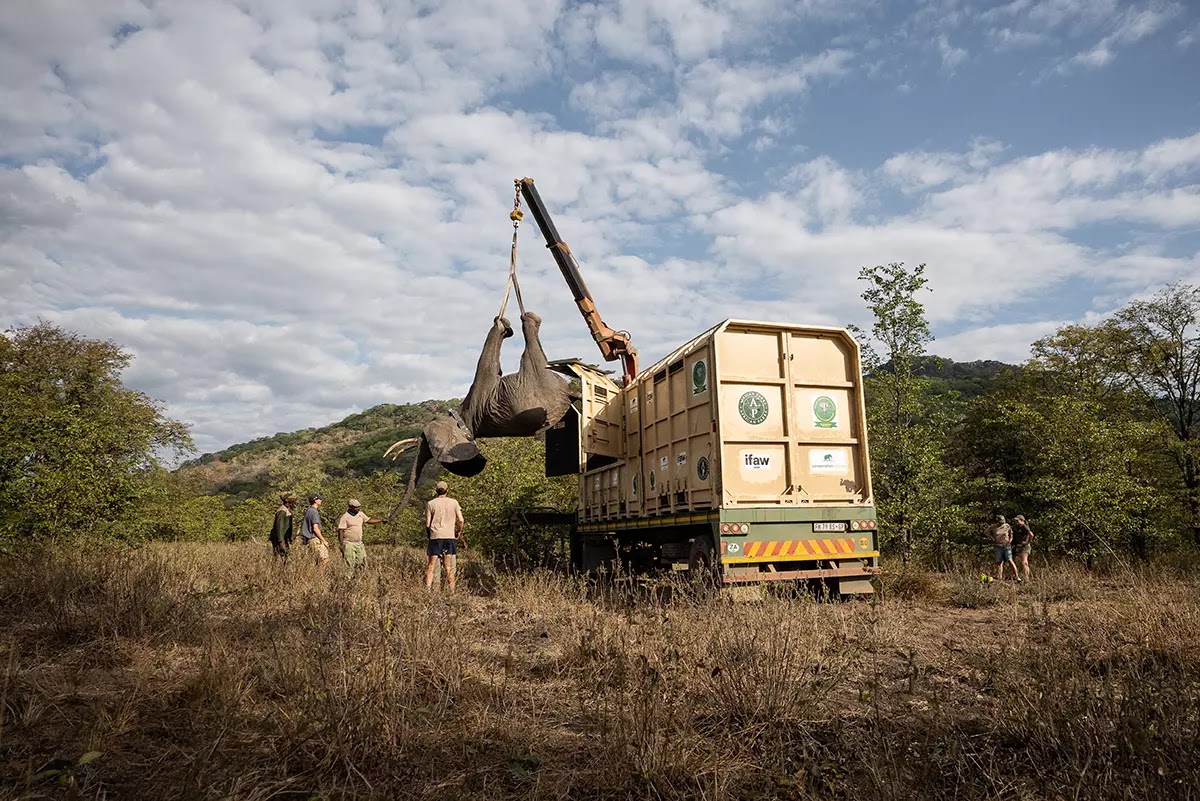
Standard way to transport one elephant.
They are unconscious at this point.
How do you handle 8,000?

So what is causing the Botswana government to offer large parcels of pachyderms to countries all over the world? It worked with Angola and Mozambique, but I guess they actually wanted the elephants.

The fact is that Botswana does have a surfeit of elephants. The previous president, Ian Khama, had a policy that wildlife would earn its keep through high-end tourism. He banned trophy hunting, cracked down hard on poaching, and welcomed international tourists in droves. Nature took its course, and now Botswana has around 130,000 elephants, about a third of the world’s total population. To hear President Masisi tell it, it sounds as though you might bump into an elephant anywhere in Botswana, or more frighteningly, it might bump into you. In fact, much of Botswana is arid Kalahari scrub and that’s not where the elephants like to hang out. They are concentrated up in the north in the magnificent Chobe National Park, particularly along the Chobe and Zambezi rivers. 

Elephant in Kasane at night.

However, elephants are nomads, and in Kasane, a town on the Chobe River, you may well see elephants wondering around the town perhaps helping themselves to a tasty hedge. More seriously, they will help themselves to crops the surrounding people depend on for their livelihoods, and there have been some bad experiences with injuries and even deaths of local people. In the national parks themselves, the trees are groaning (or dying) under the browsing pressure of the huge animals.

Masisi has reversed Khama’s ban on trophy hunting and that’s what all the fuss is about. The UK has introduced legislation to ban the import of trophies from endangered species, and elephants qualify as endangered pretty much everywhere outside southern Africa. Germany is talking about doing the same thing. Botswana says that that will just make the elephant problem worse at the same time as depriving the country of important revenue supporting local people, conservation and wildlife management.

Traffic Jam.

Let’s unpack that a bit. First, there are only a few hundred hunting licenses issued in a year, so in reality that won’t make much of an impact on the population. However, trophy hunters want the best tuskers and that can have an impact on the long term tusk quality of the population. While it’s true that a trophy hunt of a couple of weeks will cost of the order of $50,000 (and very few tourists will spend anything like that sort of money), it’s arguable how much of that money makes its way down to the people living with elephants.

Elephants in Savuti. Not much left to eat...

On the other hand, alternate population control options include culling (i.e. hunting without trophies that costs money) and contraceptives that can also be expensive and hard to administer. (No, we are not talking about condoms here.) Botswana argues that banning the import of trophies, as the UK and Germany want to do, is interfering with Botswana’s internal affairs and wildlife management. They ask how hunting elephants for trophies is different from hunters heading off to shoot deer for their antlers, which is often described as supporting deer population control, and takes place every season in the UK and Germany among other countries.

Hmm.


Thursday, May 30, 2019

Botswana revisited - Part 1


Michael - Thursday

Michael and Peter enjoying bush time
We’re just back from a wonderful trip to Botswana. It was a belated seventieth birthday celebration for Pat, and since she had never been to the Okavango delta, that was the centrepiece of the trip. But there were lots of other places to go and see, and one of the great things about Botswana is the friends one meets there. And, of course, there is always the opportunity for a little research…

The one disadvantage of living on the Cape south coast is that it’s a long way to the places we love in the bush and from Botswana. Our first destination was Kazungula and that's about 1,400 miles by road, but we took it easy stopping at in Lobatse and doing some research at Otse on the way up. (Otse features in our new Kubu mystery.) Kazungula has busy border posts with both Zambia and Zimbabwe, and is situated close to the point where the four countries meet—Botswana, Zambia, Zimbabwe and Namibia. (The actual point is somewhere in the middle of the Zambezi river.) More important, it’s the home of our great friend Peter Comley. He, and his late wife Salome, have been tremendously helpful over the years with local information for our books and with suggesting venues for the next murder. Peter is also the author of a number of guides to the wildlife of Botswana and Namibia, and he has written an autobiographical book about his early years in Botswana focused around his amazing dog, Django. If you want a moving and delightfully written view of what Botswana used to be like in the old days, get hold of a copy of Django. (It will have to be an ebook, though.)

Elephants at Chobe
Apart from the delightful time with Peter, we had the opportunity to stay at his brand new camp in the Chobe Forest Reserve. This is definitely my idea of camping! And since work on the swimming pool, for example, was incomplete, we had the place to ourselves—with elephants, buck, and birds joining us at the waterhole from time to time. One early morning there was an altercation between some lions and a pack of hyenas over a kill. We couldn't see it, but we certainly heard it!

It was a wonderful base to explore the Chobe national park and the stunning Victoria Falls.
I think someone invented the word "glamping" for this sort of tent!

The case rests
Bath or shower? Hot and cold running water, of course
Or just relax ...
... overlooking the waterhole

Fortunately the only croc who made it onto the viewing deck
It's an easy day trip to the Victoria falls across the border in Zimbabwe. But take hard currency with you to buy a visa as you enter, and expect to spend a couple of hours achieving that. However, it's worth it.
Rainbow from the lip of the Devil's cataract
Main falls
Rainbow over the Boiling Pot
Falls through the rain forest
Devil's cataract
Railway bridge over the gorge. Popular with bungee jumpers
After that it was south to the Okavango...

_______________________
Upcoming events

June 11: release of Shoot the Bastards(Poisoned Pen Press, an imprint of SourceBooks)

June 18: 1830 for 1900
Once Upon a Crime bookstore in Minneapolis
Launch of Shoot the Bastards, in conversation with Kent Krueger
Refreshments

Thursday, November 8, 2018

Police stations we have known

Michael - Thursday

Stan and I have been launching Dead of Night in South Africa, and that often raises questions about settings and sense of place. I talked a bit about out choices here last month. But I'm still wondering how much the setting affects the story and how much is the other way around. Even the police stations have an impact.

Baboons on Kgale Hill
A Carrion Death was set in several places, but Gaborone was the pivot. Kubu hangs out in an office at the the headquarters of the Criminal Investigation Department in the Millennium Park complex west of the city.  Characterless, it's surrounded by parking covered by shade-cloth that loses a daily battle with the sun. It's a newish building and encroaches on the base of Kgale Hill which is about the only bit of topography in the area.  When researching the book, we visited the director of the CID there on a Saturday, but went back for another sortie around the area on Sunday.  We were delighted to see that a troop of baboons had come down from their haunts in the rocky cap of Kgale Hill and taken over the area around the CID. They were sorting through bins and any other items of interest left as the human tide went out for the weekend. It seemed a wonderful metaphor for the juxtaposition of old and new in Africa. One we were not able to resist bringing into the stories. On several occasions Mabaku worries about what they might do to, or on, his car as he looks out of his office window.

The Linyanti where much of our second book takes place

Baobab
The Second Death of Goodluck Tinubu is set up north. The Kasane police station also has an interesting feature. Kasane lies on the confluence of two major rivers – the Chobe and the Zambezi. It's also at the meeting point of four countries – Botswana, Zambia, Namibia and Zimbabwe - clearly not an entirely comfortable location these days. However, the town is thriving with fancy modern hotels overlooking the broad Chobe river and packed with tourists taking trips into the Chobe National Park a short distance away.  Built on the site of the old prison, a modern multi-story building houses the police. The architect took care to design it in such a way that two ancient baobabs could be preserved. Both are hollowed out with once locking doors that allowed prisoners to be held within the tree itself. One tree for the men and one for the women. No more than two in each at a time one hopes! You can climb in, but it’s not a very comfortable or salubrious place to spend any time. We were shown around the inside of the police station - including the modern prison cells - but nothing was as interesting as the baobab prison.

The semi-arid country of the Kalahari  

Ground Hornbill
Our third book, Death of the Mantis, was set in the Kalahari desert part of Botswana, so we made the acquaintance of the police there. As usual they were charming and helpful. Tshane is a small village in the heart of the southern Kalahari. It has neighbours of the same type: Hukuntsi – the “commercial centre” sporting a petrol station and guest house, Lehututu – named after the cry of the Ground Hornbill, and Lokgwabe. The villages are there because of the usually dry salt pans which provide subterranean water. The only police station for the group of villages is at Tshane. Unlike the usual Botswana police building, this is an old style colonial one-story dating back to the days of British rule - the Bechuanaland Protectorate. It has the prime site in town: overlooking one of the salt pans. We were told it is the second oldest permanent police post in Botswana. Obviously someone thought this area would grow. Perhaps the old building survived because it didn’t.

The View from Tshane Police Station

Tsabong police station features in the same book
The next three Kubu books take place in Gaborone, Mochudi, and Ganzi. Dead of Night is set in South Africa, Geneva, and Vietnam. But I must admit that we haven't visited any Vietnamese police stations. Maybe just as well!


Thursday, October 31, 2013

The Big Five

Visitors to the big game areas of sub-Saharan Africa are often exhorted to spot The Big Five.  And doing so is often a badge of pride.  The name The Big Five came about apparently because the five animals are reputedly the most dangerous to hunt.  

I've just returned from 10 days in the bush, so the idea of spotting The Big Five came up.  Fortunately we succeeded in seeing all five, including the most difficult, the leopard.

Here I am in my bush vehicle, ready to go.


The animals comprising The Big Five are:

The king of the jungle – the lion (incidentally, the lion hardly ever is in a jungle – it prefers bush land or plains)

I've got my eye on you.


Here, take my photo

Time to get out of the sun
Maybe it's time for a nap

Zzzzzz


The leopard – elusive and very difficult to spot (my favorite cat)

It's all mine


The elephant – my favorite animal by far


The rhinoceros – in danger of extinction due to the demand for its horn’s (non-existent) medicinal properties

A white rhino - a grazer


The buffalo – usually placid in a herd, but decidedly cantankerous when solo.

Don't come any closer


Many visitors are surprised by the size of the animals, so I thought I would provide you with some basic facts about each of The Big Five.

The elephant – or ellie as we like to call them

This is the largest terrestrial animal, with African ellies being somewhat larger than their Asian counterparts.

A large male African ellie can stand 4 metres (13 feet) high and weigh 7,000 kgs (15,000 lbs).  With its ears out and trumpeting, it is an awesome and terrifying sight.

Ears out an trumpeting


On one of our bush trips, a group of us were canoeing along the Zambezi from Mana Pools in Zimbabwe to the Mozambique border.  We stopped for lunch on a small island, whose side were small sand cliffs made carved out when the river was in flood.  We were in the midst of setting up our picninc lunch when an ellie walked out from under a tree.  It looked at us curiously, standing about 30 or 40 metres away.  It walked around another tree and peered at us again.  Then it walked back around the tree to take another look at us.  Without any warning, up went the trunk, a soul-chilling trumpet followed, and the ellie charged.

Our options were few.  Staying where we were was obviously not an option.  But jumping over the small cliff into the crocodile-infested, hippo-infested Zambezi didn’t seem very appealing either.  But we really didn’t have a choice, so we moved with some speed towards the top of the cliff – probably 3 to 4 metres high.  Just before we had to launch ourselves over the edge, the game ranger who was accompanying us, jumped in front of the ellie, waved his arms, and shouted.

The ellie skidded to a halt – literally – looked quizzically at the crazy ranger, turned and walked away.

Of course, we were very relieved and asked the ranger why he did what he did.  He replied that when young bull ellies charge like that, it is usually a mock charge – that they are just strutting their stuff.  ‘Usually’ we thought. 

We were very thankful to have someone with us with knowledge and courage, who provided us with a story for years to come.

In the Kalahari - running for a waterhole

As frightening as they can be, ellies are also softies.  I once watched a small herd drinking at a waterhole.  There was a tortoise at the edge of the water in potential danger of being trampled.  One ellie gently moved it out of danger with it foot.  Amazing.

People who spend time around ellies are constantly amazed at their behaviour.  They have a great sense of humour.  The story goes at the game farm where I have a share in a bungalow that a group of young men, highly intoxicated, were watching a herd of ellies.  The men were making a great deal of noise, as intoxicated men are wont to do.  One ellie apparently was so irritated at the intrusive noise in the quiet bush that it wandered over to the Land Rover in which the men were sitting, lifted the front of the vehicle off the ground, and dropped it.  It them repeated this to reinforce its point and walked off.  Needless to say the bush became very quiet.

Ellies, despite their size, are remarkably quiet when they walk.  Most people who spend time in the bush have stories about looking intently at some animal or other only to find an ellie or two are standing a few metres away.  They have walked up in complete silence.  A big ellie has a foot that can reach nearly half a metre across (that’s 18 inches or so). 

This is a small footprint - and I have a big foot

Ellies are vegetarian and go through a huge amount of leaves and grass a day, often up to 150 kgs (330 lbs).  They also consume up to 40 litres of water (11 gallons). 

Elephant teeth are very interesting.  Unlike humans who replace their baby teeth with one additional set, elephants have six sets, the baby teeth followed by five other sets.  Unlike humans, an ellie’s new teeth start at the back and push forward causing the old ones to fall out.  The last set typically comes when an ellie is about 40 years old (they can live to 70) and has to last the rest of its life.  If it doesn’t, the ellie loses the ability to chew and will die of starvation.

Ellie tusks are used for digging, debarking trees, lifting, and fighting.  Tusks are relatively soft and often wear down or break off.  The record length of an African ellie tusk is about 3 metres (10 feet).  Over the past couple of hundred years, elephant tusks have on average become shorter because of natural selection – the long tusked ellies were shot for trophies.  I’m sure Darwin would have had something to say about this.

Enjoying the water

Paddling in the Okavango Delta


The most fascinating aspect of ellies, other than their amazing social structure, is their trunk.  Made up of about 150,000 muscle fascicles, it is a remarkably versatile tool.  It can lift 350 kgs (750 lbs) and can take the shell off a peanut without breaking the nut inside.  It can hold 8 litres of water (about 2 gallons) which is used for drinking and spraying over its own body.  It is also used as a snorkel when the ellie goes swimming underwater – one of the great sights of the bush.  Last week I watched two ellie teenagers cavorting in a river pool, rolling on their backs, going completely under water except for their trunks.  A hippo that had been enjoying the pool, retreated behind some rocks and glared at the ellies’ intrusion into its space.

On the banks of the Chobe River - Botswana

Family portrait - face powdered


I can watch ellies all day (and night).  Normally they are placid, but one always has to be careful when one encounters a breeding herd - mothers and young.  As with all animals, mothers can be very aggressive when their kids are threatened or perceived to be threatened.

Talking of young, a baby elephant must be the cutest thing on four feet.  It is very small, often able to walk underneath its mother's belly.  It doesn't quite know what to do with tis trunk and sometimes trips over it.  And. like other kids, little ellies love to play.  A wonderful sight.

Well that’s enough for today.  Next time I’ll write about some of the other Big Five.


Stan - Thursday