Showing posts with label Kalahari. Show all posts

Thursday, May 11, 2023

The land that dried up

Michael - Alternate Thursdays

Red sands of the Kalahari

 I'm currently in the Kgalagadi Transfrontier Park, a magnificent game reserve that is shared between Botswana and South Africa. Hopefully, when you read this, I will be at the Fish River Canyon in Namibia. I'd hoped to share some pictures and experiences from the trip, but unfortunately the internet access here isn't up to that. Next time. In the meanwhile, here is some background from a blog I wrote more than ten years ago:


The Kalahari is a huge semi-arid area, a sand-filled basin in the west of the southern African subcontinent, covering almost a third of it. The name Kalahari is derived from the Kgalagadi word for 'the land which dried up', 'the dry land' or 'the thirstland'. It doesn’t sound attractive, but desert areas are very special, rich with rare and interesting creatures and plants. And people. The Kalahari is among the last refuges of the Bushman or San peoples.

Bushman with hunting kit


Springbok
The animals that live there are remarkably adapted to the area. The Springbok – South Africa’s national animal – can live off the arid vegetation in the sand dunes right through the dry winter months without drinking, finding enough moisture in the water-hoarding plants to keep going. The magnificent Cape Oryx (known locally as the Gemsbok) is widely distributed and successful in the Kalahari. There are even elephants who manage to find a living in the desert in Namibia. 

Gemsbok
  
The Kalahari game reserve has an interesting history. The le Riche family has a long relationship with the area. In 1899, Christoffel le Riche and his wife Martie moved just south of the existing reserve. In 1899 their first son Johannes was born, and in 1904 their second son Joseph (later known as Joep).

After considerable excitement but very little action during the first world war – this part of the Kalahari borders what was then German South West Africa - the area was proclaimed as a National Park in 1931. Johannes le Riche became the first game warden. Le Riche and his assistant – Gert Januarie – patrolled the area on horseback. This was not the safest activity in the world because although lions tend to leave humans alone, horses are regarded as fair game. Staying on a horse in full flight from a lion is certainly not something I intend to attempt! (Actually staying on a horse under any circumstances is beyond me.) Nevertheless, although they had many adventures, they survived for three years.

Auob river, dry (as usual)

Their deaths were extraordinary. The Kalahari Gemsbok National Park – as it was then known – is bounded by two rivers the Auob and the Nossob. Auob means ‘bitter water’ and Nossob means ‘dark clay’. The river beds stretch between the sand dunes and calcrete ridges and are natural migration paths for animals, and now roadways for visitors. Subterranean water flows below the surface supporting the acacia trees and other vegetation along their banks. What they don’t do often is flow with water on the surface. That happens about every fifty to a hundred years.  But in 1934 they came down in flood. Johannes and Gert didn’t drown, but they succumbed to malaria in the heart of the Kalahari desert.

Johannes’ brother Joep agreed to become warden on a temporary basis. He stayed for another 36 years. One of his many achievements was to recommission the water holes which had been drilled during the war, thus supplying water points in the beds of the Auob (bitter or not) and Nossob for the animals and so encouraging them to stay in the game reserve. Another was towing my parents’ car back to camp after we had broken down fifty miles up the Nossob road. In those days he knew every visitor and where they were supposed to be. Don’t try it today.

Aardvark
I was eleven at the time. I remember the midnight journey as bumping through a perpetual cloud of the finest grey river dust with almost no visibility. The only highlight was a nocturnal aardvark flashing across the road between the two vehicles.

Joep met many interesting characters and had many tales to tell. 


A few years after that Britain proclaimed a game reserve across the border in Bechuanaland (now Botswana), Joep le Riche was given the game management of that also.  A very small group protected a huge area of semi-desert. Even in the apartheid years, the two countries co-operated there.  There was no choice.

Botswana became independent and relations cooled for many years.  There was even talk of a fence along the border between the two game reserves which would have been disastrous; game must be able to move long distances to search for food in this type of environment.  Cooler heads prevailed and the fence was never built.  Three years after the democratic elections in South Africa, the two countries proclaimed the first cross-border park: the Kgalagadi Transfrontier Park, an area of fifteen thousand square miles, jointly managed, and allowing visitors to move around freely across the international border within the park just as the animals do. 

Kgalagadi Transfrontier Park

Going back to the fifties when I first visited the area, Joep le Riche was keeping a firm hand on the South African area and a firm eye on what would become the Botswana Gemsbok National Park.  At that time no diamonds had been discovered in Botswana, although there is a story that De Beers knew about one of the deposits and kept it quiet until after independence, perhaps out of concern that such potential wealth might derail the independence process.  But lots of people were looking around, convinced that the rich alluvial diamond deposits of the Atlantic coast to the west had to have come from somewhere in the interior.

One such man was a German geologist from South West Africa named Hans Schwabe.  He regularly traveled through the south of the Kalahari park and sometimes visited Joep le Riche on the way.  On the afternoon of 20th October 1958, he joined Joep for coffee but the conversation took a strange turn. What did Joep think of the possibility of finding diamonds in the Kalahari? Hans inquired.  Would it be possible to get permission to do some prospecting?  Joep laughed.  Stories of a diamond bonanza in the Kalahari were nothing but fables and rumors.  He had lived there all his life and seen nothing.  As for prospecting, it was strictly forbidden in a national park.

Windmill water pump along a dry river
Shortly after that Hans took his leave.  He drove off towards South West Africa as Joep expected, but shortly after leaving the camp he hid his car in the bushes and waited.  When there was no sign of anyone following, he carefully cut across to the Nossob road, heading north along the Botswana border.  At Kwang Pan he parked his car and headed into the veld.

A day later the Bechuanaland police phoned Joep to tell him that an abandoned car had been found.  They didn’t have the manpower to search for the occupants and he agreed to do so.  With his son, two constables and a Bushman tracker, Joep set out on the Nossob road.  As soon as he saw the car he recognized Hans Schwabe’s Oldsmobile.  They got out and looked around.

There were a number of curious things.  There was a note from Hans which read: “No water for the car, no water for myself, no food, follow this road.  Monday 8am. H Schwabe.”  Two sets of tracks led from the car and one led back - apparently Schwabe had started out, returned, and left again.  Joep checked the radiator.  It was full.  And water was at Rooikop, 10 miles south.  Why was Hans walking north?

The group started following the second set of tracks away from the car.  Soon they climbed out of the river bed and continued along the calcrete ridge.  The trackers spotted signs of prospecting – rocks chipped, sand sieved.  “He is digging his own grave,” said Joep.  “We must hurry; soon the sun will set.”

Shortly after that they came to a high point and in the distance they saw a tree in which a vulture sat.  Under the tree they found the remains of Hans Schwabe, his body already mutilated by predators.  There was nothing to do, and he was on the Bechuanaland side of the border.  They agreed that it was best to bury the body right there.  They did so, covering it with a cairn of stones.   Joep scratched the words: “Here lies Hans Schwabe.  Died 22.10.58.” Then they left him to the desert.

The grave of Hans Schwabe

We first heard this story from our friends in Kasane, then again from Jill Thomas at Berrybush Farm in the southern Kalahari. We finally found the above account (in Afrikaans) in the book Gee My ‘n Man! by Hannes Kloppers published in 1970.  It’s an intriguing story leaving many questions unanswered.  What was Schwabe looking for along the banks of the dry Nossob River?  Diamonds indicators would be in the river.  Why did he pretend to be out of water when such was obviously not the case, and why did he return to the vehicle and then leave again?  How did he become disoriented so soon and then die so quickly with help not far away? Was he attacked by lions?  If so, why were they not on their kill?

As Stanley and I pondered the tale, we started seeing an idea for a mystery…


NEWSFLASH.
I promised an update on the Platinum Rhino Breeding Project auction. When it closed last week, no bids had been received. Some behind-the-scenes negotiations are apparently taking place, but there is really no investment case. So where does that leave the the 2,000 rhinos who live there???  


Thursday, July 28, 2022

How did they do it?

 Stanley - Thursday

We are about a month away from the launch of our eighth Detective Kubu mystery, titled A Deadly Covenant. The book starts with the discovery of several skeletons of Bushmen who had been murdered and buried in the sands of the Kalahari.


Bushmen have played a major role in a number of our books. In A Carrion Death, it is Kubu's Bushman friend Khumanego who teaches him to be observant. The backstory of Death of the Mantis is about the demise of the Bushmen and the need of the remaining ones to maintain their history and traditions. In Dying to Live, a dead Bushman is found in the desert in suspicious circumstances. His body is sent to Gaborone to undergo a postmortem. Although the man is clearly very old, the pathologist finds that his organs are young, and a bullet lodged in his abdominal muscles has no entry wound. This leads to a frenzied belief that he has discovered a plant that prolongs life.

One of the reasons Bushmen play a prominent part in our books is that we have a great admiration for them and an extreme distaste for how they've been treated. For example, it was only in the 1930s that hunting licenses were stopped being issued for hunting them.

"That will be sixpence for the kudu, sixpence for the gemsbok, and thruppence for the Bushman," one can hear the clerk behind the counter say.

There are many things that have attracted us to the Bushmen. Here are some of them.

Bushman poisons

There are a number of poisons that the Bushmen use for hunting. The most intriguing is the poison from the Diamphidia nigroornata beetles which lay their eggs on the stems of shrubs from one of the Commiphora trees in the frankincense and myrrh family. 

Diamphidia nigroornata beetle

They then cover the eggs with their own faeces, creating a hard shell when dry. Eventually the larvae shed their protection and burrow up to a metre into the sand next to the tree, where they make a cocoon from sand. It may take several years before they molt into pupae.

Larva in its sand cocoon

The Bushmen dig up the larvae and pupae and gently squeeze the liquids in them into a container. When they are ready to hunt, they apply the poison, not to the tip of the arrow in case they nick themselves, but rather to the base of the arrowhead. The poison is important because the bows and arrows Bushmen use are very flimsy and unable to kill an animal outright. 

The poison causes partial paralysis and labored breathing, followed by cyanosis and respiration ceasing. Since the poison takes time to bring an animal down, the Bushmen sometimes have to follow a large animal, such as an eland, for days. The the animal falls, the Bushmen kill it if not already dead, and cut up the meat.

They can then eat the meat without dying from the poison.

Several things about this astonish me. First, how did the Bushmen eons ago discover the larvae buried so far underground? Second, how did they figure out that the liquid inside the larvae were toxic? Finally, how many Bushmen died before they figured all this out?

There are a lot of other side issues that are interesting. Because the hunted animal often runs through scrub and bush, and because resources in the Kalahari are few and far between, the arrows that Bushmen use have two parts: the head with the poison; and the shaft. When an animal is hit and start running, the main shaft falls off and is reusable. The part with the poison remains fixed in the animal and is retrieved when the animal collapses. (Surprisingly, the arrow also doesn't have flights.)

Arrow shafts and detachable arrow heads


Poison container, pointed to stand in sand

Navigation

In the northwest of Botswana is a range of hills that rise abruptly out of the desert, known as Tsodilo Hills. 

The Tsodilo Hills in the Kalahari

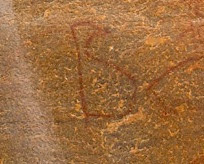
The Bushmen regard this as the birthplace of humankind. Today it is a World Heritage site boasting thousands of rock paintings, some of which go back thousands of years. I've had the good fortune to visit it several times.

Two paintings always astonish me: one of a whale and one of a penguin. 


I am astonished because Tsodilo is about 500 kilometres from the Atlantic Ocean as the crow flies. (By the way, what is now called the African 
penguin is found on the Atlantic coast of what is now called Namibia.) So how did they navigate over such large distance with no GPS and very few landmarks in the (to us) featureless Namib desert?

I've no idea.

Lack of jealousy

The Bushman were very worried about jealousy. If someone made or found something that was beautiful, they would give it away rather than keep it. Jealousy, they believed, was the cause of friction. And friction in an environment like the desert would only lead to disaster.

There's a wonderful movie about jealousy among the Bushmen. I watched it when I was a kid. It is called The Gods Must Be Crazy. it is worth finding and watching, even though some of it is dated. It is all about a Coke bottle.


Surviving in the desert

Most of us would struggle to survive in the harsh climate of the Kalahari Desert. Yet the Bushmen have been doing it for tens of thousands of years.

How?

First, the nomadic groups were usually very small, usually no more than a dozen or so. This meant that no group had to find a lot of food at any one time in order to survive. Second, they knew where to find food, sometimes buried, and water, even though there were no neon signs and signposts. 

Tsama melons growing wild in the Kalahari

And third - and perhaps the most important - was that they never finished any resource no matter how badly they wanted it. So, even if a group was very thirsty and they came across a small amount of water, they never finished it, always leaving something for the next group. 

This was because there was no such thing as ownership. Everything belonged to everyone, and therefore had to be shared. We could certainly learn from that (and from the lack of jealousy).

However, when ownership came to the territories in which they lived, that was when problems started. Farmers, Black and White, arrived owning cattle, for example, and land. The Bushmen would come across a cow. It was much easier to kill it, because it didn't run away, than to run for several days after an eland. The farmer thought differently and would either kill or enslave the Bushman if he caught him.

And that was the beginning of the end. Today there are probably no nomadic Bushmen left.

_________________________________

September events:


Thursday 8. 

Launch of A Deadly Covenant


Wednesday, 7. 4:30 – 5:30 pm 

Totally Criminal Cocktail Hour at Valley Bookstore

The Zephyr Theatre, 601 N Main St, StillwaterMN 55082

Find out more about the event HERE.


Thursday, 8, 4:15 – 5 pm 

BOUCHERCON Panel:

Multi-Tasking is Murder – Juggling Multiple Series ( How these authors create and balance multiple series at the same time.)

Chris Aldrich (Moderator); Michael Sears (Michael Stanley); Sujata Massey; Julie Hennrikus; Laura Childs/Gerry Schmitt; Anna Lee Hube

Friday, 9, 1:45 – 2:30 pm 

BOUCHERCON Panel:

The Mystery of Multiple Points of View and Multiple Timelines (Writers use dual perspectives/multiple narrators and alternating timelines to tell their stories.)

Marty Ambrose; William Boyle; Mary R. Davidsaver; B.A. Shapiro; Julie Carrick Dalton; Stanley Trollip (Moderator)

Saturday, 10, 11:30 -12:15 pm 

BOUCHERCON Panel:

Under the Sun or Below Zero (You’ve heard of “setting as a character.” Well … what about the weather?  These authors’ works represent a dichotomy of climates where rising temps or bone-chilling cold are just as effective as any villain.)

Alexander McCall Smith; Stan Trollip (Michael Stanley); Catriona McPherson; Jo NesbĆø ; Matthew Goldman (Moderator); Caro Ramsay

Thursday, 15, 12:30 – 1:00 pm (UK time) 

Virtual event at the International Agatha Christie Festival

Agatha in Africa

Michael, Stanley and Zimbabwe author Bryony Rheam discuss Agatha Christie’s trip to South Africa and Southern Rhodesia and its connection with her mystery thriller The Man in the Brown Suit.


Monday 19, 6:00 pm 

Nokomis Library event

5100 S 34th Ave, Minneapolis, MN 55417 Phone: 612-543-6800


Wednesday 21, 6:00 pm 

Thomas St. Angelo Public Library of Cumberland event

1305 2nd Ave, Cumberland, WI 54829. Phone: 715-822-2767


Thursday 22, 6:30 pm 

Spooner Library event

421 High St, Spooner, WI 54801 Phone. 715-635-2792


Saturday 24, 1200

The Bookstore at Fitger’s

600 East Superior Street, Duluth MN 55802


Tuesday, 27, 6:00 pm 

Launch of A Deadly Covenant at Once Upon A Crime

604 W. 26th Street, MinneapolisMN 5540 Phone: 612.870.3785 Email: onceuponacrimebooks@gmail.com

With Mary Ann Grossman

October events:


Saturday 1, 9:00 am – 3:00 pm

Meet us at the Deep Valley Book Festival

Mankato, MN

Free book festival. We’ll be there from 9am to 3pm. The event takes place at the WOW! Zone, conveniently located at 2030 Adams Street in Mankato, just off Highway 14.


Thursday 6, 7:00 pm

Barnes and Noble HarMar

2100 Snelling Ave N, Roseville, MN 55113


Saturday 8. 

The Poisoned Pen Bookstore

4014 N Goldwater Blvd #101, Scottsdale, AZ 85251 Phone:(480) 947-2974 Toll Free: (888) 560-9919 Email: sales@poisonedpen.com

Michael and Stanley join Barbara Peters on Saturday afternoon to chat about A Deadly Covenant.


Friday, 14, 10 am 

Lake Country Booksellers event

4766 Washington Ave, White Bear Lake, MN 55110 Phone: 651-426-0918


Saturday, 15, 10:00 am – 5:00 pm 

Twin Cities Book Festival

Minnesota State Fairgrounds, Saint Paul, Minnesota


Thursday, April 16, 2015

The surprise of deserts

Michael and I have just returned from a trip to the Kalahari desert, where we had research to do for the Detective Kubu mystery that we are currently writing.  (It is still without title.)

Ever since I visited a desert for the first time, over forty years ago, I have been fascinated by them and the things, flora and fauna, that live in there.  A trip to a desert is always the time for a surprise. 

In fact, our Detective Kubu would never have become a detective had his childhood friend, the Bushman Khumanego, not taken him into the Kalahari and exposed the hidden worlds that live there.  The following excerpt from A CARRION DEATH tells that story.

Kubu owed the Bushmen a debt of gratitude.  His childhood Bushman friend, Khumanego, had shown him how the desert was alive, not dead as he had thought.  He remembered vividly how in one school holiday Khumanego had taken him sweltering kilometres into the arid landscape and drawn a circle in the sand a few metres in diameter.

“What do you see?” Khumanego had asked him.

“Sand, stones, and some dry grass.  That’s all,” he had replied.

Khumanego shook his head gently.  “Black men!” he chided.  “Look again.”

“I see sand and stones, some small and others a little bigger.  Also some dry grass.”

An hour later the world had changed for Kubu.  Khumanego had shown him how to look beyond the obvious, how to explore below the surface, to notice what no one else would see.  In that small circle thrived a teeming world - ants, plants that looked like stones (lithops, he found out later), beetles, and spiders.  He loved the lithops – desert plants cunningly disguised as rocks, almost impossible to distinguish from the real things.  They blended into their surroundings, pretending to be what they were not. 

The trapdoor spider also impressed him.  When he looked carefully at the sand, almost imperceptible traces of activity clustered around one area.  On his knees, Khumanego pointed to the barely visible crescent in the sand.  He gestured to Kubu to pick up a twig and pry the trapdoor open.  Kubu complied, nervous of what he would find.  The open trapdoor revealed a tunnel, the size and length of a pencil, made from grains of sand and some substance holding them together.  Khumanego tapped the tube.  A small white spider scurried out and stopped on the hot sand.


“This spider,” Khumanego whispered, “knows the desert.  He digs a hole and makes walls of sand with his web.  He makes his home under the sand where it is not so hot.  He listens and listens, and when he hears footsteps on the sand, he opens the door, jumps out, catches his meal, and brings it back to his home – appearing and disappearing before the insect knows what is happening.  Very clever spider.  You don’t know that he is there, but he is very dangerous.”

Kubu thought that the spider and the lithops survived in the same way – avoiding attention by blending into the background.

It was the experience of seeing so much when there was so little to see that had the greatest impact.  Khumanego had taught him to open his eyes and see what was in front of him.  “Black people don’t see,” Khumanego had said.  “White people don’t want to.”  Kubu returned home that afternoon and vowed he would never be blind again.  From that day, Kubu had trained himself to be observant, to see what others did not and to look beyond the obvious. 

[As an aside, I am not known for my green thumb.  When I first saw lithops, I recognized their potential.  So I smuggled some into the States, planted them on a bed of stones in my home in Illinois, and proudly showed them off to my friends, who were suitably impressed.  When the lithops inevitably joined all my previous plants in flora heaven, I continued to display the planter of stones, and my friends continued to be impressed.]


Southern Africa has two deserts: the Kalahari, covering much of Botswana and stretching into northern South Africa and eastern Namibia; and the Namib, which covers most of western Namibia, along the Atlantic Ocean.  I’ve been fortunate to visit both in the last month.


In general, these two deserts are quite different.  The Kalahari comprises vast areas of sand, low scrub, and a few trees, whereas the Namib often fits the more traditional view of deserts, with even sparser vegetation and sand, sand, and more sand.

Kalahari

Kalahari

Sossusvlei dunes in the Namib

If you want to drive in the Namib, you'd better know how!

The oryx (gemsbok) needs little water to survive.

The single purpose of our trip was to visit a village in the central Kalahari called New Xade, near to which a Bushman called Kabbo, in our sixth novel, was found dead on the side of the road.  An autopsy revealed three surprising things: he was probably well over a hundred years old, closer to one hundred and fifty; his internal organs were the same as a man of forty; and third, a bullet was lodged in an abdominal muscle, but there was no entry wound.

We wanted to visit the area to ensure what we wrote about where Kabbo lived and roamed was accurate.  And we wanted to see if we could find what Kabbo had been eating that made him live so long.

We were also eager to visit New Xade because it is the focal point of a great deal of antagonism between the Bushmen and the Botswana government.  The government argues that it has a constitutional requirement to provide education and healthcare to all of the citizens of Botswana, but it is impossible to do this if the Bushmen maintain their nomadic lifestyle.  So it resettled many Bushmen from their traditional areas around the village of Xade in the Central Kalahari Game Reserve to the village of New Xade, seventy kilometers to the west.  New Xade, the government claims, provides the required schooling and healthcare, and is a far better place to be in contrast with roaming the desert, not knowing where or when food and water would be found.

Initially, we drove the five hours from Johannesburg to Gaborone, where we spent the night.  Then we took the paved, Trans-Kalahari Highway for seven hours, avoiding the cows, donkey, horses, goats and sheep that favour the firm footing afforded by a paved surface and the lush grass that grows at its edge to the safer pastures away from the road.  Obviously some drivers were not nimble in avoiding animals, as we saw cattle carcasses and a few abandoned vehicles.  Eventually we reached Ghanzi, not far from the Namibian border, and over-nighted there.  Finally, the next day, we drove the 100 kilometres on a white, calcite sand road to New Xade.

Donkeys are better
This probably hit a cow at night
Fortunately the ostriches preferred the bush.

The road to New Xade

And true to form, the desert provided some surprises.

First, instead of being dry, parched, and inhospitable, the Kalahari was green and lush as far as the eye could see, with grass growing tall on the side of the road and fields of yellow flowers adorning the landscape.  In many places, pools of water lay next to the road, extending back into the bush.  We were told that the area had received two-thirds of its annual rainfall in two days the previous week – over 200 mm (8 inches) in thirty-six hours.  Villages had been flooded; and rivers flowed that were normally sandy courses meandering through the scrub.

The Kalahari desert!
Kalahari desert 2
Flooded village

Suddenly there were flowers

New Xade was also a surprise, but not a pleasant one.  To call it a dump would be paying it a compliment.  The only things that may have been working were the school – but we couldn’t really tell, as it was school holidays – and the clinic.  But all the other buildings of substance stood empty and derelict.  Most of the homes were in poor repair, and people were sitting around doing nothing (alcoholism is reputed to be rife).  We saw no shops, and the bill-boarded craft shop didn’t look as though it had been opened in ages.  The government may have met its constitutional requirement, but it doesn’t seem to be interested in the welfare of the people it has moved there.  Michael and I were both bummed out - and sad, very sad, at what we'd seen.

New Xade craft shop - looked unused

New Xade pedestrian

New Xade children at play

New Xade residence

Top-of-the-line New Xade residence

Another top-of-the-line New Xade residence - there were only a few

Not top-of-the-lineNew Xade residence
Another not top-of-the-line New Xade residence

Traffic warning

Overall, our research trip was a success, even though we didn’t find Kabbo’s secret plant.  We learned something new; we didn’t hit an animal on the road; and we saw the Kalahari in a once-in-our-lifetime finery.


Stan - Thursday