
By the machinations of my quirky unconscious, this past week I watched my three favorite films about art during WWII: Frankenheimer’s The Train, the documentary The Rape of Europa (based on a book of the same name), and The Monuments Men, based on that same book. I chose these only because The Train, which had been on my Netflix dvd list for more than a year showed up in my mailbox. It seemed only natural then to look at the subject from three vantage points. By chance, I ended up with these visions from the past while my countrymen were tearing down monuments to people involved in hideous events.
On top of which, my one of my favorite podcasts, On the Media aired a segment about monuments and the public memory. Hence, these musings about the meaning of monuments and whether they should endure.

Some monuments deserve to live on because of their intrinsic beauty. Yet these are all too often the victims of neglect. Or worst of all, intentional destruction during wartime. Of such events, the most painful to my heart is the Nazi destruction in Florence, particularly that of the Ponte Santa Trinita. You have heard me wax enchanted here on MIE on how a trip to the supermarket in Florence takes me over the Ponte Vecchio. Walking home with my groceries, I see wondrous things that bring me joy. But also, off to my left is the reconstructed bridge the original of which the Nazi’s blew up. (They spared the Ponte Vecchio only because it was the Fuhrer’s favorite.) They destroyed the rest, including Santa Trinita, considered one of the most beautiful in the world. They did so despite the fact that Michelangelo had a hand in its design. Here is how it looked when the Allies took the town.
 |
| Attention Michael and Stan: The soldiers walking on the rubble are South African troops who helped to liberate Florence. |
It is said that destroying the bridges was meant to delay the Allies' pursuit. Were the few hours bought for the retreating Nazis worth the loss?
Barbarians! That’s what we call people who destroy the beautiful without regard to its worth.
But...

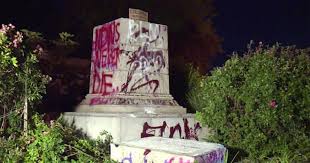
The people who are taking down statues in the United States right now are a case apart. Blacks in the United Sates have every reason to abhor the continued glorification of events that, though they "freed their ancestors from slavery," they also condemned them and their descendants to continue suffering fear, poverty, and anguish.
This is where the On the Media podcast “The Worst Thing We’ve Ever Done” tore my thinking away from Europe. It focused my thoughts on a perennial concern, but one lately in the forefront for Americans like me: white, appalled by the persistence of systemic racism, and anguished to be living at time when the flames of hatred are being fueled by the White Supremacist in Chief in the White House.
For one thing, that podcast introduced for the first time for me (DUH!) the notion that—while the US has raised many monuments to fallen rebels in the Civil War, we lack official memorials to murdered escaping slaves and those lynched to keep their fellow Blacks in terror. On the Media Editor Brooke Gladstone took listeners to three places. First to Germany and South Africa, where the governments and citizenry have erected monuments to remind them of the worst thing their countries have done. To make sure it doesn’t happen again.
 |
| Berlin |
In Berlin, there is a monument to European Jews who perished at the hands of the Nazis. The blocks are all different sizes to symbolize the fact that people of all ages were destroyed.

Also, throughout the country, Stolpersteine - “stumbling stones” - have been embedded in the streets near the sites of historic events and the homes of people who perished. They are intentionally placed where Germans can “trip” over their history. These monuments are there to teach all Germans to join all Jews in saying “Never Again.”

Next to Johannesburg, where I have had the privilege twice of visiting The Apartheid Museum. When I first arrived there, I was afraid that I would not be able to stand to look at what was inside. I had viewed apartheid only from afar. I did not think I could bear to look at it up close. It wasn’t easy, not the first time, not the second. But the place is magnificently arranged both to teach and inspire. And I came away from it, on both visits, not only informed, but encouraged. What you see in this brilliantly designed memory house is no less than the ugliest and the most beautiful things human beings are capable of.
 |
| Johannesburg: The only one of these essential words that Americans ordinarily call for is "Freedom." I pray we will learn to revere the others just as much. |
 |
| Th entrance to the Apartheid Museum gets to you immediately! |
 |
| Nooses: the weapon of choice of racists everywhere it seems. |
My country woefully lacks such places where we can learn the wages of our own original sin. But there is at least one such in the United States. Unfortunately, it is obscure. But for Covid, I would head to it right now. Alabama has not until now been on my list of places to visit. But I now know that it is home to an example of the sort of thing that Germany and South Africa have done and are doing to deal with the "worst thing" their countries have done: The Legacy Museum. I cannot give you a first-hand report. I'll have to save that for another day. But here is what I have leaned and why I want to go there: This monument is dedicated to helping Americans understand that insidious baseline of far too much of our thinking: that black people are inferior to white people. This unexamined knee-jerk assumption keeps racism alive.
 |
| The Legacy Museum |
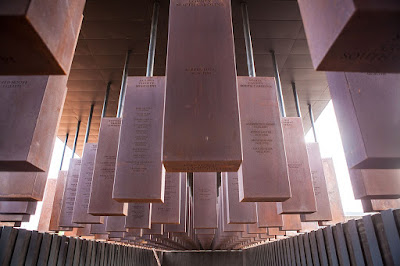 |
| The Lynching Memorial Inscribed on each hanging copper panel is the date, the name of the victim(s), and the place where the murder took place. There are 805 of them. Duplicate markers await to be claimed by the citizens and installed as local memorials. |
 |
| Citizens of the lynching locations bring samples of the dirt where the person died. Here they are, labeled with the dates of the crimes and the names of the victims. |
I could go on.
And on.
And on.
But not right now.
Highly recommended ways to learn more on this subject from "On the Media."
"The Worst Thing We've Ever Done."
"Forty Acres "





