

Are we all becoming slaves and addicts?
Internet companies are manipulating us. You knew that. But here are a couple of schemes, vastly
different from one another, that concern me:
Pricing tricks


I learned this from an article in the Author’s Guild
Bulletin.


We all know that Amazon took global hegemony over book retailing
by underselling everyone else. When it
comes pricing these days, however, it seems that Amazon is pricing books at
what it thinks customers might be willing to pay.
Roxana Robinson, President of the Authors Guild, writing in
the organization’s recent bulletin, recounted her experience trying to buy an
out-of-print book from Amazon as part of her research. She has a research assistant who also buys
such books for her.
Amazon has a lot of sub-contractors when it comes to used
books. Depending on who you are, they may not show you the cheapest price.
Instead, your search will produce choices priced at how much Amazon’s algorithm
thinks they can get you to spend. Here is
what Robinson discovered.
·
Depending on whether she or her assistant logged onto Amazon to buy a particular book and when they asked for it, they were
offered the book at wildly different prices.
·
Since she had paid quite high prices in the past
for difficult-to-find books, Amazon started off by offering her used copies of the
book at prices ranging from $37.50 to
$44.58. During that same time period,
her assistant bought her own copy of the book for ten bucks.
·
A week later, Robinson checked the price again,
and they offered a new copy for $56.97.
·
After another week, the used book was up to
$47.74 on Amazon.
·
On week three, she bought a used copy for $3.88.


Having written this far, on Saturday afternoon, I decided to
see what Amazon was now asking for my books.
I got a dizzying array of prices, that seem to have no relationship to anything.

Invisible Country Hardcover
only
$34.99, or $6.99 for Amazon Prime customers!
$44.03 used

City of Silver Paperback
$55.96 Used, for a USED paperback
$19.69 Used in a separate offering.
This for a book that is in print and that the publisher
offers for $14.95, full price!


Strange Gods
$55.76 Hardcover Used
$34.76 Paperback Used
Again, this for a book that is in print and that the
publisher offers in paperback for $14.95, full price.


It is not against any law for Amazon to charge whatever they
can get for the products they sell. Nor
is it illegal to sell a book to you for one price and to me for another. However, for writers, who more than anything want
to have their works read, Amazon’s behavior is daunting in the extreme. Globally, with their cut rate pricing, they
have—forever it seems—reduced what writers can earn from their work. At the same time, they attach ridiculously high
and discouraging price tags on works that should sell for a lot less.
Addictifying


There seems to be no question that electronic devices are
addictive. What feels sinister to me is
that developers are mining neuroscience research in order purposely to make them even
more so.
The why of this is easy.
Companies make money by selling our eyeballs. The longer they can get us to stare at the
screen, the more money they can make. They do this by making us more and more
addicted to our own brain chemicals.
Long before there was the Internet, I began to see how such
an addition worked. As a corporate consultant, I noticed that many
executives and ordinary employees seemed addicted to their own adrenalin.

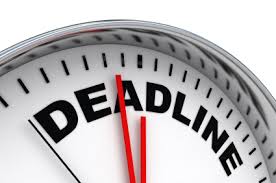
Adrenalin junkies are generally thought to be people who
participate in extreme sports—like skydiving. They don’t have to be parachuting off the roof
to be found in any office building. They
do one of two things: They put off
working toward a deadline until it is almost impossible to meet it, and then
hyped on their self-produced anxiety hormones, work in a frenzy. The real junkies I knew all had clever, unconscious
ways of producing crises so they could
get their adrenal gland to give them an adrenilin fix whenever they needed one.


The Twenty-first Century, it seems, has brought us another drug we don’t have to buy:
Dopamine. It’s a neurotransmitter
that our brain produces all on its own when we anticipate pleasure. Releasing
dopamine is what makes cigarettes, cocaine, and gambling addictive. So dopamine addiction has been around for a
long time. But you used to have to go to
the casino to get your gambling fix or the pusher to get your coke. Now we carry the means to feed our habit in
our pocket.


My phone—in my pocket—just dinged while I was typing
this. A message! The anticipation of pleasure—a note from a
friend? A positive answer to an
invitation I had sent? In this case, my
phone just told me I have two new followers on Instagram. So? If
I had not been writing about the dangers of dopamine addiction, I would have
looked at the message, felt a minor pleasure, and put my phone back in my pocket. Given my subject matter today, I turned off
the sound on the phone. I doubt that
will cure me of my junkiehood.


Current estimates are that about 10% of Internet users are
obsessed enough to undermine their family life, love life, or productivity at
work.
It seems it will get worse.
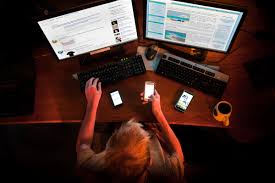
Those companies that sell our eyeballs have a powerful incentive
to mine neurological research so they can purposely make their software as
addictive as possible. Some see such efforts
as unethical and say they will not do such a thing.
But if their competitors become the electronic equivalent of drug
cartels, the moral choice will become a one-way street to the bankruptcy courts.
Like all wars on drugs, this is one we will have to fight
individually. And the first step is to
admit that you are a junkie.


Tonight I am going to try to leave my phone and iPad in
another room when I go to bed.
At least that’s what I hope I can do.
You?





