Showing posts with label A Deadly Trade. Show all posts

Thursday, March 15, 2012

Baobabs


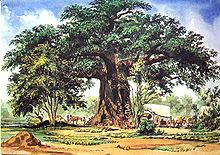
Baobabs are wonderful trees.  I love them!  They store water, the leaves are nutritious for people and animals, they are the source of cream of tartar, and...well, they look as though they come from another planet.  David Livingstone apparently said they looked like "a carrot planted upside down".  I don't quite get that comparison, but in the winter - as in the specimen above - they certainly do look as though the roots are in the air.  They're sometimes called upside-down trees.

The Bushmen have a number of legends about them.  Great story tellers, it is hardly surprising that the baobab would intrigue and entertain them.  One story is that in the beginning the gods distributed the seeds of all the plants to the animals to cultivate.  The hyena was the last to receive his seed and it was a baobab.  He was so disgusted to be last that he planted it upside down.  An even more intriguing story is that baobabs don't grow at all.  They are dropped from heaven fully grown, and being top heavy they land upside down with a loud thud still sometimes heard today... 

The second legend may come from the fact that the trees are very slow growing indeed and the young ones look very different from the adults.  Some of the adults are thousands of years old.  They've seen a thing or two. Like ones with cannon balls embedded in their trunks from battles long past. 

Women's prison tree with new police station.

The largest may grow to 150 feet in circumference, and they can be used as shelters. Baobabs are not very common in Botswana - preferring the tropics - but in the north you see them from time to time.  In Kasane, on the border with Zimbabwe, they were even once used as prisons - one for men and one for women.  When the new police station was built, it was designed so that the trees and their history could be preserved.


Prison trees seemed to be an idea whose time had come.  This one in Australia was used for a similar purpose.

This one does service as a pub.


Here's one on Kubu Island growing from the rocks.  There aren't hippos on that dry pan despite the name!


Baines' Baobabs.


A Baines painting.

This group in the northern Kalahari is known as 'the sleeping sisters', here in full leaf after unusually wonderful rains.  The group is also named after Thomas Baines, naturalist, explorer and painter who seemed to have an affinity for these trees.  He travelled with Livingstone, and also explored in Australia.  Perhaps he was after the baobab species there.  There the name is shortened (as with many names in Australia) to baobs.


Madagascar

The family name is Adansonia and there are only eight species in the world.  One is widely spread over Africa and Asia, one occurs in north-west Australia and the other six are in Madagascar.  It's one of the many reasons that I'd love to visit there one day and see the forests of these amazing trees.  The Madagascar species look quite different to ours; they have a sort of fantasy shape that makes you think they may have walked out of middle earth.

They catch the eyes of editors too.  Two of our books have them on the cover amid the African reds and oranges: A DEADLY TRADE (the UK edition of The Second Death of Goodluck Tinubu) and IL DETECTIVE KUBU (the Italian version of A Carrion Death).  We love the menace of those eyes on the Italian book!  (Cat eyes rather than hyena eyes, but then the baobabs are one of the species  from Madagascar.  No, we don't get to approve the covers!) 

Michael - Thursday


Thursday, January 13, 2011

The Mystery of Covers


This is going to be a short blog.
Michael and I have been working frantically at my house in Knysna on the final tweaks to our third book.  Our UK editor, Sherise Hobbs from Headline, sent us her edits of our manuscript about a month ago, wanting the revised work back this coming weekend.  As usual, her suggestions were very helpful, and the changes have improved the book a lot.  But as you can guess, small changes have tentacles that slither throughout the whole book.  Everything is interconnected.  So every change has ramifications that have to be checked.  And rechecked.
As we sit across the dining room table, reading and re-reading the chapters, we occasionally stop and speculate what the cover of the book is going to look like.  As you know, covers do make a difference (so they say), so our interest is not just idle.
Which brings me to the focus of today’s blog – the mystery of covers.
HarperCollins hardcover
Our first Detective Kubu book, A Carrion Death, was published by HarperCollins in 2008.  They were excited by the cover they had created.  It was a photo montage of African themes - baobabs, desert, a Land Rover, and, true to the content of the opening scene, a hyena.  HarperCollins told us they loved the cover.  And what did we think, they asked?  We really liked it, but made a few suggestions, which failed to make the final version.


Headline hardcover
At about the same time, A Carrion Death was also published by Headline in the UK.  They decided to give the cover a more stylized, African look.  Everyone was very excited by how strong the cover was, how it would stand out on the bookshelves.  And what did we think, they asked?  We liked it, we said.  And we did.


HarperCollins paperback


Obviously, HarperCollins was disappointed by sales of the hardcover of A Carrion Death and decided they needed a cover with more vavoom.  So they dropped the photo montage and adopted the stylized Headline cover for the paperback.  It would stand out on the bookshelves, they said.
When HarperCollins was ready to publish the second Detective Kubu book (The Second Death of Goodluck Tinubu), they decided to stick with the stylized look and produced another strong cover that would stand out on the shelves.  They liked it.  We liked it.
HarperCollins


Headline
Headline, however, decided that the style of their original cover didn’t work for their market and decided to drop the stylized approach for the second book and use a photo-based one instead.  They also changed the name to A Deadly Trade.  So the switch was complete.  HarperCollins had gone from photo-based to stylized; Headline had gone from stylized to photo-based.
Sigh.


Italian cover for A Carrion Death
We were pleased when Sonzongo, our Italian publisher, asked us what we thought of their dramatic cover.  We like it, we said.  It’s very dramatic, but would it be possible to change the cat’s eyes for hyena eyes, since there are no cats in the book, and a hyena appears in the first sentence?  Our suggestion never made it into the final cover.  It’s probably a good thing we didn’t tell them that the beautiful row of trees at the top of the cover are Madagascar baobabs, not African baobabs!  The cover for the second book, which was published without us knowing (!) has a haunting cover, which we like.


Italian cover for A Second Death


A Carrion Death
Eichborn, our German publisher, produced a dramatic cover for their edition of A Carrion Death.  They liked it.  We liked it.  But is the creature on the cover a hyena?  They have also just sent us the cover to our second book –we like it a lot, and the symbolism is compelling.
The Second Death of Goodluck Tinubu


If all of this is confusing to you, join the club.  It is clear that Michael and I know little about what makes a cover appealing.  But do the publishers know any more?  We have no idea which of the covers, if any, stimulate someone to buy the book.  And we often wonder whether covers make any difference at all?
What do you think?  Do covers influence your buying decisions?  Do covers attract you to a book?  Are there covers that really attract you?  Put you off?  We’d love to hear.
Stan - Thursday