Showing posts with label 2020 election. Show all posts

Thursday, January 7, 2021

Where do we go from here?

Stanley - Thursday

'Where do we go from here?' is a question I have been asking since the phone of my hosts at a socially-distanced dinner last night beeped an urgent news alert. "Trump tilhængere stormer den amerikanske kongres!"

We rushed to the TV and gawped at the scenes from Capitol grounds in Washington D.C. What I saw was what I had feared since my university days when I read Nobel laureate Elias Canetti's chilling Crowds and Power: a charismatic leader urging a mob to violence to destroy the form of government I believed in. However, I never thought it would happen in the USA. 

As long-time admirers of the USA. my host were in shock. We were all in shock. My fears were raised by the apparent lack of law enforcement. How was it possible for domestic terrorists to gain entry into the seat of American democracy? Did that mean that the president had ordered the various police forces to keep away? What about the military? Had he exercised his authority as commander-in-chief and ordered it to support him in overthrowing the election?

Ready for battle

I'm not sure why some were dressed as Vikings.

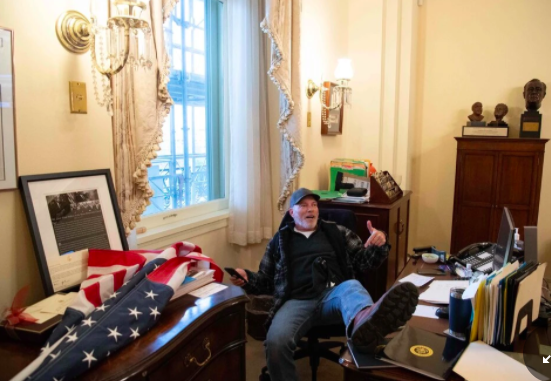
In Nancy Pelosi's office

Fortunately, it soon became apparent that this was not a coup, but Trumpian thuggery. Those inside the Capitol weren't trying to seize power for themselves, but rather were venting their frustrations over an election they thought had been stolen - a frustration fanned by the loser of the election.

I think it was Jeffrey Goldberg, editor-in-chief of The Atlantic, who provided the most compelling reason of why Trump supporters were behaving they way they were. He suggested that their anger emanates from a fear that their traditional way of life is disappearing, a fear that I think really took hold when Obama became president. The whiteness of their country was threatened and with it their jobs and their political influence. And their ability to look down on another group.

If Goldberg is right, and I think he is, we have to ask where do we go from here. The more people, like Stacey Abrams, register Black voters, the less influence the Trump base will have at the polls and the more afraid they will become as they realize their increasing irrelevance. 

Stacey Abrams - perceived as a threat

Will this lead to increased violence of the sort we saw last night? Probably - unless we can find a way to ease the fears of the Trump base. 

The perpetrators of last night's violence deserve all the criticism they receive, as well as appropriate application of the laws of the land. However, they also deserve understanding and a commitment by the new administration to improve their lot in life. 

The problem is that I see no quick way to do this. An improved education system takes years to implement and more years to reap benefits. Improving economic circumstances is likely a better and quicker approach, but the arc of economic prosperity is headed down. How does a country so deeply in debt improve the lot of all of its people, especially when so many of its citizens choose individualism over cooperative behavior, when the rich get richer and the rest poorer? 

And finally how can the country accomplish this while simultaneously addressing racism in a meaningful way? And protecting the country from further ravages of the pandemic?


I am an optimistic person, but my optimism is being severely challenged this morning.

Help! Where do we go from here?


Monday, November 23, 2020

On Spite and Its Aftermath

Annamaria on Monday


My brilliant and in every way laudable blogmates have given you a bit of respite over the past couple of days.  I interrupt that trend for a rant.  I hate to announce the - for me - unavoidable.  Warning: I am giving my inner pollyanna the day off.  She'll be back, I promise.  But today I woke up to this headline in the New York Times that set my teeth on edge:


The ensuing article, written by Michael D. Shear, began like this:

WASHINGTON — Voters have decided that President-elect Joseph R. Biden Jr. should guide the country through the next four years. But on issues of war, the environment, criminal justice, trade, the economy and more, President Trump and top administration officials are doing what they can to make changing direction more difficult.

Mr. Trump has spent the last two weeks hunkered down in the White House, raging about a “stolen” election and refusing to accept the reality of his loss. But in other ways he is acting as if he knows he will be departing soon, and showing none of the deference that presidents traditionally give their successors in their final days in office.

During the past four years Mr. Trump has not spent much time thinking about policy, but he has shown a penchant for striking back at his adversaries. And with his encouragement, top officials are racing against the clock to withdraw troops from Afghanistan, secure oil drilling leases in Alaska, punish China, carry out executions and thwart any plans Mr. Biden might have to reestablish the Iran nuclear deal.

In some cases, like the executions and the oil leases, Mr. Trump’s government plans to act just days — or even hours — before Mr. Biden is inaugurated on Jan. 20.


At a wide range of departments and agencies, Mr. Trump’s political appointees are going to extraordinary lengths to try to prevent Mr. Biden from rolling back the president’s legacy. They are filling vacancies on scientific panels, pushing to complete rules that weaken environmental standards, nominating judges and rushing their confirmations through the Senate, and trying to eliminate health care regulations that have been in place for years.


I couldn't read further.  What came immediately to my mind was pictures of the spiteful behavior of the Nazis when they were driven out of Florence during World War II.  They destroyed beautiful medieval buildings and a bridge graced with sculptures by Michelangelo.  Out of spite. There was no other possible explanation.


With the connection between Trump's behavior and that of defeated and irate fascists taking hold in my mind, I went straight to my Webster's Second Edition, unabridged, which sits on its stand near my computer.  Here's what I found:


"Spiteful" means malignant - the word we use to characterize a disease that can kill a person.  I fear that the intended victim here is not an individual but American democracy.  Nerd that I am, I went to research the behavior, hoping for insight.  And as usual, I found some.


Confucius warned "Before you embark on a journey of revenge, dig two graves."

Spite almost always hurts the person who doles it out, as well as its recipient.  Such Pyrrhic victories must promise some kind of reward or they would not be so often undertaken.  Said rewards are precisely the ones that would best obtain for our case in point today.  Spiteful people in general - and this one in particular - see themselves as having been "victimized."  Psychology Today defines this sort of rancorous behavior as "an act of gratuitous malice, undertaken by a morally bankrupt sociopath."  My reading tells me that such an emotionally charged person, knowing that he will also be hurt, convinces himself that his target will suffer more than he will. He gets the emotional relief of knowing that he has inflicted pain on the person who has "hurt" him.


But what about all those people who are supporting Trump in his efforts to undermine his inevitable successor?  Some of them, quite obviously, care only about their ends: opening up precious old growth forests for oil drilling, keeping those uppity back and brown people in their place, making sure that money will prevail over the ballot box, and so on and so forth.  Others are merely cowardly.  Over time, a knee-jerk avenger acquires a reputation for hitting back harder - a long-term benefit for the wielder of the vengeance axe.  He inspires fear in anyone who contemplates challenging him.  Without having to speak the threat, habitual dishers of revenge, especially those who keep around them only cowardly sycophants, can expect their allies to pass the ammunition the minute they start shooting. It's how their supporters avoid becoming targets.


The beat goes on....

On our sacred planet, we can find even vindictive bacteria.  They release toxins against other bacteria nearby.  In many cases, however, those avenger creatures end up poisoning themselves.

We can only hope. 


Wednesday, November 18, 2020

Politics to Pastry: What Writers Share When They Blog

 sujata massey


A novelist I greatly admire wrote her last blogpost in September. Catriona McPherson, formerly of the Femmes Fatales, declared that that with the election ahead, so much work needed to be done that she felt it useless to write about "cats and courgettes"--nor did she want to turn her blogposts into a political soapbox. 


Catriona (pronounced Catrina) comes from Scotland and is one of the funniest mystery authors on the planet. She was writing with a wink, but the truth is, writers are constantly self-censoring. It occurs when we write novels—editing out lots to make them better—and when we offer up essays to the internet or print publications. ,We become known for one thing—and people expect us to be amusing. Typically, we keep dark, pressing worries and political opinions to ourselves.


During the months after Catriona quit blogging, her activism was substantial. She penned 240 personal handwritten letters and mailed them to voters all over the country in the Vote Forward movement, something I also participated in (with just 40 letters written). Currently, Catriona’s working on letters to voters in Georgia. All the while she did this, she launched a new novel, The Turning Tide, featuring her clever and charming Mitfordesque heroine, Dandy Gilver, who lives in 1930s Scotland. 


I’m glad Catriona put her priorities the way she needed this fall. And we've got to credit today's readers for their choices. Since the pandemic, reader choices are trending toward social activist and apocalyptic books. Although there's nothing wrong with the historical novels we write, either!


You might be reading this particular blogpost because you follow Murder is Everywhere, a blog built by ten writers whose crime fiction set outside of the US. Or you've found my blogposts cross-posted to my website and Goodreads and my Amazon page. Some information you are learning about me—the protests I participate in for Black Lives Matter, women’s rights, post office service and voting inclusion—is probably not the reason you Googled me. Yet I am someone who writes about a female lawyer in 1920s India whose concerns are national emancipation and civil rights for women. What I care about is probably not a shock.


Writing about politics is most definitely allowed in Murder is Everywhere, and I learn a lot listening to the accounts of my fellow bloggers, especially when they draw cultural parallels with the past or in other countries. You must sample the words of my co-conspirators Annamaria Alfieri, Cara Black, Kwei Quartey, Caro Ramsey, Zoe Sharp, Jeff Siger, Michael Stanley, and Susan Spann to get a taste of politics and pastry around the world.


I’m pleased that there are enough of us writing that I only need contribute every other week. Fourteen days are a lot of time for events to break and then recede and for my mood to change from outraged to mellow. I can almost guarantee I'll be writing about holiday cooking within the next few weeks and post pictures of adorable dogs on the hunt for crumbs. 


The cozy and the distressing all part of the world we live in, and I thank you for being here. 


Thursday, October 29, 2020

The world is confused

Stanley - Thursday

As you can imagine, there is anxious anticipation around the world about the election because the outcome will affect every country. The anxiety is heightened because the system is so little understood, especially after the 2000 election and the election of President Trump, despite a loss in the popular vote.

One thing that is certain is that most of the world is totally confused by the electoral system in the United States. The items below are not ranked by their confusion-inducing ability. 

1. The electoral college system came into focus in 2016 for the rest of the world when Donald Trump beat Hillary Clinton, even though he trailed by over three million votes overall. What is the electoral college and why was it created?

2. The election period preceding a presidential election is at least two years. The consensus overseas is that Americans must be masochists to tolerate a system that lasts so long. For most countries that I am aware of, the period running up to an election is a coupe of months.

3. Members of the House of Representatives are elected every two years. People overseas look at this and wonder how any work gets done, because it seems that as soon as an election is finished, fundraising for the next election begins.

4. Money! It boggles overseas observers' minds that an estimated $11 billion to $14 billion will be spent on the elections this year. 

5. Money! From foreign shores, it seems reasonable to limit individual contributions to candidates. However, when it comes to PACs and Super-PACs, there is bewilderment, not only as to what they are, but also as to what and how they can support candidates financially. As a voter, I have tried to understand the rules, but have generally failed. Click here if you want to find out or if you are having trouble sleeping.

6. In all matters, not only elections, people in other countries fail to understand that the United States is far from united when it comes to laws. They don't realise that laws can differ from one state to another. This raises much confusion when reading the results of similar challenges to vote counting, for example, resulting in differing opinions. Yes, state 1, you can count mail-in ballots that arrive after election day as long as they are postmarked on or before election day. No, state 2, you cannot count mail-in ballots that arrive after election day even if they are postmarked on or before election day. 

7. It is puzzling that US voters accept jiggery-pokery when it comes to elections, no matter which side they are on. Surely, observers ask, people realise that if one side tries to limit the other side's votes or voter participation, it will happen to them when the tables are turned? Then where is democracy?

8. The Postal Service may not have the capacity to deliver all votes in time? Huh?

9. Some people have to stand in line for HOURS to vote? In the richest country in the world? Huh?

10. Nobody knows when the results of the election will be known? Huh? Remember 2000 and the hanging chads? Robert Mugabe of Zimbabwe is reputed to have offered to help the USA with subsequent elections. What happens - enquiring minds ask - if the results are not known before the electoral college convenes?

Overseas observers are not confused by one thing - the need to have free and fair elections everywhere.