Thursday, April 23, 2020

Earth Day in the time of the virus


Michel - Thursday

Street art for Earth Day
Yesterday, 22nd April, was the fiftieth anniversary of Earth Day. Probably the focus on the broader environment was catalysed by Rachel Carson’s 1962 classic Silent Spring. After that there were many initiatives that tried to focus public attention and activism.  The first Earth Day event reached twenty million people in the US, and twenty years later it was ten times that number worldwide.  Now over one billion people participate in the day in some way. So, by any standards, it’s been a success at focusing people’s attention and that’s unquestionably valuable. Actual changes to policies and behaviours have been less noticeable. 

Although, one year we had an hour blackout of electricity to mark the day, and South Africa’s hopelessly managed power utility, Eskom, liked the idea so much that it started turning off the power at random times from then on.

Earth Day aims to reduce carbon emissions, improve air quality, muffle noise pollution, be more nature friendly in general. Well, for the fiftieth anniversary, we did all of those things. But we did have some help from our enemies...

China pollution before and after the Covid 19 outbreak
Satellite images show the way pollution has cleared over big metro areas. Although some of that is the result of industrial activity being dramatically reduced, a significant fraction is because of the massive reduction of motor vehicles fighting their way through gridlocked cities and pouring pollution into the atmosphere. Carbon emissions too are dramatically down—from the reduction in industry and motor vehicles, but also because of the slump in air traffic.

Noise pollution is way down for all the same reasons (although a lot of noise and air pollution still finds a home on Facebook). On CNN yesterday, David Attenborough noted that in recent weeks birds were singing louder. Not just that they sound louder because the background noise is down, they actually do sing more and sing more loudly, apparently because they don’t have as much competition. They also gather in larger numbers. Even after only a few weeks, they seem to be adapting to a more welcoming environment. A few birds may actually miss it, though. The video below links David Attenborough and a very special bird singing a very special song. Take a listen.

And many animals are learning to relax in areas usually choked with cars and people.   
 
Civet in the street in Malabar, India
DO NOT EAT THIS!
Penguin in the road at Boulders near Cape Town
Lions relaxing on a main road in Kruger National Park
They could do this anytime, but they'd be surrounded by disturbing cars
Fox using a deserted pavement in England
Coyote with a great view in San Francisco
Goose family wanders down the road in Las Vegas. Yes, Vegas!
Mountain goats pop into Llandudno, Wales
Of course, some animals have come to rely on crowds of humans.

Sika deer at a restaurant in Japan missing their handouts.
Susan has written about them several times

Monkeys making a good living in town

Some zoos have noted that the animals miss their human watchers as they're used to interacting with them to relieve the boredom. The keepers now have to make rounds of the zoo to entertain them.

Is there a moral to the story? I don't know, but if there's any silver lining to our current cloud, it may be this. The thing we miss most is human contact and the ability to pursue our everyday lives freely and safely. Can we live without exhausting, traffic jammed commutes to offices? It seems a lot of people can. Do we need to take multiple plane trips for business and pleasure? Maybe not so much. Can we cut down on car travel? Clearly. (After the first period of the lockdown in South Africa, someone noted that his fuel consumption had improved to three weeks to the litre!) Perhaps now that we’ve proved we can do these things, and thought about what we really missed over this period, we can behave a bit more as though Earth Day is every day.

Wednesday, April 22, 2020

Victories for Nature

Sujata Massey


The skies are blue, the clouds dense, and it's quiet enough that you can hear the birds. Our two dogs have never had more attention. And with a lack of places to go, I am in my garden.

The leading picture for this blogpost is a raised bed garden belonging to my neighbors, Joe and Sarah. Their practical, proud use of front-yard real estate takes on new meaning this year, as people long for a small way to be in control during a time of uncertainty. Everywhere, people are planting masses of herbs, vegetables and fruit into so-called victory gardens--a term that hasn't been used since World War II, when people were encouraged to provide for themselves to allow more resources for men and women serving overseas.

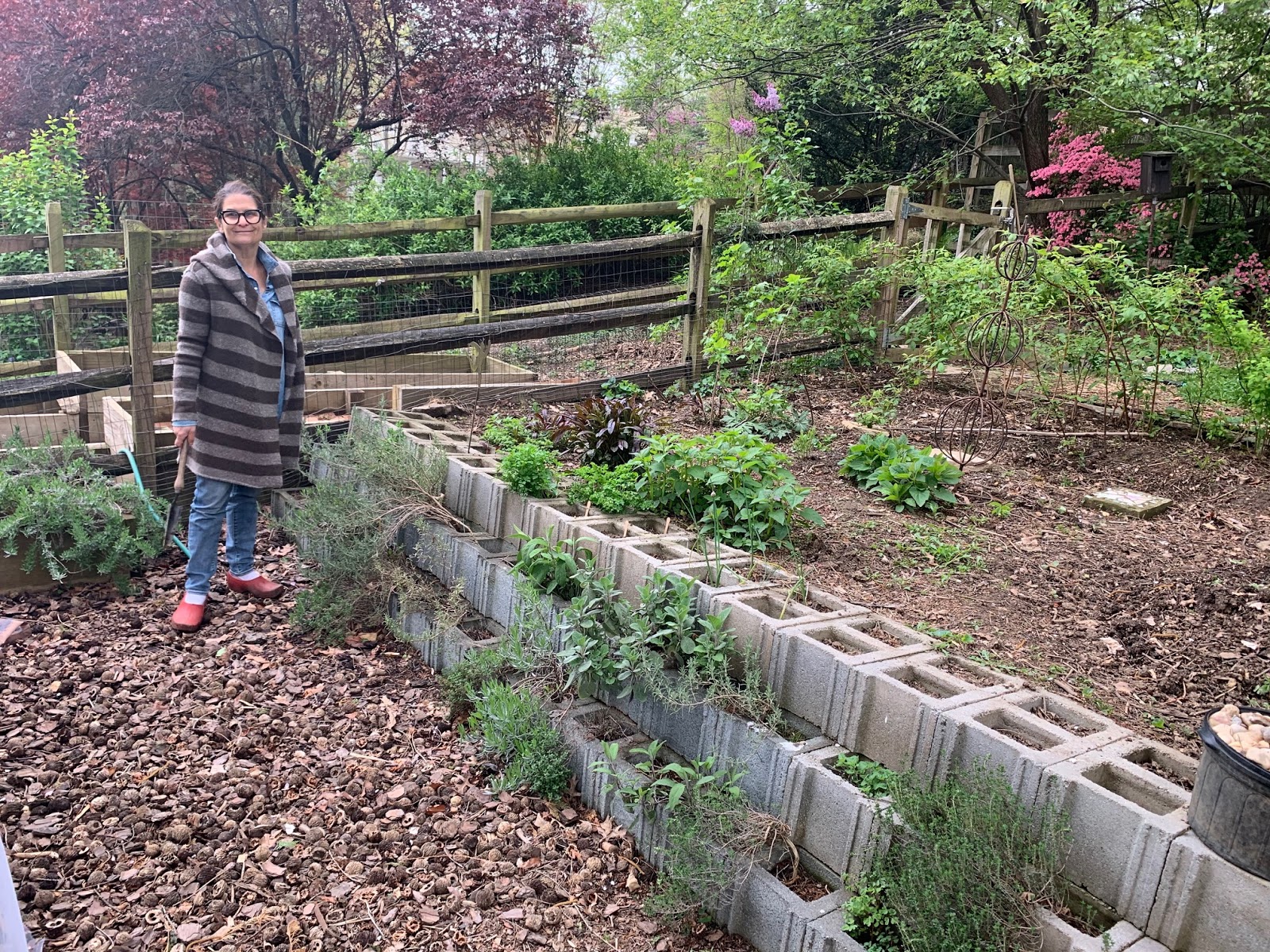
Debbie planted herbs in cinderblocks, and so much more

Growing vegetables and fruit is an exciting challenge for me, because I am more of a wishful gardener than a skilled one. I  have had the blessing of green space around home throughout my life. I have been planting and marveling at my small progresses over the years. Yet I don't believe I will ever have the commitment to be a daily gardener.

Native Toad Trilliums grown by master gardener Debbie

My mother gave me Frances Hodgson Burnett's The Secret Garden when I was 9. This masterwork of children's literature was written in 1911. It romantically details how gardening transforms two depressed children--her very old-fashioned theory that has recently been recognized as a therapeutic practice. In the novel's Misselthwaite Manor, an estate in Yorkshire, England, gardens are described as being set up in a series of outdoor rooms that literally have stone walls and wooden doors that lock, presumably to keep out animals and others who don't have rights to food or flowers. Glancing through my beloved book this afternoon, I realized that gardens in my American city suburb are anything but walled and hidden. Quite a few people, like Joe and Sarah, have turned their front yards into working kitchen gardens. Fruits and vegetables and flowers intermingle, and in my particular section of North Baltimore, plants native to the Mid-Atlantic and Appalachian mountains are widely encouraged, with transplants shared like bonbons by those in the know.

I enthusiastically visit public gardens and my neighbors yards with an appreciate eye. Until recently, I would say, "next year I will get serious about gardening." Fortunately, I decided 2020 was going to be my serious year, and I had the foresight to start working last fall. Kay McConnell, a tremendous,  environmentally oriented garden designer in my city, masterminded a backyard garden planted with natives that would thrive in the various conditions of my space; wet, dry, shaded, and sunny. Together Kay and I planted over 400 native perennial flowers, shrubs, and trees.

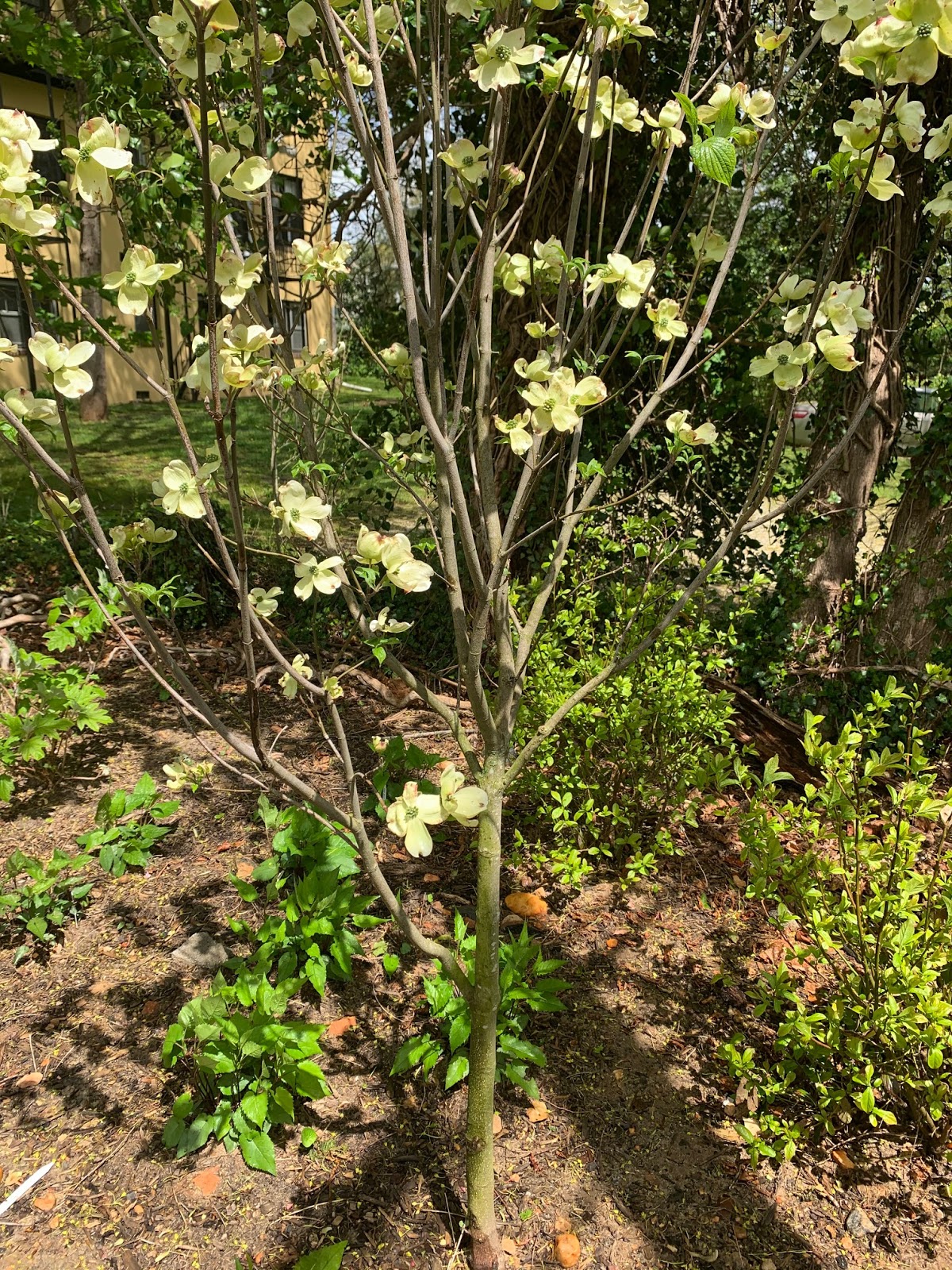
my garden's baby dogwood is part of a group a woodland grove


tulle protects strawberries in Debbie's garden
In the past, I've grown a few herbs and capsicums and lettuce in a tabletop vegetable garden (often called a salad box). My husband built the structure in a weekend (yay!) and we filled its shallow pan with soil meant for raised bed gardens. It works fine, but it's pretty small.

The "salad box" only has chives at the moment

I decided a few weeks ago to go a little bigger with vegetables. I began by making Zoom calls to  accomplished gardening friends who had been eating from their gardens for years. I picked and chose from what they were doing. I see that almost all of my mentors have blueberries growing, some of them interwoven in floral landscapes; others set aside as little monarchs, walled off from intruders. When you plant things that taste good, you have to put in obstructions, if you want some of it for yourself.

Tom and Liz's blueberry has to be fenced to keep it from the family's chickens


No chickens are getting to Tom and Liz's Stuttgarter mini onions!


I heard that blueberries are good in sandy soil, but I will spread them around to various spots to hedge my bets. The blueberries will be shielded from the birds by netting.  I don't feel guilty, because there's an open row of flowering chokeberry shrubs for the birds and anyone else. Apparently, squirrels and rabbits aren't interested in garlic and onions, so I planted shallot bulbs and garlic cloves right in the dirt under the lilacs.

Betsy's blueberry is artistically melded into a perennial landscape


Garlic and onions underground

I hope to harvest something for our family; therefore, most of our vegetable and herb plantings are on an elevated, gated deck just off our kitchen. This is the same location of the tabletop vegetable garden, and various pots of struggling tomatoes. And something new--dresser drawer garden. It's just like it sounds. We drilled holes in the bottoms of the boxes for drainage, filled them, and put them on a granite workbench.


Dresser drawers hold shallots and radishes

I'm fortunate to live in a state with an early spring, and long warm summers that allow fruit trees like plums and peaches. Another blessing is that although my city of Baltimore offers plenty of restaurants, shops, and arts establishments and diversity of experiences, it also has city neighborhoods with trees and gardens and plenty of walking space.


If I plant marigolds, will it keep pests from my veggies?

How can I feel housebound when my garden has so many corners to spend time in --whether it's to attack a patch of truculent ivy, or plant herbs and flowers in a pot, or hunt down dandelion leaves for salad? To stroll onto the deck and pluck a few chives to sprinkle over soup makes me feel wealthy beyond measure.

This spring, gardening books are piled high in the living room coffee table, next to my bed, and fill the shelves of the dining room. Still, nobody should feel they need a book to explain how to start growing flowers, fruit and vegetables. The internet is full of help. For a non-commercial, knowledgable overview, check out The New York Times column by Margaret Roach, as well as her long running podcast, A Way to Garden. (The podcast episode I've linked is a discussion of the idea of a pollinator victory garden). Adrian Higgins, the longtime gardening columnist for The Washington Post also writes inspiringly about modern victory gardens and many other topics.

The quarantine gives us room to breathe and get close to the soil. And that's a victory in itself.

Monday, April 20, 2020

Aftermath: One--The Black Plague

Annamaria on Monday


Mostly, I imagine, what we have all been wondering is when will we go back to normal life.  We've had enough time to reflect and ruminate, so most of us have figured out for ourselves something many government leaders have taken too long to conclude: Any return to normalcy will have to be gradual and cautious.

Things may loosen up a bit before we have a vaccine for covid-19.  But not until we do will we be able to go about as we once did.  Normal, at that point, will be in flux.  Of this I am sure.  Our collective idea of what normal ought to be and our personal ideas of what we want it to be will have shifted.  

I have been trying to imagine that new normal.  I have no doubt that an event as far reaching and dramatic as this pandemic will result in change, probably not all for the good, but also not all for the bad.  So, as one of the resident historicals here on MIE,  I have been going back to history (what else would a nerd like me do) to try to inform my guesses.

Today let's start with the impact of the most drastic demographic disaster ever to hit the world - the Black Death.


It lasted from 1347 to 1453 and killed somewhere between seventeen and twenty-eight million Europeans before it finally petered out in the hinterlands of Russia.  It was more contagious and even deadlier than bubonic plague.  Some historians think it might have been a combination of bubonic, typhus, and anthrax.  Others think it was a particularly virulent strain of bubonic, just as covid-19 is a particularly virulent strain of corona virus. Regardless of the exact nature of the bug that brought it, it changed the medieval world.


Historians are still arguing about its exact long-term consequences, but we can use the trends of those days to postulate what might be ahead for our world.  “Foreseeable” is not word that can apply to right now.

Much of what I read to prepare for this blog was published during the H1-N1 and Ebola outbreaks.  Here is what I learned.


Like our current virus attack, the Black Death descended on the population when, in much of Europe, society in general had never had it so good—at least when it came to the necessities of life.  They had just come out of a long period of robust economic growth and concomitant innovation.  For them, the new technologies were long-distance commerce, manufacturing, and improvements in agriculture.  But thanks to this prosperity people in general were already becoming unhappy about their imperfect institutions and monetary imbalances.  The lords were extremely rich compared to the peasants, who were underpaid and knew it.  There were already murmurs of popular rebellion against the lopsided way society dished out its rewards, with the distribution so heavily skewed toward the aristocracy.  Sound familiar?


As we are seeing now with the current pandemic, death rates varied by region and by socio-economic group.  A great deal of the demographic damage stemmed from the recurrence of the epidemic.  The disease returned as many as thirty times between 1351 and 1485, so the population numbers did not have an opportunity to rebound before another attack.  This increased the severity of the social and economic consequences.

In England, somewhere between five and twenty-five percent of the aristocracy perished, but among the clergy forty-five to sixty percent. Forty to fifty percent died in France, eighty percent in Tuscany, sixty-six in Hamburg, and seventy in Bremen. Also as we have seen in 2020, people in cities were more likely to die.


As the virus returned from time to time, it took more of the young than the old.  Some historians attribute this to the recurrences.  Adults, they conclude, who had been exposed and survived previous bouts were less likely to take sick than children who had not had the opportunity to develop their own immunity.  That it took children certainly magnified its impact, both demographically and emotionally.  Population numbers did not return to the pre-plague levels for about a hundred years after the curse went away.  More men than women perished, but that seems always to be the case.  Some scholars, investigating in 2014, concluded that the Black Death took a greater toll among the elderly and those whose immune systems were already compromised. 


The aftermath was as dramatic as the event itself, if I can call something that went on for over a century an event.


The death rate depressed the labor pool.  So, after the plague hit, finding enough people to staff the farms became more difficult, which forced the lords to better compensate the peasants.  Before the plague, they might have gotten away with just giving the workers a share of the fruits of their own labors.  But afterwards they had to pay them in cash money.  And that gave the peasants much more economic freedom.  A plowman, who got 3s in 1349 could demand and get 10s in 1350.  Peasants also bargained for better working conditions and lightened workloads.  Pushback on the parts of the lords generally had no effect.   And recurrences of the fever solidified the change.  Before long, some farm workers could buy their own land.  The most successful of them were yeomen by the end of the century. 

The standard of living (of the living) went up.  With more wealth flowing to the lower levls of society came a demand for manufactured goods.  And with too much experience of death all around them, folks adopted an eat-drink-and-be-merry attitude.  

The plague emboldened the underclasses.  Their demands for a fair share picked up volume and speed.  To avoid a total upheaval, the ruling classes began to see the wisdom of resolving rather than ignoring or trying to suppress workers’ grievances. 

It occurred in increments, but the eventual upshot of the Black Death was world changing.  Feudalism gave way to capitalism.     

What came next was the Age of Enlightenment.

Sunday, April 19, 2020

Now Wash Your Hands—the Story of Typhoid Mary


Much has been made during the current Covid-19 outbreak about looking for Patient Zero—the first person to contract the disease and pass it on to others.

More than a hundred years ago, Patient Zero for a Typhoid outbreak in New York state was an Irish cook called Mary Mallon. She became infamous in the media as Typhoid Mary—the symptom-free carrier of the Salmonella typhi bacteria that proved so deadly to her unwitting employers. It eventually led to her exile and incarceration for more than a quarter of a century.

Mary Mallon was born in Cookstown, County Tyrone in Ireland in 1869. She was orphaned as a child and raised by her grandmother, who taught her how to cook using just about any ingredients she had to hand.

In 1883, aged just fourteen, Mary emigrated to America. On Manhattan’s Lower East Side, she found work as a washerwoman, but had ambitions to escape a life of drudgery. She managed this by fabricating references that got her work in the homes of the wealthy. Starting as a scullery maid, she rose to become a cook. Her natural talent kept her in work and saw her rise in prominence.

Mary Mallon

During the early years of the last century, typhoid fever was seen as a disease that afflicted the poorest neighbourhoods. Fatality rates ran at approximately ten percent. Along with diphtheria, influenza and cholera, typhoid was rife in the slums of the Lower East Side, where the cause was sometimes attributed to the pure stench of rotting animal carcases, sewerage and garbage.

In fact, the bacillus responsible for typhoid fever had been discovered in 1880. Doctors and scientists had already assumed a micro-organism was the source, and had also posited that the spread was due to the consumption of food and water contaminated with the fƦces or urine of an existing typhoid patient.

In 1906, Mary Mallon was working as a cook for the Warren family, at the home they were renting for the summer on Long Island. By late August, six of eleven members of the household were ill with typhoid fever. Some reports say Mary herself was also ill, although with a very mild dose. At other times, she is reported as saying she had never suffered from typhoid.

The owner of the house engaged a sanitary engineer, Dr George A. Soper, to try to get to the bottom of the outbreak. Soper had previously been hired by the State of New York to investigate such pockets of disease. Initially, bad shellfish was blamed, but not all those afflicted had eaten this. Soper learned that Mary would often serve ice cream and fresh peaches on a Sunday. It was his opinion that, “no better way could be found for a cook to cleanse her hands of microbes and infect a family.”

Peaches and ice cream anyone?
As Soper traced other outbreaks among seven well-to-do families, from 1900 to 1906, he discovered that Mary Mallon had been the cook in all the infected households. Her habit of fleeing at the first sign of the illness had further helped it to spread. Soper recorded Mary as the first healthy carrier of typhoid in America.

During 1907, there were roughly 3,000 cases of typhoid fever in New York, for which Mary was largely blamed. Soper called in Dr Biggs of the NY Department of Health and Dr Josephine Baker—an advocate of hygiene and public health—to try to persuade Mary to submit to testing. Her first reaction, when approached, was to chase Soper out of her kitchen with a carving fork. She subsequently evaded capture for five hours.

Eventually, Mary was taken by police and Dr Baker to the Willard Parker Hospital, where her status as a carrier for the bacteria that causes typhoid was confirmed. Then, without any hearing or trial, she was quarantined in a cottage in the grounds of Riverside Hospital on North Brother Island, just off the Bronx.

North Brother Island
Mary still had no symptoms of the disease and, it appeared, did not believe she could be a responsible for spreading it. She deeply resented an article in the New York American in 1909, in which the nickname ‘Typhoid Mary’ was coined. “Dr Park has had me illustrated in Chicago. I wonder how the said Dr William H. Park would like to be insulted and put in the Journal and call him or his wife Typhoid William Park.”

The Supreme Court declined to release Mary in 1909, claiming the state’s responsibility in a health crisis. Her lawyer argued that she had been imprisoned without due process. The wording of the Greater New York Charter allowed the board of health to ‘remove or cause to be removed to a proper place…any person sick with any contagious, pestilential, or infectious disease…’ As Mary was not, in fact, showing any signs of sickness, then, legally, the charter did not apply to her.

In February 1910, a new Health Commissioner was appointed. He agreed to release Mary, provided she sign documents that she ‘is prepared to change her occupation (that of cook), and will give assurance by affidavit that she will upon her release take such hygienic precautions as will protect those with whom she comes in contact from infection.’

Unfortunately, no financial compensation was made available to Mary to allow for her years of confinement, nor to make up for the drop in wages from head cook back to the kind of menial laundry work she did as a newly arrived teenage immigrant.

Mary Mallon, age 39
It is hardly surprising, therefore, that by 1914 she was working once again as a cook, this time for the Sloane Maternity Hospital in Manhattan, under the assumed name of Mrs Brown. The following year, they suffered an outbreak of typhoid fever. Two people died.

Although public opinion had been on Mary’s side during her first period of incarceration, the fact she had knowingly gone back to serving food—to pregnant women this time—despite signing a legal document saying she would not do so, was the final straw. She was sent back to her cottage on North Brother Island. There she remained until her death in 1938, following a stroke. There is some controversy over whether a post-mortem examination was carried out or not, but it was claimed that evidence was found of live Salmonella typhi bacteria in her gallbladder, even at age 69.

Mary Mallon (in black dress)
on North Brother Island
And her lasting legacy? That sign you see in public restrooms everywhere saying: ‘Employees must wash their hands before returning to work.’

This week’s Word of the Week is ignotism, meaning a mistake made out of ignorance.

Upcoming Events

Next month, from May 25 to June 7, I will be on a Blog Tour for the publication of Book 2 in my Lakes crime thriller trilogy, BONES IN THE RIVER. Featuring CSI Grace McColl & Detective Nick Weston, this is a follow-up to DANCING ON THE GRAVE. More details to follow soon.

Saturday, April 18, 2020

Remembrances of Greek Easters Past


Jeff—Saturday

Tomorrow is Easter in Greece, by far the main event in Orthodoxy.  It is preceded by more than a week of significant religious and cultural observations.  And on Mykonos, Easter literally brings the island back to life.  But this year, protecting life is the order of the day. Not just on Mykonos, but across the nation.

The Greek government—but more importantly the Greek people—have received great praise for their rapid response to battling the Covid-19 pandemic.  Staying locked down at home and strict social distancing is an anathema to the Greek way of life, but the people have accepted it. 

Both were imposed early on by the government, but perhaps its most significant decision was what it did to gain and maintain the confidence and support of the Greek people.  It did so by selecting a low-key scientist, Dr. Sotiris Tsiodras, to lead the nation’s response to the crisis, and to serve as the spokesman giving daily briefings to the nation on where things honestly stood.

Dr. Sotiris Tsiodras

As of April 17, Greece had managed to keep its number of cases to 2,240 (of 2,240,768 worldwide), and deaths to 108 (of 153,871 worldwide).  The biggest test of the nation’s commitment to following its government’s recommendations comes this Easter weekend, with places of worship ordered closed, traditional mass gatherings banned, at home celebrations severely limited, and travel around the nation sharply curtailed. 

But, rather than ruminating on what this weekend may bring, or on the plague that haunts us all, I’d rather think about what life will be like once we return to celebrating the Easter holidays in all their glory. So, let me take you back to those days on Mykonos as a guide to our return to the future.


In the winter, Mykonos is a sleepy island village with virtually no tourists, no business, few open bars, fewer restaurants, and no clubs.  But come Easter Week everything changes.  Red and yellow springtime poppies burst to life all over the island’s hillsides, and those and still more varieties of flowers embroider the blanket of green covering the nearby holy island of Delos.  There are Church services every day of Holy Week, as well as daily preparations for the feast to come at the end.  Breads and cookies are readied on Monday and Tuesday, baking is done on Wednesday, and eggs are dyed red on Thursday, the day before Christ was put up on the Cross.


By Thursday, Mykonos is filled with mainland Greeks flocking to their vacation homes and others looking to participate in a perfect example of spiritual and temporal coexistence: Easter church rituals strictly observed during the day, followed by the island’s as nearly hallowed party traditions through the night.  But that taste of the coming mid-summer craziness is short lived, for if you don’t catch the action that weekend come by in June, because Mykonos is back in hibernation come Tuesday. At least that’s how it’s been up to this year, but with local and EU Parliament elections coming at the end of May, and tourists already streaming onto the island, we shall see.

Evening services on Good Friday start at seven in the old town’s three main churches, Kiriake, Metropolis, and Panachra.  At precisely nine, each church’s clergy and worshipers leave their church in separate processions carrying their church’s epitaphios (the painted or embroidered cloth representation of Christ on a bier elaborately adorned in spring flowers and symbolizing his tomb) along a prearranged route, winding past the other two churches before ending up back at their own to complete the service.  It represents the funeral of Christ, and Mykonians and visitors line the route, some standing on balconies and sprinkling the participants below with a mixture of rose water and perfumes, the rodhonoro used on Christ’s body when taken down from the cross.


The same three churches serve as the scene of the following night’s Holy Saturday services.  Most generally start heading off to church around ten, but for certain everyone is there by midnight.  For that is the high point of Easter, when church bells ring out across Greece and even total strangers exchange the traditional Christos Anesti and Alithos Anesti greetings that Christ has risen, kiss each other, and light each other’s candles to share the light and joy of the occasion—a light brought to Greece for just this purpose from the Holy Flame of Christ’s nativity cave in Jerusalem.  Worshipers carry the light back into their homes or their favorite restaurants, except for the hearty souls who remain in church for the balance of a service that lasts hours more into the morning.


Now it is time to challenge each other with the customary one-to-one smacking of those dyed-red eggs for good luck to the winner (mine always cracks first) and devour the traditional mayiritsa soup (made from parts of a lamb you may ask me about if you really want to know), fluffy tsoureki easter bread, and salads to break the forty-day fast leading up to Easter.


But the big feast, the one everyone looks forward to, comes on Sunday.  That’s when all the work of the week and all the spring lambs find their purpose.  There is church, too, of course, but this day is more about celebrating with family and friends.  And eating.


Dieting starts Monday.  Kalo Paska, God Bless, and STAY SAFE.

—Jeff

Friday, April 17, 2020

The Money Go Round

The photographs on this blog were taken at 6.30 am, Thursday the 16th of April. I bought this house ( optional roof, windows and holes in the floor) because it is across the road to the path that goes to the bluebell woods, then up onto the Gleniffer Brae.

It's a long area of raised land left by the glacier  when the Clyde was made of ice. I did learn the name for that in 3rd year Geography but it has long been forgotten. On what would be the glacier bed, there sits Glasgow airport. The planes are all parked up nicely, with extreme precision.  I wonder how the pilots got out? Stepladder?  Do pilots learn a three point turn? And I think I'm right in thinking that big planes like that don't reverse?


The sky above is empty apart  from the helicopters ferrying patients to and from the islands to the hospital and the small prop planes that island hop. They are still flying with  much reduced frequency,  all essential travel- patients coming in for kidney dialysis etc.

While working, I am  well used to getting up at this time in the morning and being out with the faithful hound. I am not at the day job now and I still get up at this time in the morning to get a speedy walk ( 3-4 miles) in our one outing allowance for exercise. 


The rules here are that you can go anywhere you like, as long as you go by foot. You are not supposed to drive somewhere and then let the dog out.  There are a few more rules I'd put in. If you are in a family group, walk at the speed of the slowest one. On  the narrower paths through the marsh and the dense trees, it's impossible to get passed when the family in front are walking single file, strewn out, a dog running between them and both parents on their mobiles, not realising that those down can't get up and those up can't get down.  It's human buffering.


I've done my SARs-CV2 course.  Much about the virus is unknown and we don't have time to learn. It's droplet spread, but some  forms of coronavirus can aerolyse allowing them to hang in the air much longer. The cast-off of those moving at speed is greater,  so cyclists and runners should really have a eight metre  non entry jet stream behind them.  


Runners do tend to off-path, keep  their distance and move away quickly. The cyclists can  treat the walkers like a slalom and  disperse God knows what as they zip through.  

But at this time in the morning, we meet the same people and the same dogs. White Tail and Slabber Chops the two German pointers.   Hugo and Unpronounceable, two wee balls of fluff that  yap a lot. 
And the brown and white collie who abhors social distancing and rounds up every body on the brae. 

It was quiet today, our only companions were four red deer, unimpressed by Mathilda the staffie.


At the start of lockdown, I worked out that if we were looking at two three  months of the business being closed and not earning, then I'd be putting  my hand into my pocket for £18 000 just to keep us out of the red.
I employ the reception staff, but not the therapists  which is an insurance type requirement.


I made the decision to close the doors, but judged it just right. It was forty minutes before Boris made his announcement. Our professional association is sitting on the fence saying you can work if you want. The insurance companies have been much more pro- active. Our professional endowment  will not be valid if we lay hands on anybody. Or any body.


I had no idea what category of worker I was. Boris immediately announced all kinds of  help. Was I  self employed?  But I am a limited company?  What box did I tick? I am an osteopath, company director and author? How many boxes do I tick?

Initially, we filled out a form online and A) who are you b) what's the rates number of the business premises.

Somebody in an office somewhere did a calculation and between £10 000 and £25 000 was deposited into the business account of all businesses who applied.  The criteria for that is having business premises with a rateable value. This was at local government level.


Then when I come to pay the staff,  the Govt will pay me back 80% of the wages a few days after the Inland Revenue have received their PAYE from us. That takes a huge stress off the employer and should go some way to  people keeping their job when there's no money coming in.

And the self employed that don't have premises? Well they will get 80% of their earnings judged on their last tax year. 

The grants came out first as I think that was the easiest calculation to do, somebody in the council pushed a button and the computer ran through the rateable values and did its thing.

The PAYE system will take a few weeks to set up as the programming is not there, the infrastructure  needs to be constructed.  Six weeks? I think that's pretty good going.  And the grant came through first and eased the cash flow.

The self -employed, well they need to wait. It's a tough one and quite labour intensive. It will  of course, be brutal to those who do not  declare their earning for tax purposes and quite frankly, hell mend them.

On a personal note, my 80 plus year old mum is out doing the garden and my sister and I are getting her food and her plants! She is not considered at risk.  But a neighbour got a letter to say that she's at high risk (COPD) so she must stay indoors, and gave instructions  to get help.  I can understand why but the letter advised doing it online,  the queues at the call centres were up to 75000 at some points. The neighbour just handed us the letter as she can't really use her computer. The ID number was  the national health number, it knew what comorbidity our neighbour has and worked out what help they needed. Emergency packs of meds like steroids so they don't annoy GPs or A&E, pharmacy deliveries of repeat scripts, plus a weekly food parcel of fresh veg and milk.

And there's much more coming. Yes, it's going to cost a fortune but it's cheaper than all those folks going on the dole, or getting ill. Businesses like mine will be up and running as soon as  we can,  we will be spending, earning and paying taxes.
 The money go round will start up again.

And yes, authors do qualify for the 80%! 

As my Dad would say, it's better than a slap in the face with a dead haddock.  

Stay safe everybody, I think we are nearing half way or  hopefully, out the other side.

Caro Ramay