Friday, May 23, 2014

The Language Of Scots.


Some books translated

The most recent census showed that 1.5 million Scots consider themselves to be native Scots speakers. I have no idea whether I am a Scots speaker or not.

As a language I can understand it but I remember getting slapped for talking it. It was considered to be seen to be ‘uneducated’ to speak it and my mother thought I might get on in life better if I spoke properly. And that is unfair on a beautiful language that is really our native tongue.  The problem is that ( and I might get into a lot of trouble for saying this )  is has never really been defined as a separate language. It’s just the way we talk.
                                          
                                                           The distribution of Scots


It’s more of a rainbow of language from one extreme (the Queen’s English) to the other (broad Scots).  Scots can be difficult to tune into if you are not used to it but most readers make the effort with Shakespeare.

                                                           
                                                       he's trying to read The Sleekit Mr Tod

I’ve just had my copy edit back for book five and there are the usual queries over words, Scots words, that I use everyday that my editor has politely queried. If I correct them it makes the book sound very  unScottish, yet it has to be understood. It has to pass the Bratislavian Airport test as a previous editor put it. The text must be understood by a …. Yeah you get the picture.

So the words Dwaddle  (a very slow waddle usually by somebody in a dwam )
Dwam  - a persistent dreaminess not paying attention  for a long period of time.
Rummell – No one English word  describes it  - a good rifle through, a haphazard search. What woman do                     in TK Maxx. Or any sales…
                               
                                                               A richt guid rummel

The aforementioned census showed that 64% of us Scots don’t consider it a separate language, and those that use it  were most likely not to see it as a separate language . Which makes perfect sense ..
I’ve read that Scots and English have the same relationship as Danish and Norwegian. Scots might be more related to German.

If I came across a wee toad in the garden, I would call it a puddock. And that is Scots but if I said  of some guy so drunk he was fair wabblin…. You would think that was just a lazy way of saying wobbling.  But if I said he was fair blootered.
                                  
                                      
                                                          There is nothing worn under the kilt
                                                           it's all in perfect working order

Weirdly a cupboard in Scot is a press.

There are some words that have no English translation…
Shilpit ;  that very thin, pale fragility of a person. I’ve heard it used for sick folk, supermodels and anorexics.
Sleekit ; like a fox or a sneaky wee person..’don’t trust her she’s dead sleekit’
Coorie  in :  a very particular form of cuddle, puppies coorie in,  people coorie in a bus shelter when heavy rain starts.
Spirlie ;  a wee skinny person, comes from spirl which is a wee twigletly, seedling type of thing…
Doit  or  numpty ;  Not a daft person but a clever person having a daft moment…. ‘I went upstairs to get something then forgot what it was, I was fair doity.’
Gowp ;  a pulsating pain…. ‘My knee is gowpin !’
Breinge ;  to go at something with no finesse what so ever.
Stour ;  plastery, dusty, ‘somebody open the windows in here’ ness


                                                       Fair Shilpit

This is a quote I found   
 ‘The survey concluded that there simply wasn't enough linguistic self-awareness amongst the Scottish populace, with people still thinking of themselves as speaking badly pronounced, grammatically inferior English rather than Scots, for an accurate census to be taken’

                                          
                                                             Hugh Himsel

In the early twentieth century a resurgence of Scots occurred as an art form.  At school we had to study this  in the form of  A Drunk Man Looks at the Thistle by Hugh MacDiarmid  which was written in  1926 and has been reworked by Liz Lochead and Denise Mina amongst others. Here is a wee taster ...

I amna fou' sae muckle as tired - deid dune.
It's gey and hard wark coupin' gless for gless
Wi' Cruivie and Gilsanquhar and the like,
And I'm no' juist as bauld as aince I wes.

The elbuck fankles in the coorse o time,
The sheckle's no sae souple, and the thrapple
Grows deef and dour: nae langer up and doun
Gleg as a squirrel speils the Adam's apple.
               

Eith Innit?


Caro Ramsay  23/05/2014

Thursday, May 22, 2014

The Man Who Swept Clean

Old Railway Bridge at Skukuza
In 1902 two men came together and headed out into the African wilderness with horses and an ox wagon of provisions.  They had taken on an extraordinary job that no one thought likely to succeed, and one which was not high on the list of the priorities of the day.  They were unlikely companions.  The two men couldn’t have been more different.

The roads would have been much narrower - or non-existent!

James Stevenson-Hamilton
James Stevenson-Hamilton was born in Dublin in 1867, the eldest son of a landed family, and had been educated at Rugby and Sandhurst.  He chose a career in the military, and was attracted to South Africa, where, as an officer of the 6th Dragoon Guards, he saw service in Natal.  After that the spirit of African adventure seized him, and he explored parts of what is now Zambia on horseback and on foot and even joined an abortive expedition to go across land from Cape to Cairo.  In 1899 he fought in the Boer War and distinguished himself on the British side.

Harry Wolhuter, on the other hand, was born in Beaufort West in the arid Karoo region of the Cape in 1877.  He had a checkered career involving hunting, being a shepherd, hunting, fighting in a rag-tag British commando called Steinacker’s Horse in the Boer War, and hunting.

Harry Wolhuter
Before the Boer War, the South African Republic under President Paul Kruger had proclaimed the Sabie Nature Reserve on the eastern side of the country in an attempt to preserve some of the rapidly dwindling wildlife of southern Africa.  It was an area of about 1,000 square miles sandwiched between the Sabie and Crocodile rivers, flush with poachers, smugglers, and malaria.  The parliament approved the establishment by just one vote, with much grumbling about good farming land wasted on dangerous animals and disease.  The Boer War came, and no one did much about the new game reserve, but in 1902 Lord Milner in Cape Town re-proclaimed the area and made Stevenson Hamilton the first Warden.  He appointed game rangers, of whom Wolhuter was one, and they set off to see what they could do with an area which poachers and predators had been intent on devastating.  Stevenson-Hamilton made Sabie Bridge his headquarters.  His approach was simple.  No hunting.  And anyone who broke that rule felt the force of his law.  He was reputed to have grumbled that if he could live on tinned meat, so could all the surrounding inhabitants.

For the two men and the black rangers they trained, the job became a mission.  Nothing was higher priority.  Stevenson-Hamilton believed - as he said in his book African Eden - “that if there were no shooting, if animals were left to live in the veld as they had lived before man came on the scene, they would lose their fear of human beings and flock to an area that had once been described as ‘red with impala’”.  At one point he cut everyone’s salary (including his own) when he needed an extra game ranger and didn’t have the funds to pay him.  And Harry Wolhuter said in his book – Memories of a Game Ranger - “My long experience has taught me that, thrilling though the pleasures of shooting undoubtedly are, infinitely greater and far more lasting pleasure and interest can be obtained from the observation and study of wild animals, unafraid and uninterfered with, in their natural haunts; and I have never regretted my metamorphosis from hunter to guardian!"

In 1923, the first tourists came to the game reserve.  The Selati railway ran through the area and tours would stop at Sabie Bridge, have a camp fire evening, and take guided walks with a ranger in the bushveld before heading on to Mozambique.

Stevenson-Hamilton had good contacts.  He persuaded companies and individuals to donate “useless” land to extend the game reserve and he started agitating for the area to become a national park; in 1912 he had a personal discussion with no less a luminary that Jan Smuts.  The First World War put it out of everyone’s mind, but in 1926 it was proclaimed as South Africa’s first national park – the Kruger National Park.  Just where Kruger himself had stood on the issue of the game reserve is unclear, but it is his lasting memorial and now extends over 17,000 square miles.  The first tourist cars arrived in 1927 - three of them.  My mother couldn't have been far behind them; I recall her stories of her visits to the Kruger Park as a girl.

This isn't my mother...but it could have been!

And today...
Wolhuter and the Lion
The pioneer rangers had many adventures as they chased poachers, reduced predator populations to try to give the big herbivores a chance to recover from the hunting, and played politics to preserve the reserve and extend it.  On one occasion on an evening patrol, Wolhuter was attacked by two lions, who killed his horse.  One dragged him into the bush while the other dealt with the horse.  Although badly injured, Wolhuter managed to unsheathe his hunting knife and stab the lion fatally.  As the second came for him, he managed to pull himself up a tree where he clung for his life until he was rescued.  He believed that he was saved by his dog which distracted the lion while he made the nightmare climb.  Wolhuter’s knife and the lion skin are on display at the administrative center of the Kruger National Park – Skukuza- renamed from Sabie Bridge.


Stevenson-Hamilton and Harry Wolhuter retired in 1946, their work done.  When Stevenson-Hamilton died at the age of 90, the Tsonga people who live in the area mourned the loss of a great man.  They had named him Skukuza – ‘the man who swept clean’.

Leopard hazard at Skukuza Golf Course

Michael - Thursday


Wednesday, May 21, 2014

Three strikes - you're out


This spring has been riddled with strikes here in Iceland. At first it was high school teachers, then airport staff and then pilots. Cabin crews have announced their intentions to join the fray as well as those which care for the elderly. A collective agreement with elementary school teachers was reached last night, avoiding a strike that was to begin today by an inch.  The pilot strike has been squished with the parliament passing a law to ban it and the airport staff has come to terms with their government owned employer, a day prior to a similar law was due to be passed on their strike.
 
Unfortunately for everyone travelling to and fro Iceland, the pilots have not let the law fully stop them protesting their salaries. They refuse to work overtime, call in sick and so on. So over 90 flights have had to be cancelled over the last week; affecting around 12000 passengers. There are also rumours of the ground staff pitching in, I arrived back home on Sunday and there were very few shopping carts in the Duty Free store so passengers had to carry their items around the store before paying. It does not take a seasoned shopper to know that one cannot shop freely under such conditions, in particular when it mainly involves liquids.   

I am not opposed to people being paid a fair salary. But I am very tired of strikes. I had just forgot how annoying they are as we have not had any strikes of consequence for about 15 years now.

But the real reason I cannot empathise greatly probably has to do with me always having worked in the private sector. There people can negotiate their own salaries as the employer is not bound by the limits of a government agreed agreement where the individual is categorised by their age, length of employment, education, etc. If I had I would probably be more inclined to understand the driving force behind such pressure tactics. There are no other options I guess.
 
Icelandic engineers went on a strike a long time ago. It was a total failure as no one really noticed. There has not been talk of a repeat since. Writers are unlikely to go on strike, although there was a protest day sometime early this year when all arts were banned. It was to show people how much influence they have on our lives. Funny thing is though, I do not remember this day at all or how it went down. Maybe it was so terrible I have blocked it from my mind.
 
 
But despite understanding that various groups have no other method of getting their requirements across than going on strike, these travel strikes of late are really starting to piss me off. Probably because I travel a lot. On Friday I have a flight coming up and I have a nagging feeling there will be some sort of move by the ground crews or the pilots that will hamper my plans. Something with more annoyance power than removing shopping carts from the duty free. Maybe there will be no flight, maybe a huge delay, maybe they will remove the seatbelts from the cabin, swap luggage barcode tags between bags from different flights, remove the wheels from all suitcases, put rocks in the luggage, refuse to hand back passports at the check-in, add an inside-the-mouth check to the security process and swab everything in sight, remove the seat numbers from the cabin, fly upside down, circle the departure airport for an hour or so before heading on, fly around looking for turbulence ….. the possibilities are endless.

But I think I have found the solution to this predicament. Instead of putting all passengers through the wringer, why not just take hostages? Ten people selected at random at the airport (preferably not locals – sorry) kept at some nice location within the country while negotiations are going on. This would bring pressure from abroad and no one need know that the hostages are eating lobster, surrounded by beautiful nature.
 
If any Icelandic pilot is reading this – please take this plan into action. Before Friday please.  

Yrsa - Wednesday      

Tuesday, May 20, 2014

Fête de Pain - bread festival in Paris and two things you couldn't make up

Fete de Pain, in it's 17th year, is held in tents in front of Notre Dame. Here all the future little bakers of Paris tested their mettle under the supervision of the masters of the metier. No less than the head Baker who every year encourages little ones to join and become skilled in the 'patrimoine' of making French baguettes.
 The wheat which produces the flour - for some of the city kids this is news.
 Hard at work rolling out the dough.


 Maybe one day they will become bakers and patissiers who keep the legacy of these delicacies going.
 A patisserie even at Guerlain, the perfumers, who've made a cake celebrating the little black dress fragrance.
 Besides the fete de la Pain in Paris, last week two events happened that would be hard to make up. During an excavation at the Thiais cemetery, outside Paris - site for pauper burials, those unknown or without families, a discovery was found.  In extending  the grounds the construction crew came upon one hundred cadavers of German soldiers from WW2 in a mass grave. Details were sparse in the reports I found but since the cadavers were identified as German soldiers they must have had ID, dog tags and/or partial uniforms left to identify them as soldiers.
On the heels of that in the well know Pere Lachaise cemetary near Belleville in Paris, home to many famous dead celebrities: Edith Piaf, Chopin, Colette, Oscar Wilde and you name it - a fresh body was discovered by a tourist in the afternoon wedged between two graves. The corpse of Monsieur Bourard, 66 years old, and nearby resident of Belleville was found bloodied and with his head bashed in. Hard to imagine the thoughts and shock of the American tourist who discovered Monsieur Bourard when he was en route to pay homage to Chopin at his famous gravesite. The newspaper reported that Monsieur Bourard was well known to the crew at Pere Lachaise as a nice local man who lived nearby and liked to share his stories of Pere Lachaise with tourists. The crew also led the police to a Monsieur X, a man in his late 20's also living nearby, who'd become violent with cemetery visitors and was a neighbor of Monsieur Bourard. In Monsieur X's apartment, which he shared with his father, they found bloody clothes and the DNA of the blood matched the victim. Case solved? But why I asked my friend, a flic, did Monsieur X with a history of violence attack his neighbor and there of all places?  She'd heard it had a been a gay rendezvous gone bad and among the living and the very dead in Paris.
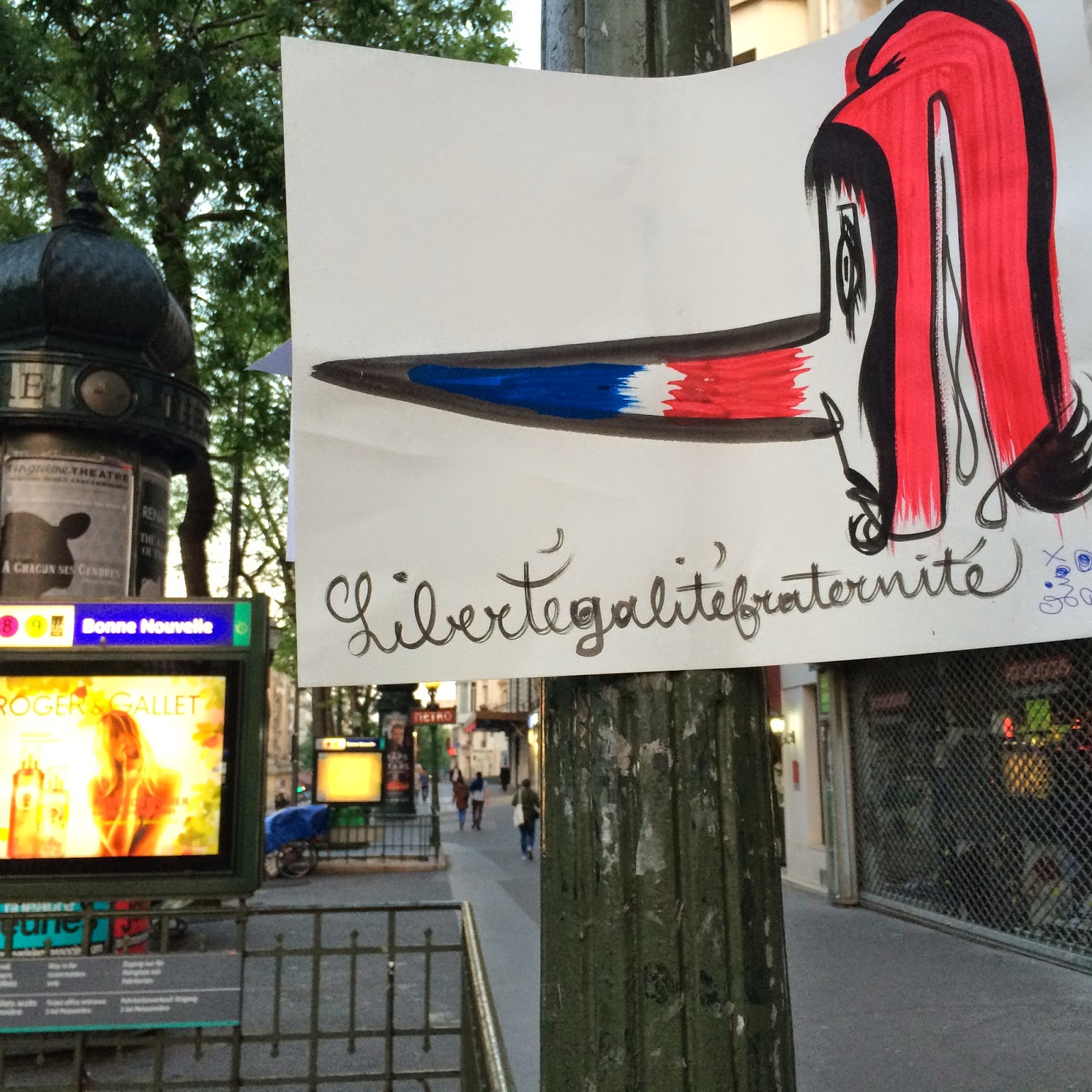
 Spotted this little taped drawing outside the Metro - a drawing of Marianne - the Symbol of France with a long Pinochio nose over the words 'Liberte,Egalite, Fraternite' - so that's the pulse on the Paris streets before the European Elections.
Cara - Tuesday

Monday, May 19, 2014

Travels with David: A Venetian Adventure

The month was May.  We were spending the whole of it in Italy.  When our friends Camille and Sharon came from Washington for a stay, we took them on their first visit to Venice.

Sharon and Camille on the Ponte Vecchio in Florence


 It is an easy trip by rail from Florence.  If you take an early train from Santa Maria Novella Station, you can be on a vaporetto on the Grand Canal by midmorning.  La Serenissima did not disappoint. Unsurprisingly, Sharon and Camille found Venice stupefyingly gorgeous.

David on the Academy Bridge in Venice


After two glorious days, we left, according to plan, on the eight PM direct train, expecting to get back to Florence at eleven and in our beds by eleven-thirty.  That’s the way it ordinarily happens.  But not that evening.  For the next five hours absolutely nothing went according to plan.

We boarded, carrying sandwiches, juice drinks, and a box of lovely little pastries.  The train pulled out of Venice Station right on time.  As we crossed the causeway from Venice to Mestre, we saw storm clouds over the mainland.   We thought nothing of them.  Storms don’t stop trains, do they?

Lightning was flashing when we unwrapped our sandwiches.  And by the first bites of those yummy pastries, the train had stopped.  We finished our snacks and chatted and read and chatted some more and after half an hour with no movement and no news, I (being the group’s Italian speaker) went off in search of a conductor and an explanation.  The conductor was nice; the explanation was not.  The train we were on was electric, run by overhead wires, but in this case, not run by overhead wires since they had been hit by a thunder bolt.

My companions had barely left off groaning over the news, when the conductor took everyone off the train and (ahem) conducted us along the tracks for about half a kilometer to the nearest station, where he said there was a train to take us to Bologna, where we could then change for Florence.


It was dark by the time we got to the station.  Fortunately the rain had stopped.  A huge, sleek, black intercity train that looked as if it belonged to Darth Vader stood at the platform—upon which a band was playing and a chorus about thirty men strong was singing.  Quite beautifully.  They wore hats with feathers.  We joked that they were there to welcome us.  It would be another hour before we learned from fellow passengers what that fuss was really about.


We boarded.  The train was packed, seats impossible to find.  David, Sharon, and Camille looked at me, shouting “help” with the desperation in their eyes.  This train’s conductor looked no less forlorn than my companions.  When I approached him to ask about seats, he promised to find us some, but begged my help first.  He had heard me speaking English to my friends, and he had a difficult passenger to get settled before the train could move.  I agreed to be his interpreter.

He escorted me to a first class compartment, where a dark-haired and pale young woman sat weeping.  Towering over her was her husband, who, the conductor had told me, spoke no Italian, only German and English.  Blond and arrogant, he still had his baby fat—exactly the type central casting would have sent to play the cruel Nazi lieutenant.  I glanced down at his trouser legs to see if they carried a red stripe.


At issue: These newlyweds were on their way to Greece for their honeymoon.  He had booked them second-class tickets from Frankfurt to Bari (at the heel of the boot), where they were to take a ferry to their final destination.  Hubby was in the process of trying to bribe the conductor to let them sit in a first-class compartment.  Those were pre-Euro days.  His offer was ten Marks.  He had no Italian lire.  He had refused to change his valuable German money into the garbage currency of this country of thieves.  He actually wrinkled his chubby nose when he told me this.   He insisted that the conductor was merely holding him up for a bigger bribe.  Everyone knew that you could bribe anyone in Italy.  And that the Italians would steal whatever you would not give them willingly.


With apologies, I gave his message to the conductor.  Hubby took out his billfold and tried to press a ten Mark note on the poor man.  Wifey sobbed.  By now I was sure her grief was, not as her husband claimed, over having to share a second-class compartment with all those noisy Italian men but remorse at having married this blustering bigot.


The conductor told me he felt very sorry for the young woman, but that he could not risk his job by accepting the bribe.  He needed to collect the extra fare before he could allow them to stay in this compartment.  In deference to the lady and the rest of the passengers, who were being held up by this interchange, he agreed to take the German’s cash, and when we got to Bologna, go to the money changers and bring the German whatever was leftover from a fifty Marks bill.  Hubby fumed that he would then be in possession of distained Italian currency, but he took the deal.  He offered to shake my hand.  I demurred.

The excessively grateful conductor then found four seats for my companions and me—two in each of two compartments in the same carriage.  The band on the platform struck up one final farewell tune.  And we were off.

Along the way to Bologna, we learned that this train was taking a large group of Alpini, members of the Italian Army’s elite mountain warfare corps to their annual reunion, that year in Bari.  In battle, gli Alpini are known for their bravery and brilliant feats of rescue.  In peace, they are known for their lovely singing and masterful wine drinking.  The music on the platform had been performed by their comrades-in-arms to see them off.


The men in the compartment with David and me plied us with homemade wine, taught us to sing their anthem, and expressed their delight at meeting real “newyorkesi.”  Time sped, like the train through the darkness.  Nearby, Sharon and Camille were getting similar treatment.


We reached Bologna at 12:05 AM.

The conductor got off with us in search of change for the German.  With an additional expression of gratitude, he told us that the next train to Florence would depart at 12:30, but he didn’t know what platform it would be on.  The station was deserted and dark.   I went in search of information and found no one until I saw a door ajar.  Inside the dim room, a man hunched over a computer terminal.  When I asked about the 12:30 to Florence, he looked at his screen and began to answer.  Then, he shouted, “Ah.  No, signora.  There is an unscheduled train.  Go fast.  Right now, to platform one.  You can leave right now for Firenze.”

I ran to my friends and we hurried to meet the train, just making it.  We boarded, a bit breathless and took seats in an otherwise empty carriage.  We had just sat down, when I looked around and saw where we were.  There in the little trash receptacle under the window was the refuse from our little supper—the sandwich wrappers, the juice cartons, the discarded box from the little pastries.

“I love Italy,” Sharon declared.  “Where else could a train SNAFU be this amusing?”


See the singing Alpini here:


Viva Italia!

Annamaria - Monday

Sunday, May 18, 2014

Guest Blogger: Michael Niemann--What is Darfur?


This week we welcome Michael Niemann as our guest author.  Michael is a newcomer to crime fiction. His story featuring UN auditor Vermeulen, AFRICA ALWAYS NEEDS GUNS, made it into the 2012 MWA Anthology. In his previous life as a university professor, he wrote a book on regionalism and numerous articles on global and African issues. He has traveled widely through Europe and southern Africa. A native German, he now lives in southern Oregon with his wife, who keeps him grounded, and his dog, who gets him up early (presumably to write).

 His debut novel, LEGITIMATE BUSINESS, continues the exploits of Vermuelen.  It’s a tight thriller set against the sandy hopelessness of Zam Zam camp in Darfur, once again proving that murder really is everywhere.  With Vermeulen following the UN missions to the world’s hot spots - of which there are unfortunately plenty - we can look forward to more of his adventures in exotic places in the future.


What is Darfur? A shorthand for genocide? Just another one of those conflicts that seem to pop up regularly in Africa? A metaphor for ill-informed outside intervention?

Let me start with the easy part, the name. Darfur simply means homeland of the Fur. But that's already misleading. The independent state of Darfur that existed in the western part of what is today Sudan for centuries was home to many others as well. Somewhere between forty and ninety ethnic groups or tribes lived in Darfur. Only a minority of those were or “became” Fur. Some were granted land rights, others were not. Some were farmers, sedentary and place-bound, others were pastoralists, taking their camels along a vast circuit from the arid north toward the fertile south during the summer and back north in the winter.

Mahammid tribe
In January 1917 Darfur was absorbed into the British empire as part of Sudan. British colonialism had always been domination on the cheap. Its “native administration system,” pioneered in India and fine-tuned in Africa, utilized existing rulers as much as possible while also empowering such rulers well beyond their customary roles. That cemented in place the unequal land distribution in Darfur. In the early 1950s, only a few years before Sudan gained its independence, the British conducted a census as a result of which certain populations were designated as Arab “settlers" while others became African “natives.” Never mind that peoples considering themselves Arab had been living in Darfur since the 1500s. That designation created the myth of the Arabs as latecomers and occupiers.

A quick word about the farmers and the pastoralists. The former tend their fields and do so because they have some sort of claim to the land they farm. The latter are wanderers, not tied to a place of their own. Their movement is determined by the seasons and the needs of their animals. It’s not hard to imagine why the two groups might come into conflict. Nobody likes their fields trampled by a herd of camels or cattle. But in reality the two groups exist in a symbiotic relationship. The camels of the pastoralists provide transport for the products of the farmers. The dung of the cattle provides fertilizer for the farmers. Sure, there have always been flash points, but rarely anything that couldn’t be settled by a council.


Millet harvest
Enter two late-modern developments: the Cold War and climate change. The Cold War turned Africa into the battleground of the Superpowers. One facet of that was the conflict between the US and Col. Gaddafi of Libya, who looked to the Soviet Union for support. Gaddafi also meddled in the affairs of his southern neighbor Chad, which borders on Darfur. That set in motion a two-decade conflict between pro- and anti-Gaddafi politicians in Chad. Whoever was on the losing side, took refuge in Darfur. By the late 1980s, the area was awash in guns. Climate change, in turn, led to an acceleration of the desertification in northern Darfur. In the last four decades, the Sahara desert has advanced by more than 100km. That pushed the pastoralists further south and left them to linger longer on the southern leg of their circuit.


Combine that with the amount of guns available and the civil war of 1987-89 seems almost predestined. By 2002, a cease fire was in place. By 2003, Darfurian rebel groups claimed that the government was neglecting their concerns and attacked. The Sudanese governments fought back. The Darfur conflict exploded on the global scene with all the misery that is modern war. At issue are still the quest for land rights, regional autonomy, and redeployment of Sudanese military and police. Since the Sudanese government is dominated by “Arabs” and led by a dictator, the shorthand for the conflict became “bad Arabs” versus “innocent Africans.”

The primary reason the war continues to date is the ready supply of guns. Without them all sides would negotiate more seriously and the Doha Agreement would have seen a better implementation. With that in mind, I wanted to write a thriller that highlighted the destructive influence of gun smuggling on the conflict. But having an agenda in fiction is always tricky. Nobody wants to read a manifesto. There’s got to be a compelling story.

The story opens with the death of a police woman at the Zam Zam camp for displaced persons, just south of El Fasher. With about 50,000 refugees, it's more than twice as large as the city in which I live. The people living in Zam Zam were at the receiving end of violence in all its terrible forms. They've lost family members, cattle, their house or their belongings. They make do under unimaginable conditions. But, just like any random sample of 50,000 people in the world, Zam Zam has its share of leaders and followers, doers and layabouts, law abiding residents and crooks. Probably more of the latter category since life has been reduced to the barest level, necessitating all kinds of acts people would not do under ordinary circumstances. Which makes Zam Zam a dangerous place. That’s one of the reasons the United Nations peacekeepers are in Darfur.

Zam Zam camp
The United Nations/Africa Union Hybrid Mission in Darfur (UNAMID) began in 2007, taking over from the woefully underfunded African Union mission. Its mandate, determined by the UN Security Council, authorizes UNAMID to protect itself and humanitarian aid personnel, to support the implementation of the Darfur peace agreements, to prevent armed attacks and to protect civilians. The mission consists of some 20,000 personnel and costs about $1.3 billion (that's US billion) a year. The personnel come from forty countries as big as Nigeria and as small as Palau. Even an operation that size can't keep the peace, since those soldiers and police officers are spread over an area the size of France.

UNAMID has a thankless job. Many of its units are deployed in isolated areas and are up against powerful armed groups, both rebels and government forces. In some cases, they can’t patrol unless they inform local commanders first. Otherwise they risk being ambushed. They do a better job policing refugee camps, but even there, situations can easily spiral out of control. As Vicki Delaney's post about South Sudan explained, UN police are strangers policing people whom they don't know and who don't necessarily want to be policed by foreigners who don't even speak their language. The death of a police woman is therefore not uncommon.

Rwandan policewomen arrive
Some of the successes have been the disarmament and demobilization activities near larger cities. And in the past several years, refugees have been resettled in home areas as a result of UNAMID actions. Finally, gender-based work by female officers has made a difference for women in the camps. Overall, though, UNAMID hasn’t kept the peace. That’s due in large part to limited mandate given to it by the Security Council.

UNAMID is a logistical nightmare. Everything from ammunition to spare parts to food to toilet paper must be brought in from the outside. Contributing countries must be reimbursed for their troops and equipment. The going rate for a deployed soldier or police officer is around $1,200 per month. Since all units have to bring their own equipment, the UN also reimburses for the depreciation of equipment. Remember the $1.3 billion per year. That's a lot of money, and, like any large sum of money, it attracts enterprising individuals who want to steer some of it their own way.

To keep that from happening auditors are sent to check the books. That’s how my protagonist Vermeulen comes to Darfur. He is an investigator for the Office of Internal Oversight Services, the UN fraud watchdog agency. Unlike regular cops, he doesn't have a gun or a badge. All he's got is an authorization from the Under-Secretary General. Ordinarily, that and $3.00 would get him a cup of coffee at Starbucks. So he uses bluster instead of authority. It gets him into trouble, but that's what protagonists are for. But he can only investigate UN related issues. Gun running is not part of his brief. The tricky part was to twist the plot so that gun running becomes his task. For that purpose I used several armored vehicles in bad repair that were being passed off as new. The vehicles were delivered by a British company that sells weapons around the world. Now Vermeulen has the reason he needs to look into that company's doings. The strange thing is that there really was such a case. All I had to do was adapt it to my story.  

Armored personnel carriers
You can learn more about Michael and his writing at his website

Saturday, May 17, 2014

Your CrimeFest Report from Bristol, UK.


I really should be off helping my best buddy get elected Mayor of Mykonos in tomorrow’s Greek municipal elections (see tee-shirt above), but instead here I am at CrimeFest 2014 in Bristol enjoying the camaraderie of terrific mystery fans and writers, and—together with Stan—toasting the celebrity of our very own Yrsa who is this year’s Featured Guest Author, along with Mark Billingham.  Congratulations to Yrsa Sigurdardottir, Queen of Icelandic Mystery.

All of which is my way of saying, here are photos of Bristol, Yrsa and her entourage (including Stan and moi), our hard work on panels, and my trusty guide showing me all around Bristol.

Around the old town:  


Hard at work:


Hard at Play:

Susan Moody, Quentin Bates
Bill Gottfried


Okay, so life is not all that tough. But it’s off to Gatwick at 01:30 Sunday to catch a flight back to Mykonos in time to join the citizens of Mykonos in celebrating their decision to bring their island the new day it deserves.


Jeff—Saturday