Wednesday, June 26, 2013

Nobel Faux Pas

 
Astrid Lindgren - 1924
On the topic of Sweden I cannot leave this subject without mentioning this country‘s greatest writer, Astrid Lindgren. I say greatest without meaning to disrespect other Swedish writers both present and past. There is simply no other place for her than at the top of the list.

For one she has sold more books than most writers in any country – over 145 million copies and counting. Huge sales do not automatically qualify a writer as being great, but continuous sales through generations do. Astrid Lindgren‘s books sell well because they are wonderful and many of the numerous titles she wrote are timeless. I remember loving her books as a child, I remember my children loving them and last night my six year old grandson was happily reading a book about the misadventures of Emil and his sister Ida. When smaller he enjoyed being read Pippi Longstocking and I expect he will soon move on to reading on his own about the brothers Lionheart, Ronia the robber‘s daughter and Mio. Every one of these books has an incredible charm that  is rooted in the characters, settings and the storylines, a mix that manages to appeal to children without ever being condescending or stupid. The young were her readers and she the author fully respected and understood them. 
It is funny to note that Astrid Lindgren‘s writing was not fuelled by financial gain. At one point in her life she paid a tax rate of 102%. Meaning the revenue for every book sold was not enough to pay what was due to the Man. She came out at a loss. Taxes in Sweden have long been odd.

It is shameful that the people involved in selecting those offered the Nobel Prize for literature prize never looked her way. It is really more than shameful – it is the most stupid oversight in the history of literature. Keep in mind that Nobel‘s will noted that his money was to be used for prizes for those who provide the "greatest benefit on mankind". There was also some hoo-ha mention about “idealistic tendency” – whatever that means.  
 
I imagine that Astrid Lindgren writing for children had everything to do with this stupendous snub. Anything to do with children seems to be considered second class when it comes to so many aspects of our civilisation. Yet most grown-ups that are lucky enough to have kids tend to agree that children being the most important thing in their lives.


Anyway, if the Academy had looked into it they could have found lot‘s of idealistic tendencies in the works of Astrid Lindgren. For one the tales of Pippi Longstocking provide little girls with a protagonist of their own gender that is not being saved all the time but is instead a catalyst and a girl that actually takes charge in every situation. Highly, higly unusual and still as much needed as when it was first published in 1945. Stieg Larsson is said to have based his Lisbeth Salander character on a grown up Pippi and chose named Mikael Blomkvist‘s last name from another Lindgren character, Kalle Blomkvist kid detective.  

I am somehow not exactly sure how Winston Churchill fits into the: “greatest benefit on mankind” or: ”idealistic tendency” category when it comes to literature. But he won the literary prize in 1953. Ridiculous if you ask me. Especially if one takes into account that no author of children’s fiction has ever been awarded the prize.
 
The Brothers Lionheart
Never will I read anything written by Churchill. Not only does his name sound like a hill with a church on it but is spelled like a sick church - but mainly I am not interested in testosterone fuelled war recitations and ponderings about generals and artillery. Now that I think about it I do not know anyone who has ever mentioned reading his books. But every single person I know has at some point in childhood read Astrid Lindgren. For those of you that have not I strongly recommend you read the Brothers Lionheart to your children or grandchildren. It is such a beautiful story, adventurous and heartwarming at the same time.

I truly believe that reading books such as the Brothers Lionheart as a child can influence the person that child will turn out to be. Books provide us with an insight into conditions, events and emotions we might never experience on our own skin, especially at an early age. They have the power to open the mind and allow complex thoughts in. Influence our aspirations and longings even. They heighten our emotional understanding and make us smarter and more wise to the world. Better people. If that is not important when it comes to the young then I do not know what is. Idealistic tendencies indeed.

Regarding the Nobel prize, I guess that all things considered Astrid Lindgren needs no such prize. Children are not snobs.

Yrsa - Wednesday   

Tuesday, June 25, 2013

The Temple of Rock Paris style

I'm doing rewrites on my next book set in Pigalle. Just yesterday I worked on a scene that takes place in an infamous disco called Bus Palladium or the Temple of Rock by people in the 60's. It's a climax in the story. I've been there and then what do I find...there are five things I don't know about the place.

Welcome to the Bus Palladium.  (Photo: The Daily Ninth)
1. In the 1930s
In the early twentieth century, the Bus Palladium was called The Red Angel. The dance bar had a checkered past and in the 30's a reporter covering the red light district of Pigalle wrote about what was a usual occurance: " On the night of February  11, 1932, a brawl bursts out after midnight at the bar-dancing Red Angel on rue Fontaine. The 'Parisians' mounted from the Saint Martin district to fight with a Corsican pimp ... "


2. The Bus Palladium music
Who's in, who's out? You like nitroglycerin is the Bus Palladium on rue Fontaine? There's a crowd for Liverpool Lads . " Serge Gainsbourg's tribute to Bus Palladium in 1968 and the Beatles.(Here's a better link thru youtube http://www.youtube.com/watch?feature=player_embedded&v=BeyOUCI5w_8


3. An ultra-popular place in 1960-1980

It was impossible to park on rue Fontaine because of the long lines waiting to get in! "says Nicolas Lespaule who remembers the Bus Palladium where he was a DJ,  "popular, very exclusive, with many people OUT and very few people IN . " The Bus Palladium so inspired Nicolas Lespaule he made ​​a show, 'Hearsay Love Bus.'

4. Rock'n'Roll dress code 

During the '80's, "with the glitz and rhinestones as we know them , " Nicolas Lespaule recalls the Bus was a casual place. " What was funny, he notes ,' is that people were dressed simply,  with a leather jacket and boots,  then stayed until closing at 3 o'clock bus, then spun to change in order to finish the evening elsewhere! " 


5. Karaoke and Slams

In the 90's the Bus kept up with the times and had a Karaoke night every month.  The singer of Dionysus - a very French band, was thrown into the audience during a slam.

Cara- Tuesday 

Monday, June 24, 2013

What's in a Name?


When Jeff was writing his introduction of me last week, he asked if I minded his telling you my real name—Patricia King. I said I did not. I decided to use a pseudonym for my fiction, not because I want to hide from the public, but because I want to distinguish myself from all the other Patricia Kings of which there are thousands.

The latest searchable census data, from 1990, gives the following statistics for the US:

  • Number of people named Patricia, the second most popular female name: 1,628,911
  • Number of people with the last name King, the 30th most popular last name: 475,530
  • Number of people named Patricia King: 2,975


 If you search “Patricia King” with Google you get 59,800,000 hits in .2 seconds.  You will not find me on any of the first 60 million or so.

Patricia King on the cover of
her last nonfiction book:
Monster Boss
I had written my nonfiction books under my real name, which made sense since they were all connected with my consulting practice. Other nonfiction writers were publishing as Patricia King: a sociologist, an expert in dollhouses, and most notably toward the end of my nonfiction career, a televangelist and entrepreneur who has published sixteen books.  More than one person, upon meeting me actually told me that they had googled me and thought I was she.

Patricia King, the televangelist and entrepreneur

When I finally broke through into as a published novelist, I wanted a name that would distinguish me from the other 2,974 women who carried my name, especially the authors.

Truth be told, I also wanted a name that would get me www-dot-fill-in-the-blank-dot-com.

My first thought was to name myself after my female forbears.  It would connect my name with my heritage for one thing.  And, to me, their names were mellifluous and much more romantic than the rather business-like and prosaic Patricia King.  So I chose my mother’s first name—Annamaria and her mother’s maiden name—Alfieri.  I wanted to honor those women, who never had my opportunities.  My mother never got to graduate from high school.  Both my grandmothers were illiterate.  I think it is amazing and wonderful that, under the circumstances, I got to be an author.

My mother: Annamaria Pisacane Puglise

On the left: Sabina Maria Alfieri Pisacane


The Original Annamaria Alfieri with her husband,Francesco


After my first novel was published using her name, I found out that my great grandmother was called the same—Annamaria Alfieri.  This makes 
sense since the tradition among many Italians is to name their children after the grandparents.  My mother, like many Italian second daughters, carried her mother’s mother’s first name.

I have only two memories of the real Annamaria Alfieri.  In the first, I am only around three and sitting on her lap; she is calling me “tesoro,” Italian for “treasure,” used as we would say “darling.”  The other is being five and standing at the foot of her bed, not really being able to see her nor understanding that she lay dying.  She was 95.  I would like to believe she knows I took her name.

By the way, Annamaria’s/my third South American historical mystery launches tomorrow.  Blood Tango takes place against the most tumultuous week in Argentine history, Buenos Aires 1945.  It imagines the murder of an Evita lookalike.  You can read all about it and get a sample chapter at www.annamariaalfieri.com


Annamaria Alfieri - Monday
  

Sunday, June 23, 2013

This week


Lisa asked me to fill in for her today as she is on tour for her newest book, HOUR OF THE RAT.  We all hope that it is very successful.

It has been another strange week in the world, so I thought I would highlight various items that caught my eye.

Nelson Mandela

My hero, Nelson Mandela, is in hospital yet again having been admitted about two weeks ago.  According to South Africa’s President Zuma, Madiba, as Mandela is known, was responding to treatment and is in serious but stable condition.  America’s CBS News, however, reported that Madiba hadn’t opened his eyes for days and that his liver and kidneys were only functioning at 50 percent, and that he had undergone two surgeries.  It also claims that Madiba’s heart had stopped at one stage, and he had to be resuscitated.
A young Mandela - in 1937

A more recent photo


It also came to light this week that the emergency ambulance that was taking Madiba to hospital in the middle of the night two weeks ago broke down en route to the hospital in Pretoria leaving him and his wife stranded for 40 minutes in 45 F (8 C) temperature.

Rapport newspaper reported that Mandela’s close family was deliberating on ““just how much medical intervention was enough for an old and very sick man”.  My cynical side wondered about Michael’s blog of a couple of weeks ago (Don’t live too long . . .) in which he reported that Mandela’s daughters, Zenani and Makaziwe, were in court seeking to get control of their father’s trusts.

[For those of you interested in why Mandela is called Madiba, it is customary to honour someone in South Africa by giving them the name of the clan they belong to.  Mandela is a Xhosa of the Madiba clan.]

Water

It seems that it is raining heavily almost everywhere in the Northern hemisphere.  My newspaper today reported that 4500 people may have died in flooding and landslides resulting from pre-monsoon rains in Northern India and Pakistan.

Rescue worker in India

Shopping is difficult in monsoon season

Calgary in Canada suffered its worst flooding ever, leaving 70,000 people homeless until the floods recede.

Devastating Calgary flooding

More from Calgary


Here in Minneapolis, we had three waves of thunderstorms come through over the past three days, leaving more wind damage than flooding.  Half a million people were left without power, largely due to thousands of trees that were blown over because the soaked soil was unable to hold them up in the face of the high winds.  Fortunately the temperatures were balmy.

Water-logged soil caused trees to fall

And road to collapse

More from Minneapolis

Protests

The civil war in Syria took a backseat to the protests in Turkey that started initially in reaction to the government wanting to develop part of one of Istanbul’s only green spaces, Gezi Park.  There was a lot of water there and in Taksim Square, where police doused protesters with water cannons.  Prime Minister Recep Tayyin Erdogan took a firm stance against the protesters, saying at one stage “Nobody but God will have the power to overthrow our government.”  Several protesters have died in the turmoil.

At least it's not bullets

I hope it wasn't cold outside


Brazil too saw massive protests initially against a hike in bus fares in Sao Paulo.  It rapidly spread across the nation of 195 million into protests against corruption and lack of basic services, as well as anger that so many billions were going to spent on the 2014 Football World Cup and 2018 Olympic Games instead on education and uplifting the poor.

We need more jobs

No caption needed

Millions protest

Tear gas

I fear South Africa could see similar protests when Madiba dies.  

Is it possible that it will pick up the World Cup if Brazil defaults?  After the 2010 World Cup, which it hosted so successfully, it is not out of the question.


World’s oldest embrace

South Africa’s Mail & Guardian newspaper reported this week on what must be the world’s oldest embrace:

“The rain was pouring down as the skies opened up in the Karoo Basin 250-million years ago. An injured amphibian Broomistega, possibly hurt by the storm, crawled into a sleeping animal's burrow to shelter from the violent weather. It is suspected that the mammal-forerunner Thrinaxodon – which, from simulations resembles a furry Komodo dragon – was hibernating, although when done for short periods of time this is called aestivation.
Both animals died, and their fossilised embrace, discovered by South African scientists, marks a world first. “

I, Broomistega, take you, Thrinaxodon, to be my ...

Creationism,

I read something this week that I found quite remarkable.

"Forty-six percent of Americans believe in the creationist view that God created humans in their present form at one time within the last 10,000 years.  The prevalence of this creationist view of the origin of humans is essentially unchanged from 30 years ago, when Gallup first asked the question. About a third of Americans believe that humans evolved, but with God's guidance; 15% say humans evolved, but that God had no part in the process."
                                                                                                2012 Gallup poll

Greece closes public television station

In what was called an effort to deal with the budget crisis in Greece, conservative Prime Minister Antonis Samaras decided to close down the Hellenic Broadcast Corporation (ERT). The country’s national broadcast service.

Great poster
The leaders of the other two parties in the government coalition were outraged. 
Protests have taken place against the decision.  Hopefully Jeff can fill in the details.

Lost firearms
Gun dealers in the USA lost 10,915 firearms last year.  So much for responsible gun ownership.

Obama’s African safari


The Telegraph reported last week: “Barack and Michelle Obama have reportedly scrapped a safari during their trip to Africa because of the costs of snipers needed ’to neutralise cheetahs, lions and other animals if they became a threat’.”


I’m delighted.  Who knows what would have happened had a baboon jumped on the game vehicle to pilfer food.

Oh Barack, what am I going to wear?

How I beat Serena Williams at .. tennis

Last Tuesday, as I was checking in for my Delta flight from Heathrow to Minneapolis, I had an interesting experience.  (And, no, it’s not another airline story of woe like Michael’s unbelievable experience last weekend – A Personal Best).  A woman, obviously from Delta, walked up to me and asked if I would like to play table tennis with Serena Williams.  I agreed with great alacrity – after all, Serena is one of the greatest tennis players of all time.  Why would I not want to play against her?  Needless to say, it was a puzzling request.

Apparently Delta was having a big promotion for its new terminal at JFK in New York, from whence Serena had just arrived.  A table tennis table had been set up in the check-in area in Terminal 4 at Heathrow.  There were cameras everywhere, and reporters were buzzing around like mosquitoes on a Minnesota lake to witness the several passengers who had been recruited to compete. 

That's me hidden on the left!


After a brief warm-up, my partner – a talented young woman with a two-fisted backhand (in table tennis?) – and I squared off against Serena and her partner.  The game was somewhat abbreviated I have to admit (best of five points), but my partner and I prevailed 3-1.

Serena waves graciously after losing to my partner and me

As you can see, I am going to make the most of these bragging rights.


Stan for Lisa - Sunday

Saturday, June 22, 2013

The Kingston Trio Said It All


I was trying to come up with something thoughtful to say, so I took a look at the front page of The New York Times.  Amazing.  Simply amazing the world we live in.  And that brought me to thinking of an old Kingston Trio Song from my grandpa's era.  So, with apologies to Dave Guard, Bob Shane, and Nick Reynolds (the original trio), here’s my updated take on the lyrics to Sheldon Harnick’s 1959 classic, “The Merry Minuet.”  Not exactly American Idol material, but it might have a shot at Eurovision.


They're rioting in Istanbul,
Feeling tense in Cairo.
The Taliban made Qatar cool,
But Karzai said no.

Our dear world is teetering
With desperate souls.
Iranians hate Israel,
Israelis hate the polls.

North Koreans hate Japanese,
Russians hate Americans,
The EU must
Hate itself from where it stands.

But we can be thankful,
Look forward with pride,
For life’s not as bad
As it once was in Chad.

At least that’s how it seems
When there disappear,
From each new day’s fresh headlines,
Played out tales of lives set in fear.

They're rioting in Istanbul
But I’m off in Greece.
Goodbye Fox, uhh-uhh CNN
And ERT please rest in peace.


Think about it. 

Jeff—Saturday

Friday, June 21, 2013

St Kilda. The Lonely Islands.


 St Kilda are the loneliest islands in Britain. It was inhabited until 1930 when the locals found out that other parts of the world did not smell of rotting sea birds. I bet Mykonos is a tad more fragrant.  St Kilda is an archipelago 40 miles North West of North Uist consisting of Hirta, Dun, Soay, Boreray and lots of rather impressive bits and bobs. It is visible from the summit ridges of the Skye Cuillin 80 miles away. The rainfall is high, 55 inches per annum. Temperatures are 5 degrees C in January, 11 degrees C in July. The prevailing winds are ‘strong’ usually 15 mph, gusting 115 mph, with 130 mph gusts recorded at sea level. Tidal range is normally 9.5 ft, with swells of 16 ft.
                                      
                                                 St Kilda....not Mykonos!
I know now that you are really keen to go so here are some things you might want to know. Some of them are true.
                                    
          The National Geographic got a photo of sunshine on Hirta- rarer than a free pint from an Aberdonian.

1)      It has been inhabited for two million years, the population never exceeding 180. The DNA pool must be smaller than the IQ of a TV Weather girl.
                         
2)      The entire population (36) was evacuated from Hirta on 29th August 1930. At their own request.
“The morning of the evacuation promised a perfect day. The sun rose out of a calm and sparkling sea and warmed the impassive cliffs of Oiseval. The sky was hopelessly blue and the sight of Hirta, green and pleasant as the island of so many careless dreams, made parting all the more difficult. Observing tradition the islanders left an open Bible and a small pile of oats in each house, locked all the doors and at 7 am boarded the Harebell. Although exhausted by the strain and hard work of the last few days, they were reported to have stayed cheerful throughout the operation. But as the long antler of Dun fell back onto the horizon and the familiar outline of the island grew faint, the severing of an ancient tie became a reality and the St Kildans gave way to tears.”
                  
                                    modern Blackhouses
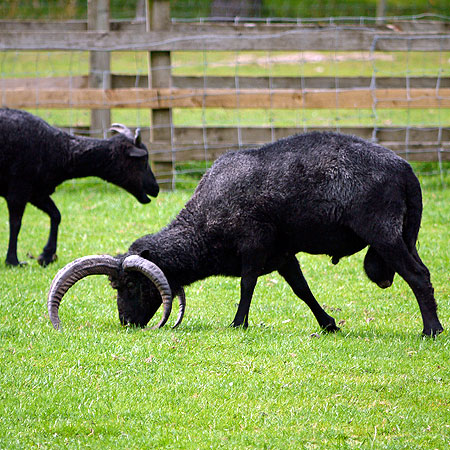
3)      Sheep!  The Soay (Neolithic), the Boreray (Iron Age) type. They were feral, owned by the landowners not the islanders. They have been exported all over the world as they are small, tough and cute! I had a friend who was a soay sheep, I called her a Soapy sheep – I was very young. The Boreray is very rare, once of the few remaining descendants of the Dunface. There is also a ‘St Kilda’, a black, four-horned breed.


                                    Four types of St Kilda Sheep - count those horns!
4)      Visiting ships in the 18th century brought cholera, smallpox, TB and tetanus, killing so many of the population the ships often did not get enough locals on board to crew for the onward journey.

5)      St Kilda wren, the St Kilda Dandylion and the St Kilda field mouse are specific species. The field mouse died out with the evacuation but the Grey seal then appeared. There are no trees. They can't cope.
                                        
6) There has been a small military base there since 1957. The canteen is not open to the public. A direct hit by a sub in WW 1I killed one lamb.  The sheep ran away and hid.
7) There is no actual St Kilda saint. A Dutchman probably overheard the Norse Sunt Kelda. Sweet Wellwater.   Sweet?  No. Bird pooh, plenty.
8) It is mostly granite and grabbo from a volcano 140 feet below sea level.  I'm sure this is puny compared to Icelandic volcanoes but we never affect air traffic control.
9) Hirta is 1,700 acres. Soay 240 acres. Much of it is vertical.  
10) It has the highest stacks in UK;  Stack an Armin reaches 643 ft. Stac Lee 564 ft, The  
 north face of Conachair is a vertical cliff up 1,401 ft high- the highest sea cliff in the UK.
                                           
11) The island of Dùn was once joined to Hirta by a natural arch.  The romantic version is that the arch was broken when struck by a galleon fleeing the defeat of the Spanish Armada. More credible is the wind blew it away.
                                    
                                        The little brothers. Ground nesting. Tasty.
 12)   St Kilda has the world's largest colony of Northern gannets, Leach’s petrels, Atlantic Puffins, The last Great Auk (Pinguinus impennis) seen in Britain was killed on Stac an Armin in July 1840. 
 13) The archipelago's isolation has resulted in a lack of biodiversity. Polite way of saying small DNA pool.
14)  St Kildans used to pay rent by collecting sea birds (gannet and fulmar), salting them, storing them. The smell was awful. Peter May’s crime novels describe a similar life style. Diet wise they ate the eggs and the young both fresh and cured. Adult puffins were also caught by the use of fowling rods– a compound of rotten fish and stinking seafowl. 
                                        
 15)  They have always been isolated. In 1697 the only way to get there was rowing in an open boat for several days through 40 feet waves. They knew nothing of the Battle of Culloden in 1746. It was rumoured that Bonnie Prince Charlie and some Jacobites had escaped to St Kilda. The British soldiers followed only to find a deserted village. The St Kilda’s, fearing pirates, had hidden in some caves. When they were talked down, the soldiers discovered that the natives knew nothing of the prince. Or King George II. Or Kim Kardashian.
                                              
16) By the late 19th century, the islanders could communicate by lighting a bonfire on the summit of Conachair and waiting for a passing ship to see it. Then the St Kilda “mailboat" was invented. The St Kildans would carve a piece of wood into the shape of a boat, attach it to a sheepskin bladder and launch it when the wind was from the north-west. The messages eventually reached the west coast of Scotland or, Norway. Still quicker than our first class post.
                                                          
17) The birding activities required considerable climbing skills, especially on the precipitous sea stacks. They have an island tradition involving the 'Mistress Stone', a door-shaped gap in the rocks of Ruival over-hanging a gully. Young men climb up there to stand on one leg, and do the twist.... to prove that they are worthy of a wife. Would you marry a man who did this to impress you? Now working the timer on the Tivo - that's impressive.
                                       
18) The daily parliament of the islands was the vision for the Scottish parliament opened in October 2004. Because the islanders felt they had true liberty.  And no St Kildan is known to have fought in a war, and in four centuries of history, no serious crime committed by an islander was recorded there. No serious crime.....so put a Scot on an island- happy chappy. Put a Scot on the same island as the England, we head the murder tables for Europe!
                                      
19) It had three churches. And five druid alters. Probably the same can be said for the mainland!
20) The Church of Scotland found out- a minister gave 13 lengthy sermons during his first 11 days. He supported the community while privately appalled by their lack of religious knowledge. Another minister introduced a routine of three two-to-three-hour services on Sunday with compulsory attendance. “It was time of intolerable gloom. Eyes were bent upon the ground. On the Sabbath It is considered sinful to look to the right or to the left."  Children were forbidden to play games and required to carry a Bible wherever they went.
                                           
21) Due to similar weather as Lewis - they also had blackhouses, 25 to 30 houses altogether.  The older beehive style, that resembled small green hills. They had thick walls of dry stone and were roofed with turf. One tiny window, a small aperture for letting out smoke from the peat fire that burnt in the middle of the room. The interiors were black with soot, hence ‘black house.’ The cattle occupied one end and once a year the straw from the floor was stripped out and spread on the ground. I use this fact as my argument for getting the Dyson out once a year.

This is the International Sea and Airport Lounge!
                                        
                                         
Just to be clear.....this is Mykonos.


This is St Kilda.  Got it?
Caro GB  21/06/2013