Sunday, December 8, 2024
The Tanganyikan Laughter Epidemic and Other Hysterics
Saturday, December 7, 2024
The Psychology of Separating You From Your Money
![]() |
| W. C.Fields |
| 100 drachma note |
![]() |
| ECB, Frankfurt |
Friday, December 6, 2024
Mr Brian Bilston
Very few people are familiar with the name Paul Millicheap.
Many more are familiar with his pen name Brian Bilston, the British poet and
author.
Here’s a few of his poems, just to make you smile. I love the one about punctuation pedants.
The poem, Refugee, is one often studied in English in schools.
The next poem is just wonderful...
This one is the favourite of Sarah Frame who runs our local bookshop. There should be an author's version of this...'I read a book of yours, I really liked it. It had a blue cover. Somebody died.'
And one about .... cheese....
hope you had a titter,
I think we all need it these days,
Thursday, December 5, 2024
All that glitters
![]() |
Back in the day South Africa was renowned for its goldmining – at one point it was the world’s largest producer of gold. That’s changed over the years. China now leads, and South Africa is only ninth. Mines have a finite lifespan, as do gold deposits. Exhausted mines are supposed to be properly closed down and sealed, and the area rehabilitated. However, as the deposits run down, the big miners who made the early running and lots of money sell the mines on to smaller producers who can still do well by lowering overheads, cutting costs, and often closing themselves down before they have to spend the money on closing the mines down. This leaves retrenched workers with no other source of income, and uncontrolled deserted mining properties. But there’s still gold down there. Just not enough for a commercial company to mine at a profit.
![]() |
Anyone who has ever spent time down an underground mine knows that it’s not pleasant. Without cooling and forced air equipment, it’s hot and stuffy. To its credit the South African government has passed and enforced strict safety regulations, but accidents and mine collapses still occur, particularly in the ultra-deep goldmines of the Witwatersrand. So why would one choose to go down a disused goldmine (or a disused shaft of an operating mine) using ladders and headlamps? Well, how else can a retrenched miner in a shrinking industry make a living? Mining skills are the only ones they have.
A new
industry has developed around these “zama zama” as they are called. They need
food and water supplied to them below ground. Criminals have set up black
market routes to buy the ore the miners produce, extract the gold, and sell it
on. Needless to say, most of the profit ends up in the pockets of these
middlemen. Just enough to live makes its way back to the miners who spend
months underground in dangerous conditions.
This isn’t
just a South African problem. It occurs wherever major gold deposits exist and
poverty abounds. (Kwei wrote about some of these issues in his novel Gold of Our Fathers set in Ghana.) It’s guesstimated
that 20% of new gold reaching the market is a result of this artisanal mining
and that 80% of the employment in the gold industry is in this category. Yes, eighty percent.
Of course,
it’s illegal almost everywhere. We’re not talking about weekend miners panning
for gold nuggets in a river here. We’re talking about a criminal-controlled
industry that compels people to risk their lives underground in awful
conditions for months at a time. It’s a form of economic slavery.

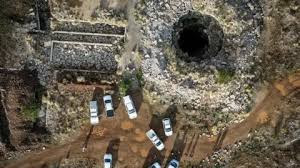
Stilfontein shaft from above
Something
needed to be done. Unfortunately, the South African Police Service decided to go
for the softest target – the miners – rather than addressing the criminal gangs
in control. They chose a well-used mineshaft at Stilfontein.
The police
sealed the mine, stopping the food and water supplies, and demanded that the
miners come to the surface and surrender. They trapped hundreds, if not
thousands, of the zama zama underground. There was a public outcry as conditions
deteriorated, but the government was adamant. The Minister in the Presidency
said that no help would be given to the illegal miners. “We are not sending
help to criminals. We are going to smoke them out,” she said.
![]() |
| Police and rescuers at the shaft with a makeshift pulley system |
Eventually, the government relented and allowed food and water down the mine. After that, they mounted a rescue operation to get the miners up. Several were in bad condition. At least four men died.
What has
been achieved? Very little. Since the zama zama have no choice, it will not be
a deterrent to others. And once the focus shifts and the police leave, no doubt a new group of zama
zama will bring their rickety ladders and well-used picks and shovels and go down the Stilfontein mine again.
There have been calls to develop the industry in a regulated way with the miners allowed to sell their production to the state at a fair price. This would supply legitimate employment and help the country's gold production. The difficulty is that to make it reasonably safe, one needs the proper infrastructure and that requires capital. But those sums have already been done by the companies that shut the mines down in the first place.
So what are the zama zama supposed to
do for a livelihood?
I don’t
have an answer.
Wednesday, December 4, 2024
Happy Early (Hmong) New Year!
Last week, I drove from Baltimore to St. Paul, Minnesota to be with family for Thanksgiving.
To my surprise, I got a bonus holiday: Hmong New Year. And what a gift it seems to live in a country where people have arrived from so many different parts of the world to share their traditional food, music, art, and other gifts. Public admission was just $12—how could I miss the party?
The traditional lunar calendar observed by Hmong people marked Saturday Nov 30 as the last day in 2024, and Dec 1 as actually New Year’s Day. Hmong New Year’s beliefs are tied to ancestor remembrance and the renewal of shamanistic energy. Yet the Hmong New Year I experienced with my outsider eyes was a very jolly celebration with upwards of 40,000 people streaming into River Centre, a huge convention hall in Saint Paul, MN. I was dazzled by the colors and complex embroidery of clothing worn by women, men and kids. The jingling of thousands of silver coins and strands of pearls on people’s clothes filled my ears. I marveled at the complexity of different hats and the festive high heeled shoes many wore to set off their finery. It seemed the most popular color was pink--often accented with green and black. Brilliant!
St. Paul happens to be of the largest population bases for Hmong in the United States; Fresno, California, is the other location. The largest New Year’s celebrations are housed in these cities, and the one in St. Paul was billed as United Hmong Family Reunion, a coming together of members of many different tribes. The Hmong people have traveled far over the centuries from their original Hmong kingdom in North China to different parts of Southeast Asia, most famously Laos. Some Hmong people still do live in China—but because of past persecutions including the suppression of language, many fled to start new lives in independent agrarian tribal communities elsewhere.
A second exodus occurred in the 1970s and 1980s. During the Vietnam war, the American military enlisted thousands of Hmong men to help fight a shadow war to suppress communism in Laos. When the Americans withdrew from that unwindable war, the Hmong remaining in Laos were in mortal danger. The first groups of Hmong military families were airlifted in the 1970s, and many other Hmong families swam, floated or boated across the water to a refugee camp in Thailand, where they lived for years until refugee visas were finally issued by the United States. The first refugees were settled in a scattershot approach in several states. In the 1980s, Lutheran Social Services and Catholic Charities in Minnesota accepted government contracts to oversee resettling Hmong families here. After that, Hmong living in other parts of the US chose to relocate to be near family members and because the city of St. Paul has largely been a friendly place to settle.
In the 1980s and 1990s, I met Hmong people selling beautiful vegetables and gorgeous embroidery at Twin Cities farmers’ markets. Some very special ornaments on my Christmas tree are fabric embroidered in famous Hmong reverse applique patterns. It was exciting to see so much bright clothing for sale at the RiverCentre and to be gifted a free book about Hmong Textile Art when I stopped to chat at the Hmong Cultural Center, a group that supports traditional culture and also helps people secure citizenship. I also met young Hmong-Americans running an early childhood education program that aims to make young children feel good about their heritage, and helps the adults involved in their education learn about Hmong family life. Several tables were staffed by the St. Paul police and similar agencies looking to hire. I learned this was the 44th Hmong New Year celebration in Minnesota—and that the anniversary of Hmong resettlement in the United States is 50 years as of 2025.
The deepest current I sensed was that of playful socialization with old and new friends. People lined up to toss colorful fabric balls back and forth to each other. Turns out this is a popular game at New Year’s that’s also a way for young men and women to signify romantic interest. An American-style beauty pageant for Hmong women took place on one stage, while youth dancers in fantastic costumes and makeup performed traditional dances on another. A food hall sold Hmong favorites like sesame balls, stuffed chicken wings, pork sausage, and a vermicelli-beef noodle soup fragrant with lemongrass and mint.
I lingered outside traditional thatched bamboo Hmong house where families posed for new year’s photographs. It seemed that under this roof, a traditional way of life was proudly remembered; an experience that many of us share during the holiday season.
Tuesday, December 3, 2024
Rails to Trails: Steps on the Tracks of Time
I’m in a liminal space, writing-wise, right now. My editor, the wonderful Krystyna Green, is retiring at the end of this year.
Krystyna has been my editor ever since she acquired my books for Constable/ Little, Brown/ Hachette and I will always owe her more than she can ever know. She's cheered, encouraged as well as reined me in over the years and made my books better than they could have been otherwise and it's a little unsettling knowing she won't be casting an eye over any future books!
Thank you, Krystyna!
I hope very much we'll stay in touch, but it's not just personal. It also means my tree history mysteries will be orphaned--I've just handed over the last book of the current contract and, unlike previous occasions, haven't yet signed a new one.
I still hope it'll happen, of course. But things move on and times--and things--change. I feel like the path ahead is uncertain yet exciting. It helps that I've been walking a lot along the Rail Corridor, ever since I found a new 'secret' access route to it.
These are the steps up at the end of Hindheade Walk. Not so easy to find... I've lived here for years now and only been able to get on the Rail Corridor at the Rail Mall or opposite Bukit Timah Plaza (both 30 minutes walk in opposite directions) but this is just ten minutes away from my front gate--greenery, away from the sight, sound, smell of urban traffic and buildings!
And yes, I'm well aware that its insulation is both cause and consequence of its few access points!
The Singapore Rail Corridor is a 26km long right-of-way, along the railway lines that linked trains from the Malaysian Peninsula to Singapore for almost a century.
Now it's a recreational walking route and full of greenery--three times the size of our Botanical Gardens and a space conservationists are hoping to preserve!
I really enjoy walking on the gravel of the former railway lines, especially with the cooler weather we're getting now.
It's ironic that this peaceful space only exists because of the trains and tracks constructed to transport tin, granite and labourers.
It's a good reminder that transformations, however uncomfortable, can birth new value and joy.
In that spirit, even as I hope Su Lin's history tree mysteries get a new contract, I'm already working on ideas for two new books and looking forward to all that this new month and the coming new year will bring.
Right now I'm looking forward to meeting Christopher Grenier-Deferre who'll be in Singapore 3 to 6 Dec to explore locations for filming the series. (I'm not involved, just excited!) and also there's the Science Cafe Murder event coming up this Friday evening-- life is almost too exciting!
I'm only wistful because it feels like I'm coming to another crossroads and this is/ has been such a wonderful phase of my life and I almost don't want to move on because I'm so happy and blessed right now...
But stagnation is death, right?
So we'll move on. But always remembering that a firm foothold in the past is the best foundation on which to step into the future.
As summed up by two of my favourite Yip Yew Chong murals at the Rail Mall--
Happy December Everybody--may this last month of 2024 be your best month yet!
Sunday, December 1, 2024
Turn Off the News and DANCE
Annamaria on Monday
Nearly five years ago, at the beginning of the pandemic, I suggested that we all should dance to raise our spirits. Nowadays, we are not under immediate threat from a killer virus, but we now have daily news reports of wars, political upheaval, and predictions of mayhem to stress us out. In stead of closely following the news, I have decided to lose myself in fiction, some of my own invention and many wonderful stories of my friends. It is a hideout I highly recommend. I check the daily news bulletins - five minutes worth once or twice a day. But otherwise, I have eschewed all the depressing commentary.
To keep my body as well as my spirits healthy, I have reverted to a practice I adopted when locked down at the outset of Covid: Loud music and dancing. Here is the blog I wrote in early 2020 hoping to inveigle you into to joining me. I hope you will. At the very least, I think just playing the songs below will raise your spirits. And I am willing to bet, they will get your toes tapping and very likely get you up and moving to the beat. I promise you will feel better for it.