Monday, February 7, 2022

Michelangelo's David: Settling an Argument

 Annamaria on Monday


Michelangelo's statue of David inspires worship in me. This emotional response explains to me why there is a Commandment against idolatry.  Fathers of religions in ancient times were trying to convince the populous to worship one God, not a statue of a golden calf.  Or some such.

Until I stood before the David, I couldn't imagine what it would feel like to adore an inanimate object.  When it comes to this statue, however, being in its presence, I cannot do anything else.

I am not the only one.  Just last month, I took my friends Diane and William to see David for their first time.  Having walked around it once, William said, "It's worth it to fly here from New York, just to see this!"  Yup!

Today, I want to weigh in on an open question about that beloved statue. It is stated in a plaque on the wall of the rotunda where the statue stands: scholars disagree on whether Michelangelo has portrayed David before or after his battle with Goliath.

I have no credentials as an art historian. I have not even read the literature on this question. But I think I know the answer.  At the very least, I think I can put up a good argument.  So I am sharing it with you today.

All three of Italy's greatest sculptors – Michelangelo, Donatello, and Bernini have sculpted statues of David. The subject was a favorite with that family of great art supporters, the Medici. The story of a boy who wins a battle against an overwhelmingly more powerful enemy appealed to the rulers of Florence, who were then just a few generations from upstart-hood.

All three portrayals of David are splendid. There is no question about that. And almost no one disagrees that Michaelangelo's is the greatest.

With the other two there is no question about when in the story they are portraying the quintessential biblical hero.

Bernini caught David in the act:


Donatello, in his greatest work, shows us David after he has vanquished Goliath. You can't mistake that, especially since the boy in the statue has his foot on the giant's severed head.

I don't get why there is an argument about Michelangelo's David. To me, even at first glance, it seems that he is portrayed before the battle.  He is holding the sling with his left hand.  It hangs down over his shoulder.

In his right hand is the rock that he intends to sling at the giant.


You would think that would end of the argument. But it hasn't.


Donatello's victorious David is still holding a rock. I'm not sure why, but if Donatello's David could be still be holding a rock after the battle, why shouldn't Michelangelo's? On the other hand, Donatello's David has cast off his sling, which is lying behind his right foot.


I think the fact that Michelangelo's David is still holding the sling is a fact supporting my point of view.

But there is more powerful evidence.

Let's look at the expressions on the faces of these boys. In no way could we mistake what Bernini's David is feeling and thinking. He's taking his best shot, with all his might.  


And Donatello's is at peace. He has nothing more to worry about. He has thrown down his sling and taken up his sword. His enemy is literally under his foot.


It has always been the expression on Michaelangelo's David's face that has convinced me.  And filled me with awe.  It is convincing because it portrays all three of the emotions one would expect in a young shepherd about to do battle with a formidable foe twice his size. Astonishing as it may seem, as one walks around and views David's face at different angles, one sees all these expressions.

In the full profile, you see the face the of a young warrior contemplating his strategy.
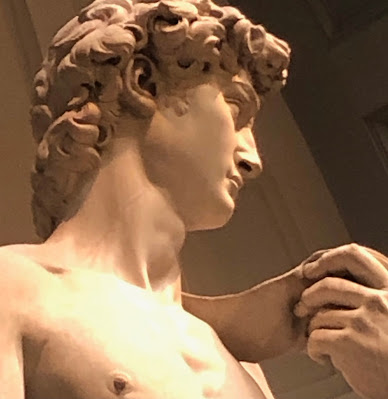

 At forty-five  degrees, you see - in the set of his jaw and in his eyes and his knitted brow - that he is gathering his courage.


Face on, you see his fear.


These are emotions powerfully portrayed in a face carved in stone!

Certainly, the art historians can see this too.  Yet, influential ones cling to the notion that they are looking at David after the battle.


Here is where I, the historical novelist, take more than the stone into account.  All we know of Michelangelo tells us that he was aspirational.  It's in his letters, his poetry, and his actions.  He was an artist constantly striving to outdo himself. He fought  against anyone who tried to limit him, even if that person was the Pope who wanted his own way when it came to the ceiling he was paying Michelangelo to paint.  What aspect of David would such an artist want to sculpt?  One satisfied with his achievement? Or one determined to win, no matter what?

I think I know.

Sunday, February 6, 2022

Slips of the Ear: Homonyms, Oronyms, Homographs, and Mondegreens

 Zoë Sharp


I like unintentional humour, and a good deal of amusement can be had from slips of the ear—words misheard, misinterpreted, or simply misunderstood. I’d no idea, though, until I started looking into the subject, how many different words there were to describe this phenomenon, so I thought I’d share some trivia with you.


Homonyms

First up is a Homonym, which is when two or more words have the same sound or spelling, but differ in meaning, from the Greek ‘same name’.


A nice example comes from ALICE’S ADVENTURES IN WONDERLAND:


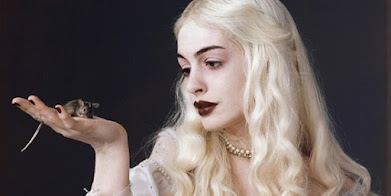
“Mine is a long and sad tale!” said the Mouse, turning to Alice, and sighing.


“It is a long tail, certainly,”’ said Alice, looking down with wonder at the Mouse’s tail; “but why do you call it sad?”


Homonyms are closely related to Homographs and Homophones.


A Homograph is one word that is spelled exactly the same as another, but which not only has a different meaning, but often a different derivation as well. A Homograph can also be a Hetronym, from the Greek ‘other named’. A good example is the word ‘sewer’, meaning both a place for sewage, and someone who sews. The derivation of the former is from the Latin, meaning related to water, but the derivation of the latter is from the Sanskrit meaning thread or string.


Occasionally, Homographs are spelled identically, but pronounced differently according to the meaning, hence:


“When I tear my fingernail, I shed a tear.”


Whereas Homophones are two words that are pronounced the same but have different meanings. Such as:


“I shed a tear as I watched him climb onto the top tier of the podium.”


Although, come to think of it, both Homographs and Homophones could fall into the overall category of Homonyms.


Confused? Stick around.


Oronyms


Then we get to Oronyms, which is apparently a word invented by Gyles Brandreth, and quite frankly I wouldn’t put it past him. An Oronym is a sequence of words that sound the same as another, with endless comic possibilities. The brain hears speech not as individual words but as an overall flow which it has to try to interpret, and what with accents and mispronunciation and slang, it’s hardly surprising that occasionally we get it wrong.


“The stuffy nose can lead to problems.”


“The stuff he knows can lead to problems.”


Actually, one of the best examples I can give of Oronyms at work is the Macho Grande courtroom scene in Airplane II: The Sequel movie:


Cause for confusion


Then there are simply many words that are easily confused, and among the most common are:


Accept – to receive or take in

Except – other than


Lead – metal

Led – past tense of to lead someone or something in a given direction


Rein – means of controlling a horse

Reign – the rule of a monarch


Principal – the head of a school, person being protected by a bodyguard

Principle – a rule or guideline


Throne – a ceremonial chair of a monarch, bishop, or similar

Thrown – propel with force through the air by movement of the hand and arm

Mondegreens

When it comes to song lyrics, the human ear has even more fun and misinterpreting words. The mishearing of words in a song is so common that American writer Sylvia Wright coined a term for it taken directly from her own experiences when as a child she misheard the words of the ballad ‘The Bonny Earl O’Moray’:


“Ye Highlands and ye Lowlands

Oh, where hae ye been?

They hae slain the Earl O’Moray

And Lady Mondegreen”


The last line should actually have been ‘And laid him on the green’ but for years Ms Wright believed that the unknown Lady Mondegreen had met a similar fate as the Earl O’Moray and came up with the name Mondegreen to describe it.


Since then, of course, the practice has been rife, with one of my childhood favourites being the Kenny Rogers song, ‘You picked a fine time to leave me, Lucille’. For years I heard this as:


“You picked a fine time to leave me, loose heel.

Four hundred children and a croc in the fields”


The Jimi Hendrix song, ‘Purple Haze’ contains the line:


“Excuse me while I kiss this guy”


So many people thought this was the genuine line, that he actually sang the alternative version in concert.


And, of course, who can forget The Eurythmics’:


“Sweet dreams are made of cheese”


I recall a friend telling me about the visually impaired ursine she heard about in church:


“Gladly, the cross-eyed bear”


And another mentioning that her mum used to swear there was a line in ‘Lucy In The Sky With Diamonds’ by The Beatles, that went:


“The girl with colitis goes by”


Or that other classic by The Beatles:


“She’s got a chicken to ride”


But I think my favourite in recent years has to be the modified lyrics to the Bond theme, ‘Skyfall’. Let’s have a rousing chorus of:


“Make a tri-fle, make a crum-ble

Build my cake tall

And we’ll eat it all together…”


All it needs is cake. Now, doesn’t that make you feel better? So, what are your favourite examples of any of the above? Let’s hear ’em!


No Word of the Week this week. I think you’ve had quite enough.


Saturday, February 5, 2022

Why I'm Missing In Action Today


Jeff--Saturday


No, it ain’t Covid—thank God.


It’s a total knee replacement – thanks to the guy who clipped me on my left leg in a high school football game.  Still, I made a good many decades on the original equipment, even after pre-arthroscopic surgery did its thing to turn injured cartilage between two bones into absent cartilage, allowing those two bones to freely and regularly wear upon one another—aggravating in every sense of the word.


Okay, enough already with TMI.  Let’s just hit the bottom line to this mea culpa. On Wednesday, I bit the bullet and went in for a replacement part that would allow me to return to some level of my former self. It seemed appropriate what with Wednesday this year coinciding with Ground Hog Day in the US—a day for which Bill Murray helped coin a new meaning with his still popular film of the same name.


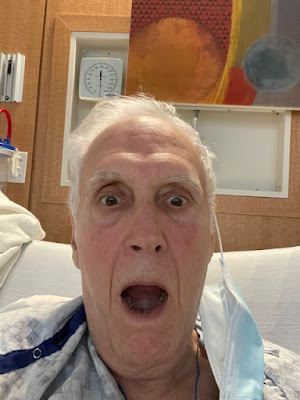
Everything went perfectly, as one would expect in the world’s finest orthopedic hospital with grade A+ personnel at every level.  HOWEVER, I’d forgotten that recuperating from surgery doesn’t always correspond with leaving your hospital bed all bright-eyed and bushy-tailed (notice groundhog reference).  So, a few hours ago when I left the hospital, I realized there’s no way I could create the witty charming post I’d imagined regaling my adventure. And, so, you’re stuck with this. 


So am I.  The left side of the following photo is where I want to be, the right is where I am.  But that too shall soon change. I feel it in my knee(s).


Better luck next week, for us all. :)


Stay safe.


--Jeff


Friday, February 4, 2022

In the beginning.....


In the beginning were the words.

 And the words were

White, nothing but white. No sense. No awareness, only white.

Those were the very first words I wrote in hospital in …. 2004 or 5 (?) when I had fractured my spine and my pal appeared with a clipboard, a pad and a papermate pen.  It needed to be a papermate as they write when upside down. I learned how to do that. I also learned how to drink tea when lying down and how to balance scrambled egg on a bit of toast while unable to move and stuck staring at the ceiling.

I suppose these talents might come in useful if I am ever in a hostage situation.

Those words, the white words, have never changed, through all the edits, all the redrafts. They were always there at the front of my debut novel.

And I have no idea where they came from.

 I had never written anything before except for academic study. Never had written anything creative except at age 7 I wrote about the teddy bears’ picnic in a story where all the bears turned on the kids. And killed them.

Now, all these years later, things have happened. I think I have written 14 books, 13 Anderson and Costello and a standalone.  I lose track of it all after a while.  It’s the marathon runner mentality. Concentrate on the bit in front of you as the big picture is too scary.

The last year has been a turbulent one in many ways, one of them being that all my editors left their companies in the same week.  I thought I was some kind of Typhoid Mary, but a patient explained to me that many people who were thinking about changing job held firm during the pandemic and once the shoots of recovery started to appear, everybody was on the move. All at once. About two years worth of job changes happened within a three month spell. So all my editors upped and left, including one that I had never met.

So the last ( the latest) contract was really negotiated , and it was negotiated in a buying a house kind of way. It was for two books in a new series. Their decision not mine, well it was their request which I agreed to.  They want me to do two series, one Anderson and Costello plus a new series and then bob about between the two. As you do.

And they wanted a brief outline. I had no idea what I was doing, then something came into my head, I put it on paper and they paid me a very nice advance thank you very kindly.

I delivered that book on Tuesday at 7am.

And I have now had time to reflect on that experience of leaving my characters behind, even if temporarily and saying hello to new ones. Sending it off to somebody I’ve ever met and not the person who green lighted the project. All a bit daunting I said to her in the email I sent her with the TS. 

 She agreed that I must find the situation discombobulating.  I think I like her already.

At the start of the process, I recall typing the word snapdragon, word count 1.

I had the 10 000 words I had sent to the publishers, the sample they had based their offer on.

I think I ended up writing a book totally different to that. Well it’s in English and somebody dies…

 But you can’t bend your creativity can you? Well that’s my argument.

 In my head and in the sample there was a female detective. She’s called away to work up north, city girl sent out to the sticks.  There are five dead bodies laid out in an old mansion of a house. Looking back, that was definitely inspired by the List Murders of 1971.

So that was in my head.

I had no idea if the thing’ would happen. I’d be interested if the thing happens to the other MIE writers.

The thing is ;- There’s a blank page. I had an idea about a character and I start writing, my blood red in my fountain pen. Then the character says, no that’s not what happened and they just take over and somehow guide me to the end of the book.


 I have no idea where Christine came from.  She told me that I had her surname wrong and would I please change it.  She told me her husband looked like Alain Delon ( lucky her) and he was born in a village near to where she was being posted. So that’s good if the publishers like her and want her to move up for a series. Christine turned out to be taller than I expected, she was a ballet dancer until she grew too tall, and she drinks green tea. She wears a hair in a low chignon and looks like a Glasgow version of Audrey Hepburn, aged mid forties.

 She introduced her family to me, a sensible daughter and a son who never gets out his bed. And her two female colleagues who she has remained close to. Those two, the female friends, both walked onto the book and said ‘Right, this is me.’ and introduced themselves and their backstory. They even told me that one of them had a brief fling with the husband of another one, until the two women met (the unsuspecting wife and the girlfriend who he had told he was single). That man, is forever to be known as The Bastard, with capital letters. Then he turned up in the book as well. As the boss of his ex wife and ex fling.

He gets a tough ride in the book.

Actually, I’m glad these characters can’t type otherwise there’d be no reason for me to be involved in the creative process at all.

And I have discovered the read aloud button on the computer.  I was listening to the book at that “final edit before it goes to the editor stage” and I noticed a character that had sneaked in without me knowing about him. I put it on Facebook as a type of lost property. ‘ I have a character in  my book who does not belong there. If you have lost a character by the name of Michael Lennon, then I shall keep him safe until you claim him.

Equally, if anybody from MIE wants to have him, he’s free to a good home.


Caro

Thursday, February 3, 2022

Animals as Characters

 Michael —Thursday

Stan’s blog last week about backstories made me think about the other features that flesh out our books and fiction in general. Character is obviously right up the list, but I was wondering about the minor characters and perhaps the very minor characters. Are animals characters or are they just part of the plot, or maybe even just part of the “sense of place”? It’s pretty clear that the answer is that they can be all three — just as is the case for human characters. There are the “extras” for crowd scenes and there are the bit parts. 


In some novels animals become major characters or even the protagonist (for example, Paul Gallico’s Jennie). However, generally, when animals become major characters they are either assigned human personalities (i.e. they are really humans in animal clothing) or their personalities are reflections of the human characters interacting with them.


You can look at this either way...

It’s intriguing to imagine a true animal protagonist, but the issue is that we really have no idea how animals think or even what their senses report to their brains. We know that dogs are much more sensitive to smell than we are and tend to find scents more interesting that sounds or sights. Do their brains process the age of the scent in some way, building a picture of the past and the present of a place at the same time? It seems unlikely. Probably they simply react more to a stronger, more recent, scent, but we don’t know.

The hyena in A Carrion Death is part of the plot, in fact part of the premise. A game ranger and a scientist find a man’s body being eaten by a hyena out in the desert. It rapidly becomes clear that the man was murdered and set out for the hyenas to dispose of because hyenas eat everything and there would be no traces left for the police to use to identify the body. Much of the story is motivated by why anyone would be so keen to prevent the body’s identification. However, the hyena is really only a prop, a means to an end.

Grey Go-Away-Bird

In the next Kubu book, The Second Death of Goodluck Tinubu (A Deadly Trade outside North America), an animal plays the role of a minor character. Moremi, the cook at a game lodge, has a pet, wild, bird – a grey go-away-bird. The species has a harsh alarm call, and with a bit of imagination the call can be interpreted as “go away", leading to its English name. But Moremi isn’t English so he calls the bird Kweh. Kweh has personality, but much of that is assigned by the cook himself. And, in turn, Moremi’s loner personality is revealed through the bird. Here's a short extract:

‘As always, on his shoulder Moremi sported a large, grey, crested bird with a long tail—a grey go-away-bird. Kweh was Moremi’s best friend. The cook constantly spoke to him, sharing observations and asking advice. “Do you think we should serve mango with the fish or just lemons?” Or “I think that everyone has had enough dessert. Or should I make some more pancakes?” For his part, Kweh appeared to listen intently, sometimes squawking an answer, sometimes nibbling Moremi’s ear.’

Kubu and Joy have a fox-terrier named Ilya as part of their family. Ilya plays roles between crowd-scene participant and bit part in the various books. Her main role is to reflect a Bengu family dynamic, a dynamic that changes when Kubu and Joy have a child.


White Rhino Kruger National Park

Of all our books, the stand-alone thriller Shoot the Bastards (Dead of Night outside North America) might be the one that seems most steeped in animals. Crys Nguyen is investigating the rhino poaching and horn smuggling scourge in South Africa. Much of the book takes place in the African wilderness (the “bush” as we call it). Obviously, rhinos are involved in the plot – they are the centre of the plot, elephants play crowd-scene roles, and the bush animals give a strong sense of place. But no animals are characters. As a new visitor to Africa, Crys doesn’t have the time or the mental space to interact with the animals at that level. She has a much more personal relationship with animals in Wolfman.

What role do animals play in the books you write? What role would you like them to play in the mysteries you read?

Tuesday, February 1, 2022

SUNSHINE NOIR

 Wed--Kwei

Up against a deadline this week, my brains are scrambled; so I’m resurrecting an old (and rather short) blog from my website in 2016 (five years already?).

_____________________________________________________________________________________

We all know about Nordic Noir, right? It’s a tradition of realistic crime fiction written in a cold, often gray, snowy setting. A group of writers including me has come up with Sunshine Noir, the principle being quality noir crime can take place in the hot countries as well. The brighter the sun, the darker the shadows. As Timothy Hallinan, acclaimed author of King Maybe, says, “Move over, mysteries set in Nordic places. The bright, warm, lush world is a greenhouse for evil.”


Michael Sears and Stanley Trollip (aka Michael Stanley) and Annamaria Alfieri are the editors (and contributors as well) of this collection of seventeen short stories, which range from the brutal, dry heat of the Sonoran Desert, to the Dominican Republic, to turmoil-torn Ethiopia.


Although we clear our throats and nudge our Nordic counterparts with good humor, there is a serious side of the issue of “cold and gray versus hot and bright,” and that is the perception in reading and publisher circles that Euro- and Nordocentric fiction is inherently superior. This cannot possibly be the case. There is much crime fiction for example out of Africa, but you almost wouldn’t know it. The website Murder Is Everywhere  is dedicated to the concept that crime fiction can spring from anywhere, and the wide variety of the authors named above with their rich and varied tales is testament.

So give Sunshine Noir a read and be pleasantly surprised. It’s available as an e-book and paperback. The short story format is perfect for air travel because one can finish a story during a short flight or several for longer hops. Be kind enough to leave a review of one, two or several stories–or even better, the whole book. Reviews and reactions are of great value.