
Michael —Thursday
Stan’s blog last week about backstories made me think about the other features that flesh out our books and fiction in general. Character is obviously right up the list, but I was wondering about the minor characters and perhaps the very minor characters. Are animals characters or are they just part of the plot, or maybe even just part of the “sense of place”? It’s pretty clear that the answer is that they can be all three — just as is the case for human characters. There are the “extras” for crowd scenes and there are the bit parts.
In some novels animals become major characters or even the protagonist (for example, Paul Gallico’s Jennie). However, generally, when animals become major characters they are either assigned human personalities (i.e. they are really humans in animal clothing) or their personalities are reflections of the human characters interacting with them.
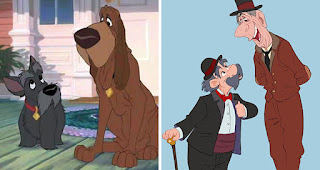 |
| You can look at this either way... |
It’s intriguing to imagine a true animal protagonist, but the issue is that we really have no idea how animals think or even what their senses report to their brains. We know that dogs are much more sensitive to smell than we are and tend to find scents more interesting that sounds or sights. Do their brains process the age of the scent in some way, building a picture of the past and the present of a place at the same time? It seems unlikely. Probably they simply react more to a stronger, more recent, scent, but we don’t know.

 |
| Grey Go-Away-Bird |
In the next Kubu book, The Second Death of Goodluck Tinubu (A Deadly Trade outside North America), an animal plays the role of a minor character. Moremi, the cook at a game lodge, has a pet, wild, bird – a grey go-away-bird. The species has a harsh alarm call, and with a bit of imagination the call can be interpreted as “go away", leading to its English name. But Moremi isn’t English so he calls the bird Kweh. Kweh has personality, but much of that is assigned by the cook himself. And, in turn, Moremi’s loner personality is revealed through the bird. Here's a short extract:

Kubu and Joy have a fox-terrier named Ilya as part of their
family. Ilya plays roles between crowd-scene participant and bit part in the
various books. Her main role is to reflect a Bengu family dynamic, a dynamic
that changes when Kubu and Joy have a child.
 |
| White Rhino Kruger National Park |
Of all our books, the stand-alone thriller Shoot the Bastards (Dead of Night outside North America) might be the one that seems most steeped in animals. Crys Nguyen is investigating the rhino poaching and horn smuggling scourge in South Africa. Much of the book takes place in the African wilderness (the “bush” as we call it). Obviously, rhinos are involved in the plot – they are the centre of the plot, elephants play crowd-scene roles, and the bush animals give a strong sense of place. But no animals are characters. As a new visitor to Africa, Crys doesn’t have the time or the mental space to interact with the animals at that level. She has a much more personal relationship with animals in Wolfman.
What role do animals play in the books you write? What role
would you like them to play in the mysteries you read?





