Friday, June 12, 2020

Peter, Sarah and Joy; Part Two

Here is part two of the interview with  Sarah Hilary, Peter Guttridge  and Joy Ellis- three very different people, three very different writers.

Here we are chatting about killing  off characters, the voices  in your head and what we look at when we look out the window when the voices in our heads are telling us what characters to kill.....  oh the power...


Have you ever killed off a character and wished that you could have kept them? Do some of your ensemble characters make a takeover bid in the novel, trying to get centre stage?


Peter

a) Killing off a character: only one.  I enjoyed writing my gangster in the Last King of Brighton – he’s an example of a main character I didn’t respect for some of the things he did – but, although I did toy with the idea of making him an irregular regular – spoiler alert – I knew he had to go. 

There are some characters I wish I could kill off.  And in fact in Brighton 9 – which I’m two thirds of the way through – I am having a small clear out.  Butcher’s Wood is a pre-virus story and I didn’t want to set Brighton 9 in these terrible times but I also didn’t want to ignore what has been going on so I’ve set it immediately post-virus (the first wave anyway). That has made the virus a believable deus ex machina for several people (not necessarily killing them off but certainly changing their circumstances).

b) Re: takeover bid.  I was lucky enough to spend a bit of time with the late great Reg Hill and I liked the way that he did move away from his main characters, Dalziel and Pascoe, to give others in his ensemble some time centre stage.  One novel is pretty much from Pascoe’s wife Ellie’s point of view.  (Although he partly did it because the TV version’s producers had ditched Ellie from the series and he was cheesed off about it.  ‘Let them try and film this,’ he said to me gleefully.)

          I was also lucky enough to have a drink or two with the late Ed McBain on his UK visits and I liked the fact that he too brought different members of his 87th precinct ensemble to the front book to book.  ‘It keeps me interested,’ he told me. ‘And that transfers to the reader, I think.’

          Bellamy Heap kind of pushed himself to the front.  As I said he arrived pretty much as a fully formed character in Brighton 4 just as a bobby on the beat but he wouldn’t stay out of that story and then he and Sarah Gilchrist have both elbowed Bob Watts out of the way as the series goes on. 

          There’s a young DC called Sylvia Wade who has been pushing herself forward in the last couple of books and in Brighton 9 is now Gilchrist’s sidekick whilst Bellamy is out of action for a couple of weeks.  (He’s not ill, just self-isolating because on the last day of the lockdown someone spat in his face – that’s only a tiny spoiler!  He’s still working though, following up on a cold case online and in the files.)

c) I think a good team is simply all kinds of different people but there needs to be newcomers every so often.  I think there could be tensions between some of them (on the grounds that ‘drama is conflict’) but I’ve gone the camaraderie and watching out for each other route.  And in Lady of the Lake and Butcher’s Wood that ensemble includes the actress Nimue Grace because I really enjoyed creating her and didn’t want to lose her quite yet.  (I think I’ll have her waiting in the wings ready to take centre stage at some point again.)


Joy

I’ve never killed off anyone that I wanted to keep for a later story-line. Stephen King said something along the lines of... never be frightened to injure, maim or kill off your characters! I reckon if you are tough enough to withstand the barrage of Facebook messages expressing horror, (and sometimes sympathy and condolences!) at what you’ve done to your character, then go for it! To be honest that’s only happened to me once, and the ‘victim’ was a dog. Maybe that is my one regret, even though the alternative would have been worse. Say no more!        I actually allow, and actively encourage, my ensemble characters to have their fifteen minutes of fame. As the series progresses I think it’s good to let them shine for a while, as it allows the reader to become much more au fait with their personal histories and what makes them tick from their point of view.    The team evolves as you write, and I think it’s very important to let them gel, love, laugh and fall out, just as all humans working together do. Make them real, make them believable, make your reader care about them, and you’ll have a good team.


Sarah 

I always agonise over killing off any character, possibly because I was
scarred at a young age by the utter carnage at the end of my favourite TV series, Blake’s 7. I always think of the repercussions for the other characters, and what a death will do to their journey.

Keen students of my series will have spotted that Marnie and Noah’s arcs are almost identically reversed over the course of the six books. Marnie begins from a place of darkness (the off-page murders of her parents by her stepbrother) and must find her way to the light. Noah begins from a place of comparative light and finds the darkness crowding in, threatening to destroy him.

For me, the interest always lies in how much of ourselves and our humanity we can retain in the face of conflict and loss. Marnie and Noah complement one another in that regard. They have each other’s backs at key points in the series, while sometimes hitting rocks in the road, and it makes for a good team. 


Do you plan the arc of the relationship and the careers of Gilchrist and Heap, Rome and Jake, Jackman and Evans at the start of the series or do you feel you have use their experiences at the end of the previous book as the starting point for the next in the series. (No spoilers in those questions!)

Peter

No planning at all, even within whichever novel I’m writing.  The relationship evolves with the narrative – and I’m never sure what that arc is going to be until I’m halfway through!  I had no idea until I started Brighton 9 that I was going to split up Gilchrist and Heap in this one.  It wasn’t entirely impulsive though, partly it was plot-led because I’ve wanted to tell this cold-case story for a while but couldn’t quite figure out how to do it. 

(The reason I’m quite a way into Brighton 9 is because the cold-case was one of the plots in Butcher’s Wood but I decided it didn’t really fit there and there was quite enough already going on in that one.)

          Anyway, I’m assuming Gilchrist and Heap will be back together in Brighton 10, though who knows whether Sylvia Wade will allow that?  


Joy

I work organically. I never know what’s going to happen from one moment to the next, so no clever plotting in advance from me. I think the end of the last book will always affect the beginning of the next, as it’s usually traumatic in some way and I like continuity. People don’t shake off a major emotional experience in a matter of days or weeks, so neither do my characters.


Sarah

I didn’t plan any of it, really. I’ve never figured out how to plot in advance, so I let the characters lead the action. I did know that I wanted them to change over the course of the series. But the direction that change took – especially in terms of Marnie’s relationship with her stepbrother, Stephen – was a genuine surprise to me. It’s made me realise that giving your characters what they (think they) want is far less important than giving them what they need.


Some of you have changed series, one is starting a new series and one is continuing a successful series. Is there a time to break away? Why change? Do you ever feel you are stuck in that groove or do you feel a new book is like meeting up with new friends? Have you had an idea that you couldn’t fit into your series? And what did you do with it?

Peter

I think when the characters get stale for you it’s time to stop.  (I used to be a huge fan of James Lee Burke’s Dave Robicheaux series but I got bored with Robicheaux never changing, always having the same problems with violence and hotheadedness.)

To be honest I stopped writing my comic crime series at six because I stopped writing altogether for a while because of Life.  When I started writing again I didn’t feel like writing humour so I moved to the (very) Dark Side, which suited my mood at the time.

As my mood improved I wanted to go back to the comic-crime series and my characters, Bridget Frost and Nick Madrid.  I dipped my toe in the water with a short story for CrimeFest’s Ten Year Stretch anthology a couple of years back featuring them. However, around that time I realised that in a way Gilchrist and Heap, with their continuing affectionate badinage, had kind of replaced them.  (One American critic said the dialogue in Lady of The Lake was like Noel Coward – high praise indeed.)  And when I suddenly found myself making an ostrich a murder suspect in Lady of The Lake I realised that the darkness of this series was brightening by the novel.

Having said that, I think 10 novels in the Brighton trilogy may be enough – but who knows since, yes, I do still love meeting up with these old friends and making new ones when I start the next novel?  I do have other ideas that won’t fit into this series, or necessarily the crime format (see question 14 for more on non-crime). I have published a standalone thriller – Paradise Island – and I’m shortly to publish a comic-crime novella (not featuring Nick and Bridget) called A Hole In The Head. I also have an outline for another series featuring a customs man on the south coast embedded among smugglers.


Joy

 Now this is complicated question. I have three series running. I am at present working on book #12, in my DI Nikki Galena, The Fen Series novels. I keep in constant contact with my lovely publisher regarding their longevity, and oddly, we both agree she has built up such a following, I can’t write fast enough. It’s an odd thing but right now, I really believe that she has a lot more mileage in her than I ever dreamed she would. It is a little like writing a long running police procedural soap, but I’m very comfortable with her and her team and sometimes feel almost relief when I know that it’s another Nikki book up next. I feel that I will know exactly when it’s time to call it a day, and I do hope that is the case. I would hate to take her one book too far. Jackman and Evans have been extraordinarily popular with Audible and I’ve written the last two as Exclusives for them. This means they cannot be published as books until Audible have had them for four months exclusively. I have just completed book # 7 and know that Jackman is far from over. The Matt Ballard series (have just completed book #3) are my ‘step outside the box’ books, and they give me scope for those books that you mentioned, the ‘don’t fit into my other series’ books. I firmly believe that you should waste nothing, so my avant garde ideas go into Matt Ballard.


Sarah

I’m ‘resting’ my Marnie Rome series, after six books. My next book, Fragile, is a standalone, without a single police officer or detective in sight. The story couldn’t be told within the series, and nor is it a story that can grow into a series. It’s complete, in one book. I do have an idea for a new series, some way down the line, but it’s on the back burner for now. I want to try and master the standalone first.


 I think most audiences are a bit too sophisticated to accept a ‘will they/won’t they’ tension between the two main characters, but how would you describe the dynamic between your two main characters? And how has that developed over a series of novels?

Peter

I think I’ve said in earlier answers they are mutually supportive and respect each other – Gilchrist immediately decks the man who spits in Bellamy’s face in Brighton 9.  No sexual tension – that will they/won’t they occasionally surfaces with Gilchrist and Bob Watts.  I guess the evolution is mostly Gilchrist recognising she increasingly relies on Gilchrist’s acumen to see the way forward.  For a couple of books Heap has been living as a couple with Gilchrist’s best friend, Kate Simpson, so that has affected the relationship of all three of them in complicated ways. 


Joy

There has never been a real love interest between Jackman and Marie, but they freely admit they love each other as dearest friends and respected colleagues. They would quite simply walk over hot coals for each other. Marie has always wanted Jackman to find a woman who would appreciate and tolerate both him and his fierce loyalty to crime fighting. She even stoops to match-making on one occasion! Jackman has a very strong protective feeling towards Marie, and when he finally meets a partner, his dearest wish is that Marie does too. As a matter of interest, sophisticated or not, in the Fen series, Nikki and her DS Joseph Easter’s relationship was been a constant cause of tension that is hugely approved of by their ‘fans’! I never in a month of Sundays planned it like that, but ‘public demand’ sent them into a situation where they did become ‘close’. I now find it a way of ramping up tension even more, as working together and keeping their relationship away from their senior officers and the mess-room gossips is very difficult, so I am using it to advantage.


Sarah

I circumvented the whole ‘will they, won’t they’ by Noah being gay, although Marnie does have a few competing passions over the course of the series. One of these is with a colleague, Harry Kennedy, the man Noah blames for his brother’s death. The dynamic between Marnie and Noah becomes correspondingly tense in Never Be Broken as Noah struggles with feelings of grief, guilt and vengeance.

At the start of the series, Noah (a Detective Sergeant) is in awe of Marnie (a Detective Inspector) but as the series unfolds, they become much closer. One of the ways they work a crime scene is by Noah taking the role of the killer as Marnie interrogates his motives. I enjoyed writing those scenes between them.


 While The Lady Of The Lake is reminiscent of the golden age, Never Be Broken and Their Lost Daughters, approach similar subject matter in very different way - both books are grounded in a huge sense of loss.  Is there anything that is too emotionally difficult to write about or is it more about the approach and handling of the subject matter? (A vague question I know but no plot spoilers)

Peter

I think it’s all about approach and handling of the subject matter.  Actually, I was always aware that my comic novels skated over true emotion because I didn’t quite know how to write about them.  One of the reasons I wanted write more serious crime fiction was to explore deep emotions and the dark parts of the psyche.

Because of where I was in my life I was ready to write about guilt, remorse, retribution, sadness and loss - all powerful tropes in crime fiction.  And I wanted to explore – well, get my main character to explore – the question: ‘Am I good man capable of doing bad things or a bad man capable of doing good things?’


Joy

I think your handling of the subject matter is everything, but even so, certain things are not palatable to some readers and you have to be prepared to understand that. We do tap into some very delicate, upsetting  and difficult crimes, and some of our readers have been unlucky enough to have either have actually experienced similar things, or possible worked with such victims. Handle with care.       Personally, I cannot and will not write about terrorist bombings. My partner was involved in such an incident and has suffered ever since... over forty years of hell.


Sarah

As a reader, I seek out emotionally truthful stories that resonate. It’s the same when I’m writing. If it hurts, if it makes me cry, I know I’m doing my best work. Given the times we’re living through, I don’t see how I can write truthfully without addressing the chaos, trauma and tragedy that’s all around us. Damn, that’s a depressing answer. My books aren’t all doom and gloom – I take care to have warmth and humour and hope in the mix, too.


 How have you found the writing process during lockdown?


Peter

At first, amazingly productive. Completed an enormous amount of work. Now, I’m struggling. I have had two edits back, a Jackman and a Ballard, whilst writing a Fen series, and suddenly I found juggling three sets of characters and diving from one series to another, rather mind-boggling! I’m now in a, hopefully short-lived, state of lethargy! Gardening has a stronger pull than writing and I’m having some very interesting conversations about future plotlines with my tomato plants. I blame the lockdown, of course.


Joy

Although lockdown has made little difference to my daily life I was quite sluggish for a few weeks.  I was expecting to finish Butcher’s Wood at the end of February but it took me six weeks more.  Having said that, I haven’t found lockdown mentally fraught, as I know some have.  I think like most writers I can be very convivial but I’m also perfectly happy with my own company.


Sarah


If you’d asked me that a month ago, I’d have cried actual tears. I wasn’t able to write, for a long time. But about a month ago, I hit my stride with a new story, and now I’m storming through at a rate of 2,000 words a day and you know what? It feels fantastic to be in control of something, to be able to bring about happy endings or chase my characters up trees before giving them the tools they need to get themselves back down again.


 If you had to write another genre what would it be?

Peter

Historical novels.  I’m about 50,000 words into a novel about 16th century piracy and about the same number into an early 19th century story set in Gloucestershire and Australia.


Joy

Paranormal, without a doubt. Had already written three many years ago, but they will no doubt see out their years in a dusty box file in the attic.


Sarah  

I’m writing a Japanese ghost story, on the side. I’d love to do more of that kind of thing.


                                        A picture from Joy

 If you look out the window of your writing space, what do you see – that’s my Grayson Perry lockdown question.

Peter

Sarah Gilchrist and Bellamy Heap chatting away as they drive by, Sylvia Wade at her desk tapping away at her computer, Bob Watts standing on the balcony of his Brighton penthouse looking across to France and Jimmy Tingley (who I’ve scarcely mentioned here because he comes and goes) sitting in the Cricketers drinking a rum and pep, his cigarette packet and mobile phone lined up neatly in front of him.

Joy

I live on the outskirts of a fen village and from my upstairs office window look out across an arable field to a distant tree line. In summer, when the trees are in leaf, the view is obscured by a row of lovely old sycamore trees and hawthorns with an edging of reeds that run along the ditch that flanks the road. I love it!


Sarah

Sunshine, seagull shit, shadows.


The view from my writing room. 


What’s next for you?

Peter

My intention is to finish Brighton 9 (I haven’t got a title yet – that’s why I keep calling it that) by mid-July then spend the rest of the year on the two historical novels in parallel.  By which time I’ll be ready for Brighton 10.

Joy

Fen Series. Matt Ballard. Jackman and Marie. Then more of the same, as long as the brain and the body holds out!

Sarah

Fragile, my first standalone, comes out in April 2021 from Pan Macmillan. It’s a psychological thriller, in the vein of Patricia Highsmith, with shades of Rebecca meets The Handmaid’s Tale. I’m very excited to see what readers think about it.


And when your characters talk to you, do they talk in your voice (as if you were reading the book out loud) or do they talk in different voices ( as if there was a cast of actors reading their direct speech)?

Peter

Hmmm.  Very interesting question that I’ve never really thought about.  They don’t actually talk to me, they talk to each other and, I guess they are therefore a bunch of actors since they have their own voices. 

A new character doesn’t have any voice at all at first – he or she speaks but not in a distinct voice - that develops as the character develops.  Sometimes I do slip with Gilchrist in first draft – I put words in her mouth (usually long ones) and expressions that she just wouldn’t use.  I kind of know it at the time but I want to get on with the story.  Touch wood I always pick up on them.


Joy

That’s hard to answer. I rather ‘see’ them, as if watching a tv drama, so I suppose I do hear their own voices. I know that I work in a very specific way, I would find using voice activation very hard I’m sure, as I seem to just channel through the keyboard exactly what I’m watching in my head. Curious, but it’s not like reading a book at all, more like describing a visual happening.


Sarah

Interesting question! I’d never really thought about it, but in their own voices, definitely. Each one distinctly different.

Caro Ramsay

Wednesday, June 10, 2020

How America's Protests are Changing

Sujata Massey


This was supposed to be America’s summer of isolation. Actions by the Minneapolis police, who asphyxiated George Floyd on suspicion of having used a counterfeit $20 in a store, changed that. People were suddenly gathering more than 9 to a group. As protests spread from Minneapolis to hundreds of towns across the country, a collective voice arose naming other Black people killed by police in situations that appear to be homicide. Most commonly, citizens began demanding fair investigations into the deaths of Breonna Taylor in Kentucky in March, and Rayshard Brooks in Atlanta a few days ago.


I used to live in Minneapolis, and most of my family members are still there, two of them living in ground zero, where they smelled fires every night, even through closed windows. They’ve lost their bank and post office and many more community businesses to destruction and arson, some of which has been linked to enemies of the Black Lives Matter movement. And Minneapolis citizens are suffering all kinds of abuse from the local police and Minnesota Safety Patrol. Law enforcement slashed tires cars parked in a K-Mart lot near a peaceful protest, and also some cars parked near Little Earth, an urban Indian reservation.


I feel the nearness of the protests in Washington, another hot spot that's about 35 miles away. Here the police and national guard and other forces have used chemical weapons and rubber-coated bullets to disperse the crowds. Police and the National Guard and Trump's  President Trump approved the teargassing of peaceful protestors gathered near the White House, in order for him to pose with a Bible outside a nearby church. Protestors are being hit with tear gas, pepper spray, and rubber 


In Baltimore, we’ve had damaging protests in past years; but so far, the city’s political reaction has been mostly peaceful. It is much more muted than the reaction in 2016 when Freddie Gray was killed by our own city's police officers; how they did it was unclear, because they'd driven off in the van with him still alive.

My neighborhood in North Baltimore, Roland Park, is majority—but not entirely—white. The street I live on is probably the city’s most diverse in terms of race, age, and income. Six excellent public and private schools in the area mean a lot of families are here, and when an activist in the education community announced there would be a student-led demonstration in Roland Park, the plan drew conflicting reactions in the online neighbors’ forum known as Next Door. What does it mean to be a white person, protesting violence against blacks in a neighborhood that up through the 1960s enforced covenants prohibiting anyone but WASPS the right of residence? And after having witnessed the wide damage done during Freddie Gray's death, was it an act of social responsibility to be in a protest? And how about gathering in public with continuing COVID-19 risks?


Many in the neighborhood were eager to join in the action, pledging to make signs and wear masks. But more doubts arose. Some wrote that Roland Park didn’t have a right to protest because it was a white neighborhood. Another person I spoke to said that he mourned George Floyd’s death, but he feared an organized protest would bring looting and violence to the neighborhood. Anything could happen; we’d seen that on CNN.

I walked to the protest by myself, on a warm Tuesday afternoon, dressed in black, as many of the protesters had also chosen. We were supposed to make signs and I didn’t have a sign board, so I went without anything to hold overhead. However, I saw many people made signs out of flattened delivery boxes, which are so plentiful because of the corona virus quarantine.


The signs said things like:

I understand I can’t understand, but I’m with you

White Silence=Violence

Class of 2020, Please Vote!

and of course:

Black Lives Matter


As I walked toward the heart of our neighborhood—the intersection of Roland Avenue with Northern Parkway, where the posh boys’ school, Gilman, faces St. Mary’s Seminary—I became part of a fast-flowing stream of people who seemed eager to see old classmates and neighbors after months apart. Masks stayed on, but distances moved a great deal closer than the suggested six feet. But that was the only rule I saw being broken, unless you count the people moving together to block off car access to Roland right at 5:15, when we dropped to one knee and remained silent for nine and a half minutes, the time that it took to kill George Floyd.


The exciting thing about a protest at evening rush hour, when a thousand people have changed the face of a normally quiet intersection. Cars honked, and we waved at them as they raised fists out of windows. A man called from his truck, "Viva la revolution!" Surely the young children in strollers could not understand what it was all about—nor should their parents have told them too much. Our reality is far too frightening for a child to absorb. Three police cars were present, but I didn’t see the officers ever get out. There was a sense of jubilation running through much of the crowd; a sense of relief at seeing so many others who wanted social change.

Then, I brought my gaze in closer. I watched a young African American woman who couldn’t have been more than twenty passionately cry out, “No Justice” through her mask. She was leading a call-and-response that took off successfully for a few minutes. As she finished, I realized that she was weeping. An older woman recognized her and embraced her.

So much for social distancing. Love was needed more than anything.


Tuesday, June 9, 2020

Guest Blogger: Laurie R. King. Murder May Be Everywhere--But What Kind?


Cara – Tuesday

I’m thrilled to host guest blogger and good friend Laurie R. King today. It’s really a delight to hear about the origins and inspiration for Riviera Gold, which publishes on June 9th, where it’s summertime on the Riviera, and the Jazz Age has come to France’s once-sleepy coastline. So have the intrepid Mary Russell and Sherlock Holmes, in search of their long-time housekeeper Mrs Hudson. Welcome, Laurie. 


As the title says, murder is indeed everywhere.

Casino Monte Carlo

When I travel my characters around the world—Palestine, India, Japan, San Francisco, France, Venice, and now the South of France—I never have any problem having them trip over a dead body or two.  (Although I’ll admit that in a couple of books, I finished the first draft only to realize, Oops, I forgot the corpse. I’m not sure the last one had an actual murder, in the end…)
But the kind of murder—now that is key. Whether the victim is a character we know and care about, or a peripheral figure only there to provide the end of a thread leading to a tangle of deceit and crime, the death has to be plausible to the time and place, and it has to tell us something about the killer. And often the victim starts out as an apparent accident or suicide, only to have the plot uncover the stark fact of murder as the tangle is unspooled.
In any case, whether or not—as the song says—the punishment fits the crime, the corpse certainly has to. A man who dies on lonely Dartmoor could only have been killed by someone whose crime fits into a countryside little but sheep, munitions training grounds, and  tin-mines.  A woman whose death appears to be at the hand of her husband but in fact was killed by another must herself have connections, however hidden, with both men.  A family who dies in an apparent motorcar accident has to do so in a place where such an accident might easily happen.
The same applies to the supporting actors and what they say about the time, place, and persons involved. When my research into 1919 Palestine included a government financial report with a brief mention of problems with salt smuggling, I knew I had to have a salt smuggler—and a colorful one, to balance the prosaic nature of his illicit substance. In another story, when my character goes down in a sputtering plane, in a remote area, it needs to seem plausible that the man she meets there all but embodies the spirit of the woods that surround her.
When I decided to write about the 1925 Riviera, I had a rich choice of crimes, villains, and supporting characters. Some were true to fact: a Russian arms dealer named Zaharoff, who literally made a killing off the Great War, was retired in Monaco.
Modern Monaco

The American expats who colonized Paris during Prohibition were discovering the Riviera during this time, which gave me the Murphys, Scott and Zelda Fitzgerald, and their friends like Picasso: these got me started with my characters. And of course, the CĆ“te d’Azur has always been a part of the Mediterranean smuggling world, connecting Greece, and Africa and beyond with southern Europe. That, combined with the caves that permeate Monte Carlo, set me off with a story line.
Invariably, I need to go to a place to feel comfortable writing about it.  Equally inevitably, my early research fails to give me the exact places I will need when I actually start to write, leaving me scrambling for help from libraries and experts.
Casino Monte Carlo

But when it came to Monte Carlo, I knew from the start that I wanted the Casino, so I planned a morning of wandering.  And I knew I was going to use the Russians who had made Monaco their winter playground before the 1917 revolution, which gave me their favorite hotel, the Hermitage.
The Hermitage, Monte Carlo

Ideally, of course, I would have spent a couple of weeks in the principality, walking its length, poking my nose into its caves, seeing how many forbidden places I could talk my way into, charming door-keepers and managers with the idea of a novelist’s interest.
But Monaco ain’t cheap. Most of its visitors these days are day-trippers staying in Nice or beyond, and looking at my bill for two nights at the Hermitage, I could understand why. Few of the hotel’s other guests appeared to be at the tail end of a two-month trip across Europe, living out of a single suitcase, dressed in LL Bean khakis and sturdy Merrill hiking shoes.  The closest I have to a diamond ring in my jewelry box is the cloudy white sapphire my husband bought me in India, forty years ago.
Eiffel's Skylight at the Hermitage
t

In the Hermitage, the cleaning women were more fashionable than yours truly.
Still, my credit card was good, and the people were friendly, and I wasn’t trying to get into the high-stakes tables upstairs. I figured my imagination would fill in the blanks—and in any case, we writers lie for a living.
So I wandered, and poked, and took lots of photographic notes, and bemused the other residents of the posh hotel, and in the end, I came away with a nice sense of where my characters were going to play.
Gaming Tables at Casino, Monte Carlo

Which yes, included the Casino:
“Russell, stop gawping like a child at a shop window,” Holmes murmured. 
I suppose my pleasure was a bit blatant, so I lowered my gaze and tucked away my expression, replacing it with a sort of languid and approving curiosity.
 I had little taste for gambling—money, that is, though one might say that my entire life has been a wager against chance—and few substantial skills when it came to cards.  Of course, a woman may always act as a decorative accessory on a male arm, but unless I wished to hover in the distance while Holmes had all the fun, I needed to stick to games that demanded no more skill than laying gaming tokens onto the table.
So the roulette wheels it was.  As with everything else under the casino roof, the machines were perfect: gleaming mahogany, a polished bronze spindle at its centre, and an ivory ball that hopped crisply along the numbers until it chose one to nestle into.  Simple, hypnotic, and—when combined with the casino’s discreet and free-flowing alcohol—potentially devastating to one’s bank account.
Several of our table-mates had note-books in which they built or adapted their systems, jealously guarding their pages from nearby eyes.  I, on the other hand, spent my first hour losing enough to see an undergraduate comfortably through Oxford, dismissing every loss and laughing happily at every win.  Holmes came out slightly ahead of me, but at my next wager, with my last worn jeton before me on the table, I won.  Then won again, and again after that.  Seeing my pile grow before me, I experienced the first pang of the gambler’s hunger.  I did my best to lose it all, but by the end of the evening—we had planned on dinner at 9:00—I had twice the counters I started with. 
Weirdly fascinating.  Utterly compulsive.


Monday, June 8, 2020

Progress Report: NYC

Annamaria on Day 100


Today, Monday 8 June 2020, is the 100th day of the Covid pandemic in New York.  And it is the day when NYC will begin Phase One of Reopening.  We are about to stand up and try to walk after being knocked for a loop.


Back before the crisis hit us, epidemiologists were issuing warnings about this new bug that might come to the US from China.  Incoming flights from China were soon banned.  In mid-February when I flew home from Florence through Frankfurt, Lufthansa wanted to know if I had a fever (No) and if I had been in China in the past two months (No, not in the past 34 years, actually).  Little did anyone know that the virus had gotten on planes in China and gone to Europe.

In the first two months of this year, I was one of three million travelers coming from Europe and landing at JFK and Newark airports,.  We were carrying all sorts of stuff: dirty laundry, new Italian shoes,  corporate paperwork, gifts for friends, swanky clothing to wear to a family wedding, souvenirs of the Eiffel Tower...  

And at least some of us were bringing in the novel Corona virus.

Three weeks later, Italy went on lockdown, and a week after that I began self-isolating in what was rapidly becoming the world's most dangerous Covid-19 hotspot.

Today, having been through three kinds of hell, New York City is ready to open up.  A bit!  Our governor--the now famous Andrew Cuomo--credits the people of New York for bringing ourselves to this moment.  What we did was follow his fact-based advice, garnered from experts world-wide.


Here is where we are as of this past Saturday, in seven-day rolling averages:
  • Daily number of New Yorkers testing positive has gone from a peak of 57% down to 2%
  • At the peak, the daily number of new cases was 12,000 out of 100,000 of population.  On Saturday, it was 6.4 out of 100,000 of population
  • New hospitalizations are down to 1.27/100K
  • In New York State, the daily number of deaths has gone from a peak of 952, down to 32 this past Friday
Our Guv's by-words that have kept us going.

Now, carefully, cautiously, with eyes and ears tuned on the Guv's daily reports, we are beginning to move around.  We must, and will abide by the cautions of social distancing and wearing masks.  We have thresholds we have to maintain.  If our stats start to climb, we all will have to put ourselves back into isolation.


I have been out more in the past week than all my cumulative outdoor time since last March 16.  On Monday the 1st, I kept an important appointment with the eye doctor, an outing within the guidelines then in force.  Eschewing my usual mode of transportation, the NYC subways, I walked the 6.6 miles round trip, which I loved doing on a gorgeous late spring morning, as attested by photos of icons viewed along my route, above.  By the way, whatever anyone else may say about me, one of the world's top retinologists pronounced me "perfect."


Paint splattered on the entrance to the cafe at the end of my block


Broken windows at a men's shop on Park Avenue
Sad to say, a couple of the things I saw on that walk were not so pleasant. Bad, but these were the only two.  You see, George Floyd had been murdered, and then criminals had hidden themselves among legitimate protestors in Union Square.  Having listened to sirens and firetrucks wailing for serval nights in a row, I expected things to look a lot worse than they were.

Those protests continue.  But they are now mostly calm.  Thanks, I believe, largely because the police are leaving the protestors to their chanting and focussing on people committing crimes.


Baracades at the ready
   
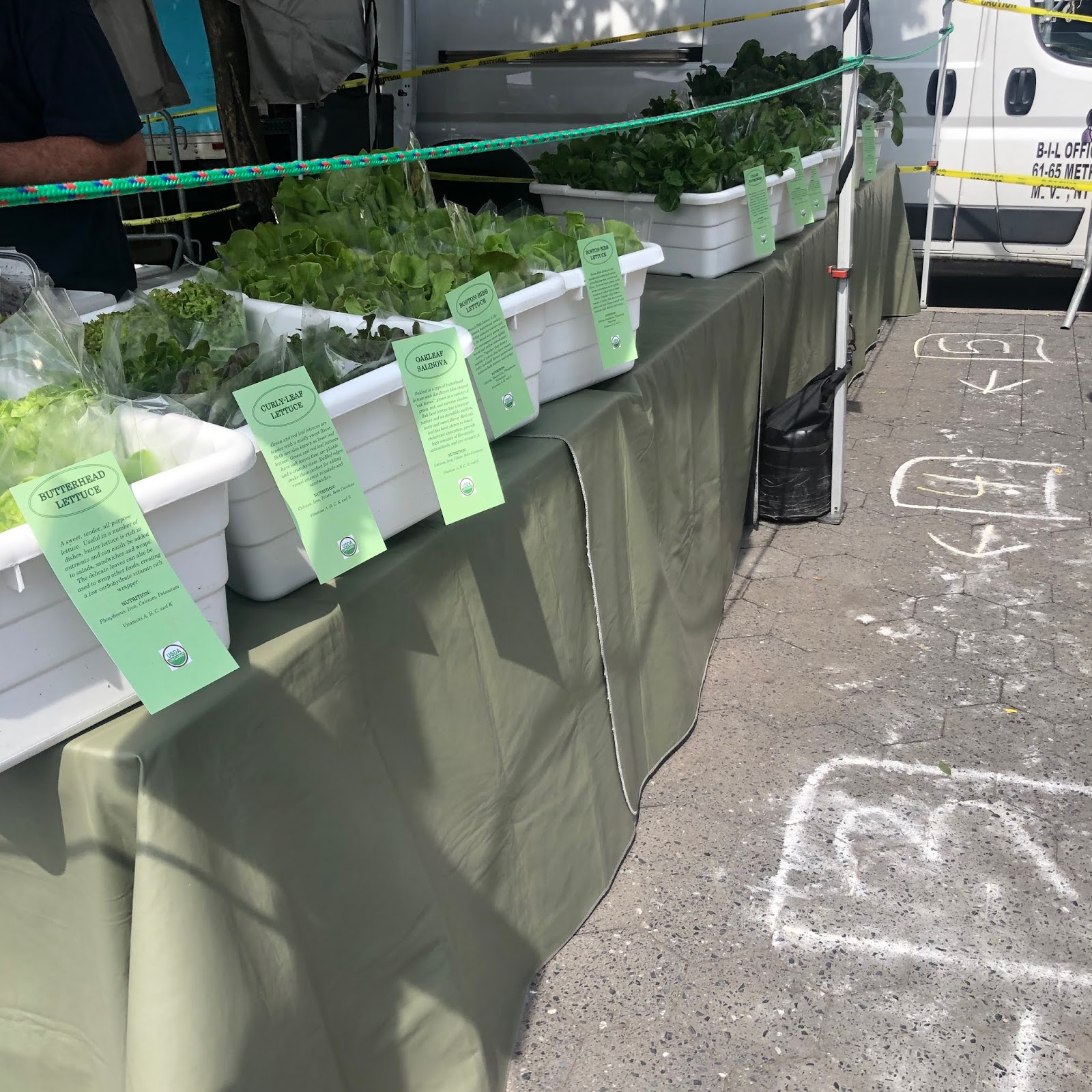
This past Saturday, I visited my beloved Union Square Market.  It has developed its own rules to keep us all safe.


WSQ monument to Mohandas Gandhi,
the patron saint of peaceful protest.

Stalls spaced further apart than before

Spacings marked for queueing six feet apart
My city is beginning to come back to a semblance of itself, and I hope heading toward a new normal that will include new rules, addressing the societal flaws so dramatically revealed by the pandemic.  Particularly, the worst of the them brought into sharp relief by the murder of George Floyd.

We in NYC worry that those mass demonstrations may result in a spike of new Covid cases, but almost all of us share the protestors' outrage.  The news of sympathetic citizens worldwide voicing support helps enormously.  And in many countries people are demanding justice also for their own underserved countrymen and women.

One of the facts that haunts me about all this is the name of policeman who in nine minutes, in broad daylight, committed the crime that opened a Pandora's Box of outrage.

Coincidence has had a profound affect on my own life.  In my case to my joy.  But I have always had almost a reverence for it.


Scaramucci

Scaramuccia


At the beginning of his administration, Trump had appointed one Anthony Scaramucci, a Wall Street financier, as his Director of Communication.  His name is Italian for Scaramouche, a villainous figure in Italian Commedia Dell'Arte.  It seemed 100% prophetic, then, when their relationship fell apart in a farcical way.


That the tragedy of George Floyd's murder and its aftermath were unleashed by a man named Chauvin looks, on the other hand, like the depths of tragedy.


No self-respecting novelist would have allowed herself to give such a name to the character who would--with that label--so predictably commit the signature act of racial injustice.

Truth once again stranger, and in this instance more unbearably tragic, than fiction.

Sunday, June 7, 2020

A Pilgrimage to Itsukushima

-- Susan, every other Sunday


It is difficult to write anything with the world in flames. Every time I turn on my computer, I see fear, anger, prejudice and hate: toxins that poison the human soul.

With Japan re-opening into a "new normal" - with masks and distancing still in place - we venture forth into a world far different than the one we left a scant four months ago. In the United States, where most of my family (and many of you reading this) still reside, the unrest continues.


Instead of talking about those issues (which would require far more space and time than I have here to address properly, not to mention that this platform is not mine alone), today I'm going to fan a different kind of flame.


The island of Itsukushima, also known as Miyajima, sits an hour by train and another ten minutes by ferry south of Hiroshima. For centuries, the island has been considered sacred to the Shinto faith, as the home to the three divine daughters of Susanoō, the god of storms and the younger brother of Amaterasu Ō-mikami, the chief deity in the Shintō pantheon (and the goddess of the sun). Susanoō's daughters, Ichikishimahime, Tagorihime, and Tagitsuhime, are storm gods in their own right--and as if that wasn't enough divinity for one island, the land and mountains of Miyajima are considered sacred, and divine in their own right.

Sacred Mt. Misen rising behind Itsukushima Shrine


The first shrine on Itsukushima (unsurprisingly, called Itsukushima Shrine) was constructed during the 6th century. At that time, most people were not allowed to set foot on the island, so the shrine was constructed partially over the water, below the high tide line.

Today, the visitors come in tour boats, rather than rowboats. Many come to look, but many still come to pray.


Worshippers would approach in boats, at high tide, to pay their respects to the island and its deities.

The Otorii at low tide.


During the 9th century, a priest named Kōbō Daishi (then called Kūkai) came to the island to meditate. While there, he founded Daishō-in, one of the most important Shingon temples in Japan. (Before his entry into eternal meditation, Kūkai went on to found Kōyasan, which remains the center of Shingon worship in Japan to this day.)

One of many sacred guardian statues on Miyajima


In addition to founding the temple, Kōbō Daishi meditated atop Mt. Misen, the island's highest peak, and lit an eternal flame in a temple high on the mountainside. It burns there to this day.


In 1168, the Shintō shrine on the waterfront was rebuilt and expanded under the patronage of Taira no Kiyomori, a leading member of the Taira clan; around this time, the shrine acquired the first of its iconic Ōtorii (Great Torii).


The Ōtorii of Miyajima


The shrine, like the temple, remains fully functional to this day. People are no longer forbidden to set foot on the island (in fact, between the picturesque shrine, the iconic "floating Ōtorii" and the island's friendly deer - who are notably less aggressive than their sacred brethren in Nara -- Miyajima is one of Japan's largest tourist draws); however, Shintō taboos about death are still respected there. No one has died on the island since the 19th century (and then, it was an accident) and burials are not permitted there.


On a personal note, Miyajima was the place where I first realized I wanted to make Japan my home. It was also the site where I climbed my first Japanese mountain--Misen--in June of 2015, and where my dream of climbing 100 Japanese mountains first took hold.

The trailhead where it all began.


The sacred flame that Kōbō Daishi lit twelve centuries ago was also used to light the eternal flame at the memorial in Hiroshima Peace Park, connecting those prayers for peace across the centuries--in which, the human race had still failed to conquer the fear, anger, prejudice, and hate that continue to plague us.

And yet, that flame--and the hope it represents--still burns.

Koi in the rain, Miyajima, 2015


Later this month, I hope to take my first trip outside of Tokyo in half a year. I considered my destination carefully . . . but the decision did not take long. Almost five years to the day after my first ascent, I will once stand on Misen's slopes, on a pilgrimage to that sacred flame, to offer prayers for peace.

The Otorii at night.


I pray the world will see it in my lifetime, but if not, I trust that we, the human race, will keep on trying. Because even when the world appears to be ablaze with angry flames, on a little island off the coast of Hiroshima, a flame of hope still burns.