Friday, August 11, 2017

Bute Noir 2017


Welcome to the Bute Noir 2017 Flanneur!


Rothesay is a past winner of Britain in bloom.
It gets enough rain to grow lovely flowers.

That cleverly form into arcs

and snakes


And borders

And colours so bright they make your eyes  ache

Three gallons of mayonnaise in transit 
Note the mayo minder
they knew there were crime writers around and you can't be too careful

The runners and riders

the puppet maker


Steve Cavanagh doing something with a stick
                                                 Craig trying to find a ball
so close but yet so far...


                                                 Luca Veste, deep in concentration
Doug Johnstone trying a new grip


trying to figure out how to get the ball in the hole.


some miscreants hanging around 

                                         
 The finale,  Craig trying to control  7 women and a Liverpudlian. No chance.


 Caro and Three Alexandras - AK Benedict is Alexandra the Third.

                                                    We clapped


We laughed

We hooted and hollered

We got a perfect ten


And that was us. not the audience
Louise Voss paying no attention to Craig whatsoever


                                             Me searching for an answer to one of Craig's deep and probing questions.
                                      Either that or I am looking at the clock to check the ferry times

                                         
We are really lucky to live on this bit of the planet - and look - the water is at the bottom, not pouring down from the top.

Clouds dancing

Sunset on Bute


Roll on August 3-5th 2018

Caro Ramsay 11 08 2017


Thursday, August 10, 2017

Bewitched

Thursday - Stanley

I had started a blog a few days ago about some issues I was having about deciding what to do with my art collection when I die.  However, my computer had other ideas.

In February I left Cape Town for Johannesburg with a perfectly functioning computer.  When I landed, it was dead. About a month later, when I emerged from the bush, I had it fixed.  Water damage, I was told.  I have used it ever since.

Last Sunday, I left Minneapolis for Paris with the same computer.  It worked fine on Monday, but when I awoke on Tuesday, it was dead again.  It obviously doesn't like flying.  So here I am on Wednesday night without a completed blog and a wonderful Chablis and three Calvados under my belt, trying to decide what to do.  So I will blog about my belongings at a later date, and replay a story about one of my favorite South Africans.  Indeed, his exploits provided the idea for a novella I've just finished -- more about that later too.

So here is The Stander Gang once again.

Well, it was meant to be the Stander Gang, but blogspot doesn't like Mette's computer.  So I apologize for my non-blog.  Sigh.

Gadzooks, I kept trying to make it work, and maybe it is.

Sigh. I tried to preview the blog and it cocked a snoot at me.  So who knows.  Apologies.
_________
Most countries have criminals or criminal events that capture the public’s imagination, sometimes positively, but usually negatively.  Some that come to mind are Bonnie and Clyde, Al Capon, Ted Bundy, Jeffrey Dahmer, Charles Manson, Ronald Briggs and the Great Train Robbery, Jack the Ripper, and so on.  We all have heard of these people and the crimes they perpetrated.

In South Africa, it was what the media called the Stander Gang that caused newspaper sales to soar.  The public couldn’t get enough information (or speculation) about the gang and its exploits, and even today there are many South Africans who wish that the gang had got away with its daring exploits.  In fact, at one stage in the spree of bank robberies, it became a badge of distinction to have been robbed by the gang.

The gang was named after its leader, André Stander, son of a senior officer in the Correctional Services, Major-General Frans Stander.  After failing high school, the Major-General suggested (!) that André join the police.


In a surprising turnabout, André was selected as the Best Recruit in 1964.  After graduating he rose through the ranks and was promoted to captain in 1977 and headed the Criminal Investigation Department at the Johannesburg suburb of Kempton Park, near Johannesburg’s international airport.

Apparently his success in the police force didn’t meet all his needs, probably both emotional and financial.  So he took up robbing banks as a hobby.  On his days off from his police job, he would fly to Durban, don a disguise, rent or steal a car at the airport, and go and rob a bank or building society.  When he finished he would drive back to the airport, fly back to Johannesburg, and become a policeman again.

He did this for three years, leaving his colleagues in the police force bewildered, with no clues as to who was pulling off the audacious jobs.  As is so often the case, he became overconfident and boasted to one of his close friends about what he was doing.  The friend worked for the Bureau of State Security (BOSS) – one of the draconian arms of the apartheid government.  The friend reported the comments, and the police set up surveillance. 

Sure enough, after flying into Johannesburg from a heist in Durban, he was apprehended with money, disguises, and a firearm in his luggage.  He was found guilty on 15 of 28 charges of bank robbery and sentenced to an effective 17 years in a maximum-security prison.

At this stage in his career, he enjoyed only minor celebrity status, which included rumours that he would rob a bank during his lunch hour, then return to it later to investigate the crime.


However, it’s what happened next that catapulted him to the spotlight and fame.

While in prison, Stander met and befriended two other bank robbers, Patrick Lee McCall and Allan Heyl.  In August 1983, Stander and McCall, with several other prisoners, were scheduled to meet with a physiotherapist.  While in the waiting room, Stander and McCall overpowered their guards and the poor physiotherapist and escaped.

About two moths later, Stander and McCall returned to the prison and sprung Heyl from the maximum-security facility.  Then the fun began. 

Over the next three months, what became called the Stander Gang, robbed at will.  They raided a gun shop and took an arsenal of weapons.  Stander took a yellow Porsche Targa for a test drive at a dealership and left the salesman gawping as the Porsche sped into the distance.  Far from coy, Stander used the Porsche to go to nightclubs and to transport girls from an escort agency to and from the gang’s three safe house in the affluent suburb of Houghton.

In the two months from mid-November 1983 to mid-January 1984, the gang robbed twenty banks, sometimes four in a day.  Each time they robbed a bank, the newspapers splashed their deeds all over the front page, and the public cheered.  They saw Stander as a modern day Robin Hood, a gentleman robber – although there is no evidence he did anything charitable with his money, and in fact the police were pretty sure he was a rapist.  The more the gang robbed, the more support the gang garnered from the public.

Again over-confidence took hold.  Stander robbed a bank, in disguise, but without his sun glasses.  A camera caught him in action, and the police at last had a clear image of his face – which they gave to every newspaper in the country, as well as to TV.  Stander realized that time was running short and arranged to buy a yacht in Cape Town in which the three could sail to the United States.  Stander flew to the States on a false passport  to finalize details.

The day after he left, apparently based on information offered by some of the escort agency girls, the police surrounded one of the safe houses.  After a mighty gun battle, McCall was killed.  Heyl, who was elsewhere that evening, then fled the country and went to ground in Greece, on the island of Hydra.

Mugshots of Stander by Florida police
Stander meanwhile assumed the guise of an Australian writer in the Fort Lauderdale area of Florida.  He bought an old Ford Mustang, but was stopped by the police shortly afterwards for driving an unregistered vehicle.  They photographed and fingerprinted Stander (or Peter Harris, as he was known) and impounded the car.  Undaunted, Stander broke into the police impound lot and stole his car back.  Then he did something that boggles the mind – something that if any of us tried to use in one of our books, the editor would delete it immediately, rolling her eyes, thinking how stupid some writers can be.  Stander took the Mustang back to the second-hand dealer from whom he had bought it and asked for it to be sprayed a different color.

As luck would have it, the dealer had read in the local newspaper about the Stander Gang and recognised Stander when he walked in.  He called the police.  That evening the police surrounded Stander’s apartment, and when he showed up around 10:30 PM, they confronted him.  He tried to wrestle with one of the policemen, whose shotgun went off, fatally wounding Stander.

As for Allan Heyl, he left Hydra for England, where he pulled a small heist.  Eventually a confidence trickster he had befriended, turned him into the police.  He was arrested at a house in Surrey.  In May 1985, he was sentenced to nine years imprison.  When he was released, he was extradited to South Africa where he received an additional sentence from which he was paroled in 2005.  And guess what?  He is now a motivational speaker!

As I was researching this blog, I spoke to one of my friends about the Stander Gang.  Twenty-five years after the events, she remembered much of what the gang had done.  She said she still wished it had got away with its exploits.  Stander’s audacity and the number of successful robberies he pulled off endeared him to large numbers of the public.  They admired his cool and daring, and probably fantasized that they too could do what he did. 

He became a people’s hero.  And of course a movie was made about him – Stander starring Tom Jane (who’s he?).  And BBC Masterminds devoted an episode to the gang.  And there are several books also.

PS.  I also discovered that one of the reasons Heyl gave to his parole hearing in South Africa was that he needed to collect his share of the royalties from the movie!  The world is a strange place.

Tuesday, August 8, 2017

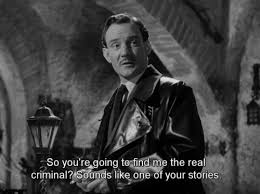
The Third Man redux...it's Noir to me

Every year I re-watch The Third Man film made in the late 40's. Many of you know it, no doubt watched this black and white classic several times. If you haven't, treat yourself, it's on Netflix US right now.
I always discover something new.  What I took away from this viewing was the Noir aspect.
Maybe I've been so seduced by the zither music, visuals and camera shots, the atmosphere of cobbled streets,  the sewer chase, war torn Vienna and the stellar actors that this hadn't registered in quite the way it had before.
The opening and ending shots take place in the cematary - in essence - sorry, it's a spoiler but The Third Man came out in 1948, so I figure a spoiler for a sixty nine year old movie is ok.
You could look at it this way - guy meets girl, girls grieving over dead boyfriend, will he succeed to win her over? The opening shot is a mirror of the last - guy doesn't get girl, he's up the creek and more disillusioned than when he arrived in Vienna. The girl has 'spoiler' lost Harry Lime twice.
When I do a workshop on setting, usually I start with the opening minute of this film.
There's narration over shots of pre-War Vienna, the Hapsburg palaces, the mention of the post-war black market and furtive men with a sleeve of watches, the four armed Allied presence - France, UK, Russia and US and the not so lucky black marketeer shown floating upside down in the Danube.
Bang. All in a minute, with the zither playing the theme, we see/hear the former glory, view the rubble strewn detritus of war, see the refugees scraping by for a living, or not,  the black market, the danger of the Allied Occupation dividing the city into four zones. To me, it's a brilliant introduction; the scene is set, danger is foreshadowed, and conflict introduced. Graham Greene, the story goes, was sent to postwar Vienna to write a screenplay which turned into this story.
That, he did. He used Vienna as a character as much as Harry Lime, who is probably in the movie about fifteen minutes, but his presence is what this film is about. Harry Lime, spoiler alert, is and here comes the twist, the Third Man. The first time I ever saw this movie, my jaw dropped. I never saw it coming. It still gives me shivers when the cat nestles on his shoes and headlights illuminate the face of undead Harry Lime.

Orson Welles, who played Lime, was two weeks late for filming and didn't want to film in the sewers. The producer Carol Reed was on a deadline and couldn't twiddle his or the crew's thumbs so he spent a lot of his waiting time, filming at night and experimenting with camera angles and shots.
Thanks to a late Welles, we have a much richer film. He contributed the famous line about the Swiss and the Cuckoo Clock but the rest was pure Graham Greene. Watch it today and it's still seamless. Tight. Dialogue, I for one, wish I could write. There's comedic touches, and nothing gets in the way of pacing and tension and each shot with Vienna a masterpiece.
Graham Greene gives Holly Martins, Lime's friend who has come to Vienna for a promised job,  a profession like his own. A writer. In this case, Holly writes Westerns and is referred to a 'scribbler with too much drink in him' and later by the British policeman here as a 'writer of cheap novelettes.' And of course, broke.
What Welles as Lime doesn't give in actual screen time - awesomeness itself - is the villain who his friend Holly cares about and a girlfriend who still loves him. We kind of do, too. Harry Lime hasn't grown up, life is a game and should be well played. His referring to the common people as ants in a charming way can't mask the the real horror of what he's done - diluting penicillin for profit which kills children and others. He's a charming cad, and a seducer. And, like the characters, I couldn't hate him. Rooted for him in the end to escape and crawl out of that sewer. That, to me, is what a brilliant writer does, get your empathy even for a villain. At least understand why he does what he does. 
The secondary characters, many of them trained Vienesse and British actors who you've seen in many films and with a long career, almost stole the scenes they were in...vivid and immersing. I think this film is one of the reasons I took a chance on a little idea I had and started writing.
Cara - Tuesday

Cara - Tuesday

Monday, August 7, 2017

Italian in Africa: Prince Luigi Amadeo

Annamaria in Absentia....Again!

Forgive me, my friends and readers.  That book that was due July 31 is still scheduled for early December.  I am now a week late.  Three weeks ago, I bragged to my publisher that I never missed a deadline.  What hubris! Given my personal circumstances she is being patient.  I ask the same of you.  In the meanwhile, here is the my post from 2014 about the inspiration for a new series character introduced on the pages sitting next to me, demanding the final read through.  


The first time I encountered his name, it was a passing reference, which caught my eye and posed a question.  The words on the page were “Duca degli Abruzzi” and I wondered, “Who was he and what was he doing in Africa?”  I am so glad I bothered to find out, for now his life has inspired a character and a whole subplot in my work in progress.

Let me tell you about the real guy.

Luigi Amedeo Giuseppe Maria Fernando Francesco di Savoia was an Italian in search of L’aventura! An explorer and mountaineer and a cousin of King Victor Emmanuel III, he eschewed the life of luxury he might have had at court to scale the highest peaks in North America and Africa, and nearly conquered K2.  He also led an expedition that set records in exploring the Arctic.


Most of the aristocrats who settled in Africa were British second sons in need of a place where they could live a sumptuous life for little money.  The Duke of Abruzzi was a third son, but he was drawn to Africa for a great deal more than its inexpensive but tony life style.

Prince Luigi was born in Madrid in 1873, while his father,Prince Amadeo of Savoy was briefly King Amadeo of Spain.   Papa abdicated his throne and returned to Italy when Luigi was three years old—at the time Uncle Umberto became Italy’s king.  The title Duca delgi Abruzzi was created for the little guy.

Luigi Amedeo started his world travels in his twentieth year: going to Italian Africa in Eritrea, to Canada, and back to Africa this time to Italian Somaliland.

After developing his mountaineering chops on Mount Blanc and Monte Rosa in the Alps, he began to look for new peaks to conquer.  He was the first to scale Mount Saint Elias on the US-Canadian border.  The New York Times reported the exploits of Luigi and his team, including detailed descriptions of the mirage city they thought they saw on the glacier.


Perhaps that was where this Italian fell in love with ice.  In 1899, he organized an expedition to the North Pole and made it further than anyone had before.  They went in winter and planned to cross the frozen sea by dogsled.  Along the way, the Duke lost two fingers to frostbite and had to let the others go on without him.  They eventually got to 86°34’, about forty kilometers closer to the pole than any other group had ever gotten.


In 1906, the Duke returned to Africa, this time to Uganda where he climbed every mountain in sight—sixteen summits in all.  One of them still bears the name—Mount Luigi di Savoia.  Three years later, he took an expedition to K2 and very nearly made it to the top.  The route to the summit of the second highest mountain in the world is still called the Abruzzi Route.  Luigi’s attempt of K2 set the then world record for altitude.


The Duke became an Admiral in the Italian Navy in 1911 and commanded the Adriatic fleet for the Italians in World War I.  After the war he went back to Somaliland and pretty much never left Africa again.  Early on, he was an ally of Mussolini, but once Il Duce showed his real stripes, the Duke gave up on him and spent his time in Africa building roads, dams, schools, hospitals, churches and mosques.

Kitty


I am, as I write this, busy inventing a character based on him.  My guy will not be Luigi himself, but a fictional version that has his regal connections and his sense of adventure.   And something like Luigi’s love life, which was no more staid than any other aspect of his experiences.  As a young man, the factual Duke fell in love with Kitty Elkins, daughter of US Senator Stephen Elkins.  But then King Victor Emmanuel III refused permission for his cousin to marry a commoner, Luigi’s brother stepped in, and in true Italian tradition played the family trump card and convinced the Duke to give up Kitty.  He eventually married Antoinette Brizzi, the daughter of a wealthy Italian nobleman who was famous for the wines from his estate.


After his wife’s death, Luigi married a Somali woman—Faduma Ali.  He died in 1933 in the Somali town he had founded, Village of the Duke of Abruzzi, and was buried there on the banks of the Shebelle River.


Lots of explorers who achieved less are much more famous.    I wonder why.

Oh, and by the way, please take note.  He wrote several books!