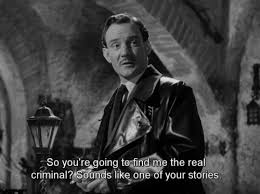
Every year I re-watch The Third Man film made in the late 40's. Many of you know it, no doubt watched this black and white classic several times. If you haven't, treat yourself, it's on Netflix US right now.
I always discover something new. What I took away from this viewing was the Noir aspect.
Maybe I've been so seduced by the zither music, visuals and camera shots, the atmosphere of cobbled streets, the sewer chase, war torn Vienna and the stellar actors that this hadn't registered in quite the way it had before.
The opening and ending shots take place in the cematary - in essence - sorry, it's a spoiler but The Third Man came out in 1948, so I figure a spoiler for a sixty nine year old movie is ok.
You could look at it this way - guy meets girl, girls grieving over dead boyfriend, will he succeed to win her over? The opening shot is a mirror of the last - guy doesn't get girl, he's up the creek and more disillusioned than when he arrived in Vienna. The girl has 'spoiler' lost Harry Lime twice.
When I do a workshop on setting, usually I start with the opening minute of this film.
There's narration over shots of pre-War Vienna, the Hapsburg palaces, the mention of the post-war black market and furtive men with a sleeve of watches, the four armed Allied presence - France, UK, Russia and US and the not so lucky black marketeer shown floating upside down in the Danube.
Bang. All in a minute, with the zither playing the theme, we see/hear the former glory, view the rubble strewn detritus of war, see the refugees scraping by for a living, or not, the black market, the danger of the Allied Occupation dividing the city into four zones. To me, it's a brilliant introduction; the scene is set, danger is foreshadowed, and conflict introduced. Graham Greene, the story goes, was sent to postwar Vienna to write a screenplay which turned into this story.
That, he did. He used Vienna as a character as much as Harry Lime, who is probably in the movie about fifteen minutes, but his presence is what this film is about. Harry Lime, spoiler alert, is and here comes the twist, the Third Man. The first time I ever saw this movie, my jaw dropped. I never saw it coming. It still gives me shivers when the cat nestles on his shoes and headlights illuminate the face of undead Harry Lime.
Orson Welles, who played Lime, was two weeks late for filming and didn't want to film in the sewers. The producer Carol Reed was on a deadline and couldn't twiddle his or the crew's thumbs so he spent a lot of his waiting time, filming at night and experimenting with camera angles and shots.
Thanks to a late Welles, we have a much richer film. He contributed the famous line about the Swiss and the Cuckoo Clock but the rest was pure Graham Greene. Watch it today and it's still seamless. Tight. Dialogue, I for one, wish I could write. There's comedic touches, and nothing gets in the way of pacing and tension and each shot with Vienna a masterpiece.
Graham Greene gives Holly Martins, Lime's friend who has come to Vienna for a promised job, a profession like his own. A writer. In this case, Holly writes Westerns and is referred to a 'scribbler with too much drink in him' and later by the British policeman here as a 'writer of cheap novelettes.' And of course, broke.
What Welles as Lime doesn't give in actual screen time - awesomeness itself - is the villain who his friend Holly cares about and a girlfriend who still loves him. We kind of do, too. Harry Lime hasn't grown up, life is a game and should be well played. His referring to the common people as ants in a charming way can't mask the the real horror of what he's done - diluting penicillin for profit which kills children and others. He's a charming cad, and a seducer. And, like the characters, I couldn't hate him. Rooted for him in the end to escape and crawl out of that sewer. That, to me, is what a brilliant writer does, get your empathy even for a villain. At least understand why he does what he does.
The secondary characters, many of them trained Vienesse and British actors who you've seen in many films and with a long career, almost stole the scenes they were in...vivid and immersing. I think this film is one of the reasons I took a chance on a little idea I had and started writing.
Saturday is the day we reserve for guest authors. Today it's the turn of J. Sydney Jones.
Some people accuse Syd of borrowing the adorable little kid shown below for publicity purposes. The management of Murder is Everywhere assures you that this is a vicious untruth. The young man really is Syd's son, Evan.
J. Sydney Jones is the author of a dozen books of fiction and nonfiction, including the first two novels of the Viennese Mystery series, The Empty Mirror and Requiem in Vienna. He lived for many years in Viennaand has written several other books about the city, including the narrative history Hitler in Vienna: 1907-1913, the popular walking guide, Viennawalks, and the thriller, Time of the Wolf. Jones has also lived and worked as a correspondent and freelance writer in Paris, Florence, Molyvos, and Donegal. He and his wife and son now live on the coast of Central California. Syd has entitled his post
The Contrarian of Vienna
For those of you who love to play butterflies or six degrees of separation, the world of Vienna 1900 is no stranger. Going forward or backward in time, you’re pretty likely to hit on a link in fin de siècle Vienna if you’re dealing with someone in the arts, literature, science, or world affairs. From Freud to Mahler, Klimt, and Hitler, the city was an amazing cauldron of cultural innovation (and, yes, in Hitler’s case, destruction) around the turn of the previous century.
At the epicenter of all was the young polymath, Karl Kraus, cultural critic, grammar policeman, and word maven of Vienna 1900. Kraus, a frail-looking man, beavered away for over three decades, single-handedly publishing his magazine, Die Fackel (The Torch). In this journal he took on the hypocrisies of the day, stood up to the rich and the powerful when need be, fought crime and societal stupidity, and generally pissed off everybody. The ultimate aphorist, Kraus termed Vienna 1900 a “laboratory for world destruction.”
In my novel, Requiem in Vienna, I describe Kraus thusly:
A slight man with a curly head of hair and tiny oval wire-rim glasses that reflected the overhead lights, Kraus dressed like a banker. One of nine children of a Bohemian Jew who had made his money in paper bags, Kraus lived on a family allowance that allowed him to poke fun at everyone in the pages of his journal.
Kraus frankly did not care who he angered. And sometimes he paid the price for his outspoken views. Once part of the Jung Wien group of writers, including, among others, Arthur Schnitzler--whom Freud termed his double--and the young Felix Salten--later author of Bambi-- Kraus soon turned against them. In a famous article, he ridiculed the group’s coffee-house culture and earned a bitch slap from Salten at the Café Central for his words. On another occasion, he took a punch on the nose from an irate cabaret performer who did not care for Kraus’s reviews.
Kraus was most definitely a man of contradictions. On the one hand, he could defend the right of prostitutes to carry on their trade unmolested by the authorities:
Corruption is worse than prostitution. The latter might endanger the morals of an individual, the former invariably endangers the morals of the entire country.
At the same time, however, he could write this about women in general:
Intercourse with a woman is sometimes a satisfactory substitute for masturbation. But it takes a lot of imagination to make it work.
No one ever said Kraus was likable.
Something of the H.L. Mencken of Vienna, Kraus enjoyed a turn of phrase, enjoyed shocking people. But most of all he enjoyed being at the center of the rippling pool of Vienna 1900’s artists and intellectuals. He was the ultimate filter of gossip in fin-de-siècle Vienna; he knew where all the bodies were buried.
Kraus was also a major celebrity in his day. “I am already so popular that anyone who vilifies me becomes more popular than I am,” he liked to say. Besides the regular publication of his journal, Kraus was also a performer. Again from Requiem in Vienna:
Despite his slightness of bearing, Kraus had a fine speaking voice. He had tried for a career as an actor as a younger man, but stage fright had intervened. He was said to be experimenting with a new form of entertainment, however, much like the American, Mark Twain and his famous one-person shows. At fashionable salons, Kraus was already entertaining the cognoscenti with his interpretations of Shakespeare and with readings from his own writings. Another of his aphorisms Werthen [my investigator protagonist] had heard: “When I read, it is not acted literature; but what I write is written acting.”
And oh my but he makes one hell of a fictional character. So acerbic, so full of self-contradictions, so full of himself. I am not sure I would have liked to sit down over a cup of coffee or glass of wine with the man--nor he with me, I am sure--but anybody who could quip that “psychoanalysis is that disease of which it purports to be the cure” would have been worth knowing.
(For those who read German, the entire edition of Kraus’s Die Fackel is available free online at http://corpus1.aac.ac.at/fackel/)




_Cover.jpg)





