Sunday, May 25, 2014

The Memory Game


As you may have realised, I TOTALLY forgot it was my MiE blog today. (Bad writer, no biscuit!)

And forgetting something so important reminded me of something I read a few years ago, in a book by Derren Brown called TRICKS OF THE MIND, about dramatically improving your memory. Derren Brown, for those of you who are not aware of him, is part illusionist, part psychologist, and all showman. The Guardian newspaper described him as, “Clearly the best dinner-party guest in history—he’s either a balls-out con artist or the scariest man in Britain.” His various TV series over here have dumbfounded and entertained in equal measure, and while the knowing style of his book has taken a bit of getting used to, the information contained in it is just fascinating.

And why is this relevant here? Because, if I understand him correctly and extrapolate accordingly, fiction writers should have the best memories ever. Elephants should be as fickle goldfish compared to us lot.

Why? Because we exercise our imaginations on a regular basis.

Ye-es, it foxed me to begin with, but stick with me on this one, OK? And do give this a whirl. I tried the example in the book and was amazed that it worked flawlessly.

You see, Brown claims that most people, given a list of twenty disparate, unconnected words, can recall about seven with any degree of accuracy. He gave such a list and suggested that you read it through, and then try and jot down as many as you can recall, in the same order. I took the liberty of substituting my own words. Or, rather, so I wasn’t subconsciously picking words that I might find easy to remember, I asked someone else to do provide the list for me. And here they are:

bicycle
cabriolet
fridge
rollercoaster
muckspreader
pincushion
blotter
hemlock
Shakespeare
thingamabob
nonagenarian
Rolex
Skyline
filter
cauliflower
grandfather
cuckoo
tortoise
carpet
blitzkrieg

So, having read through them, try and write them down, in the same order they’re listed here. Please give this a try. How did you do? If you got past seven, you’re Marvo the Memory Man and you don’t need to read any further. Put it aside for a bit, and then try again, without re-reading the list, but in reverse order this time. It’s a stumper, isn’t it?

What you do, according to Brown’s book, is create a link from one word to the next by producing an image that connects the words. A vivid image, with smells and emotions attached to it. If the image is of something that stinks, sniff it. If it’s funny, find it so.

The elements need to interact in some way, and each little scene needs to be odd enough to be memorable. Some people, apparently, don’t like visualisation and claim not to be very good at it, but we’re writers, for heaven’s sake. We spend our days making stuff up—that’s what we do.

So, here’s my own list of connections between the above words:

bicycle/cabriolet
A group of Edwardians in striped blazers and straw boater hats, riding along on their bicycles, very slow and stately, but in case of rain they all have cabriolet tops they can raise over their heads, with big curved hinges on the sides like an old-fashioned pram, and tassels along the front.

cabriolet/fridge
A nice little VW Cabriolet, gleaming in white, all colour-coded, and when you climb inside it’s still white like you’re sitting in your fridge, with wire racks and dairy products on the shelves and a light that comes on when you open the door. There’s a big bottle of milk strapped to the passenger seat. The air con keeps it frosty cold.

fridge/rollercoaster
You open the door of your fridge and a rollercoaster track unfurls out of the salad drawer, complete with screaming passengers, and goes careering round the kitchen, making it impossible to sneak down for a midnight snack without waking the entire street.

rollercoaster/muckspreader
The farmer next to the amusement park hates the people who ride the rollercoaster making all that racket, so he always drives his muckspreader along the hedge next to the bottom of the first drop, and sprays them all with cow manure as they hurtle past. Particularly nasty if you’ve got your mouth open as you go.

muckspreader/pincushion
Someone’s come up with a new way of recycling cow manure, which instead of being scattered is reformed inside the muckspreader into neat round pincushions, the size of pillows, which it deposits in a neat orderly row as the farmer drives his tractor through the local ladies’ sewing circle.

pincushion/blotter
The only trouble with the cowpat pincushions is when you stick a pin in them they let out a great cloud of stinking vapour and leak a nasty greeny fluid all over the place, which you have to soak up by putting a blotter under the pincushion wherever you go.

blotter/hemlock
An ingenious murderess decides to soak the blotter on her husband’s desk in hemlock, so he will be gradually poisoned as the hemlock leaches out and into his hands whenever he works late into the night.

hemlock/Shakespeare
The entire cast of a Shakespeare play toast each other with hemlock-laced glasses of wine, thus dying tragically at the end of the first act, not realising that the leading man is a method actor who has genuinely dosed them all with real poison.

Shakespeare/thingamabob
Will Shakespeare finds himself momentarily lost for words and invents a new one—thingamabob—which instantly becomes all the rage in Elizabethan England. Queen Elizabeth instantly demands he produce one, by royal command, and he has to cobble something together or lose his head.

thingamabob/nonagenarian
Nonagenarian little old ladies can be easily identified by the fact that they’re each followed about by a thingamabob, which is a little bouncy, squeaky thing, like a cross between a Space Hopper and a Tribble, which won’t leave them alone. There they all are in the park, swatting at these troublesome thingamabobs with their umbrellas.

nonagenarian/Rolex
When anybody reaches the ripe old age of 90, their nonagenarian status is celebrated by awarding them a Rolex watch. The only trouble is, it’s a big garish one, plastered with diamonds, and the streets are filled with old folk dressed up in flashy watches and gold chains like gangster rappers.

Rolex/Skyline
All Nissan Skyline sports cars comes with a Rolex attached to the front of the bonnet so the driver can time themselves as they lap the Nürburgring in Germany. It’s also used as a means of handicapping the faster ones. The quicker you drive, the bigger watch you have to have, thus not only increasing drag, but also preventing the driver from seeing where they’re going, and slowing them down. At least they know exactly what time they crashed.

Skyline/filter
As a party trick, someone drives their Skyline around the inside of their filter coffee machine, like a wall of death. Round and round they go, until they’re almost vertical up the sides, kicking up great rooster tails of coffee grounds and leaving tyre tracks in the paper filter.

filter/cauliflower
After heavy rain sluices cauliflowers into the drains, you have to insert big filters to stop them clogging everything up, otherwise they create the most awful stench of rotting vegetation.

cauliflower/grandfather
When your grandfather gets on a bit and loses his teeth, the only thing he can eat is mulched up very well-pureed cauliflower, which you have to cook for him in giant vats until it goes grey, and then put through a blender, at which point he packs it into his cheeks like a hamster. Grandfathers only have to be fed once a week using this method.

grandfather/cuckoo
Grandfathers are not acquired in the usual way, but introduced into the family nest like cuckoos, in the hopes that they’ll be cared for like the other family members. Of course, grandfathers can be bigger and more aggressive than other relatives, and often push them out of the nest using their Zimmer frames.

cuckoo/tortoise
Swiss cuckoo clocks are using tortoises instead of the more traditional birds to call the time. At the top of the hour the doors open and a tortoise emerges, very, very slowly, on the end of a spring. It can take these clocks several days to strike noon and midnight.

tortoise/carpet
To keep your tortoise warm in winter, you cover his shell in carpet, preferably shag pile, so there’s all these tortoises ambling about with multicoloured carpet stuck to their backs.

carpet/blitzkrieg
Brings a whole new meaning to carpet bombing. There’s the archetypal RAF squadron leader with handlebar moustache and flying helmet, piloting his bomber through flak-ridden skies over war-torn Europe, waiting for his bombardier to give the word that he can release his load of Axminster and Wilton. Once away, these rolls of carpet plummet through the clouds in a lightning attack on the terrified populace.

I have to say that Derren Brown’s own list—and the explanation of the links between the words—was probably much better and far more amusing than my own. But you get the idea. If anyone can come up with sillier or more vivid connections, please feel free. But let me know how you get on. Isn’t it nice to know that this fertile imagination we have can be put to other uses, isn’t it?


Oh, and before I forget, this week’s Word of the Week is zeroable, which is a word that is able to be omitted from a sentence without any loss of meaning. I try to eliminate all zeroable words at the copy-editing stage. Doesn’t always work, though … 

Saturday, May 24, 2014

A Challenge for All That is Greece


I hate the blame game.  It’s a favorite of the ideologue, demagogue, and bigot, used to convert into political power the natural instinct of so many to fault anyone but themselves for what’s gone wrong in their lives.  For some it’s a means of gaining power, for others of maintaining what they no longer rightly deserve.  

Which brings me to Greece and tomorrow’s elections. It’s the runoff round of municipal elections and the first chance in five years for Greeks to choose their representatives to the European Union Parliament.  Yes, I have views on what’s happening, but in light of my buddy’s very tight runoff election for mayor of Mykonos tomorrow, I think I’d best hold off on getting into any of that. Besides, from the way things have played out so far, there is such a terrific book in it—a crime for sure, but no mystery to any local—I might just leave it to Chief Inspector Andreas Kaldis to work out.  To be honest…whoops, wrong word in this context…he may be the only cop in Greece even willing to try.

So, let me instead turn to what the Greek newspapers are saying about Greece’s European Parliamentary elections.  Most are perplexed as to whether the left or right will win, perhaps because all of the media’s elaborate pre-election and exit polling for last Sunday’s round proved very wrong.  It’s as if the Greek people didn’t want to tell the press what’s really on their minds.


But that’s not stopped the Greek press from telling it like they think it is.  Right or wrong, they have an opinion.  And in this case a very scary one.  

Four years ago I gave an interview to America’s largest circulation Greek-American Newspaper, The National Herald (ΕΘΝΙΚΟΣ ΚΗΡΥΞ), and said, “Perhaps its time for Greeks around the world to come to the defense of their cultural homeland…Fiscal blame fades, cultural stigmas persist.”  In Target: Tinos (published in 2012) the warning came from the lips of a fictional Greek government minister:

“But our adversaries would love to switch the focus of the debate from our country’s financial problems to our national character.  Paint us as indifferent to the plight of non-Greeks, an intolerant place where only Greeks are treated as deserving of protection, and all others be damned.  It’s a volatile, irrational, and emotional argument but one that could turn world opinion against us if it found traction in the press.  And then it would no longer be just a question of denying us further bailout funds, but whether or not to drum us out of the E.U.”

Eight days ago, the respected publisher of The National Herald wrote an editorial titled “Greek Election Forecasts” in which he referred to a “recently-published survey of the Pew Research Center” on views held by the Greek people.  He noted the survey found Greeks to be the most “negative” in the EU about the future, and in his final paragraph wrote:

The survey also revealed Greece to be the most anti-Semitic country in Western Europe, with an unacceptably high rate of 69 percent. Somewhere in all these figures a person can discern the “logic” that will drive the upcoming elections.


That paragraph stopped me cold. I personally have never had an anti-Semitic experience in Greece, something I can’t say for other places I’ve known.

But there’s no denying Nazis are here, in force, and violent.  Chrysi Avgi (Golden Dawn) barely masks its veneration of Hitler and his blame-spewing hatred that brought such horror to the world. 


They seem to have forgotten, or choose to ignore in their rush for power, that Mein Kampf’s ethnic prejudices led to the utter devastation of Greece at Hitler’s hands.   


Yet despite all of that, and the serious criminal charges lodged against virtually every one of the party’s eighteen members of Greece’s parliament following the murder of a Greek by Golden Dawn supporters, its popularity continues to rise.  It drew 16% of the vote in Athens last week…enough to swing tomorrow’s runoff election.


And the concerns expressed over the rise of Nazism in Greece are not confined to Diaspora journalists.  The following unsettling editorial appeared this week in Ekathimerini, Greece’s equivalent of The New York Times; it’s title, “Serpent Alibi Doesn’t Hold Water”:

The excuse that “the serpent deceived me, and I ate” has been a part of the human narrative since the dawn of time, according to the Bible. Our homegrown Nazis would certainly throw the good book in the fire and not because they ostensibly get their learning from the ancient Greeks (and display it by holding up torches and attacking the helots), but because according to their “Mein Kampf” beliefs, anything remotely Jewish should be destroyed.

The ploy of consigning responsibility to the proverbial serpent neither explains nor justifies anything. If you don’t have the will power to stand up to temptation, if you succumb and sit on the serpent’s egg, it is not the reptile’s fault for trying to bite you. And just like that, after three electoral contests in which Golden Dawn scored high percentages, we can no longer talk about innocents who have been deceived. The first time, maybe; the second, not so much; but definitely not the third. And each time they were “deceived” was worse than the last because they knew more and had a better understanding of their decision. So the longer we hide behind the alibi that the Golden Dawn voters have been deceived by the serpent, the longer we shy away from the problem, not daring to look it in the face and call it what it is.

The possibility that some of Golden Dawn’s voters cast their ballots as they did to lash out against the system (blind to the fact that the party is itself an offshoot of the system) and not because they embrace the party’s ideas does nothing to acquit them. Those who vote for Golden Dawn but do not, for example, revere Hitler, are not free of political culpability, because by casting their vote they are legitimizing those who do indeed do. And anyway, it’s not as though they can write “Yes, but I have some reservations” at the top of the ballot before they put it into the box.

What has Golden Dawn’s record been so far? Dark and criminal, as ongoing judicial investigations are revealing and our experience as a society has shown. The party has succeeded in bringing together an element that already existed in Greek society and which embraced tyranny, chauvinism, racism, intolerance and anti-Semitism. It has never been small, just preferred to hide behind bigger parties. The junta was not that long ago and we can still vividly remember who served it voluntarily and who (albeit a small number) resisted it. The Nazi occupation is not so deep in the distant past either for us to have forgotten GD’s forefathers.

Voting for Golden Dawn is not an emotional overreaction, but an expression of ideological allegiance. It is clear that this is something we are ashamed to admit. We cannot confess that a large part our society embraces, openly and consciously, Golden Dawn’s prejudice. But if we keep refusing to talk about it, we will do nothing and have nothing left but our shame – which will just get bigger.


Extremist right views are gaining traction across Europe, yet many of Golden Dawn’s natural European allies shun any public association with them.  Or so it seems.  As reported this week in EuroObserver:

None of Europe's popular far-right parties has backed or sought to make an alliance with Greece's extremists, who are often labelled "neo-fascists" – something the party denies….

While many radical right-wing parties across Europe, led by France's National Front, have indicated they will club together in the next European Parliament, they are steering clear of Golden Dawn.
Late last year National Front leader Marine Le Pen said Golden Dawn had a "filthy image". In February she told a Greek journalist that far-right parties "have been very clear about not including" Golden Dawn in their alliance.

But some experts say the gap between them is not that wide.

Vasiliki Georgiadou, a political science professor at Athens Panteion university, believes the continent's leading far-right parties, including France's Front National, are not teaming up with Golden Dawn merely for strategic reasons rather than outright objection to their policies.

Jackboots are on the march again in Europe and Golden Dawn’s performance in tomorrow’s European Parliament elections is expected to shake up the EU.

The question is, will it shake up the Greek people?


I certainly hope so. 


Jeff—Saturday

Friday, May 23, 2014

The Language Of Scots.


Some books translated

The most recent census showed that 1.5 million Scots consider themselves to be native Scots speakers. I have no idea whether I am a Scots speaker or not.

As a language I can understand it but I remember getting slapped for talking it. It was considered to be seen to be ‘uneducated’ to speak it and my mother thought I might get on in life better if I spoke properly. And that is unfair on a beautiful language that is really our native tongue.  The problem is that ( and I might get into a lot of trouble for saying this )  is has never really been defined as a separate language. It’s just the way we talk.
                                          
                                                           The distribution of Scots


It’s more of a rainbow of language from one extreme (the Queen’s English) to the other (broad Scots).  Scots can be difficult to tune into if you are not used to it but most readers make the effort with Shakespeare.

                                                           
                                                       he's trying to read The Sleekit Mr Tod

I’ve just had my copy edit back for book five and there are the usual queries over words, Scots words, that I use everyday that my editor has politely queried. If I correct them it makes the book sound very  unScottish, yet it has to be understood. It has to pass the Bratislavian Airport test as a previous editor put it. The text must be understood by a …. Yeah you get the picture.

So the words Dwaddle  (a very slow waddle usually by somebody in a dwam )
Dwam  - a persistent dreaminess not paying attention  for a long period of time.
Rummell – No one English word  describes it  - a good rifle through, a haphazard search. What woman do                     in TK Maxx. Or any sales…
                               
                                                               A richt guid rummel

The aforementioned census showed that 64% of us Scots don’t consider it a separate language, and those that use it  were most likely not to see it as a separate language . Which makes perfect sense ..
I’ve read that Scots and English have the same relationship as Danish and Norwegian. Scots might be more related to German.

If I came across a wee toad in the garden, I would call it a puddock. And that is Scots but if I said  of some guy so drunk he was fair wabblin…. You would think that was just a lazy way of saying wobbling.  But if I said he was fair blootered.
                                  
                                      
                                                          There is nothing worn under the kilt
                                                           it's all in perfect working order

Weirdly a cupboard in Scot is a press.

There are some words that have no English translation…
Shilpit ;  that very thin, pale fragility of a person. I’ve heard it used for sick folk, supermodels and anorexics.
Sleekit ; like a fox or a sneaky wee person..’don’t trust her she’s dead sleekit’
Coorie  in :  a very particular form of cuddle, puppies coorie in,  people coorie in a bus shelter when heavy rain starts.
Spirlie ;  a wee skinny person, comes from spirl which is a wee twigletly, seedling type of thing…
Doit  or  numpty ;  Not a daft person but a clever person having a daft moment…. ‘I went upstairs to get something then forgot what it was, I was fair doity.’
Gowp ;  a pulsating pain…. ‘My knee is gowpin !’
Breinge ;  to go at something with no finesse what so ever.
Stour ;  plastery, dusty, ‘somebody open the windows in here’ ness


                                                       Fair Shilpit

This is a quote I found   
 ‘The survey concluded that there simply wasn't enough linguistic self-awareness amongst the Scottish populace, with people still thinking of themselves as speaking badly pronounced, grammatically inferior English rather than Scots, for an accurate census to be taken’

                                          
                                                             Hugh Himsel

In the early twentieth century a resurgence of Scots occurred as an art form.  At school we had to study this  in the form of  A Drunk Man Looks at the Thistle by Hugh MacDiarmid  which was written in  1926 and has been reworked by Liz Lochead and Denise Mina amongst others. Here is a wee taster ...

I amna fou' sae muckle as tired - deid dune.
It's gey and hard wark coupin' gless for gless
Wi' Cruivie and Gilsanquhar and the like,
And I'm no' juist as bauld as aince I wes.

The elbuck fankles in the coorse o time,
The sheckle's no sae souple, and the thrapple
Grows deef and dour: nae langer up and doun
Gleg as a squirrel speils the Adam's apple.
               

Eith Innit?


Caro Ramsay  23/05/2014

Thursday, May 22, 2014

The Man Who Swept Clean

Old Railway Bridge at Skukuza
In 1902 two men came together and headed out into the African wilderness with horses and an ox wagon of provisions.  They had taken on an extraordinary job that no one thought likely to succeed, and one which was not high on the list of the priorities of the day.  They were unlikely companions.  The two men couldn’t have been more different.

The roads would have been much narrower - or non-existent!

James Stevenson-Hamilton
James Stevenson-Hamilton was born in Dublin in 1867, the eldest son of a landed family, and had been educated at Rugby and Sandhurst.  He chose a career in the military, and was attracted to South Africa, where, as an officer of the 6th Dragoon Guards, he saw service in Natal.  After that the spirit of African adventure seized him, and he explored parts of what is now Zambia on horseback and on foot and even joined an abortive expedition to go across land from Cape to Cairo.  In 1899 he fought in the Boer War and distinguished himself on the British side.

Harry Wolhuter, on the other hand, was born in Beaufort West in the arid Karoo region of the Cape in 1877.  He had a checkered career involving hunting, being a shepherd, hunting, fighting in a rag-tag British commando called Steinacker’s Horse in the Boer War, and hunting.

Harry Wolhuter
Before the Boer War, the South African Republic under President Paul Kruger had proclaimed the Sabie Nature Reserve on the eastern side of the country in an attempt to preserve some of the rapidly dwindling wildlife of southern Africa.  It was an area of about 1,000 square miles sandwiched between the Sabie and Crocodile rivers, flush with poachers, smugglers, and malaria.  The parliament approved the establishment by just one vote, with much grumbling about good farming land wasted on dangerous animals and disease.  The Boer War came, and no one did much about the new game reserve, but in 1902 Lord Milner in Cape Town re-proclaimed the area and made Stevenson Hamilton the first Warden.  He appointed game rangers, of whom Wolhuter was one, and they set off to see what they could do with an area which poachers and predators had been intent on devastating.  Stevenson-Hamilton made Sabie Bridge his headquarters.  His approach was simple.  No hunting.  And anyone who broke that rule felt the force of his law.  He was reputed to have grumbled that if he could live on tinned meat, so could all the surrounding inhabitants.

For the two men and the black rangers they trained, the job became a mission.  Nothing was higher priority.  Stevenson-Hamilton believed - as he said in his book African Eden - “that if there were no shooting, if animals were left to live in the veld as they had lived before man came on the scene, they would lose their fear of human beings and flock to an area that had once been described as ‘red with impala’”.  At one point he cut everyone’s salary (including his own) when he needed an extra game ranger and didn’t have the funds to pay him.  And Harry Wolhuter said in his book – Memories of a Game Ranger - “My long experience has taught me that, thrilling though the pleasures of shooting undoubtedly are, infinitely greater and far more lasting pleasure and interest can be obtained from the observation and study of wild animals, unafraid and uninterfered with, in their natural haunts; and I have never regretted my metamorphosis from hunter to guardian!"

In 1923, the first tourists came to the game reserve.  The Selati railway ran through the area and tours would stop at Sabie Bridge, have a camp fire evening, and take guided walks with a ranger in the bushveld before heading on to Mozambique.

Stevenson-Hamilton had good contacts.  He persuaded companies and individuals to donate “useless” land to extend the game reserve and he started agitating for the area to become a national park; in 1912 he had a personal discussion with no less a luminary that Jan Smuts.  The First World War put it out of everyone’s mind, but in 1926 it was proclaimed as South Africa’s first national park – the Kruger National Park.  Just where Kruger himself had stood on the issue of the game reserve is unclear, but it is his lasting memorial and now extends over 17,000 square miles.  The first tourist cars arrived in 1927 - three of them.  My mother couldn't have been far behind them; I recall her stories of her visits to the Kruger Park as a girl.

This isn't my mother...but it could have been!

And today...
Wolhuter and the Lion
The pioneer rangers had many adventures as they chased poachers, reduced predator populations to try to give the big herbivores a chance to recover from the hunting, and played politics to preserve the reserve and extend it.  On one occasion on an evening patrol, Wolhuter was attacked by two lions, who killed his horse.  One dragged him into the bush while the other dealt with the horse.  Although badly injured, Wolhuter managed to unsheathe his hunting knife and stab the lion fatally.  As the second came for him, he managed to pull himself up a tree where he clung for his life until he was rescued.  He believed that he was saved by his dog which distracted the lion while he made the nightmare climb.  Wolhuter’s knife and the lion skin are on display at the administrative center of the Kruger National Park – Skukuza- renamed from Sabie Bridge.


Stevenson-Hamilton and Harry Wolhuter retired in 1946, their work done.  When Stevenson-Hamilton died at the age of 90, the Tsonga people who live in the area mourned the loss of a great man.  They had named him Skukuza – ‘the man who swept clean’.

Leopard hazard at Skukuza Golf Course

Michael - Thursday


Wednesday, May 21, 2014

Three strikes - you're out


This spring has been riddled with strikes here in Iceland. At first it was high school teachers, then airport staff and then pilots. Cabin crews have announced their intentions to join the fray as well as those which care for the elderly. A collective agreement with elementary school teachers was reached last night, avoiding a strike that was to begin today by an inch.  The pilot strike has been squished with the parliament passing a law to ban it and the airport staff has come to terms with their government owned employer, a day prior to a similar law was due to be passed on their strike.
 
Unfortunately for everyone travelling to and fro Iceland, the pilots have not let the law fully stop them protesting their salaries. They refuse to work overtime, call in sick and so on. So over 90 flights have had to be cancelled over the last week; affecting around 12000 passengers. There are also rumours of the ground staff pitching in, I arrived back home on Sunday and there were very few shopping carts in the Duty Free store so passengers had to carry their items around the store before paying. It does not take a seasoned shopper to know that one cannot shop freely under such conditions, in particular when it mainly involves liquids.   

I am not opposed to people being paid a fair salary. But I am very tired of strikes. I had just forgot how annoying they are as we have not had any strikes of consequence for about 15 years now.

But the real reason I cannot empathise greatly probably has to do with me always having worked in the private sector. There people can negotiate their own salaries as the employer is not bound by the limits of a government agreed agreement where the individual is categorised by their age, length of employment, education, etc. If I had I would probably be more inclined to understand the driving force behind such pressure tactics. There are no other options I guess.
 
Icelandic engineers went on a strike a long time ago. It was a total failure as no one really noticed. There has not been talk of a repeat since. Writers are unlikely to go on strike, although there was a protest day sometime early this year when all arts were banned. It was to show people how much influence they have on our lives. Funny thing is though, I do not remember this day at all or how it went down. Maybe it was so terrible I have blocked it from my mind.
 
 
But despite understanding that various groups have no other method of getting their requirements across than going on strike, these travel strikes of late are really starting to piss me off. Probably because I travel a lot. On Friday I have a flight coming up and I have a nagging feeling there will be some sort of move by the ground crews or the pilots that will hamper my plans. Something with more annoyance power than removing shopping carts from the duty free. Maybe there will be no flight, maybe a huge delay, maybe they will remove the seatbelts from the cabin, swap luggage barcode tags between bags from different flights, remove the wheels from all suitcases, put rocks in the luggage, refuse to hand back passports at the check-in, add an inside-the-mouth check to the security process and swab everything in sight, remove the seat numbers from the cabin, fly upside down, circle the departure airport for an hour or so before heading on, fly around looking for turbulence ….. the possibilities are endless.

But I think I have found the solution to this predicament. Instead of putting all passengers through the wringer, why not just take hostages? Ten people selected at random at the airport (preferably not locals – sorry) kept at some nice location within the country while negotiations are going on. This would bring pressure from abroad and no one need know that the hostages are eating lobster, surrounded by beautiful nature.
 
If any Icelandic pilot is reading this – please take this plan into action. Before Friday please.  

Yrsa - Wednesday      

Tuesday, May 20, 2014

Fête de Pain - bread festival in Paris and two things you couldn't make up

Fete de Pain, in it's 17th year, is held in tents in front of Notre Dame. Here all the future little bakers of Paris tested their mettle under the supervision of the masters of the metier. No less than the head Baker who every year encourages little ones to join and become skilled in the 'patrimoine' of making French baguettes.
 The wheat which produces the flour - for some of the city kids this is news.
 Hard at work rolling out the dough.


 Maybe one day they will become bakers and patissiers who keep the legacy of these delicacies going.
 A patisserie even at Guerlain, the perfumers, who've made a cake celebrating the little black dress fragrance.
 Besides the fete de la Pain in Paris, last week two events happened that would be hard to make up. During an excavation at the Thiais cemetery, outside Paris - site for pauper burials, those unknown or without families, a discovery was found.  In extending  the grounds the construction crew came upon one hundred cadavers of German soldiers from WW2 in a mass grave. Details were sparse in the reports I found but since the cadavers were identified as German soldiers they must have had ID, dog tags and/or partial uniforms left to identify them as soldiers.
On the heels of that in the well know Pere Lachaise cemetary near Belleville in Paris, home to many famous dead celebrities: Edith Piaf, Chopin, Colette, Oscar Wilde and you name it - a fresh body was discovered by a tourist in the afternoon wedged between two graves. The corpse of Monsieur Bourard, 66 years old, and nearby resident of Belleville was found bloodied and with his head bashed in. Hard to imagine the thoughts and shock of the American tourist who discovered Monsieur Bourard when he was en route to pay homage to Chopin at his famous gravesite. The newspaper reported that Monsieur Bourard was well known to the crew at Pere Lachaise as a nice local man who lived nearby and liked to share his stories of Pere Lachaise with tourists. The crew also led the police to a Monsieur X, a man in his late 20's also living nearby, who'd become violent with cemetery visitors and was a neighbor of Monsieur Bourard. In Monsieur X's apartment, which he shared with his father, they found bloody clothes and the DNA of the blood matched the victim. Case solved? But why I asked my friend, a flic, did Monsieur X with a history of violence attack his neighbor and there of all places?  She'd heard it had a been a gay rendezvous gone bad and among the living and the very dead in Paris.
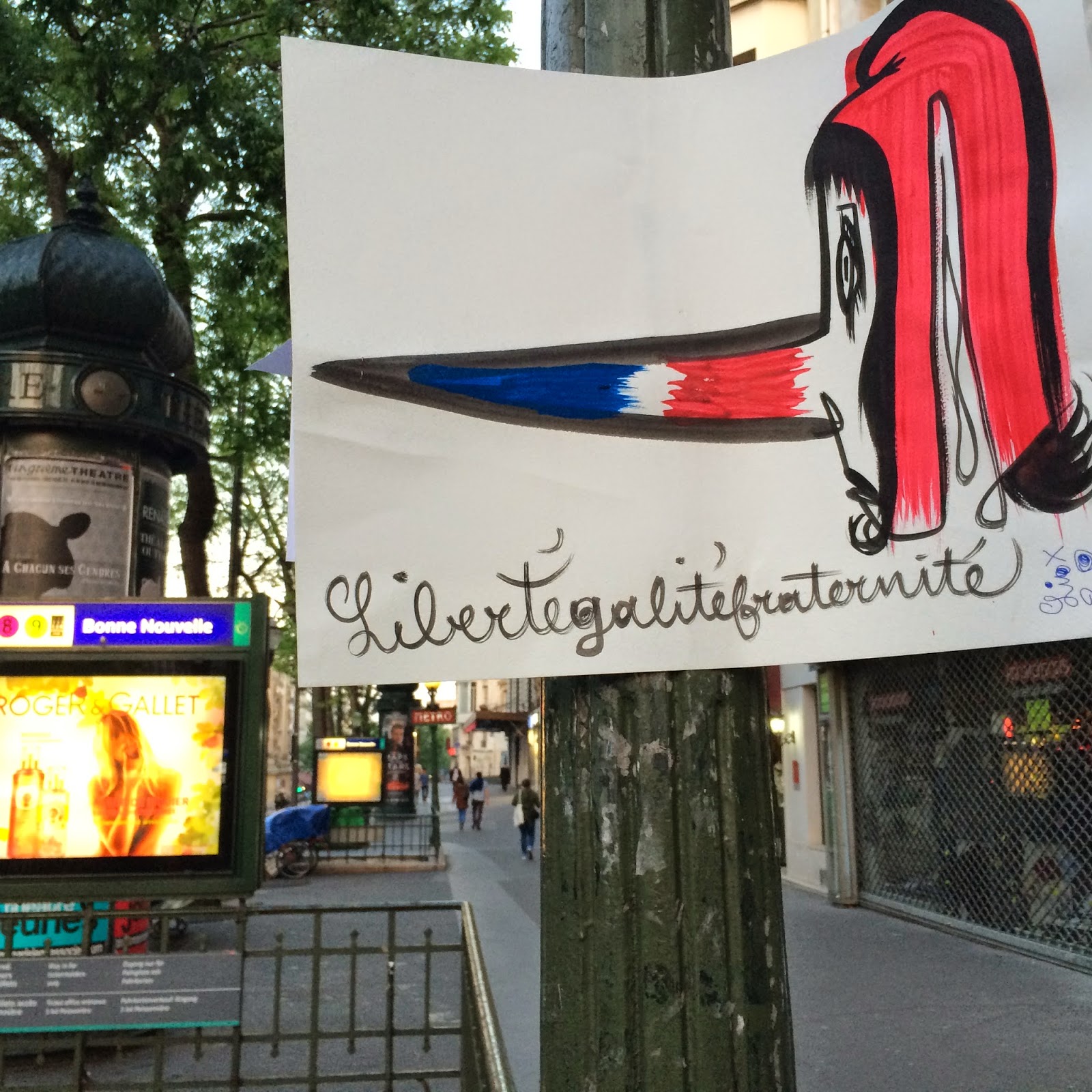
 Spotted this little taped drawing outside the Metro - a drawing of Marianne - the Symbol of France with a long Pinochio nose over the words 'Liberte,Egalite, Fraternite' - so that's the pulse on the Paris streets before the European Elections.
Cara - Tuesday