Thursday, April 27, 2023

Freedom Day

 Michael – Alternate Thursdays


Today is Freedom Day in South Africa, at least as significant here as July 4 is in the US. It commemorates the first election in South Africa where everyone was allowed to vote—irrespective of race. In fact, it was irrespective of nationality. Anyone currently living in the country was allowed to have their say. One received a short-term indelible ink mark on one’s thumb to prevent voting twice and that was it. Was there fraud? Probably a little but not enough to make any difference to the outcome, which was a resounding victory for the African National Congress led by the incredible Nelson Mandela. The day was declared as a national holiday then, and has remained one ever since. That was just as well because the lines were long and in the end the election extended over two days. It was vital that everyone would have the chance—for the first time ever—to have his or her voice heard. The logistics didn’t matter. It was the process itself that was vitally important. Perhaps even countries with longer and more established democratic traditions could learn something from that.


Even before, I usually voted in elections. If there was a Progressive Party candidate under the leadership of the redoubtable Helen Suzman, I would vote for her/him and even help to canvass. But even with a party that reached out towards black people and condemned the evils of apartheid, one knew that it was a sham. The party was trying to represent black people but they themselves had no representation. On April 27, 1994, there was no such reservation. At last everyone had a say, even if it took a whole day or longer to reach the front of the line. The mood was exuberant. People chatted, shared food, and no one seemed to find it weird that black and white and Indian and mixed race people shared the line and the process—something unthinkable a couple of years before. In fact as apartheid collapsed around us, it was revealed for what it was: a system to suppress black people. Everything else was just smoke and mirrors. 


It’s hard to explain the feelings I had that day, but they included relief and excitement about a future that had seemed out of reach for so long as South Africa trod the road followed so disastrously by Rhodesia. Somehow, we’d avoided all that. I had no doubt that both Nelson Mandela and FW De Klerk deserved their Nobel prizes when they received them. Certainly not as equals, but if PW Botha had held onto the leadership, the outcome would have been appallngly different.


The previously ruling National Party emerged from the election with little support and as politics realigned, it disappeared as its members were absorbed into other right wing or center parties or retired from politics altogether.

After several hours in the line, I went home and watched as the results came in. The rest is history.

We now look back to that day 29 years ago with mixed feelings. Almost ten years ago, I wrote about the upcoming twentieth anniversary of those elections—Freedom Day 2014—and a report from Goldman Sachs on Twenty Years of Freedom. Perhaps they will produce one for thirty years also, but I suspect not. (You can read that blog HERE.) The report showed gaps and problems, but the drift was upbeat. There was excitement for the future.

The last ten years haven’t been good, and the list of bad things would be longer and more negative, while the good things would be less impressive. Fortunately, we have Annamaria to encourage us to look at the positive side. Today, that’s what I intend to do.

Wednesday, April 26, 2023

CLIMATE CHANGE AT A GLANCE

 Earth Day 2023 was on April 22. The earth faces tough challenges, especially global warming and climate change.

1.Definitions

Global warming: increase in Earth's average surface temperature due to the release of greenhouse gases.
Climate change: long-term changes in the climate system, including changes in weather patterns as a result of global warning

2. History

  • 1824: Joseph Fourier describes the greenhouse effect, the process by which gases like methane and carbon dioxide in the Earth's atmosphere trap and absorb heat, leading to warming of the planet's surface.


  • 1896: Svante Arrhenius calculates the effects of CO2 on global temperatures
  • 1938: Guy Stewart Callendar links CO2 emissions to rising temperatures
  • 1958: Charles David Keeling begins measuring CO2 concentrations
  • 1979: World Climate Conference acknowledges human influence on climate

3. The Present State of Climate Change

A. Impact of human activities on climate change
  • Fossil fuel combustion: major source of greenhouse gas emissions


  • Deforestation: loss of carbon sinks and biodiversity


  • Agriculture and livestock: methane emissions and land-use changes

B. Observed consequences
  • Global temperature increase: average of 1.2°C since preindustrial times
  • Extreme weather events: heatwaves, droughts, storms, and floods
  • Melting ice caps and glaciers: sea level rise and disruption to ecosystems
C. Current international efforts
  • 2015: Paris Agreement – global commitment to limit temperature rise
  • 2021: COP26 – renewed focus on climate finance and net-zero targets
  • Ongoing initiatives: renewable energy, reforestation, carbon capture

4. The Path Forward

  • Decarbonizing energy production: solar, wind, nuclear, and hydro
  • Electrifying transportation: electric vehicles and public transit
  • Enhancing energy efficiency: green buildings and smart grids

5. Conclusion:

  • The history of climate change research informs current understanding
  • Urgent need for collective global action to mitigate impacts
  • Continued innovation and collaboration necessary for a sustainable future

Tuesday, April 25, 2023

It's My Birthday tomorrow--

Ovidia--every other Tuesday

It's my birthday tomorrow--that's my excuse for using this space to take a look at where I am in my life  now, and how I hope to go into the next year of my life.


The excuse to eat celebrations with unhealthy delicious sweet stuff started last weekend and it's super lovely catching up with people. But mostly the meet ups have got me wondering why I/ we don't feel much older. 

I'm going to be 62 years old and I can remember a time, right after dropping out of med school, when I felt really, really old. I was reading Sylvia Plath, JD Salinger and Joe Orton and was all tired and cynical, and world weary. I didn't know what I wanted to do with my life--just that I really didn't want to be a doctor.

Compared to that, now I'm three times older than I was then and I feel--relatively speaking--like a kid who's excited by all the incredible stuff in this world and existence. 

I've also been thinking about my late parents recently, given they were responsible for my original birth day. 

I only started getting books published after my mother died and it's a pity she never saw them.


But maybe her going gave me 'permission' to write what I wanted. Though I never meant to write about her, two aunts (both of whom contributed considerably to Aunty Lee's character, as great nonya cooks who fed me regularly) have told me how much of my mum they see in Aunty Lee, so maybe some of her got on the page without my realising it! 

And then my history mystery books came after Daddy died. I left for Galle for a literary festival two days after his funeral. 


I remember very little about what happened at that festival. I spent a lot of time alone on the beach thinking about his growing up during the war years and how we're all shaped by our personal, geographical and literary histories and when I got back I had a an idea for a new book which became The Frangipani Tree Mystery, the first of my history tree mysteries.

Right now I'm trying to draft the eighth book in that series, which is another reason for my scattered attention!

I wish I worked harder (In Sujata's Anne Perry post a few day's back she mentions Anne Perry's typical writing schedule of twelve hours a day--I wish I could regularly write for just half of that time!)

But I'm taking encouragement from Anne Perry herself too. I've been re-reading her books as my own memorial tribute. This is from Three Debts Paid: Miriam is talking to her father, who supported her studying medicine at a time when women couldn't legally do so in England. Marcus fford Croft has just asked her if she wants to be like her mentor, Dr Eve.

"I would like to be as diligent, which is up to me. And as brave. I've never seen her flinch from anything. And hardworking. That is up to me also."...

"Whether or not I have it in me to be as brilliant," she went on, "I don't know. But I will certainly try."

Looking ahead to the coming year and the rest of my life, I would like to be diligent and brave and hardworking. Whether or not I have it in me to be brilliant, I will certainly try.

I'll end this with some flowers from today's walk. 


The photo below shows the same flowers in context and barely noticeable against the tropical jungle background--


Nothing further from 'desert air' where these beauties are blushing unseen, but I hope you enjoy them today. 

And may you enjoy this day as much as I mean to, wherever you are in the world and wherever you are in your life right now.


Monday, April 24, 2023

Kubrick: A Man Who Could Tell Every Kind of Story

 Annamaria on Monday

I have been binge watching the films of Stanley Kubrick, and because I am such a nerd, doing it in date order. I had seen and greatly admired almost all of them before, but packing them densely into the past couple of weeks has tripled my respect for breadth of his talent.

Here is my evidence. And if you are tempted to say that Kubrick had co-writers on most of these films, I give you that. But, in all but one of the his movies, he had complete control over the storytelling. You may also be tempted to say that he based almost all of his screenplays on previously published written works. Please don't go there if you don't want to hear my ever-ready passionate lecture on the greatness of Shakespeare.


Killer's Kiss 1955 Film Noir

This was Kubrick’s second film, but the first one where he was the writer as well as the director.  It is a typical war story that involves a down and out, over the hill, boxer, who when the story begins, encounters a woman who could never be his. She, of course, draws him into a problem she is having with a very bad guy.

Kubrick wrote the screenplay on his own and filled it with unusual turns and twists. It also departs from the typical film noir at the very end. I wondered about that. It was not at all when I was expecting in a genre that never ends happily. While researching this blog, I found that, because his budget was very low, toward the end of making the, Kubrick had to turn to United Artists for support. They agreed but only if he would give the film a happy ending.


The Killing 1956 Caper Movie

Like all its brothers and sisters in this genre, Kubrick's story focuses on a veteran criminal planning one last heist. After this one, he expects to be so rich that he will be able to go straight. The screenplay is brilliant. The main character of course, enlists, all of his former partners in crime, but there is no standard scene where he lays out the whole plot for his friends. Kubrick has him tell some of his cohorts some of the story and others other parts, and he keeps quite a few surprises to himself. It keeps viewers from ever knowing exactly what's going to happen next!


Paths of Glory 1957 War Story

This was the first Kubrick film I ever saw, and I've loved it every time I've seen it, including a week ago this past Saturday! It has battle scenes and deaths as every war story must, but there is triumph at the end. Kubrick is in league with with my anti-war convictions, and though there are heroic deeds, the story is tragic. And beautifully told, as well as brilliantly played by the entire cast, especially Kirk Douglas.

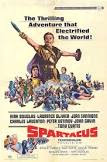
Spartacus 1960 Epic Historical Drama

This story of a slave revolt in antiquity also stars Kirk Douglas, this time heading a brilliant cast the includes Lawrence Olivier, Peter Ustinov, John,Gavin, jean Simmons, Charles Laughton, and a drop-dead gorgeous Tony Curtis! In my research, I discovered some thing quite wonderful about the writing here. Only in this one film did turn over the screenplay to someone else: Dalton Trumbo. Kubrick and Douglas, who were coproducers, boldly announced the name of their writer, even though Trumbo had been blacklisted by the McCarthy committee. As I suspected communist, he was not supposed to have a job.  Ordinarily in those bad old days. work of the blacklisted carried the name of a front.  But Kubrick and Douglas made it a point to be openly defiant.  The screenplay was based on a book by another blacklisted author--Howard Fast, who had been forced to self-publish because no publisher was allowed to do so.  On opening night, Spartacus was picketed by the American Legion. President John F. Kennedy crossed the picket line to support the flick. This film was instrumental in putting an end to blacklisting.
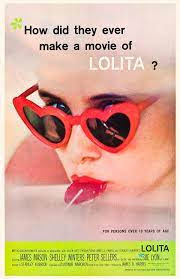

Lolita 1962 Psychological Drama

Kubrick wrote this screenplay jointly with Vladimir Nabokov, author of the notorious novel of the same name.  The Motion Picture Production Code enforcers had everything to say about what aspects of the original story could be kept in and which had to be toned down to such an extent that they lost all their drama and shock value.  Not even brilliant performances by James Mason, Shelley Winters, and Peter Sellers could compensate for the losses.  Kubrick later admitted that, had he known how deep censors' cuts would go, he wouldn't have tried the project in the first place.


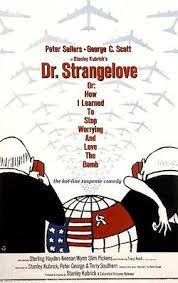
Dr. Strangelove or: How I Learned to Stop Worrying and Love the Bomb 1964 Satiric Thriller 

At the begining, Kubricks intention was to make the movie a serious thriller based on a book by Peter George called Red Alert.  Peter George himself, Terry Southern, and Stanley Kubrick worked on the play, but it became clearer and clearer to Kubrick that the story was not working as a straight thriller, that it needed to be a comedy. A stroke of brilliance that resulted in a masterpiece, one of the funniest movies ever made. I'll give you a little taste of the fun by just giving you the names of the characters: US Air Force Brigadier General Jack D. Ripper (Sterling Hayden), Group Captain Lionel Mandrake,and US president Muffley and Dr. Strangelove (all played by Peter Sellers), General Buck Turgidson, Chairman of the Joint Chiefs of Staff (George C Scott.  To name just a few.  I sincerely suggest that you buy this movie and watch it every few years. You'll never tire of it.


2001: A Space Odyssey 1968 SciFi

Kubrick wrote this screen play with with the brilliant Arthur C. Clark, who--as they were working on it--also wrote a novelisation of the story.  When one sees the film these days, Kuprick and Clark and the film's Art Director and Costume Designer seem to have been prescient!  If you watch it today, you will see clothing styles that look familiar, a laptop-style computer on which a traveler has a FaceTime phone conversation with his daughter back on earth, and, showing that the film is completley current, the main character has many conversations with an AI chatbot called HAL.

Not so impressive you think?  Well, consider this: this flick was released a full year before the then "miraculous" first humans landing on the moon.  Just four years before the film debuted, I worked on the first "real-time" computer project outside the Pentagon.  It required three room-size computers (two IBM 7080s and one 7740).  They sat in a specially air-conditioned glass box erected on a floor raised three feet; the space underneath it was fill with wires and quite a number of cathode-ray tubes.  The miracle that monstrosity could perform was that it could calculate an employee's retirement benefit in less than twenty minutes.  And yet, right around the same time, Kubrick and his team were inventing the setting and technology for their movie 2001, that also asked philosophical questions.  When I saw it for a the first time fifty-five years ago, it felt like a religious experience.
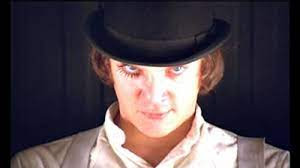

A Clockwork Orange 1971 Dystopian Crime

Kubrick based his screenplay on Anthony Burgess's astonishing 1962 novel.  The flick created a sensation when it was released.  I went to see it in its first week, bought the book the next day, read it immediately, and returned to see the film a second time one week later.  Parts of it very are violent, but the story is so well told that none of it seems like gratuitous sensationalism.  Malcolm McDowell's performance as Alex is perfect.


Barry Lyndon 1975 Period Drama

My professor of writing would have called this film and Thackery's book on which it was based picaresque: a story in which we follow the main character through al long series of life experiences.  Kubrick's direction and John Alcott's cinematography produced a gorgeous work of art.  Every frame of it looks like a beautiful painting. the acting, the music, the costumes, all perfect. 


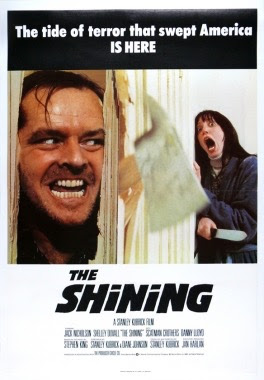
The Shining 1980 Horror

I tried to watch this film again, in fact I repeatedly tried until now there are less than three hours till midnight, when I have to click on "Publish."  I am sorry, I can't take horror in print or on the screen.  Not even if the story comes from the brilliant Stephen King.  Not even if it's a film by Kubrick.  Not even if it stars Jack Nicholson. In fact, especially if King, Kubrick, and Nicholson are involved.  they are all so brilliant at scary.  But no go for me. I run from the room.

I spent so much time trying to watch The Shining, that I haven't gotten to a new viewing of Full Metal Jacket and Eyes Wide Shut.  But I think I have made my case about the breadth of Kubrick's genius.

By the way, the way, the music in each film is worth a discussion in itself.  I used to own recordings of the soundtracks of Strangelove, 2001, Clockwork, and Barry Lyndon.  The have gotten lost in the shuffle of life.  First think tomorrow, I am going to rectify those omissions. 

Saturday, April 22, 2023

Dominion Voting Systems One, FOX NEWS Zip


Jeff–Saturday


Much of the media coverage this past week on a settlement reached on the first day of trial in the Dominion Voting Systems v. Fox News defamation lawsuit, got under my skin. So much so, that I decided to blog about it. But in a parody roughly based upon Mark Antony‘s soliloquy at Caesar’s funeral in Act III, Scene II of Shakespeare’s (who else) “Julius Caesar.”


The gist of what prompted my displeasure was watching the talking heads at some of the more liberal news networks tearing into Dominion and its lawyers for daring to settle this lawsuit.  They would have preferred to see Dominion risk it all for the potential psychic joy many might find in weeks, if not months, of reporting on FOX stars and key executives badgered and roasted in court while fessing up to truths about lies they’d been telling for years.


Yes, that would have made terrific theater, but done nothing toward guaranteeing compensation for the victim.


It’s also unclear the extent to which any of that would affect FOX’s ratings dominance.  After all, FOX is said to simply ignore reporting on anything it doesn’t wish its base to know—such as, for example, the amount or even the fact of its settlement with Dominion!


Bottom line, I see this as an expression of Fox’s critics’ anger at missing out on watching their longtime ratings nemesis relentlessly chastened as it twists in the wind on someone else’s nickel.


But we’re not talking about nickels. To be precise, Dominion would be passing on FOX’s 787.5 million dollar offer of settlement, a/k/a more than three-quarters of a billion dollars, a/k/a $787,500,000.00


WOW, those numbers remind me of some of the digits appearing in my new contract with my new publisher—more on that later.


So, here’s what I see as Mark Antony’s likely take on the masterful job done by Dominion and its lawyers:


FOX, CNN, MSNBC, lend me your ears.
I’ve come to bury Dominion, not to praise it.
The evil that networks do lives on;
The good is oft interrĆØd with their brands.
So it may be with Dominion. Murdoch
Hath told you Dominion was litigious,
And to strike at FOX was a grievous fault.
But Dominion pursued on undeterred,
Doing battle with Murdoch and his son.
(Murdoch is said an honorable man;
The same as others claim to be at FOX),
So they do not need me to speak for them.
Our besieged champion Dominion does,
‘Cause Murdoch views life as sacrilegious
When not seen as an honorable man.
For he brought many viewers home to FOX,
Along with ratings that filled its coffers,
Launching bitter lies at Dominion’s heart.
While FOX’s competitors whined and bantered,

Dominion showed itself of sterner stuff.
Facing down Murdoch’s minions’s words and threats,
And claims to be an honorable man,
The court did see, behind Carlson et al,
Was Murdoch offering a kingly crown
To one who claimed in lies to have earned it.
Still, Murdoch stood in battle, toe-to-toe,
Until his sharp rebuke before the court.
But I speak not to explore Murdoch’s words,
Rather to reveal what I do now know:
All that we’ve learned we owe to Dominion,
Yet the media is faint in its praise.
Favoring schadenfreude over clear judgment?
Has envy driven their reason away?
Dominion did its job: FOX surrendered.

To beat FOX ratings is another’s job––

Requiring far sterner stuff than banter.


Bravo, Dominion and its legal team, on a job well done.


Now for the promised announcement.


I’m thrilled beyond measure to announce that Chief Inspector Andreas Kaldis has found a new home at Severn House/Canongate Books and his next adventure (Book #13) will be released in February 2024.  It is set on Greece’s grand dame Aegean island of Syros–with New York City’s East Village in a supporting role–and features an
ambitious cast of complex characters caught up in the most challenging societal issue of our time: the dark-side ramifications of Artificial Intelligence.


–Jeff


Friday, April 21, 2023

Walking the Wall; The Roman Baths


Chester is a town in the west of England, slightly to the north and not that far from the Welsh border. it's 209 miles from London and sits on the River Dee. It's a lovely town, with the charm of Stratford Upon Avon and with the history of Bath, yet it's quieter and much less touristy.

The town is surrounded by a wall that is two miles long. Because of its unique position, Chester has been fought over, occupied, unoccupied, put under seige, released from seige and then reoccupied many times, and it bears the scars.

"The siege of Chester occurred over a 16-month period between September 1644 and February 1646 during the First English Civil War. In the engagement, Sir William Brereton and the Parliamentarians were ultimately successful in taking possession of the city and Royalist garrison commanded by Lord Byron."

Fair to say it has played a very important part in the history of Englandshire.


 It's famous for many things,  mostly Roman, and the famous wall still exists. It's a totally charming place, full of old buildings- the coffee shop dates from 1350. The town has 'rows' above street level, so the shops, bars, restaurants are on two layers. Walk around the bottom, one set of shops, around the top and you'll get a completely different experience.

You need to watch your head though, as the medieval types were short people - five feet tall in their stocking feet.

Lots of tall tourists in Chester have a sticking plaster on their forehead.

 For this blog, and for some cake at the end, we walked the full length/circle of the wall and you’ll see the pics in a future blog.

For now......


The old bridge and the River Dee, pic taken from the wall.

What a fabulous address.
These houses are high up, the wall being the height of a third story building in places.
The residents must be used to nosey tourists sauntering past peeking in while they are making a brew.

The wall skirts the racecourse.
This large house sits on the far side.
I think it's going in a book.


We descended the steps of the wall to explore the Roman gardens.


Bathing Roman style.
Quote "The laconicum (i.e. Spartan, sc. balneum, bath) was the dry sweating room of the Roman thermae, contiguous to the caldarium or hot room. The name was given to it as being the only form of warm bath that the Spartans admitted."

A brief history of the plants in the garden.
With a lovely quote about why gardening makes folks happy.


Bits of the mosaic floors have been replicated.


Areas of the Roman garden show the walls of the tombs.

The mosaic at the entrance.


The walk through, you can see the wall on the right.

The remains of the burial sites

The back of the famous Chester Cathedral- see a later blog.

The wall took a bit of a hammering in 1643 to 1646, you can see the damage the cannon balls did, and  the repairs. Chester was under seige at that time.

It's peaceful now and very pretty, a bit like the town itself.

Up on the wall, looking down at the racecourse. Hooves have dug up the grass on the sharp curve so replanting is underway.

Walking the top of the wall, circling round the back of the cathedral.

The luxury central heating of Roman times.
Might be useful nowadays if the cost of fuel doesn't stop going up.


We rewarded ourselves. It was 13000 steps horizontally.
Goodness knows how many up and down!

 Cheers

C