Thursday, October 27, 2022

Ghosts of the Karoo

 Michael - Thursday

Karoo Landscape

I’ve always been attracted to desert environments. The major ones in southern Africa are the Kalahari (mostly in Botswana), the Namib (unsurprisingly in Namibia) and the Karoo (in South Africa). Apart from the amazing topography that deserts offer, they are home to all sorts of interesting creatures and plants—some of which are still undiscovered. And who knows what sort of pharmacological properties they may have. That was the backstory of Dying to Live. They also have extreme temperatures by South African standards. I’ve seen the Karoo covered with snow, and I’ve baked in the shade at 110F.

The sparsity of the population in these arid semi-desert areas also leads to stories and legends, and the Karoo has plenty. Given the season, let’s listen to a few ghost tales.


The has-been railway station

There is the loneliness in the deserts, the settlements are sparse and unstable. There are many sad histories of towns that grew, and then died and became ghost towns. The bustling and well-kept railway station Putsonderwater in the Northern Cape Karoo is such a place. Only forty years ago it was a busy stop on the railway line linking the Cape to Windhoek and the railway station won an award for the best kept station in South Africa. Then drought gripped the area. “Putsonderwater” means “well without water” and it seems that most of the wells went that way as the water table dropped. The area lost support and eventually the trains didn’t stop there at all anymore. Not a scary ghost, but a poignant one.

Lord Milner Hotel, Matjiesfontein

A very different fate awaited the town of Matjiesfontein, gateway to the Karoo from the lush Cape the other side of the mountains, also a railway town. Founded in 1884, the Lord Milner Hotel was an upmarket destination for travellers escaping the damp of the Cape in winter to refresh their lungs in the clean, dry desert air. The town has been carefully restored and preserved as a tourist attraction—a Victorian town in the Karoo complete with a London bus! The Lord Milner continues to host tourists in an approximation of old-world English elegance.


Complete with Bus and Bugle

Cards anyone?

As for ghosts, The Lord Milner is host to Kate the Nurse. The hotel became a convalescent home for wounded British soldiers during the South African War (Boer War), and Kate apparently tried to cheer up her patients by playing card games with them. It is said that she sometimes stares down from a turret, and that you can occasionally hear her shuffling cards late at night. Kate seems pretty harmless, and it’s rather odd that she, rather than any of her suffering patients, haunts the hotel. However, as you drive along the main road, you pass small graveyards of the soldiers who didn’t make it to the Lord Milner. Travellers tell tales that if you drive the road at night, you may see a few soldiers standing at the side of the road, limbs wrapped in bloodied bandages. I’ve done that section of the road many times and several times at night, but I’ve never seen much more than a jackal and an occasional owl. Certainly nothing scary.

The old days...

In fact, generally the ghosts of the Karoo seem, if not friendly, at least not dangerous. One can’t help wondering at what stage in the The Lord Milner’s marketing campaign Kate were inserted. Before the bus, I’d guess. It seems that most of the ghosts evolve from the English settlers. The Dutch Voortrekkers, with their horrendous and often deadly journeys, diseases, and nasty wars with the local Africans, would seem to be a richer vein for ghosts, but perhaps not so attractive from the marketing point of view.

Another tourist attraction is the “Merry Ghost Trail” from Uniondale to Burgersdorp. Various stories are told about the road. The one I like best illustrates the good sense of the local God-fearing settlers. Apparently, one evening the lady of the house was entertaining a few guests and they were drinking sherry. (The story does not specify the amount of sherry.) Suddenly, from the fireplace, a poker and tongs jumped up and began to cavort around the sitting room. The hostess didn’t panic or even look particularly surprised. She immediately rose and fetched the family bible. Then she read suitable passages to the tongs and poker until they calmed down. After that she returned to her sherry.


Happy Halloween everyone!

Wednesday, October 26, 2022

My Halloween Confusion

Wed--Kwei 


This is a repeat of my post from last year because every year I ask myself the same question: “Remind me again why we’re doing this?"

Like many celebrations throughout the year, the meaning of Halloween has morphed over the centuries and lost its original meaning. As most sources will tell you, the word Halloween comes from All Hallows Eve, or the eve of All Saints' Day, which is the first of November; hence the eve is October 31. The Oxford English Dictionary records the earliest use of All in 1556, and the latest in Shakespeare's Measure for Measure of 1616 (Allhallond-Eue)After that, the "All" seems to have dropped out of use.

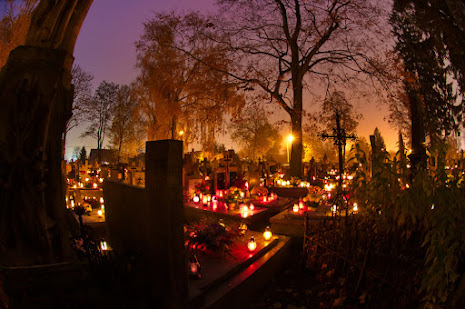
Decorated cemetery on All Saints' Day night (Shutterstock/Jaroslav Grudzinski)

All Hallows Eve(n) --> Hallows E'en --> Halloween

"Hallows" refers to a holy person, deriving from the old English word, halig for holy. We're familiar with the phrases "hallowed grounds," and "hallowed be thy name," in the Lord's Prayer, meaning venerated in those contexts. For an in-depth linguistic discussion of the history of Halloween, see this piece by Neal Whitman.

What might be less well-known is that although the word Halloween derives from a single source, the celebration itself draws on two historic celebrations: the ancient Gaelic (subset of Celtics) festival of Samhain, [pronounced, oddly enough, sow-win] (from sunset of October 31 to sunset November 1) and the Christian holiday of All Saints' Day. Here's a little bit about Samhain:

Samhain has pre-Christian roots and marks the end of the harvest season and the start of the darker half of the year. In Samhain, there was the belief that spirits, good and bad, could more easily enter the physical world. As part of the festival, people would gather to burn animals and crops in bonfires as sacrifices to the Celtic gods and deities. During the celebrations, people would dress up in costumes and dance around the bonfires. The point is, the festival was very much tied to the cycle of life and death. As was the habit of Christians, they annexed a "Christian" celebration, All Saints' Day, to a pagan one in the hopes of "converting" said pagans. (NB: paganism is not in itself evil, but it has become a derogatory word at the hands of monotheistic religions). The "trick-or-treat" tradition might have come from Irish and Scottish holidays in which people would dress up and visit homes to perform antics, sing a song, recite a poem, etc. in return for a treat.

Often discussed in this context is the Day of the Dead, or El Día de Los Muertos. This tradition dates back some three thousand years ago to the Aztec people. Celebrated in Mexico and elsewhere, it's sometimes incorrectly called, "Mexican Halloween." The "day" is actually Day of the Innocents on November 1, and Day of the Dead on November 2. Rather like the Celtic tradition of Samhain above, on the Day of the Dead, the border between the spirit world and the real world disappears. During this brief time, the souls of the dead come awake and return to the living world to celebrate. Hence, food and drink are left out at gravesides and on altars. Also prominent are decorative and elaborate skeletons and skull masks.


Dia de los Muertos festival in Mexico City (Shutterstock/IlanDerech)


Is there Halloween in Africa?


There is no original African celebration, event, or occasion on a selected day called "Halloween" as known in the US and other western countries that have adopted the tradition. Halloween's origins are not shared by African traditions, particularly as the history of Halloween is tied in part to the changing of the seasons from summer/autumn to winter. Certainly in West and Central Africa, there are only two seasons: wet and dry. Halloween has little relevance to most Africans. I asked a Ghanaian friend who has never been out of Ghana about it; he had never heard of Halloween or All Saint's Day. (Arguably, Christmas shouldn't be relevant in Africa either as its origins are tied up with pagan traditions around the winter solstice. But Christmas, for lots of reasons not the least of which is Jesus is at the center of the tradition, is in a league all of its own all over the world.)

If Halloween parties are held somewhere in Africa, they would be almost certainly "borrowed" from the West and perhaps held by expatriates. In Rwanda in 2013, Halloween parties did not go down well with the Rwandan government, which banned such gatherings, stating that "hono[u]ring the spirits of the dead is inappropriate and against Rwandan culture." One reason why that could be the case in Rwanda and other African countries is that phenomena like spirits, the ancestors, magic, and juju are taken seriously and can even be part of daily life. Essentially, the African perspective--certainly West Africa--is don't joke around with that kind of stuff. Placing a mock graveyard with ghosts and ghouls in your front-yard as Halloween "fun" would be seen as seriously bizarre in Africa and probably offensive as well. 

At the same time, there are many African ceremonies with a central theme of communicating with the ancestors, and some are performed with the wearing of elaborate masks, which represent the spirits of those ancestors e.g. FESTIMA in Burkina Faso, and Nigerian mask festivals. In other words, unlike modern Halloween, there is a deep meaning embedded in those traditions themselves. 

Ceremonial mask dance in Burkina Faso

                                                        (Shutterstock/Dietmar Temps)


The bottom line

Halloween has historical origins, but in modern times it's a commercialized celebration of dubious value in which children and adults dress up in costumes of all types--scary and not--often their alter egos or favorite superhero. It's also the warning that the interminable holiday season is about to begin, so start shopping.

And finally, what do pumpkins have to do with all this? All you need to know about this is there's an Irish legend with a guy called Jack whose ghost roams around restlessly. The carved pumpkin (originally carved turnips) is supposed to scare Jack away. 

As time passes, perhaps the occasion will be called Holloween. One celebrant, an adult, thought the name originated from the fact that your stomach is hollow before you get all that candy from trick-or-treating.


Tuesday, October 25, 2022

Happy Deepavali! Today is 'Mountain of Food' Day!

 Ovidia--every other Tuesday

Deepavali celebrates the triumph of good over evil, light over darkness, knowledge over ignorance.
It's celebrated with oil lamps light displays and--for the first time in three years--joyous gatherings!

Even though Deepavali is a five day festival, here in Singapore only one day (yesterday, the actual Deepavali) is a public holiday. But being Singapore, celebrations, decorations and food are up a month in advance.

I know, I should have come to get photos after dark when all the decorations are lit up--this is a celebration of light over darkness so there are also oil lamps and kids playing with sparklers--but I needed to get this post out! 

A quick run through of this festival:

Day One: October 22: Dhanteras or Dhan Trayodashi, a day dedicated to Lakshmi, the goddess of wealth.

It's an auspicious day to celebrate the Goddess Lakshmi by buying gold, silver, clothes, electronic gadgets...

Day Two:  October 23: Narak Chaturdashi, also known as Choti Diwali

According to tradition, this is the day Lord Krishna fought and defeated the demon Narakasura and liberated the sixteen thousand princesses that had been held captive.

Day Three: Monday October 24: Deepavali 

This is the main festival day of Deepavali, and a public holiday here. This celebrates the day Lord Rama returned after killing Ravana and the day Goddess Lakshmi comes to bless people with luck and riches.

Day Four: Today, Tuesday 25 October is Govardhan Puja, the 4th of the 5 days of Deepavali, also known as Annakut, meaning 'mountain of food'.

This commemorates a(nother) flood story--after 7 days of torrential rain, the people of Mathura begged Lord Krishna to save their lives. Lord Krishna told the villagers to go towards Govardhan Hill, which he uprooted and held on his little finger. The villagers and all their animals took shelter beneath and were saved.

And it's celebrated (sorry I only have a secular experience of this) with offerings of sweet and savoury delicacies (vegetarian) and flowers that are then shared among the people.

I went down to Campbell Lane and Hastings Road in Serangoon to see some of the decorations and feel the excitement. It was raining, but the atmosphere was fantastic!

(It was a bit demoralising to be called 'Aunty' by strangers but when they're offering me a seat/ an umbrella/ directions/ warning me a patch up ahead is slippery and giving me mithai I can live with it!) 

And there were flowers everywhere, the fragrance was amazing!


Just one example of the flowers. 

It was really crowded on the five foot ways as people tried to stay out of the rain as much as possible without missing anything that might be happening on the other side of the road. Men were threading jasmine garlands as women painted henna tattoos and 'bracelets' and children pointed to cakes and candies...

Which I also found very interesting.


These are just some of what I brought home. I don't know the names of all of them but they're all delicious!

Day Five: Wednesday 26 October. Tomorrow is Bhai Dooj, the final day which celebrates the unconditional and eternal bond between siblings.

This is an occasion to exchange sweets (or at least sweet words) with your brothers or sisters!

This is as far as I've got in identifying my sweet loot. 


If you help me identify the orange and white cakes I would really appreciate it!

The only one I'm sure of is the 'adhirasam' because the nice lady who recommended them (she was getting them as gifts and to pray with) spelled it for me. The sugee biscuits and coconut candy are guesses because they taste like sugee cake and coconut.

And though I'm a little late, Happy Deepavali everyone!


Monday, October 24, 2022

Limericks for Mental Health


Annamaria on Monday

New one to introduce this repeat:

Every Sunday Patricia must blog
On a subject she chooses to flog, 
But she cannot today
Her brain's not okay
It's stuck in a terrible fog.

The rest is a repeat I hope you will enjoy;


For many years now, I have written limericks to let off steam. Perhaps the rigidity of the form forces me into a more logical place in my brain, which would be very helpful when I am about to go over an emotional cliff. Limericks have been a source of glee and groans and, I think, sanity in our house since my husband and I got together. Though he was always a classy man and often hilarious at the higher levels of humor, there ran beneath his quick wit an indomitable sophomoric streak, often fueled by the limericks he memorized in his youth. Those included many I cannot publish here. According to Wikipedia:

“A limerick is a kind of a witty, humorous, or nonsense poem, especially one in five-line anapestic or amphibrachic meter with a strict rhyme scheme (AABBA), which is sometimes obscene with humorous intent. The form can be found in England as of the early years of the 18th century. It was popularized by Edward Lear in the 19th century, although he did not use the term.

The following example of a limerick is of unknown origin.

The lim'rick packs laughs anatomical
In space that is quite economical,
But the good ones I've seen
So seldom are clean,
And the clean ones so seldom are comical.”


 Here is one of David’s unclean favorites that (with two small changes) I think I can safely include.  He recited it whenever anyone mentioned the woman’s name:

There once was a woman named Harriet,
Who dreamed she made love in a chariot
With seventeen sailors
A monk and two tailors
Dick Cheney and Judas Iscariot


David and I once won a limerick contest. We were traveling in Wales and stayed at a hotel that had once been a castle. The hotel staged a fake medieval dinner each evening in which, in addition to eating lamb stew with one’s fingers, the guests were invited to submit a limerick to a contest. The first line was given.  The weekend we were there, the required first line was: “A Squire with a hole in his shoe.”

The wittiest Brit wrote took second place with:

"A Squire with a hole in his shoe
Invented a substance called glue.
The source was a horse.
He boiled it, of course,
And the smell killed a family in Crewe."

But to the great surprise of all, David and I – two Yanks, no less – took first place with this little ditty:


"A Squire with a hole in his shoe
Was badly in need of a screw.
With his tool in his hand,
He scoured the land,
But decided a small nail would do."

A few years ago, while renovating our apartment, an architect appointed by the building management was delaying our simple project for months and running up his bill, which we were required to pay.  It was costing me sleep as well as lucre. While I lay awake at night fuming, I preserved my sanity by writing a cycle of twelve limericks describing how an architect by that SOB's name destroyed every great building project in history.  I give you one stanza of my poem, concealing his identity by substituting the words “Sir Note:”


To span an English river of renown,
“Let’s build London Bridge,” decreed the Crown.
But then enter Sir Note,
Who declared and I quote,
“If we never put it up, it can’t fall down.”

By the way, I gave him a Spanish-i-fied  moniker and killed him in my second novel—Invisible Country.  That character, Ricardo Yotte’ is so hideous that it is almost impossible to figure out who killed him, since everyone in the village wanted to.

Not all my limericks have been pejorative.  Some celebrated my friends—their birthdays, their achievements.  But I wrote my favorite one just for fun.  Here is my proudest limerick achievement:


In the subways of Paris, his home
This elf forever will roam.
So if you hear “Tick tock.”
Don’t think it’s a clock
Undoubtedly, it’s Metro Gnome.


I should apologize, but I can’t. 

Sunday, October 23, 2022

The Ultimate in Recycling--on Japan's Kumano Kodo Pilgrim Trail

 -- Susan, every other Sunday


Japan is big on recycling. From multiple bins and collection days (I have six bins in my kitchen, and take out various types of recycling three days a week) to recycling bins beside (almost) every vending machine,  for easy disposal of empty cans and bottles, it's a country that loves "reduce, reuse, recycle." 

But perhaps the most impressive example of recycling I've seen in Japan goes far beyond plastic and aluminum.

The village of Koguchi sits nestled in a narrow valley along the ancient Kumano Kodo Nakahechi, a pilgrim trail that winds through mountainous Wakayama Prefecture to the three Kumano Grand Shrines (Hongu, Shingu, and Hayatama Taisha).

It's difficult to photograph Koguchi from a distance, as the picture below demonstrates. The village sits between the Kogumotori-goe ("Small Cloud-Grasping Pass") and Ogumotori-goe ("Large Cloud-Grasping Pass") - two of the highest passes pilgrims encountered on the trail, and two of the last, for those who took the pilgrimage in a West-to-East direction.

I took the picture below standing atop the lower Kogumotori-goe, and the Ogumotori-goe passes over the mountains in the background. Koguchi lies far below the clouds, between them.

The Kumano Kodo, coming over Kogumotori-goe

For centuries, Koguchi (whose name translates "little mouth") was isolated by its mountain location, but also a vital link in the Kumano Kodo chain. The village inns hosted travelers, and its restaurants offered refreshment to hungry and thirsty pilgrims, who often stopped there for the night before attempting the trail's highest pass the following day. 

Entering Koguchi on the Kumano Kodo Nakahechi

The trail enters the village near the river that cuts Koguchi in two, and is home to the sweetfish that formed a primary part of the village's diet for centuries.

The bridge, entering Koguchi

Today, a bridge makes it easy to cross the river, but at the height of the pilgrimage's popularity during the 12th and 13th centuries, pilgrims had to cross the river on one of the flat-bottomed ferries operated by villagers.

The river runs lower than it used to, especially in winter.

On the far side of the river, and a small way up the road, stands the former Koguchi Middle School.

Formerly, Koguchi Middle School

Japan's declining population, combined with the tendency of young people to move to the cities in search of modern types of work, has sent many remote, traditional villages into decline. The smaller, aging population also meant that the middle school, once a necessity for the village children, closed from lack of need. (Today, the middle school children of Koguchi take the bus to schools in cities up to an hour away.)

However, instead of letting the school go derelict and decay, the residents of the village came together and came up with an intriguing plan: why not transform the school into a village-run ryokan (traditional Japanese inn) for modern travelers hiking the Kumano Kodo Nakahechi? 

Koguchi Shizen-no-Ie

The plan succeeded, and the former school--now a ryokan called Koguchi Shizen-no-Ie--allows hikers on the Kumano Kodo to stay on the actual trail, in the village where pilgrims have sheltered for centuries. Each of the former classrooms has been converted to a Japanese-style guest room, complete with tatami floors and seating area. 

A guest room at Shizen-no-Ie

Residents of the village man the front desk, cook and serve the evening and morning meals (which are delicious), and handle all of the other tasks that go along with running a ryokan.

Another guest room, where I stayed in 2020

The inn is small, with only 11 rooms (each of which can accommodate 1-4 guests, depending on the number in your party), and often fills up far in advance year-round. It employs the local residents, and continues the centuries-old tradition of Koguchi playing host to travelers on the Kumano Kodo.


A beautiful morning in Koguchi.

An excellent example of recycling, indeed.

Saturday, October 22, 2022

SECOND UPDATE: Murder, He Wrote


Jeff–Saturday


Fifteen months ago, I reported on a murder so horrendous that it shook the Greek people to the core. [See, Murder, He Wrote for an extensive description of events.] So much so, that Greek National TV interrupted coverage of the Euro football championships to broadcast details of the confession.


It involved a 20-year-old British-Greek wife and mother, Caroline Crouch, murdered on May 11, 2021 in the presence of her pilot/flight instructor husband, Babis Anagnostopoulos, and 11-month-old baby.  The original story, as told by the husband, placed the blame on a band of brutal home invasion thieves claimed to have entered their suburban Athens home at random.  He accused them of being Eastern European foreigners—so ruthless that they also strangled the couple’s dog.  The crime spread fear across the nation over the potential risk to each family’s safety in its own home.


On June 16, 2021, after eight hours of police questioning, Husband confessed to the murder, claiming his wife told him that she was planning to leave him and take their baby with her before he “blurred” and killed her. In other words, a crime of passion, not premeditated.

At the time I wrote, “I’m sure [the story] will make its way into any number of fiction and non-fiction novels, for it’s a tragedy steeped in outrageous deception, domestic violence, and endemic prejudice.  It’s also a tale of sharp police work, with an ironic final twist.”

Five months ago, in an update to my original post, [See, UPDATE: Murder, He Wrote] I described in detail a new twist asserted by Husband on the verge of trial.  He now claimed to have acted “in a fit of rage” over Caroline’s “mistreatment” of their baby daughter and that he’d acted to protect the baby. As the press reported at the time, Husband was desperate to avoid the life sentence and minimum twenty-year imprisonment imposed for premeditated murder. Not to mention an additional likely ten-year sentence for killing their dog.


I concluded that update with this line: Stay tuned for further plot developments…

Well, those developments have come to pass.  They’ve been reported in a media feeding frenzy that overlaps so much in coverage, including translations, that the best I can offer is a fair representation of the participants’ quotes, as culled from BBC, Daily Mail, Guardian, Greek City Times, Greek Reporter, and the Sun, but the substance is all here. 

As described in Greek City Times, “In court on Wednesday [May 11, 2022], the killer recounted how he had met his wife when he was in his late twenties, and she was just fifteen. The two began a sexual relationship when Crouch was just sixteen.

“‘She is the rarest person I have ever met in my life. A brilliant woman. At 16 you could speak with her about anything. Her personality was lovely. She filled anyone with love,’ he stated.

“If I could turn back time, I’d choose Caroline again.”


All of that was offered as part of Husband’s plea to the court for mercy, hoping for a finding of no premeditation. This time, though, he dropped his “protecting the baby” contention in favor of a return to his claimed “heat of the moment” reaction to Caroline telling him she wanted to leave him and take their child with her.

Bottom line: A mixed court of jurors and judges didn’t buy it, and unanimously found husband guilty of the premeditated murder of his wife and strangulation of their dog. 


On June 16, 2022, the court sentenced Husband to the toughest penalty possible under Greek law: a life sentence for the premeditated murder of his wife, a jail term of 11 years and six months for the brutal killing of the family’s pet dog, and a fine of €21,000.


Not surprisingly, Husband has appealed the sentence and is attempting to paint himself as a model prisoner, dedicated to helping his fellow inmates, and having personally intervened to end dangerous interactions among inmates.


However, not all his fellow inmates would agree.


Remember those unidentified “foreigners” husband originally had blamed for the murder of his wife? 


Let’s just say, as the adage goes, Karma is a bitch!

According to the Daily Mail, three days after Caroline’s murder a Georgian man was arrested up by the border of Greece and Bulgaria.

The Georgian matched a photofit of one the burglars Husband had given investigators.  Allegedly, he was tied to a chair and beaten for four days by Greek homicide police.

Following his arrest, the Georgian was paraded in front of the court in Athens by triumphant police who said he was the prime suspect.

The Georgian told Georgian media: “I was tied up for four days and beaten while they told me to confess to this girl's murder.

“I did not know what was happening, I had never even heard of this girl. They would take turns beating me very hard, my head was spinning, and I had a concussion.

“When one got tired, the other would then start to beat me. All they would say was 'Tell us how did you kill her, how did you get in the house, how did you get out of there?”

Ultimately, he was released, after being charged with an unconnected robbery.


Upon Husband’s conviction, three officers from the Athens homicide squad were demoted by reason of the treatment of the Georgian man while in custody.

Husband, though, faces far more serious consequences by reason of his part in the treatment of the Georgian.  As described in this Daily Mail headline:


Greek pilot who murdered his British wife, 20, is moved to a tougher prison as it emerges he was previously attacked by inmate 'wanting to kill him' in revenge after his friend was wrongly arrested during investigation.”

Husband spent a year in Athens’ high-security, notoriously tough Korydallos prison awaiting trial. While there, he was attacked by a Georgian inmate, who the guards were able to stop before he did harm to Husband.  According to the inmate, he’d come from another prison, and been looking for Husband because he wanted to kill him in retaliation for how his fellow Georgian­–who’d been wrongfully arrested for Husband’s crime–had been treated by the police.

According to Husband’s lawyer, “The attack happened in the wing where my client was in custody and there have been other attempts to attack him. He is scared but, at the moment, he is fine.’`             

Husband has since been moved 250 miles away from Athens to another notorious prison, Malandrino, and he is not happy about his transfer.

He’s complained that the location makes it much harder for his family to visit him and it will be very difficult if not impossible for him to see his daughter.

Yep, that’s one of his arguments. Sort of like the old dark joke about the father who brutally killed his wife looking to avoiding the death penalty by claiming his execution would leave his children orphans.   

But, as you may have guessed, in truth there’s a more likely reason for Husband challenging the transfer. He’s now in a prison housing 900 hardened criminals, many convicted of heinous crimes. Husband fears for his personal safety. He claims there are contracts out on him offering a “huge amount of money” for his death. As bad as it was in Athens, where he is now is worse.


Husband is said to have spent his first few days at the new prison in solitary confinement before being placed in a cell with three other inmates.

As for Caroline’s family’s reaction to Husband’s current predicament, her father, David, had this to say:

“No amount of prison time can ever bring back my beautiful daughter but I am just gratified that the court didn't believe the scurrilous nonsense that he produced during his testimony.

“I am further gratified to know that he will serve his time in the toughest prison in Greece which has one of the worst prison systems in Europe.

His being “incarcerated with fellow murderers and perverts of every stripe in that prison has provided a sliver of consolation.”

“When he eventually completes his sentence, which many people think he might not survive, he will be a changed man, a broken man, far older than his true age.

'Now that his fate is settled, Susan and I can move on. I intend to change Lydia's name to that of her mother so that she will never be associated with this odious creature.”


Why do I sense this story is not over?


––Jeff


Jeff’s Upcoming Book Events

Friday, November 18, 2002 @10am

ICELAND NOIR

Reykjavik, Iceland

Where is My Mind? Madness and Obsession
AUTHORS:  Louise Mangos, Paul Cleave, Jeff Siger, Thomas Fecchio
MODERATOR: Ewa Sherman