Showing posts with label short stories. Show all posts

Thursday, March 21, 2024

TITLE PAGE

Wendall --- every other Thursday

I was having a discussion with my film students last week about the importance of titles and it got me thinking about whether their function is any different for novelists than for screenwriters. 

Did its one word title land it in the top grossing movies of all time?
 

Many studies have been done that suggest films with one or two word titles do better at the box office. When I checked a list of the 50 biggest hits in film history (adjusted for inflation) 31 of the 50 were indeed short ones, including Jaws, Star Wars, Titanic, Ghostbusters, The Exorcist, Avengers: Endgame, Black Panther, The Sting, Home Alone, Forrest Gump, Grease, and The Graduate. But that left 19 that were three words or longer, and in fact, the top four on the list are slightly longer: Gone With the Wind, Star Wars: Episode V A New Hope, The Sound of Music, and E.T. the Extra-Terrestrial.

Hit book and film. Was it the single word? Or the shark?

 
Another hit book and film. Was it the two word title, or the nylons?

For me, one of the most important things, after the length, is the tone of the title and whether it suggests the genre it’s going to deliver. I remember once reading a script called The Hitler Family Reunion. You can imagine my dismay, and disconnect, to find out it wasn’t a comedy. So it needs to prepare you for what is coming, particularly in the submission stage.


When I began to look up this question in regard to novels, the opinions seemed to be all over the place. Some sites suggested one word titles were preferable, because they left more room for cover art. But many said the length didn’t really matter, citing the enormous popularity of books like Harry Potter and the Philosopher’s Stone (or any of the Harry Potter titles . . .), All the Light We Cannot See, or The Hitchhiker’s Guide to the Galaxy.


Title length didn't seem to hurt this book. . .

 
Or this one.

Perhaps with novels, the writer’s name means more than the title—Lee Child, Michael Connelly, and Sara Paretsky have largely varied titles (many of which I can’t recall in this moment) but I bought all of them. Of course, when you have a famous author and a title with a hook—Sue Grafton’s A is for Alibi and the rest of her Kinsey Milhone alphabet series or Janet Evanovich’s One for the Money, Two for the Dough, Stephanie Plum series—you appeal to the audience in two ways.


This hook worked the first time, and for almost 25 more. Sob.

 
First edition of Cornwell's bestseller-- all about the title.


And a later one, all about the writer.

Certainly, most of the novels by Dickens and Austen fall into the “two word” category, but Faulkner and Hemingway usually spilled over to at least three or four.


So, it’s hard to know what changes and compromises you need to make to your title, for the marketplace.


Most of my scripts and novels have gone through a few “working” (and ultimately non-working!) titles before I finally settled on the right one. My first script, about a woman who says no to a genie, started as a nod to Bruno Betelheim, The Uses of Enchantment, but on the advice of my agent, became Wishful Thinking. My second script, about the “Robin Hood” of insurance started and remained entitled Premiums for 20 years, until it was optioned by two Australian producers who wanted it rewritten for that market, and so I renamed it The Kangaroo Clause.


When I wrote a script about my experiences as a woman teaching Jack Kerouac novels at an all-male boarding school, it started as In Loco Parentis, then Lunatic Lit, and finally went out as Off the Road.


My favorite rom/com script started as Our Little Secret, then, Liars in Love, was submitted around town as A Case of You, and currently exists as 15 Reasons to Live.


Now that I am writing screwball mysteries, which have an amateur sleuth, but don’t obey the rules of the cozy, I needed titles that might attract open-minded cozy readers, but would also indicate a slightly zanier tone and suggest the travel aspect of the series. All four book titles have been a challenge.


Lost Luggage was based on my original script, Animal Instincts, which, in the end, I thought sounded too much like soft-core porn. But when I started with a two word title, it seemed I was locked into that for the series. Thank goodness, one of my dear friends came up with Drowned Under, which totally captured the Australian cruise element, but it took me months to land on Fogged Off for Cyd’s adventures in London, after testing truly horrible ideas like Thames to Die and Death Tube.


My peek into the world of endangered bird smuggling, was initially Bali,Why? until the copy-editing stage, where my editor vetoed the idea, saying everyone wouldn’t get the joke. I lobbied for The Big Tweet, until Elon Musk ruined that. Fowl Play was taken. We were right down to the wire in finally settling on Cheap Trills.  I’m really happy with it, aesthetically, but it has proved problematic, since no matter how many times I’ve written Amazon, when you type in Wendall Thomas, Cheap Trills, it takes you straight to a page full of cheap, wild-headed TROLLS! 


See below!


I have to admit, I enjoy choosing short story titles much more, since the pressure to buy the book isn’t on my shoulders, it’s down to the editors’ title choice. In Murder A-Go-Gos, where all the stories were inspired by Go-Go’s hits, my work was done for me. But I feel like my first published story, “Loser Friend,” as well as the two below, are my favorites.


From Sisters in Crime LA's Anthology, Last Resort.

 
From this year's Crime Under the Sun.

Readers, writers, and MIE compatriots, do you agonize over your titles? And how often do you choose a film, or a book, based on the title alone?


---Wendall


Wendall’s fourth Cyd Redondo novel, Cheap Trills, has been nominated for a Lefty for Best Humorous Mystery of 2023 and she will be attending Left Coast Crime April 10-14.


Please find her on the Best Humorous Panel (Friday the 12th), the “Dogs and Cats and Birds, Oh My” panel on Sunday the 14th, at the table she is hosting with James Bartlett, or stop and say hello in the hallways or the bar!

Thursday, July 13, 2023

I Would Prefer Not To, But I Did

 Wendall -- every other Thursday

I’ve always loved short fiction. There’s something about a concentrated nugget of narrative—in any genre—that I find so satisfying. I’ve written before about my admiration for Henry James, and Flannery O'Connor, both considered masters of the form, and their examples have always delighted, astounded, and intimidated me. 


I was mad for Ann Beattie stories in college—I loved the way they just stopped, rather than ended. I devoured all the Hemingway stories I could get my hands on, for the economy of prose, and the Faulkner stories for the exact opposite. I’ve mentioned my mentor Doris Betts before, and her collection, Beasts of the Southern Wild, was also a favorite. “Bartleby, the Scrivener” was always in there, somewhere. And, like him, when it came to writing short fiction, my internal critic always chimed in to say, “I would prefer not to.”


So, until 2015, I’d never even considered trying to write a story myself. But when Sisters in Crime LA sent out a call for blind submissions for their LAdies Night anthology, I wondered if I should at least give it a try. I figured I had nothing to lose.


I’d been carrying around a line for ten years that I’d wanted to use but had never found the right home for. I heard it one morning in the 90s, when I was writing in a local cafe. Three twenty-something, visibly unemployed actors were talking loudly about their future careers. At one point, one of them said “Yeah. When we’re the Sean Penns of our generation, then we can probably keep, like, one loser friend.”


After a less than subtle spit take with my cappuccino, I committed the line to memory. And felt a bit of a twinge, since in that period, I was aware that I was probably the requisite “loser friend” for a few of the “rising star” actors, writers, and musicians in my life. 


90s Loser Friend to the stars...
 

So I sat down to try to write “Loser Friend.” I set it in Los Angeles in the 90s, drawing on my experience as an entertainment reporter and house sitter for the rich and famous during that time. By some miracle it was accepted and was the first thing I ever had published. I was privileged to have Naomi Hirahara as my editor. She made the story appreciably better and going to the launch party was one of the best nights my husband James and I have had in LA.


Me and James on our way to the LAdies Night launch party

Book cake!
 

My second published story, also set in LA in the 90s, began with another line I’d been carrying around in my head—something I often said to my husband about our very loud and erratic next door neighbor—“Tweedledum is off his meds again.” Since the story was set in that nether world inhabited by so many part-time screenwriters—the restaurant job—I called the story “Eggs Over Dead.” I was lucky enough to have Matt Coyle as my editor and, like Naomi, he pushed me to improve the story.


Me and Matt promoting Last Resort at the LA Times Festival of Books
 

When I was lucky enough to be commissioned by editor Holly West to write a story inspired by the song “Forget That Day” for the Murder-a-Go-Gos anthology, I was starting from a line again. This one was a bit tougher, since it wasn’t something I’d been chewing on for ages. I flailed around for a bit, and then decided it might help if I returned to my “sweet spot” of 90s Los Angeles and another of my former part-time gigs, as a casting assistant on Young Guns. I got the story in just in time, and of course, Holly made it better.


Working with the Young Guns cast back in the day.
 

I’m thinking about all this, because last week I was lucky enough to have my fourth story published in the new San Diego Partners in Crime anthology, Crime Under the Sun, and it also started with a line that wouldn’t leave me alone, one I’d heard from my kitchen, voiced in the kind of hysterical gleefulness of late night TV ads. It was for a Los Angeles bail bonds company which proclaimed “Your 10th Bond is Freeeeeeeee!” I couldn’t stop laughing.


I knew I wanted to write a story with this title and started, and abandoned, five or six different storylines over several months. Should it be about someone trying to commit their tenth crime? Should it be about a bail bondsman who knocks off his clients before they hit ten? I couldn’t quite crack any of those ideas. Then, when another blind submission call came, complete with deadline, the story came to me.


Of course, “Your 10th Bond is Free!” it’s set in late 80s/early 90s Hollywood. Of course, like the others, it is significantly more cynical than my Cyd Redondo books. By a lovely twist of fate, the anthology was edited by Naomi Hirahara, Matt Coyle, and Tammy Kaehler, who was also very instrumental in helping my career early on. 


ME and Naomi at Book Carnival
 

I had Naomi as my editor for the second time and her support has helped me feel that maybe there is a small lane for me in this part of the mystery world, which intimidated me for so long.


--- Wendall

Tuesday, May 31, 2022

Dark Deeds, Down Under


Craig every second Tuesday

Kia ora and gidday everyone,

So it's the half-term break here in the UK, and I was meant to be going camping with Miss Seven the past three days - her first 'sleepaway' camp with the local Woodcraft group she's been going to (Woodcraft Folk is a Scouts-like group that I hadn't heard of myself until recently, but has been going for almost 100 years and is pretty big here in the UK - I guess like some of those other outdoorsy groups in the US like Camp Fire etc). 

Unfortunately a wee gastro bug on Friday put paid to our plans for the weekend - and my thoughts of writing today about getting out into nature, or revisiting the childhood Scouts/camping/summer camp kinds of thing with my own daughter now rather than being a kid or a leader for others' kids, as I've done in the past. Another time. 

But while I was feeling a bit sorry for myself and like the world's worst Dad (I was the one who came down sick just before we were meant to go to camp), something good happened to lift my spirits. Well, Miss Seven was being an absolute trooper and keeping a smile on my face, even though she was pretty disappointed herself - but this was another outside-the-household thing that made me grin when I woke up on Saturday morning: the cover was finalised and the official announcement made about the first anthology I've edited: DARK DEEDS DOWN UNDER

DARK DEEDS DOWN UNDER is a first-of-its-kind anthology
of Australian & New Zealand crime and thriller short fiction

So if you'll indulge me, I thought I'd share a bit more about this cool project I've been involved in for the past few months. I'd say 'I'll write about nature next time', but in fact there's a fair bit of nature in this book, threaded through some criminally good stories. After all, the presence and impact of rugged elements (and weather) is one of a few things that can make antipodean crime writing a little distinct and different from its British counterparts.

While you could say that next month's publication of DARK DEEDS DOWN UNDER will be the culmination of a project kickstarted last European summer/autumn, you could also say that the seeds of it all go back far, far further. In a way, it's another culmination of several of the crime writing related things I've been doing the past fourteen years - and that Lindy Cameron, the long-time President of Sisters in Crime Australia as well as the publisher at Clan Destine Press and an acclaimed crime writer in her own right, has been doing for twice as long. 

It's been fabulous to collaborate with Lindy and all the authors on DARK DEEDS DOWN UNDER. We have 20 outstanding storytellers in the first volume, a diverse constellation of Aussie & Kiwi storytelling talent. And yes, I said first volume, because due to the enthusiastic response from many, many authors I reached out to as Commissioning Editor we've already decided to make it something of a series. The second volume (many of the stories already gathered for that one) will be out late this year, just before Christmas. And the third, next year. 

The 'Quiet King of Aussie Crime', Garry Disher, is among the authors providing brand-new stories with the series characters for DARK DEEDS DOWN UNDER

While some things dragged out a little - as many creative projects can do at the best of times, and our pandemic-bruised lives are hardly the best of times - I'm so stoked with how it has all come together. The lineup of 20 authors includes three Ned Kelly Lifetime Achievement Award recipients, multiple Ngaio Marsh Awards, Ned Kelly Awards, and Davitt Awards winners (the three main crime prizes Down Under), and some fresh newer voices too. It's a great mix, with authors ranging from 30s to 90s, across most states and territories, and several writers of colour. 

I couldn't be happier with how it has come together, and I'm looking forward to keen crime readers out there getting a chance to try the stories. Several include characters familiar to keen crime readers from books series, eg Constable Paul 'Hirsch' Hirschhausen from Garry Disher's award-winning books, Vanda Symon's Detective Sam Shephard, Sulari Gentill's gentleman sleuth Rowly Sinclair, Kerry Greenwoods baker and amateur sleuth Corinna Chapman, and more. From the raucous antics of the Nancys in small-town Otago to a prequel tale starring Dinuka McKenzie's Kate Miles, to the futuristic noir escapades of Matiu and Penny Yee in a supernatural-tinged Auckland, DARK DEEDS DOWN UNDER has got quite the mix of characters whose adventures you can follow elsewhere too. 

It also includes some brilliant standalone crime tales. 

And the long-awaited return of Murray Whelan, the political functionary who found himself investigating crimes linked to his job in an outstanding series of novels by Shane Maloney that were first published in Australia and internationally between 1994-2007, and made Maloney Australia's most popular crime writer of the time. 

David Wenham starred as Murray Whelan in a TV adaptation in 2004.
Our anthology includes the first new Murray Whelan tale in 15 years

I feel very honoured and privileged to get to be the Commissioning editor of this book (series) that showcases some of the amazing modern-day crime writers we have in Australia and New Zealand. While I know short stories and anthologies aren't for everyone, I hope the keen crime readers out there will give it a go. 

Here's a sneak peek at the line-up in Volume One: 

  • Alan Carter
  • Nikki Crutchley
  • Aoife Clifford
  • Garry Disher
  • Helen Vivienne Fletcher
  • Lisa Fuller
  • Sulari Gentill
  • Kerry Greenwood
  • Narelle Harris 
  • Katherine Kovacic
  • Shane Maloney
  • RWR McDonald
  • Dinuka McKenzie
  • Lee Murray & Dan Rabarts
  • Renee
  • Fiona Sussman
  • Stephen Ross
  • Vanda Symon
  • David Whish-Wilson

Sulari Gentill, who was born in Sri Lanka and now lives in the Snowy Mountains,
offers readers a prequel to her award-winning Rowly Sinclair historical mysteries

There's lots more I could say about DARK DEEDS DOWN UNDER, but perhaps another time. For now, I'm just swimming in gratitude for the Aussie & Kiwi crime writing community. It's been a pleasure. 

Stay safe, and happy reading. 

Until next time, ka kita ano. 

WhakataukÄ« of the fortnight: 

Inspired by Zoe and her 'word of the week', I've been ending my fortnightly posts by sharing a whakataukÄ« (Māori proverb), a pithy and poetic thought to mull on as we go through life. I'd usually never use the same whakatauki in repeated posts, but given this one's celebrating storytelling on s small scale, it seemed particularly apt. 

Ahakoa he iti he pounamu

(Although it is small, it is greenstone)

Pounamu are treasured items carved in a variety of traditional designs. While they are relatively small - often worn as necklaces - they are powerful and full of meaning.


Sunday, December 2, 2018

FOR THE SAKE OF THE GAME: In The Footsteps of Sherlock Holmes


My introduction to crime, as I’ve probably mentioned before, was from the opposite direction to most readers. Not from the detective’s point of view, but the criminal’s. Simon Templar, known as The Saint, who was hero of numerous novels and short stories, as well as several TV and film incarnations. With a twinkle in his eye, he ran rings around the inept but dogged Inspector Claude Eustace Teal of Scotland Yard.
  
Ivor Dean (l) as Claude Eustace Teal and Roger Moore as Simon Templar
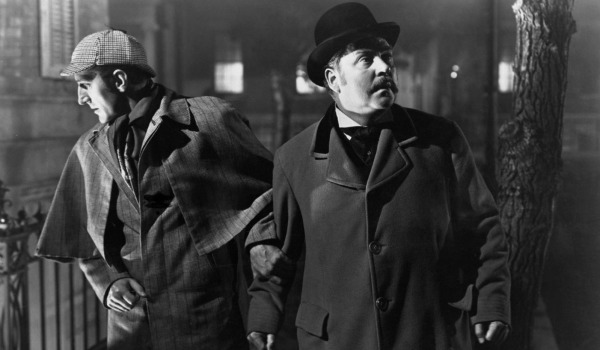
Ironically perhaps, I moved from the works of Leslie Charteris to those of Sir Arthur Conan Doyle, whose fictional hero also made the police look somewhat like dolts. Sherlock Holmes was no criminal, although he was known to ponder that he would have made an excellent one. I devoured every Sherlock Holmes story and novel, and taking great delight in the black-and-white movies with Basil Rathbone in the title role and Nigel Bruce as the slightly bumbling Doctor Watson—always to my mind an unfair portrayal.
 
Basil Rathbone (l) as Sherlock Holmes and Nigel Bruce as Dr Watson
The first consulting detective and famous occupant of 221B Baker Street never lacked for TV and movie outings, some taken more seriously than others. I was a particular fan of the version starring Jeremy Brett and Edward Hardwicke. This adaptation did not shy away from Holmes’ cocaine use, and Watson was far closer to the stout companion of the novels.

Jeremy Brett (l) as Sherlock Holmes and Edward Hardwicke as Dr Watson
Those two versions of the Sherlock Holmes stories kept the characters in their original Edwardian setting—more or less. I seem to recall the Rathbone incarnation being stretched into wartime. But more recently there have been two very successful modern takes on the Baker Street detective which have approached things from very different angles.

Elementary, starring Jonny Lee Miller as Holmes very much on the autistic spectrum and a recovering drug addict, with Lucy Liu as his sidekick and sobriety minder, Dr Joan Watson. This is not the only gender-swapped role—Moriarty is now Jamie rather than James—and the action has been shifted almost entirely to the States.

Lucy Liu (l) as Dr Joan Watson and Jonny Lee Miller as Sherlock Holmes in Elementary
Sherlock, on the other hand, keeps the famous sleuth (played by Benedict Cumberbatch) firmly in London, in his flat in Baker Street, with Mrs Hudson as his long-suffering landlady. Dr Watson, perhaps at his most dynamic when brought to life by Martin Freeman, retains originality in that he is still an army medic who was wounded in Afghanistan. Instead of chronicling Holmes’ adventures for the newspapers, Watson pens a blog. The Irregulars—Holmes’ unofficial eyes and ears throughout the city—is a network of the homeless. His older brother, Mycroft, is something sinister in the Security Services.
(l to r) Mark Gatiss as Mycroft Holmes, Benedict Cumberbatch as Sherlock Holmes, Martin Freeman as Dr Watson in Sherlock
So, it’s hardly surprising that if you offer the chance to writers to take the Conan Doyle canon as their inspiration and let their imaginations run riot, you’re going to get a wide range of weird and wonderful stories. Editors Leslie S Klinger and Laurie R King first did this with A STUDY IN SHERLOCK in 2011, featuring writers such as Lee Child, Michael Connelly, and Neil Gaiman. Two more outings followed—2014’s IN THE COMPANY OF SHERLOCK HOLMES, and ECHOES OF SHERLOCK HOLMES in 2016.


I was delighted to be asked to contribute a short story to the latest anthology, FOR THE SAKE OF THE GAME, which comes out on December 4th. The stories in this book take a variety of forms, including a song and a graphic-strip version.


My own effort, called ‘Hounded’ is a retelling of THE HOUND OF THE BASKERVILLES, modernised, although still featuring most of the elements of the tale. I chose this as it was the nearest to a close-protection plotline, but rather than substitute my bodyguard protagonist Charlie Fox into the roles played by Holmes and Watson as protectors of Sir Henry Baskerville, I approached it from a different angle. By taking a subplot as my main strand, and relegating the infamous hell-hound to a subplot, I hope I’ve managed to provide an entertaining new take on the story while still paying homage to the original, even down to some of the dialogue and certain characters’ enthusiasm for phrenology and butterflies.

This week’s Word of the Week is snickersnee, which is a large knife. The word comes from a Dutch phrase, steake or snye, from the Dutch words steken, meaning to thrust or stick, and snijden, to cut. A similar phrase in English is ‘cut and thrust’ but as this Dutch phrase was often written as stick or snee, or snick-a-snee, it came into common usage as snickersnee

Events:
Fellow author David Beckler has very kindly included my latest standalone novel, DANCING ON THE GRAVE, in a multi-title giveaway of signed print books by Northern English writers. The other books are NO TIME TO DIE by Andrew Barrett, KISS OF DEATH by Paul Finch, CRASH by Keith Houghton, and THE BLOW OUT by Bill Rogers. More details on how to enter the sweepstake here. The event ends on December 12th.


Sunday, December 3, 2017

How Long is a Good Book?


Are our reading habits changing? And, because of that, should our writing habits be changing too? Or is it vice versa? I’ve spent much of the last month planning my next two writing projects, and because of this, I’ve discovered that, actually, size probably IS quite important after all …


Increasingly, I find that many books I download in digital format feel shorter than the paperbacks on my shelves. Perhaps this is just my perception rather than reality because having to check the progress bar and finding it at 58% is somehow less informative than sticking your finger between the pages and guess-timating that you’re more or less halfway through. Also, a fatter spine stands out more on a shelf. I’ve even come across people who admit to being only occasional readers, who will make a final decision between two titles by the width of them.

Are today’s authors simply more aware of pace, so more of the type of novels I tend to choose are better at keeping me turning the pages? Or is the average length of a book really coming down?

To find out more, I started hunting around for details on word lengths, and found this amazing bit of research by BetterNovelProject blogger, Christine Frazier. I can recommend downloading the study if you’re at all interested in the length of books.


It’s a look at the average word counts of a few of the bestsellers in various different genres, from children’s picture books at a few hundred words in some cases, to fantasy epics at over 300k. It includes some well-known titles from the Mystery and Thriller world, which, according to Ms Frazier’s findings, averages out at around 128k words. It held a few surprises, for me. I would never have guessed that Gillian Flynn’s recent GONE GIRL would be a weightier tome than JURASSIC PARK or THE DA VINCI CODE, for instance.

For my own part, I wondered about the length of Lee Child’s Jack Reacher books, and was amazed to learn that his debut novel, KILLING FLOOR, was a massive 178k words, compared to the latest, THE MIDNIGHT LINE, at less than 120k words.

To date, the instalments in my Charlie Fox series have usually come in at around 100,000 words, with the longest of them close to 130,000 and I’ve always felt that was about par for the course. But do people want to read books in this genre of this length anymore? When I wrote ABSENCE OF LIGHT at a little under 60,000 words, I initially labelled it as a novella because it seemed so much shorter than the others. Now, however, I realise that it’s far longer than many examples in the genre.

So, what classifies as a novel-length work, and what is a novella?

Generally speaking, it seems that these days a crime/mystery/thriller novel can be anywhere from 75,000 words up to 130,000, although I’ve spoken to many authors who tell me their crime series have never exceeded 65,000 words per book. There will always be exceptions to any rule, as with Lee’s early books, all of which topped 175k words. Long novels have to justify their bulk, just as very short novels have to make every word work that little bit harder.

Every year at CrimeFest in Bristol, I judge the FlashBang Flash Fiction competition, which is described as ‘an original crime story in 150 words’ and if it comes to a real tie-breaker, then one at dead-on (pun intended) the word-count nips in ahead of another that falls a word or two short.

Mind, you flash fiction is often described as up to 500 or even up to 1500 words, so very short stories then become micro fiction. Ernest Hemingway is often credited with the famous story told in just six words, although, there’s evidence this appeared in print in classified adverts going back to 1906.


Stories to be told in 50 or 100 words, or within the 140-character confines of a twitter post, also fall into the micro fiction category.

Short stories can be 1000 to 8000 words, with all the usual exceptions. If for a contest, they often set fairly tight criteria for submissions, particularly if they’re planning to gather the winning entries into a printed anthology. I’ve recently been asked for anything up to 10,000 words, but generally they’re designed to be read easily at a sitting. I suppose word-length then really depends on how fast you read.

Above short stories, but before the novella comes a strange category called the novelette, which I’ve seen described as low as 7,500 words, up to about 17,500. I would usually have called this a long short story, if that’s not a slight contradiction in terms …

After that come novellas, which I’ve seen described as anywhere between 17,500 and 50,000 words, although the cut-off point is often put at 40k. Until the rise of e-publishing, novellas were often a difficult thing to get published, as the cost of printing them sometimes outweighed the price that could be charged, but they were designed to contain more nuance and character description than a short story, but fewer complexities of plot than would be found in a novel proper.

As for novels themselves, it would seem that anywhere from 40,000 words to the sky’s the limit is the case. Ray Bradbury’s classic FAHRENHEIT 451 is a smidge over 46k, while Tolstoy’s WAR AND PEACE and Vikram Seth’s A SUITABLE BOY slug it out around the 600,000-word mark.


How long are the books you like to read? Or write, for that matter? Inquiring minds need to know!

This week’s Word of the Week is ubique, from the Latin meaning everywhere. It is the motto and later battle honour of the Royal Artillery and Engineers, given to them by King William IV in 1832. It was also the title of a poem by Rudyard Kipling about the Boer War. 

Sunday, September 10, 2017

A Story Not My Own

Zoƫ Sharp

The short story, as a separate form of writing in itself, has increasingly come to intrigue me. I was never an instinctive short story writer. My first forays into fiction were novels rather than vignettes. But now I have come to really appreciate the freedom of imagination that is encouraged by the short story.

small can be beautiful
A subject, character, or location that would be difficult to sustain for the length of a novel becomes far more achievable in truncated form. Not that I insist on having visited everywhere I write about in my books—although I do try, it isn’t always possible. Parts of the Middle East where I wanted to set part of my latest book, for instance, were simply not practical for travel, however, fascinated I might have been to go there.

The best you can do is look at as many images as you can of the locations you want to use, and to read a lot of nonfiction by people who lived or worked in those countries. I find in particular that books written by non-natives are the most instructive. Unless you want to tell your story from the perspective of a local, then you need an outsider’s view.

As is always the case, the fewer words you can use to get across a flavour of a place, the better. The short story does not allow the luxury of waffle, and that helps you to be concise. Always a snapshot, not a portrait.

I’ve written short stories about subjects that were too complex for me to easily use for a novel without a huge amount of research beforehand. The mechanics of virtual reality for one. If I’d intended to make it the mainstay of the plot of a novel, I would have spent considerable time reading into this amazing field of rapidly expanding technology. As it was, I didn’t have the word allowance to go into it in any depth. A hint of the process was all that was needed.

One of the hardest things, I think, is to get inside the head of someone from another culture to your own—to write from their point of view. Changing age and gender I have never found a problem when it comes to my narrators, but getting not just the dialogue but also the thought patterns authentic for an American, Australian, or European, is much more difficult.

And then we come to my current challenge—writing a story that is partly somebody else’s. Last year I was asked by editors Les Klinger and Laurie R King to contribute to FOR THE SAKE OF THE GAME, an anthology of stories inspired by Sherlock Holmes and the work of Sir Arthur Conan Doyle.


As Les explained, “We are not asking for ‘Sherlock Holmes’ stories (though you can write one if you want!) Rather, we are asking you to be inspired by the Holmes stories. You might revisit an existing Holmes story from a different perspective or imagine a character who imitates Holmes or place one of the Holmes menagerie at the center of the story. You can write a Victorian tale or a tale of the far future. You can write about a detective or villain who resembles someone in a Holmes story or who admires Holmes or is inspired by a Holmes story to commit a crime or solve a case. In short, you can do anything you want, so long as there is some visible (or deducible) connection to the Sherlock Holmes Canon.”

These instructions give both the freedom I enjoy about short stories, but also a certain amount of restriction that always makes life interesting. The worst thing, I often find, is being asked to write a story about “Oh, anything you like.” But, being asked to include, in some inventive manner, a man with a wooden leg, or a green rabbit, or to use a provided opening line, really gets the creative juices flowing.

I was once asked to judge a crime short story competition in Lancaster, and set the opening line of:

‘I always swore that, if ever I came back to Lancaster again, I’d kill him/her/them.’

It was very interesting to see what the entrants did with that opening line. Some of them clearly wrote a story to suit, and others just clearly grafted the line onto an existing tale, slightly modified to fit, with varying degrees of success.

But back to Sherlock Holmes.

There is plenty to choose from—Conan Doyle wrote four novels and more than fifty stories featuring Holmes and Watson, quite apart from the option of adding one of Conan Doyle’s characters into a new story altogether. The Benedict Cumberbatch and Martin Freeman incarnation, Sherlock, has shown how effectively Conan Doyle’s work can be brought into modern times.

Benedict Cumberbatch and Martin Freeman in Sherlock
So, I knew I wanted to write a modern story, and the one that sprang to mind was THE HOUND OF THE BASKERVILLES, mainly because it revolves around the protection of Sir Henry Baskerville from the demonic hound that is the curse of his family. What better starting point for a tale involving Charlie Fox, than a man in need of a bodyguard?

cover of the First Edition, originally serialised in The Strand between 1901 and 1902
Of course, it would have been too simple to just swap out Holmes and Watson for Charlie. So I went at this from an entirely different angle, working up one of the subplots into my main storyline. And yes, Charlie does get to sit down to breakfast with Sherlock himself.

But if you want to know more than that, you’re going got have to wait for the anthology …

What are your feelings on short stories? Do you like to read them? Do you enjoy writing them? Do you prefer some kind of themed anthologies or a free-for-all?

This week’s Word of the Week is Cynophobia, which is the fear of dogs, and particularly of stray dogs. On Dartmoor, perhaps?


Upcoming events:

Crime comes to the Lancashire coast at the end of this month, with the inaugural Morecambe & Vice event at the Winter Gardens, from September 29th to October 1st. I’m honoured to be appearing on the ‘Local Legends: I Did It My Way’ panel at 10:15am on Saturday, September 30th, moderated by Kevin Wignall and featuring AS Chambers, Beth Jones and myself.

the Winter Gardens, Morecambe
I’ll also be taking part in Noir @ The Bar at the Winter Gardens on Friday evening, September 29th29th, from 6pm-7pm, where some of the attending authors will be reading out three-minutes bites of their work.

And next month, of course, there’s Bouchercon in Toronto, but more of that at a later date.