Showing posts with label book titles. Show all posts

Thursday, March 21, 2024

TITLE PAGE

Wendall --- every other Thursday

I was having a discussion with my film students last week about the importance of titles and it got me thinking about whether their function is any different for novelists than for screenwriters. 

Did its one word title land it in the top grossing movies of all time?
 

Many studies have been done that suggest films with one or two word titles do better at the box office. When I checked a list of the 50 biggest hits in film history (adjusted for inflation) 31 of the 50 were indeed short ones, including Jaws, Star Wars, Titanic, Ghostbusters, The Exorcist, Avengers: Endgame, Black Panther, The Sting, Home Alone, Forrest Gump, Grease, and The Graduate. But that left 19 that were three words or longer, and in fact, the top four on the list are slightly longer: Gone With the Wind, Star Wars: Episode V A New Hope, The Sound of Music, and E.T. the Extra-Terrestrial.

Hit book and film. Was it the single word? Or the shark?

 
Another hit book and film. Was it the two word title, or the nylons?

For me, one of the most important things, after the length, is the tone of the title and whether it suggests the genre it’s going to deliver. I remember once reading a script called The Hitler Family Reunion. You can imagine my dismay, and disconnect, to find out it wasn’t a comedy. So it needs to prepare you for what is coming, particularly in the submission stage.


When I began to look up this question in regard to novels, the opinions seemed to be all over the place. Some sites suggested one word titles were preferable, because they left more room for cover art. But many said the length didn’t really matter, citing the enormous popularity of books like Harry Potter and the Philosopher’s Stone (or any of the Harry Potter titles . . .), All the Light We Cannot See, or The Hitchhiker’s Guide to the Galaxy.


Title length didn't seem to hurt this book. . .

 
Or this one.

Perhaps with novels, the writer’s name means more than the title—Lee Child, Michael Connelly, and Sara Paretsky have largely varied titles (many of which I can’t recall in this moment) but I bought all of them. Of course, when you have a famous author and a title with a hook—Sue Grafton’s A is for Alibi and the rest of her Kinsey Milhone alphabet series or Janet Evanovich’s One for the Money, Two for the Dough, Stephanie Plum series—you appeal to the audience in two ways.


This hook worked the first time, and for almost 25 more. Sob.

 
First edition of Cornwell's bestseller-- all about the title.


And a later one, all about the writer.

Certainly, most of the novels by Dickens and Austen fall into the “two word” category, but Faulkner and Hemingway usually spilled over to at least three or four.


So, it’s hard to know what changes and compromises you need to make to your title, for the marketplace.


Most of my scripts and novels have gone through a few “working” (and ultimately non-working!) titles before I finally settled on the right one. My first script, about a woman who says no to a genie, started as a nod to Bruno Betelheim, The Uses of Enchantment, but on the advice of my agent, became Wishful Thinking. My second script, about the “Robin Hood” of insurance started and remained entitled Premiums for 20 years, until it was optioned by two Australian producers who wanted it rewritten for that market, and so I renamed it The Kangaroo Clause.


When I wrote a script about my experiences as a woman teaching Jack Kerouac novels at an all-male boarding school, it started as In Loco Parentis, then Lunatic Lit, and finally went out as Off the Road.


My favorite rom/com script started as Our Little Secret, then, Liars in Love, was submitted around town as A Case of You, and currently exists as 15 Reasons to Live.


Now that I am writing screwball mysteries, which have an amateur sleuth, but don’t obey the rules of the cozy, I needed titles that might attract open-minded cozy readers, but would also indicate a slightly zanier tone and suggest the travel aspect of the series. All four book titles have been a challenge.


Lost Luggage was based on my original script, Animal Instincts, which, in the end, I thought sounded too much like soft-core porn. But when I started with a two word title, it seemed I was locked into that for the series. Thank goodness, one of my dear friends came up with Drowned Under, which totally captured the Australian cruise element, but it took me months to land on Fogged Off for Cyd’s adventures in London, after testing truly horrible ideas like Thames to Die and Death Tube.


My peek into the world of endangered bird smuggling, was initially Bali,Why? until the copy-editing stage, where my editor vetoed the idea, saying everyone wouldn’t get the joke. I lobbied for The Big Tweet, until Elon Musk ruined that. Fowl Play was taken. We were right down to the wire in finally settling on Cheap Trills.  I’m really happy with it, aesthetically, but it has proved problematic, since no matter how many times I’ve written Amazon, when you type in Wendall Thomas, Cheap Trills, it takes you straight to a page full of cheap, wild-headed TROLLS! 


See below!


I have to admit, I enjoy choosing short story titles much more, since the pressure to buy the book isn’t on my shoulders, it’s down to the editors’ title choice. In Murder A-Go-Gos, where all the stories were inspired by Go-Go’s hits, my work was done for me. But I feel like my first published story, “Loser Friend,” as well as the two below, are my favorites.


From Sisters in Crime LA's Anthology, Last Resort.

 
From this year's Crime Under the Sun.

Readers, writers, and MIE compatriots, do you agonize over your titles? And how often do you choose a film, or a book, based on the title alone?


---Wendall


Wendall’s fourth Cyd Redondo novel, Cheap Trills, has been nominated for a Lefty for Best Humorous Mystery of 2023 and she will be attending Left Coast Crime April 10-14.


Please find her on the Best Humorous Panel (Friday the 12th), the “Dogs and Cats and Birds, Oh My” panel on Sunday the 14th, at the table she is hosting with James Bartlett, or stop and say hello in the hallways or the bar!

Sunday, March 5, 2023

Borrowed From The Bard Redux

Book titles taken from William Shakespeare


Zoë Sharp


I hope you will forgive me, with ever-present deadlines surrounding me, if I revisit a post I wrote originally back in 2016, with a few suitable additions.


Shakespeare was arguably the greatest writer in the English language. Next month sees the anniversary both of Shakespeare’s approximate birth, and his death. Both of these events are thought to have taken place on the same date in April – the 23rd, although exact birth dates were often not recorded at that time.


By the time he died, in Stratford-upon-Avon, he had written 38 plays and 154 sonnets, as well as a number of other works. He was only 52, although that was considered quite a good run in Elizabethan times, when the life expectancy of the average Londoner was 35.


Shakespeare’s work has been translated into every major living language, and his plays are constantly re-imagined for each generation, bringing new meaning each time. It could easily be said that the themes and schemes and tribulations of his characters are just as relevant today as they were 400 years ago.


His characters, words, and phrases have seeped into everyday life to such an extent that they are everywhere you look. And nowhere more than in the chosen book titles of other authors.


BRAVE NEW WORLD, Aldous Huxley

The title of Huxley’s 1932 science fiction classic is taken from lines spoken by Miranda to Ferdinand and his companions in The Tempest:


"O wonder!

How many goodly creatures are there here!

How beauteous mankind is!

O brave new world

That hath such people in it"


Macbeth has provided inspiration for many other writers when it comes to naming their work.


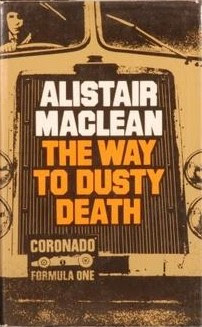
THE WAY TO DUSTY DEATH, Alistair MacLean

The title of MacLean’s 1973 novel comes from Macbeth’s soliloquy when he hears of the death of Lady Macbeth:


“She should have died hereafter;

There would have been a time for such a word.

— To-morrow, and to-morrow, and to-morrow,

Creeps in this petty pace from day to day,

To the last syllable of recorded time;

And all our yesterdays have lighted fools

The way to dusty death. Out, out, brief candle!

Life's but a walking shadow, a poor player

That struts and frets his hour upon the stage

And then is heard no more. It is a tale

Told by an idiot, full of sound and fury

Signifying nothing.”


WALKING SHADOW was the title of Robert B Parker’s 1994 Spenser outing, while THE SOUND AND THE FURY was used by William Faulkner for his 1929 novel.


DOUBLE, DOUBLE, Ellery Queen

The title of this 1950 novel comes again from the witches in Macbeth:


1 WITCH.

“Round about the caldron go; 

In the poison'd entrails throw.— 

Toad, that under cold stone, 

Days and nights has thirty-one; 

Swelter'd venom sleeping got, 

Boil thou first i' the charmed pot!”

ALL.

“Double, double toil and trouble; 

Fire burn, and caldron bubble.”


SOMETHING WICKED THIS WAY COMES, Ray Bradbury

Ray Bradbury’s 1962 dark fantasy takes its title from the second witch in Macbeth:


“By the pricking of my thumbs,

Something wicked this way comes. [Knocking]

Open locks,

Whoever knocks!

[Enter Macbeth]


Agatha Christie used a several Shakespeare quotes and references as titles of her novels, including from that same speech in Macbeth:


BY THE PRICKING OF MY THUMBS, 1968

SAD CYPRESS, 1940, from “Come away, death” a song in Twelfth Night

ABSENT IN THE SPRING, 1944, from sonnet 98 

THERE IS A TIDE, 1948, (later renamed TAKEN AT THE FLOOD) from Brutus’ speech in Julius Caesar


And the title of her famous play The Mousetrap, 1952, is apparently taken from Hamlet’s answer to Claudius regarding the play the court had just watched.


THE CASE OF THE GILDED LILY, Erle Stanley Gardner

Gardner took the title of his 1956 Perry Mason novel from a speech made by Salisbury in King John:


“Therefore, to be possess’d with double pomp,

To guard a title that was rich before,

To gild refined gold, to paint the lily,

To throw perfume on the violet,

To smooth the ice, or add another hue

Unto the rainbow, or with taper-light

To seek the beauteous eye of heaven to garnish,

Is wasteful and ridiculous excess.”


THE DOGS OF WAR, Frederick Forsyth

Forsyth took the title of his 1974 thriller from a speech by Marcus Antonius in Julius Caesar: 


“And Caesar's spirit, raging for revenge,

With Ate by his side come hot from hell,

Shall in these confines with a monarch's voice

Cry ‘Havoc!’ and let slip the dogs of war,

That this foul deed shall smell above the earth

With carrion men, groaning for burial.”


Currently, my work-in-progress novel has the working title NOTHING WE CAN CALL OUR OWN, taken from the monologue in Shakespeare’s Richard II, Act III, Scene II):


“Let’s choose executors and talk of wills.

And yet not so – for what can we bequeath

Save our deposed bodies to the ground?

Our lands, our lives, and all, are Bolingbroke’s,

And nothing can we call our own but death;

And that small model of the barren earth

Which serves as paste and cover to our bones.

For God’s sake let us sit upon the ground

And tell sad stories of the death of kings”


I’m sure there are plenty more I haven’t listed here. What are your favourite crime or thriller titles taken from Shakespeare quotes, or do you have a quote for which you have yet to find the right story to fit it?


My own favourite is actually a stage direction from Act III of The Winter’s Tale: EXIT, PURSUED BY A BEAR. I’m sure someone’s beaten me to it, but it’s a great title.


This week’s Word of the Week comes from Shakespeare, appropriately enough, and is Anthropophaginian, meaning one who eats human flesh, used in humorous context in The Merry Wives of Windsor:


HOST

“What wouldst thou have, boor? what: thick-skin?

speak, breathe, discuss; brief, short, quick, snap.”


SIMPLE

“Marry, sir, I come to speak with Sir John Falstaff 

from Master Slender.”


HOST

“There's his chamber, his house, his castle, his 

standing-bed and truckle-bed; 'tis painted about

with the story of the Prodigal, fresh and new. Go 

knock and call; hell speak like an Anthropophaginian 

unto thee: knock, I say.”


Events

In March, Zoë Sharp will be one of the Derbyshire authors taking part in Author Assemble. “This is a literary event, showcasing the work of authors who are local to the High Peak or who have supported and worked with the Buxton Crescent Heritage Trust. The aim is to bring writers from a variety of genres together under one roof, to shine a light on the former use of the Assembly Rooms as Buxton’s town library from 1972 to 1992—a time which many local residents remember fondly. We aim to give authors the opportunity to share their work with new audiences, give talks about their writing and of course sell their products. Attendees will also be introduced to the work of the Buxton Crescent Heritage Trust and enjoy some time inside the splendour of the Crescent’s Assembly Rooms.” Time and date: Friday, March 17 2023, 10:00 – 17:00 at The Assembly Rooms, The Crescent, Buxton, SK17 6BH. Speakers, signing, and stalls. More details to follow.


In April, Zoë Sharp will be appearing with Caro Ramsay and Sarah Ward at Ceredigion Museum in Aberystwyth as part of the Gŵyl Crime Cymru Festival. Their panel will be Event 6: Trade Secrets, 10:15 – 11:15 on Saturday, April 22 2023. “Writing a long series, has its own difficulties, as does writing under two names in two different directions. How do you keep track? What are the things you know from your other lives that you bring to your writing? Learn a few trade secrets from three of the best. Panellists: Caro Ramsay, Zoë Sharp. Chair: Sarah Ward. Close Up Reader: Nigel Williams.”