Showing posts with label Yellow Journalism. Show all posts

Monday, October 26, 2020

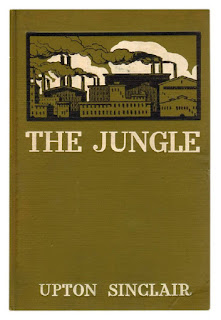
When a Novelist Ran for Governor: Upton Sinclair

 Annamaria on Monday


So.  It's California. The electoral campaign is on.  A socialist from the East is garnering enormous and enthusiastic support from the State's Democrats. The Republicans are up in arms about his unapologetic insistence on universal health care, greater support of the rights of working people, higher minimum wages, and so on.  Something must be done to stop him from ruining the heyday of the privileged class.


Sounds familiar, right?

Yes!  That's what drew me to this story.  But surprise!  It took place in 1934.  What makes it relevant today it that this Depression-era political battle gave birth to what we think of as the "modern" use of fake news, conspiracy theories, hysteria, and the merciless use of tons of money to stop a frontrunner from winning an election.


In the dead center of the Great Depression, the novelist Upton Sinclair had already lost two bids for office while running as Socialist.  He changed his tactics.  He switched to the Democratic Party, signed up to run in the party's gubernatorial primary, and declared, "There is no reason for anyone to be poor in a place as rich as California."  To reach his ends, he promulgated a plan called End Poverty in California or EPIC.  It called for those long-sought-after but (so far) elusive benefits listed above.  He won the Democratic primary by a landslide, delighting the workers and giving the privileged a hissy fit.


To defend their candidate, the Republicans went so far as to hire the first ever "professionals" at electioneering - a company invented that moment: Campaigns Incorporated, who immediately introduced techniques such as quoting Sinclair out of context, relentless pamphleteering, and trying to anticipate and defang any Democratic tactics.

The cops sided with Sinclair's opposition.  When, at a rally, he started to read the Bill of Rights, the LAPD moved in to arrest him and many of his supporters.  When challenged on behalf of the First Amendment, the head of the police contingent declared "We'll have none of that Constitutional stuff."


The elite of California threw themselves into the battle.  The ultra wealthy Chandler family, owners of the LA Times, without the slightest bow to journalistic ethics, put their paper's full force behind smearing Sinclair.  They found a favorite ploy in the famous author's body of fiction. They took outrageous statements made by his fictional characters, turned them into headlines, and ascribed the opinions to Sinclair personally.  (How would you like that to happen to you, my fellow author's out there?)


Hollywood got into the act.  Louis B. Mayer docked all his employees a day's pay and turned the funds over to the Republican Party.  Irving Thalberg (Yes that Irving Thalberg) started producing fake newsreels, using actors from his studio who pretended to be working people, espousing outrageous opinions.


The scariest flim-flam for the residents of California was the "news" that hundreds of thousands of "bums" from all over the country were flocking there to take advantage of the State's handouts once Sinclair became governor.


Newsreels were a trusted source at the time.  You can now find some of the footage on YouTube - very convincing fakes to scare the residents into voting Republican.  Of course, the granddaddy of yellow journalism, William Randolph Hearst got into the act.  And he owned movie theaters to make sure the scary fairy tales got wide distribution.


Sinclair lost.


And so did the country.  Because now we are stuck with an electioneering tradition that makes the majority of us nauseous.  But one that looks as if it will never go away. 

Monday, June 1, 2020

What happened to Journalism

Annamaria on Monday


I know you have seen this before. (Thanks again, Stan.)
As far as I am concerned, it cannot be seen enough,

Ask around with this question, and many of the answers you discover will blame the current sad state of journalism on the dawn of digital media.  This is only partially true.  Spreading lies, as you would imagine, long predated the invention of the iPhone.  Digital information did however make it much easier to spread misinformation.


I was inspired to look into and cogitate about this subject by a shock I received.  An email from the progressive organization MoveOn contained this statement about the Trump administration: “So he and his cronies have begun pushing dangerous conspiracy theories to explain his failures—and, as usual, the media is playing right into his hands.”

What I thought?  It’s the right-wing that usually makes this sort of statement.  They are the ones who have, in the USA anyway, turned the words “the media” into a pejorative, as in the statement above.  Imagine if it said, “the free press is playing right into his hands.”  No one would seek to condemn journalism in general by calling it “the free press.” If one is finding fault with it, it is “the media.”


 Problem is these days it is hard to tell the difference between journalism based on facts and other forms of writing.


True journalism, in other words the reporting of the truth, follows rules.  It does not pass off lies as the truth.  It shares fact checked information.  It does not intermix it with questionable statements or opinions and make them all look like the same thing.

Let’s take a quick look at some definitions:

Fact: a thing that is known or proved to be true.

News: newly received or noteworthy information, especially about recent or important events.  Note: In professional news reporting this “information” must be based on assurances that the report contains facts.  Where such reports offer opinions, they are given as such and attributed to the holder of the opinion along with his or her credentials to opine on the subject at hand.


In the old days, when the news came printed on paper, reliable publications let readers know the difference between the news and their editors' opinions by what page they put them on.  They kept their opinions for a special “editorial” section.  Broadcast, tabloid, and especially digital reporting seem to have blurred these boundaries until they have just about disappeared.   

Then there are the black sheep of journalism:

Propaganda: information, especially of a biased or misleading nature, used to promote or publicize a particular political cause or point of view.


Yellow Journalism: journalism that is based upon sensationalism and crude exaggeration.  This dastardly technique has been around for a long time.


These are techniques meant, not to inform the public so people can make their own judgments, but to manipulate them into thinking the way some power grabbers want them to think.

The latest addition to these enemies of an informed electorate is Fake News.


It terrifies me to have to say that, these days, what is available for public consumption is a complete mishmash of all of the above.  Worst of all, those in power have so manipulated public opinion against "the media" that even the most trustworthy outlets of factual, reliable journalism are mistrusted and disregarded, while a large segment of the population have become addicted to propaganda purveyors, who slant everything in the direction of what they want to hear.  This hardens their belief in propaganda and fake news.


As the enemies of professional journalism fully intend, this turns any democracy into a pale, frail, moribund version of the sinewy, vital form of government that it used to be.


If you care about this, I urge you to check out these two ways of learning about journalism:

A greatly entertaining TV series that shows what it takes to cover the news well and how it can go awry.


A podcast that discusses current events and how the media is covering them.  Fascinating in every way.
