Showing posts with label Fake News. Show all posts

Monday, October 26, 2020

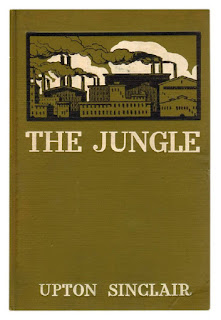
When a Novelist Ran for Governor: Upton Sinclair

 Annamaria on Monday


So.  It's California. The electoral campaign is on.  A socialist from the East is garnering enormous and enthusiastic support from the State's Democrats. The Republicans are up in arms about his unapologetic insistence on universal health care, greater support of the rights of working people, higher minimum wages, and so on.  Something must be done to stop him from ruining the heyday of the privileged class.


Sounds familiar, right?

Yes!  That's what drew me to this story.  But surprise!  It took place in 1934.  What makes it relevant today it that this Depression-era political battle gave birth to what we think of as the "modern" use of fake news, conspiracy theories, hysteria, and the merciless use of tons of money to stop a frontrunner from winning an election.


In the dead center of the Great Depression, the novelist Upton Sinclair had already lost two bids for office while running as Socialist.  He changed his tactics.  He switched to the Democratic Party, signed up to run in the party's gubernatorial primary, and declared, "There is no reason for anyone to be poor in a place as rich as California."  To reach his ends, he promulgated a plan called End Poverty in California or EPIC.  It called for those long-sought-after but (so far) elusive benefits listed above.  He won the Democratic primary by a landslide, delighting the workers and giving the privileged a hissy fit.


To defend their candidate, the Republicans went so far as to hire the first ever "professionals" at electioneering - a company invented that moment: Campaigns Incorporated, who immediately introduced techniques such as quoting Sinclair out of context, relentless pamphleteering, and trying to anticipate and defang any Democratic tactics.

The cops sided with Sinclair's opposition.  When, at a rally, he started to read the Bill of Rights, the LAPD moved in to arrest him and many of his supporters.  When challenged on behalf of the First Amendment, the head of the police contingent declared "We'll have none of that Constitutional stuff."


The elite of California threw themselves into the battle.  The ultra wealthy Chandler family, owners of the LA Times, without the slightest bow to journalistic ethics, put their paper's full force behind smearing Sinclair.  They found a favorite ploy in the famous author's body of fiction. They took outrageous statements made by his fictional characters, turned them into headlines, and ascribed the opinions to Sinclair personally.  (How would you like that to happen to you, my fellow author's out there?)


Hollywood got into the act.  Louis B. Mayer docked all his employees a day's pay and turned the funds over to the Republican Party.  Irving Thalberg (Yes that Irving Thalberg) started producing fake newsreels, using actors from his studio who pretended to be working people, espousing outrageous opinions.


The scariest flim-flam for the residents of California was the "news" that hundreds of thousands of "bums" from all over the country were flocking there to take advantage of the State's handouts once Sinclair became governor.


Newsreels were a trusted source at the time.  You can now find some of the footage on YouTube - very convincing fakes to scare the residents into voting Republican.  Of course, the granddaddy of yellow journalism, William Randolph Hearst got into the act.  And he owned movie theaters to make sure the scary fairy tales got wide distribution.


Sinclair lost.


And so did the country.  Because now we are stuck with an electioneering tradition that makes the majority of us nauseous.  But one that looks as if it will never go away. 

Monday, June 1, 2020

What happened to Journalism

Annamaria on Monday


I know you have seen this before. (Thanks again, Stan.)
As far as I am concerned, it cannot be seen enough,

Ask around with this question, and many of the answers you discover will blame the current sad state of journalism on the dawn of digital media.  This is only partially true.  Spreading lies, as you would imagine, long predated the invention of the iPhone.  Digital information did however make it much easier to spread misinformation.


I was inspired to look into and cogitate about this subject by a shock I received.  An email from the progressive organization MoveOn contained this statement about the Trump administration: “So he and his cronies have begun pushing dangerous conspiracy theories to explain his failures—and, as usual, the media is playing right into his hands.”

What I thought?  It’s the right-wing that usually makes this sort of statement.  They are the ones who have, in the USA anyway, turned the words “the media” into a pejorative, as in the statement above.  Imagine if it said, “the free press is playing right into his hands.”  No one would seek to condemn journalism in general by calling it “the free press.” If one is finding fault with it, it is “the media.”


 Problem is these days it is hard to tell the difference between journalism based on facts and other forms of writing.


True journalism, in other words the reporting of the truth, follows rules.  It does not pass off lies as the truth.  It shares fact checked information.  It does not intermix it with questionable statements or opinions and make them all look like the same thing.

Let’s take a quick look at some definitions:

Fact: a thing that is known or proved to be true.

News: newly received or noteworthy information, especially about recent or important events.  Note: In professional news reporting this “information” must be based on assurances that the report contains facts.  Where such reports offer opinions, they are given as such and attributed to the holder of the opinion along with his or her credentials to opine on the subject at hand.


In the old days, when the news came printed on paper, reliable publications let readers know the difference between the news and their editors' opinions by what page they put them on.  They kept their opinions for a special “editorial” section.  Broadcast, tabloid, and especially digital reporting seem to have blurred these boundaries until they have just about disappeared.   

Then there are the black sheep of journalism:

Propaganda: information, especially of a biased or misleading nature, used to promote or publicize a particular political cause or point of view.


Yellow Journalism: journalism that is based upon sensationalism and crude exaggeration.  This dastardly technique has been around for a long time.


These are techniques meant, not to inform the public so people can make their own judgments, but to manipulate them into thinking the way some power grabbers want them to think.

The latest addition to these enemies of an informed electorate is Fake News.


It terrifies me to have to say that, these days, what is available for public consumption is a complete mishmash of all of the above.  Worst of all, those in power have so manipulated public opinion against "the media" that even the most trustworthy outlets of factual, reliable journalism are mistrusted and disregarded, while a large segment of the population have become addicted to propaganda purveyors, who slant everything in the direction of what they want to hear.  This hardens their belief in propaganda and fake news.


As the enemies of professional journalism fully intend, this turns any democracy into a pale, frail, moribund version of the sinewy, vital form of government that it used to be.


If you care about this, I urge you to check out these two ways of learning about journalism:

A greatly entertaining TV series that shows what it takes to cover the news well and how it can go awry.


A podcast that discusses current events and how the media is covering them.  Fascinating in every way.


Sunday, December 31, 2017

An end-of-the-year Listicle: New words added in 2017

Zoë Sharp

Derbyshire village in the winter mist.

This year has been an interesting one. For me it's been one of change, with more travelling, yet another house move, and lots of upheaval. But it’s also seen the publication of a new Charlie Fox book, FOX HUNTER, and a plan in place for several new projects in the early part of the New Year. I’m not making any resolutions for 2018, but I see a great deal of scribbling in my immediate future.

One of the many other things that have taken place this year is the addition of new words to the dictionaries. They may have been in use previously, but now they’re official. Here are a few of my favourites. Let me know the ones I’ve missed, or that you particularly like:

Bokeh, meaning ‘the blurred quality or effect seen in the out-of-focus portion of a photograph taken with a shallow depth of field.’

Craptacular, which is something that is especially bad in a highly visible way.

Fake news, meaning a sensational story, reported as fact when it is fiction.

First World problems, which is a minor or trivial problem or frustration (implying a contrast with serious problems such as those that may be experienced in the developing world).

Ghost, meaning ‘to abruptly cut off all contact with (someone, such as a former romantic partner) by no longer accepting or responding to phone calls, instant messages, etc.’

Listicle, meaning ‘an article consisting of a series of items presented as a list.’

Microaggression, which is ‘a comment or action that subtly and often unconsciously or unintentionally expresses a prejudiced attitude toward a member of a marginalized group.’ It is usually something that is invisible to the perpetrator, who may be convinced that they do not possess such a biased attitude.

Mumblecore, meaning ‘a genre of narrative film focusing primarily on the intimate lives of young characters and featuring scenes of ample dialogue and minimal action.’

Pareidolia, which is ‘the tendency to perceive a specific, often meaningful image in a random or ambiguous visual pattern’ much like a Rorschach test.

Sausagefest, which is ‘an event or group which is predominantly male.’

Squad goal, meaning someone seen as a role model to a person or group, often used as a hashtag.

That’s it for this year from me. Wishing you Health, Luck and Happiness in 2018!


Saturday, June 24, 2017

On "Being Happy": The Debunked Papal Homily


Jeff—Saturday

A couple of days ago a dear friend sent me what she described as “A speech Pope Francis gave in yesterday’s homily/sermon. It’s to be read and reread several times.  This is the Pope with the greatest spirituality since Peter.”

I respect my friend, and greatly admire Pope Francis, so I read the portion, and I too was moved, so much so that I decided to feature it in this week’s post as a balance to all that is so very out of whack with our world.  As is my practice, I went on line to see what more I could learn about the Pope’s words and perhaps even their inspiration.

Lo and behold, what to my wondering eyes should appear but a rush of articles and posts declaring the speech a false speech, never given by the Pope! Yes, fake news had penetrated the Vatican, in this case sometime around September 2015. 

Gideon Lasco, MD, PhD

As reported by Gideon Lasco, in a story titled “Putting Words in Pope Francis’ Mouth,” published on Inquirer.net, the text of “Being Happy” attributed to Pope Francis is “actually an almost-word-for-word translation of a Portuguese text titled ‘Palco de vida’ (Stages of life), attributed to the renowned poet Fernando Pessoa (1888-1935). Only the concluding ‘Life is an incredible show’ was changed from the less-exciting ‘Life is a no-miss obstacle.’”

No, this is not a Melania Trump situation, where a delivered speech is borrowed from another’s work, but a totally made up story baselessly attributing another’s work to a wholly innocent party.  But wait, there’s more.

Fernando Pessoa

As Lasco points out, “There’s an additional twist here: Even the attribution to Pessoa has been dismissed by scholars, citing major differences from his style and the absence of any actual manuscript. They conclude that it was likely a fabrication borne of the Internet,” innocently begun by a Brazilian blogger who’d written the final phrases as his own, only to later learn they’d gained life on the Internet as attached to Pessoa.

Lasco found the text first linked to Pope Francis “in September 2015. The Facebook page of a ‘Missionary Community of St Paul the Apostle and Mary, Mother of the Church’—a Kenya-based Catholic group—shared the same passage in English, attributing it, in what appears to be the first such attribution, to Pope Francis. Given Filipinos’ entrenchment in social media and our collective fondness for the Pope, it did not take long for someone to share it, and the rest is history.”


And, that folks, is how a false Internet story was born.  But wait (once more), because for me, at least, there’s more. 

Yes, Pope Francis never said those words, nor does he claim to have done so, but anyone reading the speech could easily see them as his own, and gain comfort from thinking he had. I know that my friend did, and from the number of Facebook views on pages posting the words as the Pope’s, I’d venture to say millions more around the world have as well.

So, in recognition of one of the few instances I know of where fake news offers at least some palliative benefit, I am reproducing the text of “Be Happy” below.  Be it a poet’s or blogger’s work, or that of some Bobby McFerrin fan inspired by “Don’t Worry Be Happy,” I frankly don’t care. 


Nor do I suspect does Pope Francis, as long as the end result for those inspired by these words is a closer kinship to its promise of Being Happy:

You can have flaws, be anxious, and ever angry, but do not forget that your life is the greatest enterprise in the world. Only you can stop it from going bust. Many appreciate you, admire you and love you.

Remember that to be happy is not to have a sky without a storm, a road without accidents, work without fatigue, relationships without disappointments.

To be happy is to find strength in forgiveness, hope in battles, security in the stage of fear, love in discord. It is not only to enjoy the smile, but also to reflect on the sadness. It is not only to celebrate the successes, but to learn lessons from the failures. It is not only to feel happy with the applause, but to be happy in anonymity. Being happy is not a fatality of destiny, but an achievement for those who can travel within themselves.

To be happy is to stop feeling like a victim and become your destiny's author. It is to cross deserts, yet to be able to find an oasis in the depths of our soul. It is to thank God for every morning, for the miracle of life.

Being happy is not being afraid of your own feelings. It's to be able to talk about you. It is having the courage to hear a "no". It is confidence in the face of criticism, even when unjustified. It is to kiss your children, pamper your parents, to live poetic moments with friends, even when they hurt us. To be happy is to let live the creature that lives in each of us, free, joyful and simple.

It is to have maturity to be able to say, “I made mistakes.” It is to have the courage to say, “I am sorry.” It is to have the sensitivity to say, “I need you.” It is to have the ability to say, “I love you.”

May your life become a garden of opportunities for happiness ... that in spring may it be a lover of joy … in winter a lover of wisdom. And when you make a mistake, start all over again. For only then will you be in love with life.

You will find that to be happy is not to have a perfect life. But use the tears to irrigate tolerance. Use your losses to train patience. Use your mistakes to sculpt serenity. Use pain to plaster pleasure. Use obstacles to open windows of intelligence.

Never give up. Never give up on people who love you. Never give up on happiness, for life is an incredible show.

Thanks, author, whoever you are.


—Jeff