Showing posts with label WWI. Show all posts

Monday, November 28, 2022

The Harlem Hellfighters

 Annamaria on Monday

My work in progress these days is the fifth in my Africa series, set in 1915 against the background of WWI.  You might think you that my topic today is something that I discovered by accident while researching that awful conflict. But no! I learned about the Harlem Hellfighters during a casual casual conversation with a vendor in the Union Square farm market.  We were talking about music. I'll get around to the music in a minute.  First, who were the Harlem Hellfighters?
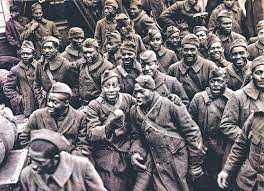
The regiment of today's topic was formed in New York State, comprised of black volunteers who wanted to join up and fight for their country despite the despicable way a lot of their countrymen treated them. They, largely mistakenly, believed that if they showed their valor and patriotism, they might earn the respect that they merited.

Valorous they were!! The 396th Infantry was organized in June of 1916 in New York and went through combat training in October 1917 at Camp Wadsworth in Spartanburg, SC--not exactly a welcoming locale.  But, according to the men of the regiment, the nasty Jim Crow treatment they received in South Carolina forged a bond among them that stood them in good stead when they faced combat.
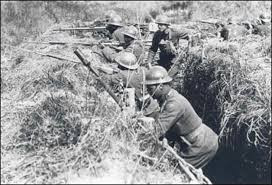
And face it, they did.  They shipped out from New York for France on December 27, 1917.  At first they were relegated to only lowliest tasks, but in April of 1918, the US Army decided to assign the unit, which wanted to serve in combat, to the French Army. The French welcomed them as comrades in arms and assigned them the French 185th Infantry Brigade.  They were issued French weapons and gear to go with their American uniforms, and a month later, they went into the trenches as part of the French 19th Division.  
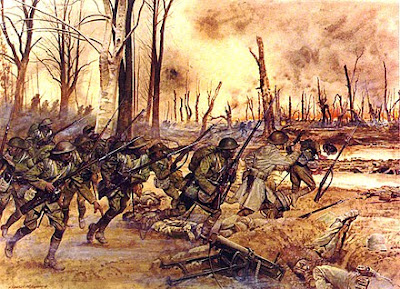

They proceeded to distinguish themselves in battle after battle.  At one point they were under fire for over six months, the longest deployment for any unit during that war.  Six days after the armistice, they were the first Allied unit to reach the banks of the Rhine.
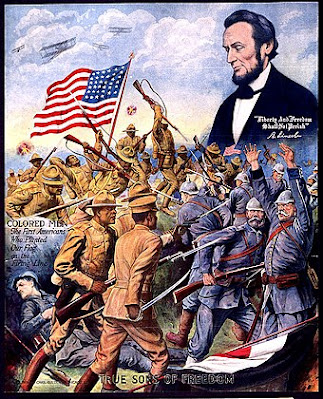


One of the most decorated was Pvt. Henry Johnson, who had been a railway station luggage porter in Albany, New York.  Along with Pvt. Needham Roberts, he fought off 24 Germans, who were attacking their observation post.  Roberts was badly wounded early on.  Johnson, after spending all of his ammunition, fought back with grenades, with the butt of his rifle, and finally with a knife. He was able to turn the Germans away.  He himself sustained 21 injuries.  He became the first American to be awarded the Croix de Guerre!

It took until the Obama administration for his heroism to be properly recognized by this own country.
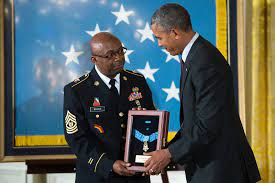
Command Sergeant Major Louis Wilson
 of the New York National Guard accepting the Medal of Honor
on behalf Herman Johnson, who died in 2004 


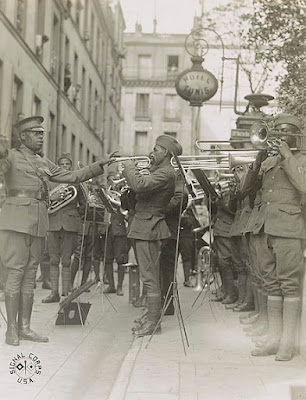
Now, about that music: the Hellfighters Marching Band.  The fabulous musicians, recruited from jazz and ragtime musicians in NYC, were lead by James Reese Europe, a composer and prominent musician in Harlem before the war. The band went to France with the soldiers and while there were the first to introduced jazz to the French and other Europeans. They were a sensation in Paris and remained one in the United States after the war. I heard about them in that conversation at the market. I came home, found a sample on YouTube, and went straight ahead and bought all of their available recordings at the iTunes store.  They are perfect! I wish I could give you a better-mastered recordings, so impressed was I of how elegantly they played. Here is a scratchy example, the best I can share on Blogger.


Sunday, November 27, 2022

Reasons To Be Thankful

 The Thankful and Doubly Thankful Villages


Zoë Sharp


November traditionally sees the annual Remembrance Day here in the UK, when we remember the fallen – particularly in the two World Wars of 1914-1918 and 1939-1945. Despite the fact that World War II saw more than three times the casualties of the conflict that preceded it, we still mark this occasion on the eleventh day of the eleventh month, at eleven in the morning – the moment hostilities ceased in 1918.


The number of fatalities in these two wars boggles the mind – there are simply too many zeroes to compute. In WWI, it is estimated that there were anywhere between 15 million and 22 million casualties, including military personnel and civilian deaths. WWII added a staggering 70-90 million to this total. (And that’s before we reckon up the number of animals who died in the service of man during those conflicts, as detailed in Caro Ramsay’s beautiful blog about the Hyde Park memorial.)


Those who are skilled with statistics calculate that the number of people killed in WWII was roughly 3.5 percent of the entire population of the planet, which totalled around 2.3 billion in 1940. To bring that into context, if there was a similar war today, and the same percentage of the world’s population was killed, the dead would number 274,295,000.


As it was, everywhere in the UK (as with every other nation involved) saw the flower of their youth march off to war – many never to return. There are memorials in every town and village, usually erected after WWI, with more names added in 1945. Often, the same last names crop up over again, as members of the same local families fought, and fell, and died.


This is why it is such a surprise when you come across a sign like the ones at the top of this blog, for villages that claim to be Thankful. You may have to look hard to find one, though – there aren’t many around.


Reason to be Thankful

After WWI, it was discovered that, of the tens of thousands of villages in England and Wales, fifty-three stood out. All the men who had gone to fight returned safely. Not one village in Scotland or Ireland has yet been identified as being so lucky.


Of the fifty-three Thankful Villages – also known as Blessed Villages – the most fortunate county was Somerset. Here, there are nine places on the list, followed by Lincolnshire and Yorkshire, with five each, then Nottinghamshire with four. Gloucestershire, Leicestershire, and Suffolk have three each. The rest have one or two.


In Derbyshire, the county I currently call home, there is just one Thankful Village  – Bradbourne, home of the oldest surviving watermill in Derbyshire.


Bradbourne has another claim to fame, however. It is one of only fourteen villages that classify as Doubly Thankful. All its combatants in WWII also returned safely at the end of that conflict.


The Doubly Thankful villages are:


Herodsfoot in Cornwall


Bradbourne in Derbyshire


Langton Herring in Dorset


Ironically perhaps, Upper Slaughter in Gloucestershire


Middleton-on-the-Hill in Herefordshire


Arkholme-with-Cawood, and Nether Kellet in Lancashire


Allington, Flixborough, and High Toynton in Lincolnshire


Stocklinch, and Woolley in Somerset


Butterton in Staffordshire


St Michael South Elmham in Suffolk


Catwick in Yorkshire


As well as Llanfihangel-y-Creuddyn in Ceredigion, Wales


And Herbrandston in Pembrokeshire, Wales


The term Thankful Village was made popular by the educator, writer, and journalist, Arthur Henry Mee. Mee worked on The Children’s Encyclopædia (called The Book of Knowledge in the USA) before founding a weekly publication, The Children’s Newspaper in 1919. Much of Mee’s writing looked back to the years immediately following WWI. He is best known for The King’s England, a series of guides to the counties of England.


To put the Thankful Villages into perspective, only one village in the whole of France came through WWI with no casualties – Thierville in Normandy. Even more remarkably, Thierville’s small population also survived the Franco-Prussian War, WWII, the First Indochina War, and the Algerian War without a single fatality, either.


Reasons to be Thankful, indeed.


This week’s Word of the Week is nepotism, which comes from the Italian, nepotismo, which in turn is taken from the Latin, nepos, meaning nephew. It dates back to the Middle Ages, when Catholic popes and bishops would bestow the kinds of office and favours that would be normally given by fathers to sons, to their nephews instead. Pope Paul III appointed two of his nephews – aged just fourteen and sixteen – as cardinals.


It wasn’t until 1692 that Pope Innocent XII issued a papal bull that prohibited popes from bestowing such honours, titles, or income onto relatives. In more recent times, the phrase ‘nepo baby’ has come into use to describe celebrities whose main claim to fame is being the offspring of someone more famous.

Monday, November 16, 2020

Warriors in the Ranks

Annamaria on Monday 


Native Americans, like indigenous populations all over the  world, have been grossly mistreated since the first European ships arrived on their shores.  Of late, we have heard how the number of Native Americans suffering from Covid is out of proportion to their population.  Though ethnic data is not available from every state, where we have it, we can see that Native Americans are three and a half times more likely to test positive than the non-Hispanic white population.  This tragedy is, therefore, befalling groups already overly vulnerable because of poverty, poor health-care under any circumstances, and because they often live great distances from clinics and hospitals.

But among the sick is not the only place you will find disproportionate numbers of Native Americans.  They are also much more likely to serve their country in the military. This despite the fact that their government once tried to destroy their way of life.  Yes, since the September 11 attacks, close to 19 percent of the Native American population--regardless of tribal connection--have served the country, as compared to 14 percent for all other ethnic groups. (And need I say 0% for the Trump family!)


For his service in WWII, one particular American Indian actually--for a while anyway--received quite a bit of adulation. He was a US Marine paratrooper named Ira Hamilton Hayes.  And he was not comfortable with the recognition heaped upon him.

Almost everyone has seen the iconic photo of the Marines at Iwo Jima.  Here it is with the men identified.  Ira is the the second from the left.


Some people also know that there were two photos of the planting of the American flag at the summit of Mount Suribachi on the island of Iwo Jima.  The battle had been fiercely fought.  On the American side, of the 30,000 combatants, 6800 were killed and another 19,200 were wounded.  Photographer Joe Rosenthal took the first photo as the Marines took the hill.  But the flag in that photo was deemed too small, so a staged version of the photo was repeated with a larger flag.  Ira Hayes was recruited for the second photo. Though he had fought as bravely as anyone else, he felt he did not deserve the fame that came from being one of those Marines.


After the victory, the men in the second photo were brought back to the USA to appear at bond rallies that raised money for the war effort.  Eventually, Ira portrayed himself in the John Wayne movie The Sands of Iwo Jima.


Ira Hayes had always been a bright, studious, but extraordinarily quiet boy.  When the image he had been part of was reproduced as the Marine Corps Monument in Washington DC, he was there at its dedication on 10 November 1954.  That, it seems, was too much for Ira Hayes to bear.  Having suffered from what we now call PTSD, and what we now recognize as survivors' guilt, he had already taken to drinking heavily.  He went back to his home in Bapchule, Arizona.  After two days of binge drinking the following January 23 and 24, he was found dead in a ditch of exposure and alcohol poisoning. There were, you understand, no special treatments for or consideration of those who suffered from "battle fatigue."


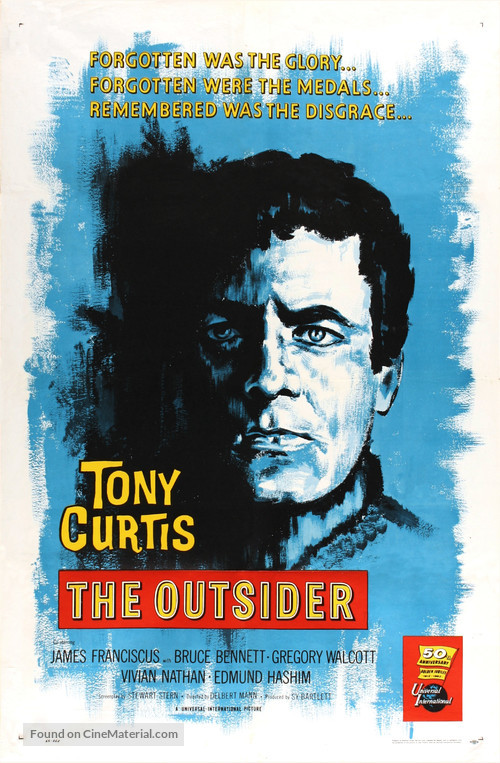
Ira's life was the subject of a 1961 film, The Outsider, in which Tony Curtis played Ira Hayes. Actor Adam Beach played him in Clint Eastwood's Flags of Our Fathers in 2006.


Ira, by then, had been buried with full military honors in Arlington National Cemetery.    


Considering what unwanted adulation did to Ira Hayes, perhaps I should not be upset by what happened to other Native American servicemen.  But I can't help it.  I resent my country's failure to recognize the critical role Native Americans played in American victories WWI. They were the Code Talkers - soldiers on the battlefields who used their native tongues as a way to transmit secret tactical messages. The Cherokee and Choctaw soldiers in France in WWI pioneered the technique of communicating in their own languages to keep the enemy from understanding.


And those who took up the technique in WWII, were not given the place in history they deserved until 1982. 


I knew about the Navajo Code Talkers in the Pacific from my dad.  They invented code words in Navajo for English words for which there was no Navajo equivalent.  They were incredibly creative about the way they used their own language.  In fact, though the Brits at Bletchley were able to break the infamous German Enigma code, the Navajo Code Talkers’ messages were never cracked. Not Ever!

Immensely brave in battle and brilliant at their job, the nation took them for granted.  

Thursday, February 21, 2019

A very special, if confused, day

Stanley - Thursday

Today is Armed Forces Day in South Africa - chosen because it is the date of one of the country's worst military disasters - the sinking of the SS Mendi in 1917. 

What is confusing is how the tragedy has been regarded over the years. It's enough to give one a headache. And heartache. And it almost totally due to the oral history tradition of the blacks in South Africa that we remember it at all.

The story

Fighting a war is a very complex enterprise requiring not only soldiers, but also non-combatant personnel to support them. In 1916, the British government asked South Africa to send 10,000 men from the South African Native Labour Contingent to Europe to help the war effort. South Africa complied, and large numbers of black South Africans (about 21,000) headed for Europe, expressly barred from doing any fighting because of fears that they may return and confront the white government. Most who went were volunteers who hoped that they would be rewarded for their service on their return.

The South African Native Labour Contingent's last parade before heading to Europe

Just before embarking
On the evening of February 20, 1917, the SS Mendi set sail from Plymouth headed for La Havre, France, with 805 black privates, 5 white officers, 17 non-commissioned officers, and 33 crew. On the morning of the next day, another ship, the SS Darro, sailing at high speed in unfavourable conditions, rammed into the SS Mendi, causing it to sink in less than half an hour.

The SS Mendi
Due to the rapid listing of the SS Mendi, some lifeboats were unusable, others were not launched because the men were unable to untie the knots on the ropes holding them. Apparently, the men had not been told that the ropes were designed to be cut, not untied. And those that were launched soon filled up, a few overturning due to overloading. 

The SS Darro did nothing to help rescue the men of the SS Mendi. However, lifeboats from the SS Mendi's escort, the destroyer HMS Brisk, did all it could to rescue survivors. In the end, 649 men perished. In an enquiry into the tragedy, the captain of the SS Darro, a Captain Stump, was found negligent and had his license suspended for a year.

The wreck 
In a rare, possibly unique, gesture, all members of the white South African House of Assembly stood in respect for the dead.

The legend

The courage shown by those on the SS Mendi has become a legend in South Africa. Certainly, there are verified accounts of amazing discipline and bravery, with men helping each other without respect to colour. As you would expect, there are also stories that have been elaborated and exaggerated, the best known of which is of a black paster, Isaac Dyobha, who called out to the men too afraid to jump overboard:
Be quiet and calm, my countrymen, for what is taking place now is exactly what you came to do. You are going to die, but that is what you came to do. Brothers, we are drilling the drill of death. I, a Xhosa, say you are all my brothers. Zulus, Swazis, Pondos, Basutos, we die like brothers. We are the sons of Africa. Raise your war cries, brothers, for though they made us leave our assegais at our kraals, our voices are left with our bodies.
Assegai - spear
Kraal - village

It is also said that the men danced on the deck in their bare feet, stamping in unison. However, this is highly unlikely, given the listing of the ship.

The aftermath

Many of the dead are buried in the countries where their bodies were washed ashore. There are memorials in a number of places in Europe and South Africa, but official recognition was only given in 2017, a hundred years after the tragedy, with the installation of a plaque at the South African National Memorial at Delville Wood.

The plaque at Delville Wood
The survivors of the disaster were treated very badly on their return to South Africa. Their contribution was barely acknowledged and promises that had been made before heading to Europe were not kept. No members of the South African Native Labour Contingent received a ribbon or medal for their service, nor did they receive promised pensions or grants of land or cattle or a reprieve from the hated hut tax. 

However, some did have something to take home with them - the thanks of the king. As one veteran later wrote 
We met King George and Queen Mary. The King addressed us personally and thanked us for the services we rendered. He told us that we were going home within a few days, and when we reached home we must tell our Chiefs and fathers how he had thanked us.

King George thanking members of the South African Native Labour Contingent
Another veteran, A K Xabanisa, later wrote:
I am just like a stone which after killing a bird, nobody bothers about, nobody cares to see where it falls.
The UK at last gives something back - the bell from the SS Mendi
During the years of white rule in South Africa, particularly under the apartheid government, the story of the SS Mendi was downplayed. I was well into my adult years when I first heard about it.

On the other hand, for the most part, the incident has been a rallying cry for blacks - something to be proud of. But even among blacks, it has waxed and waned in importance. I read just last week, that a government agency refused to provide some financial support for a memorial service scheduled to take place today because the men on the SS Mendi were supporting a colonial cause.

It makes my head spin.

South Africa's highest award for courage is now called the Order of the Mendi Decoration for Courage. And the South African navy honours those who died by having a Warrior class fast-attack craft named the SAS Isaac Dyobha, and a Valour class frigate named the SAS Mendi.

As I am writing this, I can hear South African Airforce jets flying low over Table Bay and heavy guns firing from Bloubergstrand across from Robben Island in remembrance of all of the country's war dead, no matter their colour.

May they rest in peace.


Thursday, November 27, 2014

Too little, and far too late. But better than nothing.

I do not know why World War I means so much to me.  

Ever since I can remember, I have been fascinated by the sheer idiocy of the entire venture.  Unlike World War II, there was no reason to go to war, other than rampant nationalism and male testosterone.  But to war, the major European powers went, resulting in the deaths of millions of men and the associated family tragedies.  The war was so horrific that it still sears people’s minds, even though no combatants are still alive.

800,000 ceramic poppies at the Tower of London - one for each death

My first associations with World War I were through poetry.  Initially I loved the jingoistic verses of Rupert Brooke, who died at the young age of 27 in 1915, not from action but from sepsis en route to fight at Gallipoli.

Rupert Brooke


The Soldier

IF I should die, think only this of me;
That there's some corner of a foreign field
That is forever England. There shall be
In that rich earth a richer dust concealed;
A dust whom England bore, shaped, made aware,
Gave, once, her flowers to love, her ways to roam,
A body of England's breathing English air,
Washed by the rivers, blest by suns of home.

And think, this heart, all evil shed away,
A pulse in the eternal mind, no less
Gives somewhere back the thoughts by England given;
Her sights and sounds; dreams happy as her day;
And laughter, learnt of friends; and gentleness,
In hearts at peace, under an English heaven.

But then my interest turned to the more realistic and bitter verses of Wilfred Owen, who died in Europe at age 25.  In particular, I love the poem Dulce et decorum est, which really benefits from being read out loud:

Wilfred Owen

Dulce et decorum est

Bent double, like old beggars under sacks, 
Knock-kneed, coughing like hags, we cursed through sludge, 
Till on the haunting flares we turned our backs 
And towards our distant rest began to trudge. 
Men marched asleep. Many had lost their boots 
But limped on, blood-shod. All went lame; all blind; 
Drunk with fatigue; deaf even to the hoots
Of tired, outstripped Five-Nines that dropped behind.
Gas! Gas! Quick, boys! – An ecstasy of fumbling, 
Fitting the clumsy helmets just in time; 
But someone still was yelling out and stumbling, 
And flound'ring like a man in fire or lime. . . 
Dim, through the misty panes and thick green light, 
As under a green sea, I saw him drowning. 
In all my dreams, before my helpless sight, 
He plunges at me, guttering, choking, drowning. 
If in some smothering dreams you too could pace 
Behind the wagon that we flung him in, 
And watch the white eyes writhing in his face, 
His hanging face, like a devil's sick of sin; 
If you could hear, at every jolt, the blood 
Come gargling from the froth-corrupted lungs, 
Obscene as cancer, bitter as the cud  
Of vile, incurable sores on innocent tongues, 
My friend, you would not tell with such high zest  
To children ardent for some desperate glory, 
The old Lie; Dulce et Decorum est 
Pro patria mori.

What really gets to me in this poem is the last line, spat out in ultimate sarcasm and bitterness:  Dulce et decorum est, pro patria mori, which means It is sweet and beautiful to die for one’s country.  Owen lifted this line from Roman lyrical poet Horace's Odes.

On this 100th anniversary of the start of one of mankind’s greatest tragedies, I want to say a few words about African involvement in the war.  

I suspect that very few people could tell you anything about the involvement of Africa and Africans in WWI – with the exception, of course, of blog mate Annamaria.  I will leave it to her to cover the East African campaigns, in which well over a million people died, and I’ll postpone to some other time, the campaign in German South West Africa.

I want to pay tribute to the thousands of Black South Africans who went to Europe to support the country’s fighting troops.  They worked as cooks, builders, stevedores, batmen, and so on – but not as combatants.  All in all, over 30,000 non-White South Africans went to the Western Front, and several thousand died. 

The greatest tragedy to befall Black South Africans in the war was the sinking of the troopship SS Mende off the Isle of Wight on February 21 1917 after a collision in thick fog with another vessel, the SS Darro.

SS Mende

On board were 823 personnel of the 5th Battalion the South African Native Labour Corps.  607 of them died.

Of course, they and other Black casualties could not be buried in the same cemeteries as their White compatriots, but were buried in nearby civilian cemeteries and, for all intents and purposes, forgotten.

Until this year . . .

Private Myengwa Beleza was one of the first black South African soldiers to be killed in France during the 1914-1918 war.  He died on November 27, 1916 and was buried in a civilian cemetery at the port city of Le Havre.

In June this year, his remains were exhumed and he was reburied at the South African Memorial, where 600 of his White fellow South Africans are buried.

South African Memorial at Delville Wood - now multiracial

"The re-interment process is part of government efforts to restore the dignity, particularly of those black South Africans who made an immense contribution towards world peace," spokesman Ronnie Mamoepa said.

In addition, the Mende disaster is remembered through The Mende Award, which is South Africa’s highest award for bravery.

So after 100 years, some recognition is being made of those who were not White, who lost their lives for King and country.  Far too little, and far too late, I think.  But better than nothing.

Stan - Thursday