Nazi Gold. Two words that conjure up hidden treasure, greed, the horrors of World War II, a Ludlum thriller, and which strike continued fascination, today, seventy years after the war. Old newsreel clips on Youtube show the Allies at war’s end in the Austrian salt mines recovering crates of gold wedding rings from Holocaust victims, gold bars, paintings of Rembrandt and Vermeer, treasures looted and hidden by the Nazi’s from all over Europe. Recovered treasure looted from the Third Reich that Hitler envisioned to become the Thousand year Reich. Given the sheer quantity of art and valuables pillaged by the Reich, one historian claims, it may take a thousand years to recover.
The stuff of legends? Maybe, yet a recent rumored ‘discovery’ of a Nazi gold train, buried in a tunnel in Poland either under a castle or in the mountains, has sparked treasure hunters, the curious, World War II buffs and the attention of the world to the Polish region near the border of Poland and Germany.

News came to light several weeks ago after two men, only identified as one Polish and one German, registered a finder’s claim which legally would entitle them to ten percent of the findings from a hidden Nazi gold train which they claimed to have discovered. As reported in the Telegraph UK “Since the end of the Second World War rumours and legends of a Nazi gold train that disappeared without trace in the dying days of the conflict have swirled around the town of Walbrzych, in south-west Poland. Stories put the train in the hills around the town, but despite many attempts to track it down it was never found – until now, it seems.”
Naysayers comments abounded; how could this be hidden for so many years, the logistics were impossible, who would leave gold and how could a long train be ‘hidden’. They insisted this was yet another fable of lost treasure. Turns out, well-known to the residents of that region, that the Nazi’s used slave labor to build warrens of tunnels threading the mountains and construct rail tracks to these tunnels.

But almost every day since the claim was registered in the Walbrzych town hall, a new turn in this story comes to light. A treasure hunting group insisted they had ‘discovered the location of the gold train’ under a hill two years previously. That the group mapped the location, stored the information on their computer and it was stolen. Hence, their claim should be rightful as the first discoverers. No proof of this has surfaced and one wonders why the group can’t remember the location which they said was on a four-kilometer stretch of the Wroclaw-Walbrzych main train line near Walbrzych.

Rival treasure hunters, stolen maps, tunnels, castles, hidden Nazi gold. All the components for a historical thriller, right?
Following that the town hall spokesman came out with a statement to the effect that since a finder’s claim was filed, all necessary actions were being taken to investigate this location and the procedure was complicated involving the fire department, heavy land moving equipment, experts at defusing munitions, rights to the property and access. This would all take a long time and involve cooperation on many levels. In the meantime the spokesman asked for what amounted to a plea to dissuade the rush of treasure hunters combing the area. The spokesman asked them to back off since they had no idea how dangerous the remains, if any, and their contents could be. The press was asked to wait for further announcements when they had information.

Now disgruntled treasure hunters complained over what they saw as a press blackout, how this reeked of a cover-up or it was a plot for tourism to bring visitors to this quiet region. "There are discrepancies between maps of the area from the 1920s and the 1940s which suggests there are tunnels under the town which have never been found," a local is quoted as saying. "Up to 1947 the Soviets were here and we do not know what they found."
The Ksiaz castle was being prepared for Hitler's arrival right up to the end of World War Two with a study and en suite lavatory installed for the dictator.
A comprehensive bunker complex based on the blueprint of the dictator's Berlin wartime base was also under construction when the fortress was overrun by Soviet troops in 1945.
Local politician Lukasz Kazek claims that just one third of the vast tunnel network built by the Germans during the Second World War, dubbed the 'Riese' project - German for 'giant' - have been discovered.
This story fascinated me. Every day a new aspect has been unfolding. I wondered why no residents of this area between the four-kilometer stretch of the Wroclaw-Walbrzych main train line near Walbrzych had been interviewed. Surely, if these gold train rumors existed since the war wouldn’t anyone still alive remember? Or their descendants recall hearing stories? Or had interviews and accounts occurred on Polish radio and didn’t make it to the international papers. Again, it intrigued me, and that thought of what if, the what if spark that triggers a story. What if the locals knew about this train and had kept quiet over the years because they had helped themselves long ago to the contents?
The could almost parallel my next book involving Nazi gold and a train through France. I’d done research concerning the Reich’s trains carrying gold from Switzerland, through France to Spain and their destination of Portugal. Documentation shows the Nazi’s paid Salazar, the dictator of Portugal, in newly minted bars of looted gold for Tungsten, also know as Wolfram the metal mined in Portugal needed to armor plate tanks. Salazar had wised up early in the war, refused Reich marks and demanded gold in payment.
A hurdle in this transportation operation, that had to be surmounted again and again, was that the French rail tracks, the standard European gage-tracks and the Spanish broad-gage didn’t match.

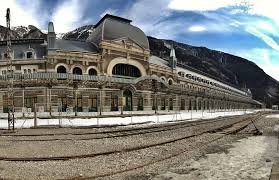
No forklifts then. And gold is heavy. Think of a five kilo bar, that’s a little over 11 pounds. If each box carried five bars, that’s 55 pounds requiring not one strong man but two. Think of hundreds of boxes with gold bars needing to be transferred. The villagers of Canfranc were enlisted for the work.

In the journalist Ramon J. Campo’s exhaustively researched book, Canfranc, Gold and the Nazis, new revelations about the station’s old secrets emerge. According to Campo, 86 tons of gold passed through Canfranc. He describes border officials who loaded up on gold bars, people who got glimpses of paintings and clocks. The people in Canfranc who Campo met and interviewed knew the stories. Hence in my story, the gold headed for Canfranc plays a role.
During the war Nazi’s systematically looted works of art and cultural property from public and private collections in Europe with close to 80,000 objects confiscated in Poland alone. We know from historical documentation that a German army presence existed there all during the war and they headquartered at Ksiaz castle on a hill, close to Walbrzych, where you can lodge today.

The saga continued yesterday in a startling announcement by Piotr Zuchowski, head of conservation for the Polish Arts Ministry, who revealed at press conference that a 90 year old man on his deathbed confessed to being involved the operation to hide the train 70 years ago.
The minister said he is now “99 per cent” that the train has been found, after seeing photographs of an object taken with ground penetrating radar.
“This is unprecedented. The train is over 100 metres long, and is armoured. We do not what’s inside but its armour indicates it has a special cargo,” said Mr Zuchowski. “There is probably military equipment but also jewelery, works of art and archive documents which we knew existed, but never found.”
The identity of the dying 90 year old man, and the two treasure hunters remain part of the mystery still surrounding the train. Historians have warned that the train could be booby-trapped and the possibility that it contains toxic chemicals.
What do you think?
Cara - Tuesday