Showing posts with label The Lunatic Express. Show all posts

Sunday, March 24, 2024

The Lunatic Express Again


Annamaria on Monday

This past week, a writer friend told me that he has, in his future, a meeting with a person who is researching "railroads in East Africa!"  He asked me if one of my books takes place against the building of the railway. But that all happened about seventeen years before my stories start.  The railway is, however, an essential part in most of my stories.  My characters travel by train, beginning with the first book in the series: Strange Gods, just now out in a new edition. 


Since the new edition of that book just launched, I took that question as a suggestion for today's blog.  Here is repost of my blog about the creation of what came to be known as "The Lunatic Express."
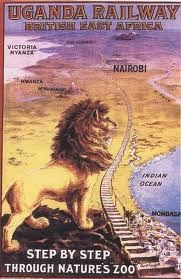


It was called the Uganda Railway, but all of it was in the Protectorate of British East Africa, now Kenya.  It goes 660 miles from the port city of Mombasa, on the Indian Ocean, to Kisumu on the Eastern shores of Lake Victoria, across the water from Uganda.


It is credited with cementing Britain’s colonial power in East Africa.


But also with being instrumental in stopping the “trail of tears”—the route where slaves were dragged from the interior to the coast and then shipped to work in the households of Asia Minor and on the sesame plantations of the Zanzibar.

Construction began in 1896.  It cost Great Britain’s taxpayers 55 million pounds sterling: £20.1 Billion or $33 Billion in today’s money.


If the indigenous people tried to stop its progress through their territory, “punitive expeditions” were sent out to put them in their place.  Keep in mind that the King's African Rifles had firearms.  The tribal people fought with iron (not even steel) spears and swords.  Still, the Maasai won one of those battles.


32,000 Indians were shipped in from the Raj to build it.  6,724 of them stayed after the work was done and made a life there—many of their descendants remain today.  

It crosses 35 viaducts, 120 bridges and culverts.


Its engineers and construction crews braved man-eating lions and deadly scorpions.

2,498 perished during its construction.

Before the Brits built the railroad, the route from Mombasa to Kisumu was an oxcart trail.  To traverse from the coast took about three months with most of the party walking, carrying water and food.  Ordinarily around three hundred at a time, most of them tribal porters, made the trip.  People died.

A new way to travel that distance was called for.  But not everyone agreed.

Calling the railroad a “gigantic folly,” Liberals in Parliament were against the project, saying that Britain had no right to drive what African’s called the “Iron Snake” through Maasai territory.  The magazine Punch called it “the Lunatic Line.”  In 1971, Charles Miller wrote a book about it: The Lunatic Express: An Entertainment in Imperialism.  Many politicians and newspaper editors called it a waste of the taxpayer’s money.  Shaky wooden trestles over enormous chasms, hostile tribes, workers dying of until-then unknown diseases—much of what transpired seemed to support those against the idea.


But from the outset, the Uganda Railroad had its adherents.   Conservatives saw it as an important salvo in the “Scramble for Africa,” that Nineteenth Century madness of the European powers to take over whatever chunks of the African continent they could lay their hegemony on.  Winston Churchill admired it as “a brilliant conception."  He said, “The British art of ‘muddling through’ is seen here in one of its finest expositions.  Through everything—through forests, through the ravines, through troops of marauding lions, through famine, through war, through five years of excoriating Parliamentary debate, muddled and marched the railway.”


In the end it was seen as a huge achievement—both strategically and economically.  It became vital to the suppression of slavery.  Its existence eliminated the need for huge squads of human beings to carry goods.
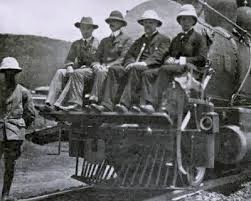


The American President Teddy Roosevelt rode the railroad during his visit to British East Africa in 1909.  He wrote, "The railroad, the embodiment of the eager, masterful, materialistic civilization of today, was pushed through a region in which nature, both as regards wild man and beast, does not differ materially from what was in Europe during the late Pleistocene."  On his way into the interior from the coast, he often rode on a platform on the front of the locomotive, giving him a great vantage point for viewing the huge array of wildlife along the way.  According to Teddy, "...on this, except at mealtime, I spent most of the hours of daylight."  It's a view I sorely wish I could have seen.

Here is a link to give you a glimpse of the line as it passes through some of the most incredible scenery on earth, as shown in the opening credits of Sydney Pollack’s brilliant Out of Africa.

 htttp://www.youtube.com/watch?v=9FB1LS3WhIU


Monday, March 4, 2024

The Man-Eating Lions of Tsavo

Annamaria on Monday 

It's 5 PM in Florence.  I just returned from three weeks in Kenya and Tanzania, and thanks to my share of the world-wide pandemic of air travel snafus, I have just three days to organize things for my return to NYC on Tuesday.  There are a LOT of details to be seen to.  So today, I offer you a story that I told here then years ago, and one that I recounted to friends when I was in Nairobi these past weeks. 

This is about a pair of serial killers in a story written by a guy named Patterson.

No.  Not that Patterson.  This Patterson is Lt. Col. John Henry Patterson, who was commissioned, in 1898, to build a railroad bridge over the Tsavo river in the Protectorate of British East Africa, now Kenya.  This project was part of the building of the Lunatic Line, the subject of a couple of my previous posts.


Patterson was not an engineer.  He had joined the British Army at the age of seventeen, having only whatever education was available in County Westmeath, Ireland for a lad like him—the son of a Protestant father and a Roman Catholic mother.  That heritage may account for the sang-froid and fearless determination he exhibited in the trackless African wilderness of the time.


Patterson’s work on the bridge had barely begun when a couple of the area’s maneless male lions began attacking his Indian workers, dragging them from their tents as they slept.   Building thorn-bush enclosures and bonfires in the night did not stay the beasts.  After a few deaths, the building crew began to think that the lions were a manifestation of evil spirits who put a curse on their work.  Pretty soon the project came to standstill because workers decamped en masse.  Without his large crew, Patterson himself became more exposed to the danger.

To save his job and his own life, he had to find and kill the marauders—who in the end turned out to be a pair of rogue males with a taste for human flesh.  Multiple theories have been posited to explain why the cats preferred human flesh—everything from a paucity of other game in the area to the fact that captured slaves often died nearby while being dragged to the coast, and their corpses made for easy meals.

Accompanied by a brave gun bearer and often by other shooting companions, Patterson went on the attack.    It took him months to find and do away with the lions, who continued to kill in the meanwhile.


He recounted one attack while he and two other men were asleep and thought themselves safe in a railway carriage.  Patterson took the top bunk (an excellent choice), another British officer was on the bottom bunk, and an Italian hunter slept on the floor.  The downstairs Brit could not stand the heat and opened a window.  In the middle of the night, a lion entered through it, landing on the back of the Italian.  In the melee of shouting, reaching for rifles, and trying to run out of the locked door, the man-eater managed to drag the man on the bottom bunk through the window and made away with him.  Patterson buried what was left of his remains the following day.  The Italian decided that, much as he loved hunting, he would be better off trying his luck in another locale.  He left for Mombasa on the next train.


Eventually, Patterson killed both lions—huge males, nine feet from the tips of their noses to the ends of their tails.  It took eight men to carry each one back to camp.  In all, the monsters had killed twenty-eight railway workers.

The bridge was completed two months after the second lion bit the dust.

Patterson had them made into rugs, which he kept in his home until 1924, when he sold them to the Field Museum in Chicago.  Their skulls are still on display there, as is a diorama of what they looked like in life.


Patterson went on to write his account these and his other adventures durings the building of the railroad in his 1907 book, The Man-Eaters of Tsavo.  His story (Hollywoodized) was made into two films: Bwana Devil in 1953 with Robert Stack and Nigel Bruce and The Ghost and the Darkness in 1996 with Val Kilmer and Michael Douglas.  I have not seen either one.  I will watch the first one this evening, so by the time you read this, I will be able to tell you if it is worth watching.  If you want to know about the Val Kilmer/Michael Douglas film, you have to take your chances on your own, as it is against my religion to watch a film with either one of them.  Both in the same film will, I am sure, be more than I bear.

As close as I will ever get to seeing a movie with Val Kilmer
