Showing posts with label Prince Albert. Queen Victoria. Show all posts

Sunday, July 23, 2023

The Dark, Enchanting River: My Multiple Encounters

I am delighted to introduce our guest today, best-selling, multi-award nominee Karen Odden. If you haven't read her wonderful novels yet, this is a great introduction to her interests and POV on Victorian London. Please see her bio at the end of the post and check out her newest book, Under a Veiled Moon. Welcome, Karen!


 KAREN ODDEN

Thames, possibly from tamesa, Celtic "the dark one"' or tamesis, Latin for "dark: or tamasa, Sanskrit for "dark river."

The first time I ever saw the Thames River was in a Monet calendar on my bedroom wall when I was sixteen. In this rather idealized version, painted in the final years of Queen Victoria’s reign, Westminster’s spires sketch a delicate calligraphy against gorgeous pastel clouds. I thought it looked enchanted. I also naively thought the river was pronounced Th-aims. 


Image of Money painting Houses of Parliament, London

Fast forward to grad school at NYU in the 1990s when I was studying Victorian literature and encountered this illustration of the Thames during the Great Stink of 1858.  


"The Silent Highwayman" 1858  

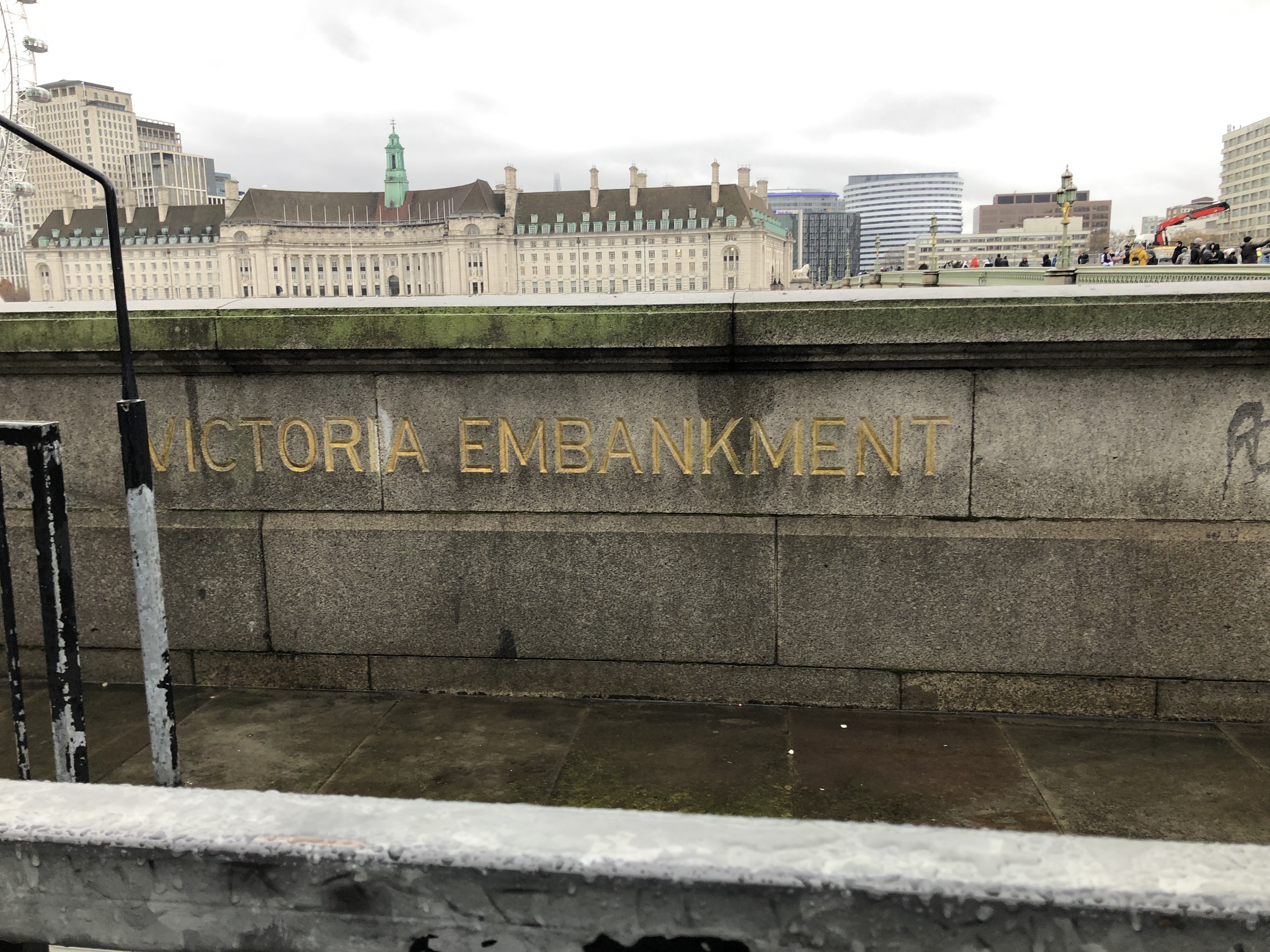
Not quite the Monet, is it? At the time, the river was up to 20% raw sewage (horse, human, etc.) and the stench and “miasma” from the river was so disgusting that the Members of Parliament covered the windows of Westminster with huge cloths, sprayed with a type of bleach, and addressed each other through scented handkerchiefs. (Sound vaguely familiar?) They speedily hired civil engineer Joseph Bazalgette to overhaul the sewer system, and the enormous pipes he required lie underneath the Victoria Embankment on the north bank, where you can still see his name. 


It wasn’t until the summer of 1999 that I spent time in person near the Thames River. I was researching for my PhD dissertation on Victorian railway disasters and the injuries to hundreds of travelers, including Charles Dickens.


Dickens ministering to the injured

I was tracing the connections from Victorian railway injuries (sometimes called “railway spine”) of the mid-1800s, to Sigmund Freud’s “hysteria” in the 1890s, to “shell shock” in WWI, and to our present-day PTSD.


So by day, I would sit in the British Library on Euston Road poring over medical treatises, parliamentary papers, novels, and newspaper accounts of railway disasters. On nights and weekends, I walked London. Now I saw the Thames for myself, in different lights and from different bridges. As I stood on Blackfriars Bridge (built in 1869) and watched the river lapping at the pillars beneath me, rhythmic as a pulse, I’d think of all the Victorians who had passed where I stood, including Queen Victoria herself, who paraded across the day it opened. 


Queen Victoria opening Blackfriars Bridge November 1869.

It wasn’t until I began researching for my first Inspector Corravan novel, Down a Dark River, that I read Peter Ackroyd’s magisterial Thames and learned that the river is tidal for about 100 miles inland from the North Sea. (I probably should have known this.) Twice a day, well past London, the river changes direction, throwing up a mix of trash and treasure onto the banks. In his novels, Dickens wrote about the mud-larkers, who scrounged along the muddy banks for coal, wood, and anything usable or sellable. You can still do it now: for around $35 on TripAdvisor, you can join a guided tour, with rubber boots, a pail, and a grabber tool for digging, as you see here.


Mud larkers, viewed from Blackfriars Bridge, December 2021.

Between my reading and live observation, I came to realize how marvelously complex the Thames is -- at once changeful and steady, both a sewer and the lifeblood of Victorian trade, older than the Romans and yet essential to London’s modernity.

My most recent visit to London was in 2021. My daughter was studying abroad at Oxford (where she rowed crew on the Thames!)


I flew over in December to meet her. We spent two weeks walking London, a safe activity during Covid. I also ventured to the Museum of the London Docklands, which is housed in an old Victorian warehouse on a cobblestone street that was desperately difficult to walk in. This museum illuminated another aspect of the Thames – the world of Victorian dockwork.


Michael Corravan, my protagonist in Down a Dark River, is a former thief and bare-knuckles boxer from Whitechapel; he is also a dockworker and then a lighterman, ferrying goods from ship to warehouses. This museum had lighter boats, scales and weights, the swan-neck carts used to move barrels, maps of the changing shore and evolution of the Victorian docks, and even a lighterman’s license from the 1870s, like the one Corravan would have carried.  


Corravan’s knowledge of the Thames is crucial to solving the case in Down a Dark River, where young women are being murdered, placed in lighter boats, and being sent down the Thames.


In the sequel, Under a Veiled Moon, my starting point was a maritime disaster in 1878. The Princess Alice, a small wooden pleasure steamer, was coming upstream by moonlight when the Bywell Castle, a 900-ton iron-hulled coal carrier rammed it, breaking it into pieces and sending all 600-some passengers into the water, where most drowned, bringing London to a horrified standstill.  


As I read about this tragedy, I recognized that a small wooden steamship clashing with a metal behemoth suggested all sorts of transitions and conflicts that were occurring (often violently) in the nineteenth century – small cottage industries versus large industrial factories, people versus machines, and so on. Again, the Thames felt rich with symbolism.


Each time I have returned to the Thames, in life or in my fiction, I have found something different and strange. I love it as a setting for my novels because I want to represent a society where ideas about mercy and justice, and loyalty and duty, were morally complicated for my characters rather than neatly binary, and the river, with all its complexity, seems the proper setting for this. 

---Karen


USA Today bestselling author Karen Odden received her PhD from NYU, taught at UW-Milwaukee, and edited for academic journals before writing fiction set in 1870s London. Her fifth novel, Under a Veiled Moon (2022), was nominated for the Agatha, Lefty, and Anthony Awards for Best Historical Mystery and features Michael Corravan, a former thief turned Scotland Yard Inspector. Karen serves on the national board of Sisters in Crime and divides her time between Arizona and Utah, where she dreams up murder plots while hiking. Connect with her at www.karenodden.com, where youll find her history blog, newsletter, and social media handles.


Friday, January 16, 2015

The Albert Memorial


                                                    The Albert Memorial

Poor Queen Victoria. For years she was perceived as a rather stern, matronly, black clad woman who went into a deep depression at the death of her 'beloved Albert'. And probably never had any fun ever again. (Apart from, I hope, a few stolen moments in her later years warming her bunions with Ghillie John Brown.)
                                                           
                                                     Queen Victoria and Ghillie Brown

For many years, the image of 'beloved Albert' has been that of a man who was a bit dim, a bit of a political afterthought who stood by the Queen as she ruled her empire.
                       
                              
                                      Ghillie and some pleasant pheasant dogs


Neither of these perceptions are true of course.

Letters from Victoria’s early life show she was a passionately romantic soul, scribbling up to 2500 words a day about Albert; how beautiful he was, how good he was in bed, etc etc. Much of the writing was destroyed after her death as such talk was not the done thing in Victorian times. Indeed table legs were covered up in those days, deemed to be too risqué.

                                 
                                          The happy couple. Do they look miserable or what?

Much closer to the truth is that Victoria battled with her heart ruling her head, she spent her whole life kicking against domineering men who wanted to control her, and fighting with Albert. The Prince Consort, a rather clever and scheming soul wanted the Sax Coberg  Gothe dynasty to marry into as many European Royal families as possible and to that end, Victoria had to produce as many children as possible.  While running an empire.

She had her first child within a year of marriage, robbing her of time alone with 'beloved Albert', and she bitterly resented that. She had a very poor relationship with her own mother, moving her out of the palace to an apartment of her own and making sure she stayed there. Maybe that lack of bonding, plus the Royals habit of seeing their children for fifteen minutes before supper every second Wednesday, seriously affected Victoria.  She was little more than a baby factory. Her letters hint at post natal depression and horrific mood swings. They clearly show her frustration as Albert and his advisors pat her on the head over a good luncheon as they decide which child to marry off to who.
'Vicki', Princess Royal, Her Dad and a  dog who is in need of a good dinner 

Her eldest daughter Vicki was sent off for a walk to a romantic highland spot with a 25 year old suitor (Frederick The Third I think ) who she later married or was told to marry.  Vicki was 14 at the time.

After our disappointing visit to the Diana Memorial Non fountain, we walked up to The Albert Memorial (about seven minutes stroll). It is so spectacularly ostentatious you can’t help but admire it. When it was opened in 1872, it had cost 11 million pounds in today’s money to build. All paid for by public subscription. Albert had died eleven years previously at the age of 42, of typhoid or Crohn’s disease or stomach cancer.

It was when Albert died that Victoria grew confident on her own abilities and evolved into the political powerhouse that had elder statesmen quaking in their breeches. She was probably the last of the monarchs who had her opinion listened to  and valued by the government of the day. Nowadays some of the Royals can't be trusted  to put their shoes on the right way round. I'm sure Stan and CO would come up with a mathematical model to prove how much cross breeding should take place before the chinless wonder, good with horses, can't walk and chew at the same time gene  comes into play.

But in all seriousness, the number of other memorials around the UK, show what a popular chap Albert was. He was an astute politician, a true statesman with a powerful intellect, multi lingual and aware of the precipitous nature of the Empire and the social condition that some (most of!) Victoria's subjects lived under. His contribution to organizing the Great Exhibition of 1851 is well documented.
                               
                                              This was as far as they would let me go

And looking at the monument now, to me it smacked of imperialism and the empire, and when Britannia ruled the waves and all that stuff. But seemingly not. Or maybe the component parts have been reinterpreted to be more palatable and ethically sound.


The official version is that “two allegorical sculpture programs: four groups depicting Victorian industrial arts and sciences (agriculture, commerce, engineering and manufacturing), and four more groups representing Europe, Asia, Africa and The Americas at the four corners, each continent-group including several ethnographic figures and a large animal. (A camel for Africa, a bison for the Americas, an elephant for Asia and a bull for Europe.)”


To me it just looked like a woman lording over her lessers!

The central part is  surrounded  by the  Frieze of Parnassus  which depicts  composers and poets on the south side , architects on the north side, painters on the west side.

The Albert Memorial was influenced by the style of – the Scott Monument in Edinburgh which was designed twenty years earlier.
                                       
 Albert is shown looking south, towards the Royal Albert Hall.

The canopy has two historical figures on each side, made from enamel, polished stone, onyx, marble and granite. King David, Homer, Apelles, Raphael, Solomon, Ictinus Phidias and Michelangelo all beautifully depicted. The pillars have statutes representing sciences: Astronomy, Geology, Chemistry, Geometry, Rhetoric, Medicine, Philosophy and Physiology.
                                           

Around the canopy reads Queen Victoria and Her People • To The Memory Of Albert Prince Consort • As A Tribute Of Their Gratitude • For A Life Devoted to the Public Good.
At the top of the canopy are eight statues of the moral and Christian virtues; Faith, Hope, Charity and Humility Fortitude, Prudence, Justice, Temperance.
Above that gilded angels raise their arms heavenwards.
Above that is a gold cross.

By the late 1990s the Memorial had fallen into a state of some decay and it took twenty million dollars to repair it. The sprayed figure of Albert himself is now back to glowing gold leaf, for the last eighty years it has been covered in black paint. Theories are that it was blackened during World War 1 to stop it being a target for Zeppplins, other theories that it was part of the anti German sentiment that was prevalent at that time. During the restriction though they found out that the black paint pre dated the WW1 and might have been an attempt to protect the leaf from atmospheric pollution.

                                          
As it stands at the moment, you can walk round it but there is a padlocked gate which is open for guided tours where all the above will be explained in great detail just in case anybody gets the wrong end of the stick and thinks it’s a monument to the Imperialist past when Britannia really did rule the waves.

And anything else she could get her hands on.


Caro Ramsay 16 01 2015