Showing posts with label Charles Dickens. Show all posts

Sunday, July 23, 2023

The Dark, Enchanting River: My Multiple Encounters

I am delighted to introduce our guest today, best-selling, multi-award nominee Karen Odden. If you haven't read her wonderful novels yet, this is a great introduction to her interests and POV on Victorian London. Please see her bio at the end of the post and check out her newest book, Under a Veiled Moon. Welcome, Karen!


 KAREN ODDEN

Thames, possibly from tamesa, Celtic "the dark one"' or tamesis, Latin for "dark: or tamasa, Sanskrit for "dark river."

The first time I ever saw the Thames River was in a Monet calendar on my bedroom wall when I was sixteen. In this rather idealized version, painted in the final years of Queen Victoria’s reign, Westminster’s spires sketch a delicate calligraphy against gorgeous pastel clouds. I thought it looked enchanted. I also naively thought the river was pronounced Th-aims. 


Image of Money painting Houses of Parliament, London

Fast forward to grad school at NYU in the 1990s when I was studying Victorian literature and encountered this illustration of the Thames during the Great Stink of 1858.  


"The Silent Highwayman" 1858  

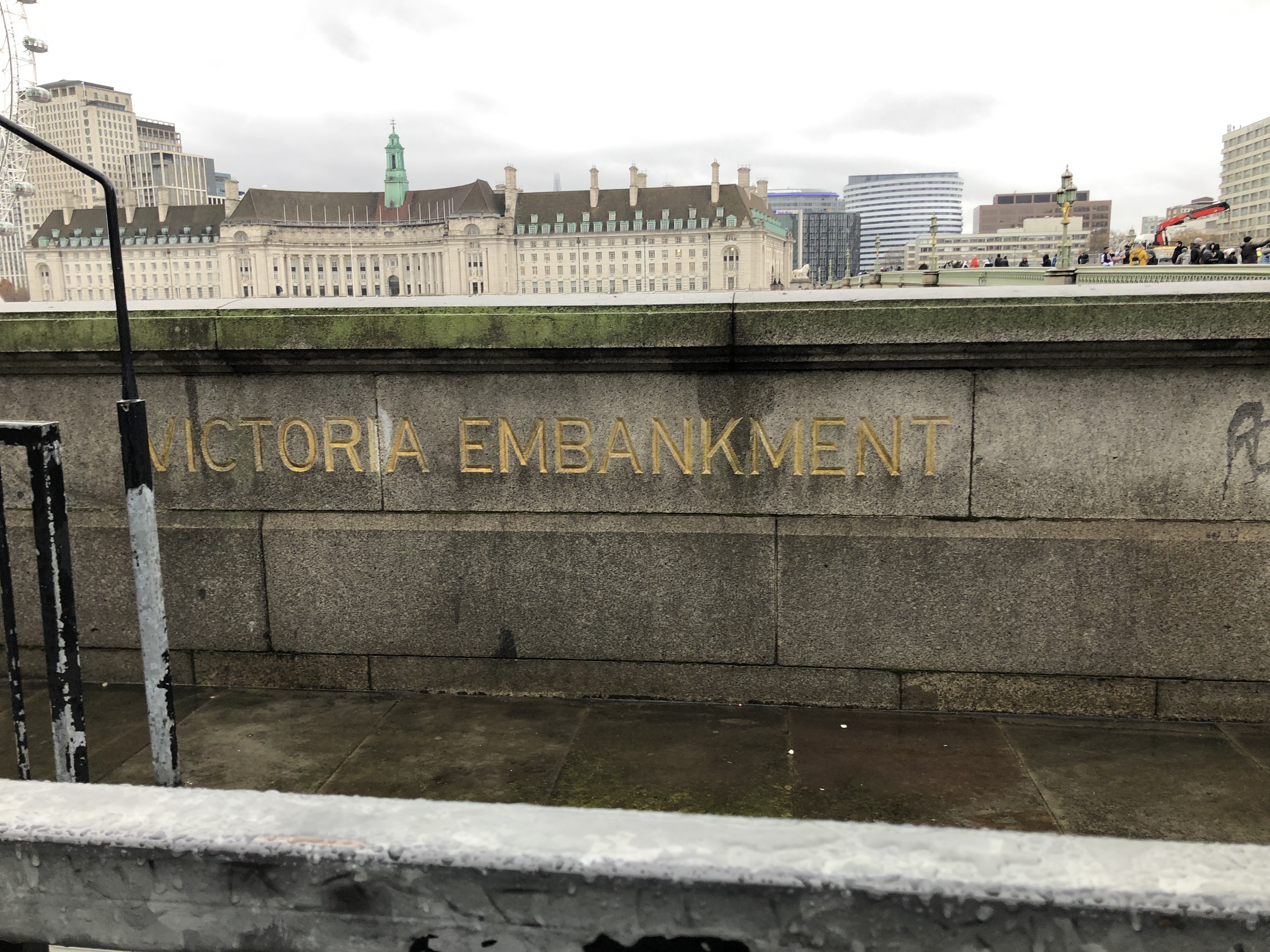
Not quite the Monet, is it? At the time, the river was up to 20% raw sewage (horse, human, etc.) and the stench and “miasma” from the river was so disgusting that the Members of Parliament covered the windows of Westminster with huge cloths, sprayed with a type of bleach, and addressed each other through scented handkerchiefs. (Sound vaguely familiar?) They speedily hired civil engineer Joseph Bazalgette to overhaul the sewer system, and the enormous pipes he required lie underneath the Victoria Embankment on the north bank, where you can still see his name. 


It wasn’t until the summer of 1999 that I spent time in person near the Thames River. I was researching for my PhD dissertation on Victorian railway disasters and the injuries to hundreds of travelers, including Charles Dickens.


Dickens ministering to the injured

I was tracing the connections from Victorian railway injuries (sometimes called “railway spine”) of the mid-1800s, to Sigmund Freud’s “hysteria” in the 1890s, to “shell shock” in WWI, and to our present-day PTSD.


So by day, I would sit in the British Library on Euston Road poring over medical treatises, parliamentary papers, novels, and newspaper accounts of railway disasters. On nights and weekends, I walked London. Now I saw the Thames for myself, in different lights and from different bridges. As I stood on Blackfriars Bridge (built in 1869) and watched the river lapping at the pillars beneath me, rhythmic as a pulse, I’d think of all the Victorians who had passed where I stood, including Queen Victoria herself, who paraded across the day it opened. 


Queen Victoria opening Blackfriars Bridge November 1869.

It wasn’t until I began researching for my first Inspector Corravan novel, Down a Dark River, that I read Peter Ackroyd’s magisterial Thames and learned that the river is tidal for about 100 miles inland from the North Sea. (I probably should have known this.) Twice a day, well past London, the river changes direction, throwing up a mix of trash and treasure onto the banks. In his novels, Dickens wrote about the mud-larkers, who scrounged along the muddy banks for coal, wood, and anything usable or sellable. You can still do it now: for around $35 on TripAdvisor, you can join a guided tour, with rubber boots, a pail, and a grabber tool for digging, as you see here.


Mud larkers, viewed from Blackfriars Bridge, December 2021.

Between my reading and live observation, I came to realize how marvelously complex the Thames is -- at once changeful and steady, both a sewer and the lifeblood of Victorian trade, older than the Romans and yet essential to London’s modernity.

My most recent visit to London was in 2021. My daughter was studying abroad at Oxford (where she rowed crew on the Thames!)


I flew over in December to meet her. We spent two weeks walking London, a safe activity during Covid. I also ventured to the Museum of the London Docklands, which is housed in an old Victorian warehouse on a cobblestone street that was desperately difficult to walk in. This museum illuminated another aspect of the Thames – the world of Victorian dockwork.


Michael Corravan, my protagonist in Down a Dark River, is a former thief and bare-knuckles boxer from Whitechapel; he is also a dockworker and then a lighterman, ferrying goods from ship to warehouses. This museum had lighter boats, scales and weights, the swan-neck carts used to move barrels, maps of the changing shore and evolution of the Victorian docks, and even a lighterman’s license from the 1870s, like the one Corravan would have carried.  


Corravan’s knowledge of the Thames is crucial to solving the case in Down a Dark River, where young women are being murdered, placed in lighter boats, and being sent down the Thames.


In the sequel, Under a Veiled Moon, my starting point was a maritime disaster in 1878. The Princess Alice, a small wooden pleasure steamer, was coming upstream by moonlight when the Bywell Castle, a 900-ton iron-hulled coal carrier rammed it, breaking it into pieces and sending all 600-some passengers into the water, where most drowned, bringing London to a horrified standstill.  


As I read about this tragedy, I recognized that a small wooden steamship clashing with a metal behemoth suggested all sorts of transitions and conflicts that were occurring (often violently) in the nineteenth century – small cottage industries versus large industrial factories, people versus machines, and so on. Again, the Thames felt rich with symbolism.


Each time I have returned to the Thames, in life or in my fiction, I have found something different and strange. I love it as a setting for my novels because I want to represent a society where ideas about mercy and justice, and loyalty and duty, were morally complicated for my characters rather than neatly binary, and the river, with all its complexity, seems the proper setting for this. 

---Karen


USA Today bestselling author Karen Odden received her PhD from NYU, taught at UW-Milwaukee, and edited for academic journals before writing fiction set in 1870s London. Her fifth novel, Under a Veiled Moon (2022), was nominated for the Agatha, Lefty, and Anthony Awards for Best Historical Mystery and features Michael Corravan, a former thief turned Scotland Yard Inspector. Karen serves on the national board of Sisters in Crime and divides her time between Arizona and Utah, where she dreams up murder plots while hiking. Connect with her at www.karenodden.com, where youll find her history blog, newsletter, and social media handles.


Monday, February 28, 2022

A tale of two cities

 Annamaria on Monday


I have stolen this title from Charles Dickens, as I'm sure you all know. But I think I have the right. This is a story about highly improbable coincidences. But every word of it is true.

Dickens, as I have written about before in these precincts, was a master unparalleled at making outrageous coincidences believable in his fiction. No one but he could have gotten away, for instance, with the number of times David Copperfield accidentally encounters Mister Micawber. 


As you've probably noticed, I have nothing approaching Dickinsons's skill. Well, whether you believe it or not, what I am going to tell you today is the truth, every word of it.  It won't be as weird a tale as the one Caro told last week, and very likely not as entertaining, but I can't help but recount it because, on some level, my strange story also feels paranormal.


Ultra-fortunate person that I am, I live in two apartments, each in one of the most wondrous cities on our sacred planet.  Over the past few months, the buildings that house my two apartments have been living uncannily parallel lives.

Both Florence and New York have, this past year, required apartment buildings to inspect their façades and to correct any faults.  Consequently, in both cities the building managers and owners scrambled to get this work done and avoid hefty fines. In both Florence and New York, the buildings where I own apartments have found that work needed to be done.  During the work, both buildings required scaffolding to protect pedestrians from any accidents.  Both buildings also had roofs that needed repair, and it was decided that, since scaffolding would be in place, it would be a good time to repair the neglected roofs as well.


As plans went ahead in both cities, it became clear that there were not enough materials available to erect scaffolding in so many places in order to have the repairs completed before the end of 2021. In both cities, the government extended the deadline because of the lack of available scaffolding. In both cities the management and the residents of the buildings decided they would postpone beginning the work until the end of March.


I had been laughing at the fact that these buildings were leading parallel lives, and chalked it up to an unlikely but possible coincidence. I do know for sure that I am the only person who owns an apartment in both these buildings.

Then something really weird happened. About a week ago, I came into my building here in Florence and found the elevator was out of order. Some nitwit had opened the doors before the elevator came to a halt, managed to get out, but left the elevator out of service. I called the number posted to ask for assistance and walked up to the seventh floor. When I got to my place, I checked my email only to find that my neighbors in New York were emailing each other, including me, that the elevator was broken.  These two buildings, six time zones apart, both had a broken elevator at the same moment                                                                                               

The next thing that happened put the icing on the paranormal cake. At 3 o'clock in the afternoon in Florence, my doorbell rang.  It was the elevator technician, asking me to let him in so that he could make the repair. As I was pressing the button to open the front door, I received a message on my phone.  It was from the building manager in New York, where it was 9 AM, asking if I could buzz in the elevator technician who was waiting at the front door.

????.......

Monday, October 14, 2019

A Lesson From a Master

Annamaria on Monday


It has always been my goal to write vividly.  I imagine the inside of the reader's forehead as a movie screen onto which I - too seldom successfully - try to project a moving image of the story I seek to tell. The gods I look to to show me how this might be done are almost always masters of fiction who never in their lives saw a film projected on a screen.  I speak of the authors whose books we call 'the classics."  I read them and read them, wielding mental screwdrivers and wrenches, taking their prose apart, trying to figure out how they do it.

This week my model is the astonishing Charles Dickens.  This afternoon, as I read Chapter 10 of Oliver Twist, I saw the action of Dickens' story so vividly, it became a perfect example of what I wish I could do.  The scene is tumult, moving, speeding, noisy, as irresistible to us as  the chase Dickens describes is to his butcher, his baker, his milkman...

Here it is.  See it - projected on your imagination for yourself:

They were just emerging from a narrow court not far from the open square in Clerkenwell, which is yet called, by some strange perversion of terms, 'The Green': when the Dodger made a sudden stop; and, laying his finger on his lip, drew his companions back again, with the greatest caution and circumspection.
'What's the matter?' demanded Oliver.
'Hush!' replied the Dodger. 'Do you see that old cove at the book-stall?'
'The old gentleman over the way?' said Oliver. 'Yes, I see him.'
'He'll do,' said the Dodger.
'A prime plant,' observed Master Charley Bates.
Oliver looked from one to the other, with the greatest surprise; but he was not permitted to make any inquiries; for the two boys walked stealthily across the road, and slunk close behind the old gentleman towards whom his attention had been directed. Oliver walked a few paces after them; and, not knowing whether to advance or retire, stood looking on in silent amazement.
The old gentleman was a very respectable-looking personage, with a powdered head and gold spectacles. He was dressed in a bottle-green coat with a black velvet collar; wore white trousers; and carried a smart bamboo cane under his arm. He had taken up a book from the stall, and there he stood, reading away, as hard as if he were in his elbow-chair, in his own study. It is very possible that he fancied himself there, indeed; for it was plain, from his abstraction, that he saw not the book-stall, nor the street, nor the boys, nor, in short, anything but the book itself: which he was reading straight through: turning over the leaf when he got to the bottom of a page, beginning at the top line of the next one, and going regularly on, with the greatest interest and eagerness.
What was Oliver's horror and alarm as he stood a few paces off, looking on with his eyelids as wide open as they would possibly go, to see the Dodger plunge his hand into the old gentleman's pocket, and draw from thence a handkerchief! To see him hand the same to Charley Bates; and finally to behold them, both running away round the corner at full speed!
In an instant the whole mystery of the hankerchiefs, and the watches, and the jewels, and the Jew, rushed upon the boy's mind.
He stood, for a moment, with the blood so tingling through all his veins from terror, that he felt as if he were in a burning fire; then, confused and frightened, he took to his heels; and, not knowing what he did, made off as fast as he could lay his feet to the ground.
This was all done in a minute's space. In the very instant when Oliver began to run, the old gentleman, putting his hand to his pocket, and missing his handkerchief, turned sharp round. Seeing the boy scudding away at such a rapid pace, he very naturally concluded him to be the depredator; and shouting 'Stop thief!' with all his might, made off after him, book in hand.
But the old gentleman was not the only person who raised the hue-and-cry. The Dodger and Master Bates, unwilling to attract public attention by running down the open street, had merely retired into the very first doorway round the corner. They no sooner heard the cry, and saw Oliver running, than, guessing exactly how the matter stood, they issued forth with great promptitude; and, shouting 'Stop thief!' too, joined in the pursuit like good citizens.
Although Oliver had been brought up by philosophers, he was not theoretically acquainted with the beautiful axiom that self-preservation is the first law of nature. If he had been, perhaps he would have been prepared for this. Not being prepared, however, it alarmed him the more; so away he went like the wind, with the old gentleman and the two boys roaring and shouting behind him.
'Stop thief! Stop thief!' There is a magic in the sound. The tradesman leaves his counter, and the car-man his waggon; the butcher throws down his tray; the baker his basket; the milkman his pail; the errand-boy his parcels; the school-boy his marbles; the paviour his pickaxe; the child his battledore. Away they run, pell-mell, helter-skelter, slap-dash: tearing, yelling, screaming, knocking down the passengers as they turn the corners, rousing up the dogs, and astonishing the fowls: and streets, squares, and courts, re-echo with the sound.
'Stop thief! Stop thief!' The cry is taken up by a hundred voices, and the crowd accumulate at every turning. Away they fly, splashing through the mud, and rattling along the pavements: up go the windows, out run the people, onward bear the mob, a whole audience desert Punch in the very thickest of the plot, and, joining the rushing throng, swell the shout, and lend fresh vigour to the cry, 'Stop thief! Stop thief!'
'Stop thief! Stop thief!' There is a passion FOR hunting something deeply implanted in the human breast. One wretched breathless child, panting with exhaustion; terror in his looks; agony in his eyes; large drops of perspiration streaming down his face; strains every nerve to make head upon his pursuers; and as they follow on his track, and gain upon him every instant, they hail his decreasing strength with joy. 'Stop thief!' Ay, stop him for God's sake, were it only in mercy!
Stopped at last! A clever blow. He is down upon the pavement; and the crowd eagerly gather round him: each new comer, jostling and struggling with the others to catch a glimpse. 'Stand aside!' 'Give him a little air!' 'Nonsense! he don't deserve it.' 'Where's the gentleman?' 'Here his is, coming down the street.' 'Make room there for the gentleman!' 'Is this the boy, sir!' 'Yes.'
Oliver lay, covered with mud and dust, and bleeding from the mouth, looking wildly round upon the heap of faces that surrounded him, when the old gentleman was officiously dragged and pushed into the circle by the foremost of the pursuers.
'Yes,' said the gentleman, 'I am afraid it is the boy.'

I am within about 5000 words of the end of my WIP.  Disaster after disaster has befallen my poor characters and now their pace is, of necessity in their world, frantic.  I am daunted by the scene above.  I did not intentionally seek it out at this moment.  I know I will never be able to match its perfection.  But at least I will do what I can; with vivid touches, with motion!!  Motion, it seems to be is what is called for.  I am going to spend the next few days as breathless as I can.

(Aside:  I ordinarily look for lots of pictures to breakup and enliven my posts.  Once I turned this offering over to Charles Dickens, I knew that you wouldn't need pictures other than ones his words paint.)