Showing posts with label Pittsburgh. Show all posts

Saturday, June 17, 2023

Current Reflections on What it Means to be a Pittsburgh Jew.


Jeff—Saturday

Four and a half years ago I shared my thoughts in the wake of the October 27, 2018 massacre of eleven elderly and disabled Jews in the Squirrel Hill neighborhood of Pittsburgh, Pennsylvania. Yesterday, a federal jury found the victims' murderer guilty on all 63 counts, and now deliberates on whether he should face the death penalty.  In light of that verdict and the dramatic increase in antisemitic acts around the globe, I thought it appropriate to revisit that post today.  And yes, I'm well aware that tomorrow is Father's Day. Indeed, I can think of no better way to honor all fathers of all children who have faced discrimination because of how they look, believe, originate, or love that we should and shall NEVER FORGET.


Each of my grandparents immigrated to the US from Europe around the turn of the twentieth century and settled in Pittsburgh. My parents grew up there, and my two brothers and I were raised in its neighborhoods

My mother came from the predominantly non-Jewish neighborhood of Dormont, my father was a product of Pittsburgh’s vibrant equivalent of New York City’s Lower East Side.  His neighborhood is where August Wilson set his plays and the building in which he placed them sat behind my great aunt Bella Siger’s grocery store on Bedford Avenue in the Hill District.


The Hill District is a distinctly different neighborhood from Squirrel Hill, but I think few would disagree that descendants of the Jewish immigrants who once called the Hill District home consider Squirrel Hill its spiritual successor.  I know that I always have.

I was raised in another part of town, away from those neighborhoods, amid a community so dominated by Catholics and Protestants that my brothers and I were virtually the only Jewish boys within a quarter-mile radius of our home. We observed Orthodox traditions and were the only Jews who played in neighborhood pickup games, the only Jews in our local Boy Scout troop, and the only Jews I knew of who were reminded by our non-Jewish buddies that we weren’t allowed to eat their Easter candy, because it wasn’t Kosher for Passover.

Morningside is at top framed in red, Squirrel Hill is four neighborhood to its south, and The Hill District is between them off to the west.

It was a gloriously ecumenical way to grow up.

In that Morningside neighborhood of Pittsburgh’s East End, I acquired my values, learned how to interact with people of different faiths and backgrounds, to see folk for what they are as human beings, and to go with my instincts.


Yes, I had my share of fistfights in the neighborhood. Some would say more than my share, but they always had a purpose, and with two exceptions, not one had to do with my faith.  My first anti-Semitic experience was when I was nine or so heading home from school for lunch.  I took the same alley I always did, but this time I was jumped by a gang of older boys from a sectarian school who dragged me into a garage, and held me down as they burned my chin with matches, calling me a “Christ Killer.”

Have I forgotten that experience? Never, but not for the reason you might think.

Later that day I told some older friends who went to the same sectarian school as my attackers what had happened.  The next thing I knew they’d swept me along in a wave toward where they knew my attackers hung out.  We found them and promptly beat the hell out of them.

My elementary school

As politically incorrect as that response may be viewed today, my friends taught me a lesson that’s shaped who I am: It’s not hateful principles of faith that attacked me, but hateful people. Never confuse the two.

The second experience was more complex.  I was twelve and playing baseball on the neighborhood’s ball field when out of nowhere a learning-disabled, powerful man twice my age came at me shouting similar anti-Semitic slogans.  This time, too, my friends came to my assistance and helped me to escape.  Later I learned that an older boy had fired up the man to attack me through a raging diatribe of anti-Semitic canards and worse.

That day I learned another lesson about hate: words matter, for they spawn action.

I spent much of my life in and around Squirrel Hill, and two of my nephews celebrated their Bar Mitzvahs in the Tree of Life Synagogue, the place of Saturday’s slaughter. My brother once taught there. In other words, it’s personal.  

I know Pittsburgh. I bleed the black and gold of its sports teams, as does much of this nation.


And, yes, I get the Trump rallies.  It’s Pittsburgh 101…at least from the perspective of the neighborhood of my youth.

For virtually everyone attending one of his rallies, it’s a The Rocky Horror Picture Show-type fan experience.  It’s all about having a good time, where folk get to be part of the show. They come in their expected costumes, and know when to laugh, when to boo, and when it’s time to shout out their lines.
 

And when it’s all over they go back home, have a good laugh about what they did, and return to living their everyday lives.

BUT, for some it’s more than that. They don’t see it for the performance art it is, but as a passionate call to action. They take it seriously, and the results can be catastrophic. 

Just ask any Pittsburgher.  Jew or not.

Yes, words matter.


—Jeff

Monday, November 1, 2021

Pittsburgh


 Annamaria on Jeffrey’s Turf

This past Wednesday, I flew to Jeff’s hometown as part of a museum tour group.  I came to this place with mixed emotions. There is so much beautiful art and architecture to admire in Pittsburgh, and I did. On the other hand, I am the granddaughter of a coalminer in western Pennsylvania who died of black-lung and left behind my nine-year-old father and his siblings, ranging in age from 14 to 2 years.  My widowed grandmother and her children were immediately evicted from the house she lived in, because there was no longer a miner living there. My anger about the resultant pain and deprivation that plagued my father’s young life cast a pall over my enjoyment of the trip.  I saw many manifestations of the wealth that people like my grandfather died producing.    As with many other places, many of Pittsburgh's historic glories were made on the backs of poor immigrant labor.

That said, I found Pittsburgh to be an interesting place with many wonderful things to see and experience.  Here is a photo record of them.

I loved the bridges:


The Carnegie Museum:


This was in a collection of self-portraits.  If I could have thought of it and 
painted it, it could have been mine!


The Statue of George Washing and Seneca Leader Guyasuta:


George was a twenty-one year old British officer during the French and Indian War.


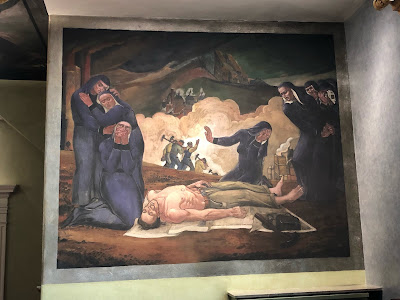
St. Nicholas Croatian Church:

This artist painted murals that were at once deeply religious and 
an Indictment of the treatment of immigrants who died in factories
and were used as cannon fodder in war,


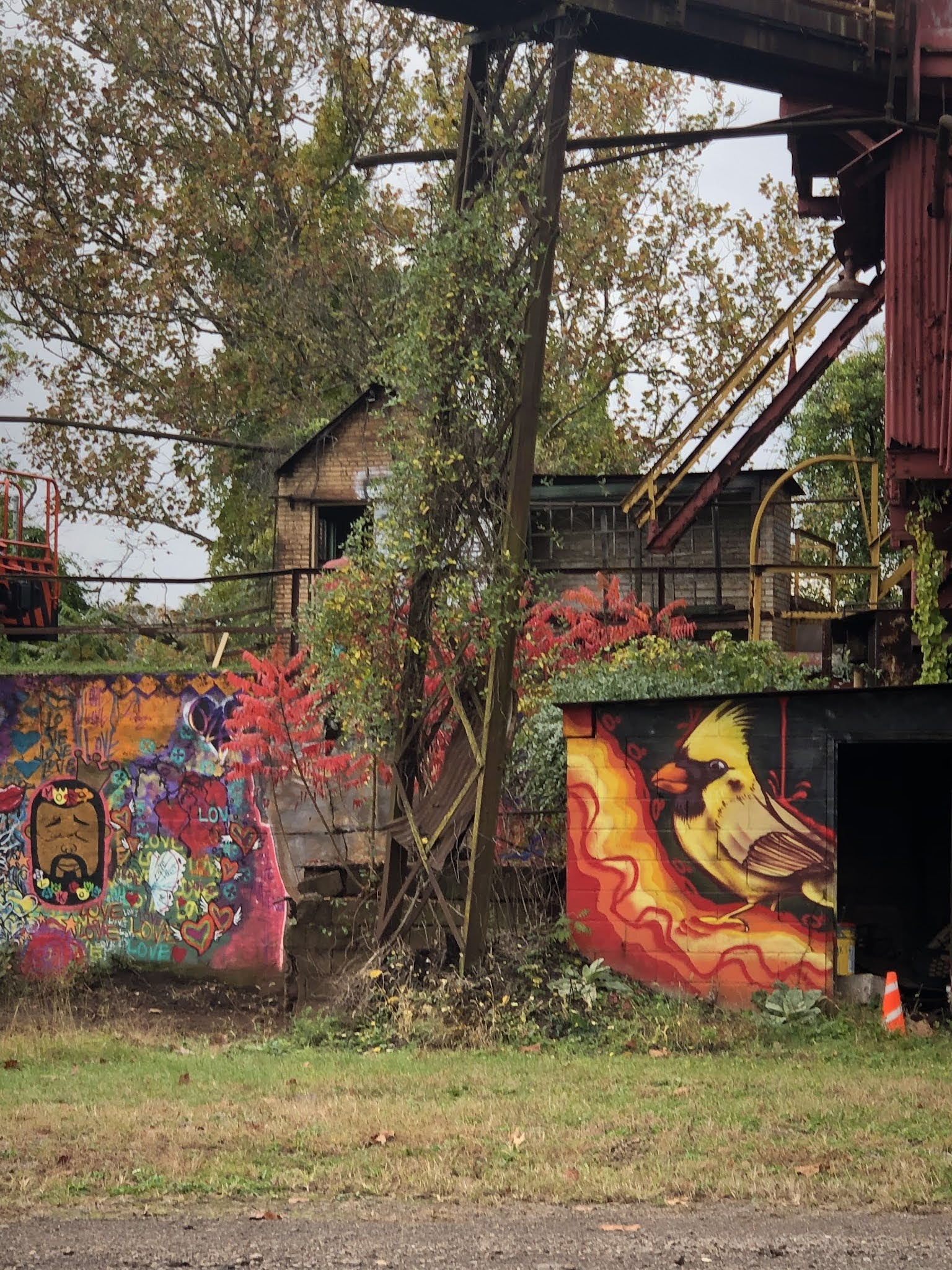
Rivers of Steel, the Carrie Blast Furnace Site:

This was my absolute favorite of the places we visited—fascinating, marvelous to photograph, and replete with history of the the otherwise forgotten workers who made America possible.  That’s it behind me in the selfie photo at the top of this post.  At the beginning of the 20th century this installation fed a river of molten iron to the steel mills across the river.  Today is it a place where people learn about its history, artists decorate it and also cast their sculptures in iron and aluminum.


An artist melting aluminum to pour into his molds


Now I am happy to be home!

Saturday, May 9, 2020

Mom's Legacy


Jeff—Saturday

It’s strange how these days of quarantine have us musing over matters we once rarely thought of at all, and even then only in passing. Tomorrow is Mother’s Day, and having been without a mother for nearly twenty-five years, or married to one (until this year :)) for far longer, I’ve largely forgotten all about the significance of the day—just ask my daughter or daughter-in-law.

This year, though, as I sat down to write my blog for the week, I found myself thinking of my mother, and all she’d been through as a child of immigrant parents; born in the final year of the Spanish Flu Pandemic, growing up through the Great Depression, and living through World War II.  How very different her life experiences had to have been from those of her three sons.

Spanish Flu Emergency Hospital in Pennsylvania


Pittsburgh Unemployment Line


Old time Pittsburgh Steel Mill
With Covid-19 and Depression Era unemployment upon us, I’ve been wondering how what we’re going through these days might re-shape the lives of my grandchildren in the same manner as what my mother experienced in her formative years altered her approach to life.

That’s when I remembered the thank you message I’d written to the many who’d attended my mother’s funeral. I don’t know why I wrote it—I’d no intention of becoming a writer back then—but I felt that I should as a tribute to a glorious soul who’d weathered so much with grace, charm and a deep love for all. 

Reading it again gave me great comfort, for it reminded me that, no matter how harsh the times, beautiful souls surrounded by love and familial support shall prevail.

So, thank you, Mom, for all the sacrifices you endured to make me the man I am today.  I’ll leave it to others to decide whether that was a good or bad achievement. J 

I love you mom. We all do.


THELMA SIGER (1919‑1996)

My mother never knew how to be anything but nice to everyone she ever met.  She never thought it was anything special to be that way, she figured it was just part of who she was ‑‑‑ much like flames at night along the river just seemed to be part of the mill‑town skies of the Pittsburgh of her youth.  But she was special, extraordinarily special.

Mother wasn't much on words (except when delivered to one or more of her sons on certain deserved occasions at equally appropriate decibel levels), but boy was she ever big on deeds.  Mother was always there with an embracing heart, steel will and much more for anyone who ever needed her; and heaven protect you if you said one unkind word about any soul in her protection.

Mother's last years were not kind to her.  Those of us who knew her and loved her didn't really question God's hand in this, because she would not have wanted us to.   Rather, we prayed she would not be in pain, and in our separate ways thought we were preparing ourselves to accept her passing.  But that was something we could never do; no more than we could prepare ourselves for the ending of warmth.  As long as there remained one sweet ember of her life we felt the warmth of her soul still with us.  Now gone, I can no longer feel, only remember.  That makes me very sad and I miss her very much.

But life goes on, and armed with the knowledge that no one could ever have had a better mother I'll just try to do what is necessary to make her proud.  After all, when I get to see her and my dad again (assuming they'll be able to convince whoever is in charge to let me in), I want her to know that I tried my best to live my life following her teaching that unquestioning loyalty among family and friends is a treasure beyond value.  That's why this thank you is for more than just your kindness in mother's memory, it is for your friendship and love.  Thanks.

—Jeff


Saturday, November 3, 2018

What Does It Mean to be a Pittsburgh Jew?


Jeff—Saturday

I’ve thought about that question quite a bit this week in the wake of last Saturday’s massacre of eleven elderly and disabled Jews in the Squirrel Hill neighborhood of Pittsburgh, Pennsylvania.  


Each of my grandparents immigrated to the US from Europe around the turn of the twentieth century and settled in Pittsburgh. My parents grew up there, and my two brothers and I were raised in its neighborhoods

My mother came from the predominantly non-Jewish neighborhood of Dormont, my father was a product of Pittsburgh’s vibrant equivalent of New York City’s Lower East Side.  His neighborhood is where August Wilson set his plays and the building in which he placed them sat behind my great aunt Bella Siger’s grocery store on Bedford Avenue in the Hill District.


The Hill District is a distinctly different neighborhood from Squirrel Hill, but I think few would disagree that descendants of the Jewish immigrants who once called the Hill District home consider Squirrel Hill its spiritual successor.  I know that I always have.

I was raised in another part of town, away from those neighborhoods, amid a community so dominated by Catholics and Protestants that my brothers and I were virtually the only Jewish boys within a quarter-mile radius of our home. We observed Orthodox traditions and were the only Jews who played in neighborhood pickup games, the only Jews in our local Boy Scout troop, and the only Jews I knew of who were reminded by our non-Jewish buddies that we weren’t allowed to eat their Easter candy, because it wasn’t Kosher for Passover.

Morningside is at top framed in red, Squirrel Hill is four neighborhood to its south, and The Hill District is between them off to the west.

It was a gloriously ecumenical way to grow up.

In that Morningside neighborhood of Pittsburgh’s East End, I acquired my values, learned how to interact with people of different faiths and backgrounds, to see folk for what they are as human beings, and to go with my instincts.


Yes, I had my share of fistfights in the neighborhood. Some would say more than my share, but they always had a purpose, and with two exceptions, not one had to do with my faith.  My first anti-Semitic experience was when I was nine or so heading home from school for lunch.  I took the same alley I always did, but this time I was jumped by a gang of older boys from a sectarian school who dragged me into a garage, and held me down as they burned my chin with matches, calling me a “Christ Killer.”

Have I forgotten that experience? Never, but not for the reason you might think.

Later that day I told some older friends who went to the same sectarian school as my attackers what had happened.  The next thing I knew they’d swept me along in a wave toward where they knew my attackers hung out.  We found them and promptly beat the hell out of them.

My elementary school

As politically incorrect as that response may be viewed today, my friends taught me a lesson that’s shaped who I am: It’s not hateful principles of faith that attacked me, but hateful people. Never confuse the two.

The second experience was more complex.  I was twelve and playing baseball on the neighborhood’s ball field when out of nowhere a learning-disabled, powerful man twice my age came at me shouting similar anti-Semitic slogans.  This time, too, my friends came to my assistance and helped me to escape.  Later I learned that an older boy had fired up the man to attack me through a raging diatribe of anti-Semitic canards and worse.

That day I learned another lesson about hate: words matter, for they spawn action.

I spent much of my life in and around Squirrel Hill, and two of my nephews celebrated their Bar Mitzvahs in the Tree of Life Synagogue, the place of Saturday’s slaughter. My brother once taught there. In other words, it’s personal.  

I know Pittsburgh. I bleed the black and gold of its sports teams, as does much of this nation.


And, yes, I get the Trump rallies.  It’s Pittsburgh 101…at least from the perspective of the neighborhood of my youth.

For virtually everyone attending one of his rallies, it’s a The Rocky Horror Picture Show-type fan experience.  It’s all about having a good time, where folk get to be part of the show. They come in their expected costumes, and know when to laugh, when to boo, and when it’s time to shout out their lines.
 

And when it’s all over they go back home, have a good laugh about what they did, and return to living their everyday lives.

BUT, for some it’s more than that. They don’t see it for the performance art it is, but as a passionate call to action. They take it seriously, and the results can be catastrophic. 

Just ask any Pittsburgher.  Jew or not.

Yes, words matter.


—Jeff

Saturday, March 24, 2018

On a Whim and a Prayer


Jeff—Saturday  

I’m not a stream of consciousness sort of writer.  Talker yes, writer no. But since it’s approaching the witching hour, and I have yet to write anything for tomorrow’s blog, I’ve decided to risk it, and let the stream take me wherever it chooses.  Hopefully, not anywhere near tragic mudslides once again threatening California, flooding in the heartland, or another Nor’Easter out this way. 

Thank God there’s no such thing as climate change.

Speaking of thanking God, I’ve got a big thank you out there for some good news I just received about a dear friend.  Sometimes the good guys (that’s gender neutral) do get a break.  YAY!!


I’m slowly getting back to typing—it’s almost five weeks since my rotator cuff shoulder surgery—and so far so good (puh puh puh).  I’d like to say my typing is of the sort likely to yield a new book, but alas it’s tied into an IRS audit, and preparations to moderate a panel at CrimeFest in mid-May, just before my return to Mykonos.

Sadly, I had to miss Left Coast Crime this year—it’s going on in Reno as I type this—but my doctor said a definitive NO on traveling so soon after surgery.  Oh, well, hoist a few rounds for me, my friends, you’re sorely missed by Barbara and me.

Another thing I sorely miss is Fred Rogers. 

It’s the 50th anniversary year for Mister Rogers’ Neighborhood, having debuted nationally on February 19, 1968 on WTAE public television in my hometown of Pittsburgh (actually, it originated locally in 1963, with roots back to 1953).  He was a fixture on local TV, though I was a bit too old for his target audience. Later, after I’d moved away and had children, my kids fit his demographic perfectly, and from time to time I’d watch with them, reminiscing about how I remembered him from earlier days. 

Like one of his trademark cardigan sweaters, Fred Rogers became more comfortable with wear.  His ever-calm demeanor brought his seminal message of love and understanding to bear on bitter issues others feared addressing, and he did so in a way that made you feel good about yourself for sharing the world with someone like Fred Rogers.

In the mid-1980s, I was walking home from my law office on Fifth Avenue in Manhattan, when for some unfathomable reason I felt compelled to stop outside St. Patrick’s Cathedral. Anyone who knew me would have assumed I meant to go into the building just south of it, Saks Fifth Avenue.  But they would have been wrong.

I felt drawn to leave the hustle and bustle of the day and street, and go inside. Permit me to pause and offer my compliments to the Cathedral’s architects for having created a structure that achieves its purpose of luring in the heathen.

As I stood inside the sanctuary I noticed a man sitting alone a few rows from the back, staring straight ahead.  Even from behind I recognized Fred Rogers instantly from his distinctive head, neck, and shoulders.  I sat at the very back, not wanting to disturb him, and we each sat quietly thinking whatever we were.  I left before he and we never spoke, but I felt as if I’d gained a spiritual soul mate in that time we’d shared together in Saint Pat’s.

I know that sounds hokey—at best—but in this world of suppressed hopes, bartered faith, and a paucity of good examples for our children and grandchildren, I feel blessed to have that personal memory of a simple good man (gender neutral again—Fred would have wanted it that way). He passed away in 1997.

And oh yes, my father’s name was Fred, and he too was good man. Also from Pittsburgh.

As for thoughts about Greece, I’d prefer not to think about that situation.  Between Turkey holding two Greek soldiers hostage and making claims to Greek islands, Greece’s Prime Minister in a brouhaha over the use of the name “Macedonia” by its neighbor to the north (FYROM) while pressing corruption charges against his immediate predecessor Prime Ministers from rival political parties, worsening economic situations closing in on many, and continuing horrors faced by refugees—one set himself on fire today in the Moria Relocation Center on the island of Lesvos (the focus of my latest book, An Aegean April)—it’s enough to make one lose heart.

Thankfully, things are all wonderful back here in America.

I think it’s time to get out of this stream and make myself a hot chocolate.

God Bless, and March for Life.

—Jeff