Showing posts with label Nairobi. Show all posts

Wednesday, January 6, 2021

RETURN TO AN UNSOLVED MURDER MYSTERY

Kwei--Wednesday

One week away from the January 12 release of the second novel in my Emma Djan PI series SLEEP WELL, MY LADY, I wanted to revisit the true-crime story that gave rise to the novel. The 2012 murder of Kenyan Careen Chepchumba remains unsolved and as baffling as it ever was. 

A Valentine's Murder: Beauty and celebrity 

Careen Chepchumba was a 26-year-old, vivacious young Kenyan who worked for Kenya Power in Nairobi. On Sunday, February 12, 2012, her brother Emmanuel Kiptoo dropped her off at her upscale apartment in Santonia Court, a gated community in the posh Nairobi Kilimani neighborhood.


Careen Chepchumba (Image: The Kenya Star)


The following day, Monday, Emmanuel tried but failed to reach Careen by phone. One news account states that subsequently, “he [Emmanuel] said their mother asked him to drive her to his sister’s apartment to check on her.” That suggests Emmanuel and his mother went to the apartment the same day, Monday the 13th, the day before Valentine’s. Nevertheless, most accounts relate that it was February 14th that the awful discovery was made.


Careen did not respond to Emmanuel’s knocking on her apartment door. To his surprise, the door was open and so he entered, noticing two things: first, that Careen’s sandals were at the door, suggesting she was home, and second, two used wine glasses were in the kitchen sink as he went past. Music was playing, but Careen was in bed with her laptop at the bedside. Emmanuel said he thought “she was sleeping.” (It seems odd that he wouldn’t have checked to be sure she was okay, given an unlocked door, two wine glasses and so on. In that circumstance, many would have felt that something was wrong.)


Emmanuel returned to the car, where his mother was waiting, and they went back to Careen’s apartment together. Emmanuel’s mother started opening some windows because the room was “stuffy,” and then she went to Careen’s bedroom, shortly after which Emmanuel heard his mother screaming as she realized Careen was dead. Her autopsy would show that “death was due to lack of oxygen due to manual strangulation.” The pathologist reported that the considerable force exerted on Careen’s throat had caused hemorrhage from her eyes and into her neck muscles.


Who had motive?

In considering possible motive, attention turned immediately to a man called Louis Otieno. This was no ordinary Joe. Otieno was one of Kenya Television Network's (KTN’s) most successful and high-profile TV anchors, known for his eloquence and hard-hitting interviews.


Former TV news anchor Louis Otieno (Image: file photo, Nation)

However, a darker reputation haunted Otieno. Media reported his love of a lavish lifestyle with fancy cars, spending sprees, alcohol, and glamorous women. If this was the case, then it was a familiar story of becoming too rich too young and then foolishly squandering one’s earnings. I wasn’t able to put Otieno’s meeting Careen on an exact timeline in relation to his financial woes, but certainly by late 2011, Otieno was in serious trouble and was turning to Careen for help. To support him, she borrowed heavily from family and business partners to the tune of 4.2 million Kenyan shillings, about $42,000. Some of this money she obtained under pretext, suggesting Otieno was heavily pressuring her to obtain the cash.


What was all that money for? Answering that question was the purpose of Careen’s father calling an “emergency” family meeting on Sunday February 12, 2012, in which Careen admitted to family that she had been paying Otieno’s rent, medical bills, and his children’s school fees. Otieno had two children from a first marriage. Careen was also paying for Otieno’s expensive taste in cigars.


The February 12 meeting, at which a chastised Careen agreed to drastic measures to pay back the money she owed, must have marked the pinnacle of the crisis with Otieno, because the police reported that on February 6, Careen had written a note to her father expressing remorse for having entered into a relationship with Otieno. She also apparently wrote, or started to write, a note to her father on February 12, but for some reason, she tore it up and put it in her bedroom trash bin.


Was Careen a case of a young, smitten woman falling into a relationship with a celebrity only to realize, too late, that she was trapped in a hornets’ nest? Evidently, events took such a horribly wrong turn that Careen, just before she was murdered, had been about to file an extortion claim with the police and get a restraining order for Otieno not to visit or call her. It had taken her a while to realize how much she had been used by Otieno, but she was seeing it now.


A bungled investigation

Careen was pulling away from her lover just before her death. From Otieno's viewpoint, perhaps it was a case of, “If I can’t have you, no one else will,” a strong motive for murder. The inquest into Careen’s death was, incredibly, delayed for 4 years. At the inquest, the judge ruled that the police had bungled the case, making it impossible to make an arrest.


It appears that DNA testing of possible suspects was never done. The chief government pathologist thought Careen might have been sexually assaulted by the assailant. “We took samples for further analysis but I have never seen the report,” he said. The samples were supposedly handed over to the detectives at Kilimani Police Station, but no one seems to know what happened to the samples after that.


Kilimani Police HQ (Image: Naibuzz)

The police station, colorful as it is, has long outgrown itself and a new, modern facility has been under construction.

Kilimani Police Station, proposed (Image: Naibuzz)

Nagging questionsIn this unsolved case, some of the major unanswered issues are as follows:

  1. 1. What about the two wine glasses in Careen’s kitchen sink? Glass is a gold mine for fingerprints and there might have been DNA as well.

    2. Otieno’s nail clippings were not tested for DNA. It turned out that the clippings obtained were Careen’s and not Otieno’s--a clerical error or mixup in the chain of custody, perhaps. Still, Careen’s nail clippings could have been tested against samples from possible suspects with whom Careen might have struggled as she was being strangled.

  2. 3. Questioned, a friend of Careen’s said Louis Otieno often “sneaked” into Careen’s Santonia Court apartment. This corroborates what one of the security guards at the apartment complex reported. According to him, Careen had instructed him to give Louis Otieno unrestricted access to her. What about on the eve of the discovery of Careen's body? Did Otieno pay a visit that night or not?

  3. 4. A taxi driver called Samuel Gacheru was a kind of gofer for Careen. He sometimes took her shopping, and on other occasions he went to the airport to pick up packages for her, including Otieno’s costly cigars. Careen owed Gacheru money as well! On February 14, he had texted Careen to remind her to pay up. The prosecutors alleged also that Gacheru made a 17-second call to Careen the day she was killed. All this is murky. What’s the taxi driver’s story? Did he have a crush on Careen? Was his alibi explored?

On the face of it, all the above speaks of incompetence to such an egregious degree that it makes one speculate whether there was a coverup. In some ways, Louis Otieno seems to have been calling the shots, e.g. refusing to do a DNA test. 

The decline, fall, and rise again of a celebrity?

Louis Otieno’s glorious past is exactly that–past. It could be said that it began as a falling-out with the KTN editors and crew as Otieno became arrogant, egotistic, and short-tempered. But his fall became more precipitous once the scandal and murder of Careen Chepchumba broke. In 2014, Otieno was admitted to the hospital with acute pancreatitis, likely as a result of alcohol abuse. He subsequently lost his hearing, a rare complication of pancreatitis, as well as suffering a loss of balance and difficulty walking (ataxia). The medical details are complex and beyond our scope here. Otieno, all but penniless, crowdfunded enough money, about $40,000, for a cochlear implant. The surgery was performed in Nairobi in 2018 and appears to have been successful. Otieno’s deafness had been a major cause of his depression. Will restoration of his hearing set him on a path to a reinvigorated life? We don’t know, but meanwhile, Careen is still dead. What will happen to the investigation into her murder? We don’t know that either, but the prospects do not look good.


Update (December 28, 2020)

As of July, 2020, there appears to have been no break in the Careen Chepchumba murder--that is, if it's still being investigated. I feel a tremendous sense of sadness that this murder was allowed to slip through the tracks. Will the murderer take their secret to the grave? I say no, on the basis of my unproved theory that no one really gets away with murder, no matter how long it takes for the offender to meet their comeuppance in some form. In SLEEP WELL, MY LADY, does Emma catch the killer? Well, it's complicated.


Wednesday, May 27, 2020

CORONA IS EVERYWHERE--PART TWO

THE CORONAVIRUS PANDEMIC IN AFRICA

Wednesday--Kwei Quartey

As of this posting, the continent of Africa has around 116,000 recorded cases of COVID-19, of which some 3500 have died. From South Africa's high of 24,000 cases and 429 deaths to Western Sahara's low of only ten cases, the profile of the pandemic in Africa is as varied and multi-layered as the continent itself.

Map of the COVID-19 outbreak in Africa. (Image: CanuckguyLokal_Profil + Xfigpower)    100,000+ Confirmed cases    10,000–99,999 Confirmed cases    1000–9999 Confirmed cases    100–999 Confirmed cases    10–99 Confirmed cases    1–9 Confirmed cases
Lockdowns/Stay-At-Home

Some African governments followed the lead of western nations in imposing stay-at-home orders, but as has been pointed out, in many cases, the efficacy of such a measure is questionable. Consider slums such as Nairobi's Kibera or Accra's Agbogbloshie, where six to ten people may live in a small wooden shack. The notion of "social distancing" in this situation is farcical. For many of these people who work in the informal economy, missing even a day's work can mean going hungry.

Agbogbloshie slum, Accra (Photo: Kwei Quartey)

In Ghana, President Nana Akuffo-Addo probably read the signs of rapidly growing malcontent among the citizenry and eased the restrictions after a strict lockdown of only three weeks. Like Trump, Akuffo-Addo faces a challenge to his reelection at the end of 2020, and media optics of out-of-control Ghanaian policemen assaulting people in the streets for not staying home reflected badly on Ghana's president, who is not wildly popular at the moment. 

Testing

Like other parts of the world, the numbers in Africa depend on several factors, including the fundamental ability to perform the COVID-19 test in the first place. Here, individual nations have widely differing capabilities. With vast testing experience for HIV, South Africa, with less than 5% of the continent’s population, has a testing rate of 6.5 per 1000 population, with Ghana following at 5.5/1000. But Nigeria, with more than three times South Africa’s population, has tested only about 0.2/1000. 

Therefore, do we have a true representation of the number of cases and the fatality rate in Africa? Almost certainly not, particularly as many young people may not be showing any symptoms (pre-symptomatic or asymptomatic). Remember that 19 of the top 20 youngest countries are in Africa.

Ghanaian lab tech with SARS-CoV-2 test kit (Image: Shutterstock)


Bearing in mind that even the US has had months-long problems with access to testing, Africa faces great difficulties in the areas of infrastructure, equipment, and trained human resources, but the most severe obstacle is the availability of reagents necessary for the testing. Warns Africa CDC head John Nkengasong, "The collapse of global cooperation and a failure of international solidarity have shoved Africa out of the diagnostics market. With its lack of hospitals and high prevalence of conditions such as HIV, tuberculosis, malaria and malnutrition, Africa could see COVID-19 mortality rates higher than elsewhere, even in children."

Under the Partnership to Accelerate COVID-19 Testing (PACT), established by the African Union and Africa CDC, the number of tests throughout the continent grew from a mere 415,000 in mid-April to approximately 1.2 million now. PACT aims to strengthen capacity to test at least 10 million Africans for COVID-19 across Africa in the next six months.  

Dodgy Predictions and an Incomplete Picture

There have been dire predictions of a devastating 300,000 to 3.3 million COVID-related deaths in Africa. During a CNN interview, Melinda Gates said, "Look at what’s going on in Ecuador. They’re putting bodies out on the street. You’re going to see that in countries in Africa.” While Gates was undoubtedly expressing a fear she had and not relishing the notion, it's no surprise that this declaration did not go down well with Africans, many of whom are already suspicious of the Bill and Melinda Gates Foundation's involvement with vaccine production. 

Melinda Gates's distasteful imagery ("putting bodies out on the street") painted the 54 different African countries with a broad, sweeping brush suggesting passivity and helplessness. But, it should be recalled that the African continent has had experience with HIV, malaria, tuberculosis, and Ebola. Whereas the concept of lockdown for COVID-19 was foreign to the US and many European countries, Sierra Leone and Liberia were already familiar with it from the Ebola epidemic, and both countries wrestled with Ebola until they beat it, much of it through local efforts. 

Just as the states in the US can hardly be said to have had homogenous responses to the novel Coronavirus outbreaks, neither has Africa, but many African countries imposed travel bans before or around the same time that the US government did. For example, Ugandan President Yoweri Museveni announced a ban on large public gatherings including weddings and church services on March 19, 2020 before Uganda had a single COVID-19 case. Uganda has around 212 recorded cases and an unknown number of deaths, according to the site ncov2019.live

Rwanda, with 327 recorded cases, was also quick to react. Shortly after the outbreak was confirmed in January, the government set up a committee to evaluate and bolster preparedness and response to the pandemic, training about 500 health workers, including laboratory technicians to cope with a potential national epidemic.


Hospitals and Health Care Systems

Some of Africa's best hospitals, both private and public, are found in South Africa, Tunisia, Kenya, Tanzania, Rwanda, Algeria, Egypt, Morocco, Zambia, Tanzania. Even so, South Africa has fewer than 1,000 intensive care unit (ICU) beds, of which 160 are in the private sector, for a population of almost 60 million.

Aga Khan University Hospital, Nairobi, is used as a benchmark by other hospitals in Africa.
(
Photo: Aga Khan University Hospitals)


Estimates are that South Africa currently has 3,216 ventilators, with 2,105 in the private sector. South Africa's health authorities put the projected need for a peak COVID-19 epidemic at 7,000. Meanwhile, Kenya has 259 machines; Ghana, 200; Nigeria, 169; South Sudan, 4; and Somalia, zero. Fortunately or unfortunately, depending from which angle you look at it, the desperate ICU/ventilator scenarios in the West months ago could not even logistically exist in most of Africa, and the continent's response to COVID-19 will not be a picture of elite hospitals like the Aga Khan placing hundreds of people on ventilators.

Instead, it will be a story of how the illness affects communities with few resources. As in Ghana, the unfolding march of the disease might be more represented by mortuaries overflowing with bodies as families wait for a day in the future when full-scale funerals can be held again. They may have to wait a long time.

Monday, January 28, 2019

Africa 2019: First days

Annamaria in Africa

It's been a whirlwind first three days since my friend Nicoletta and I left Rome to fly, via Addis Ababa, to Nairobi, which--on my third visit in five years--is beginning to feel familiar to me.  


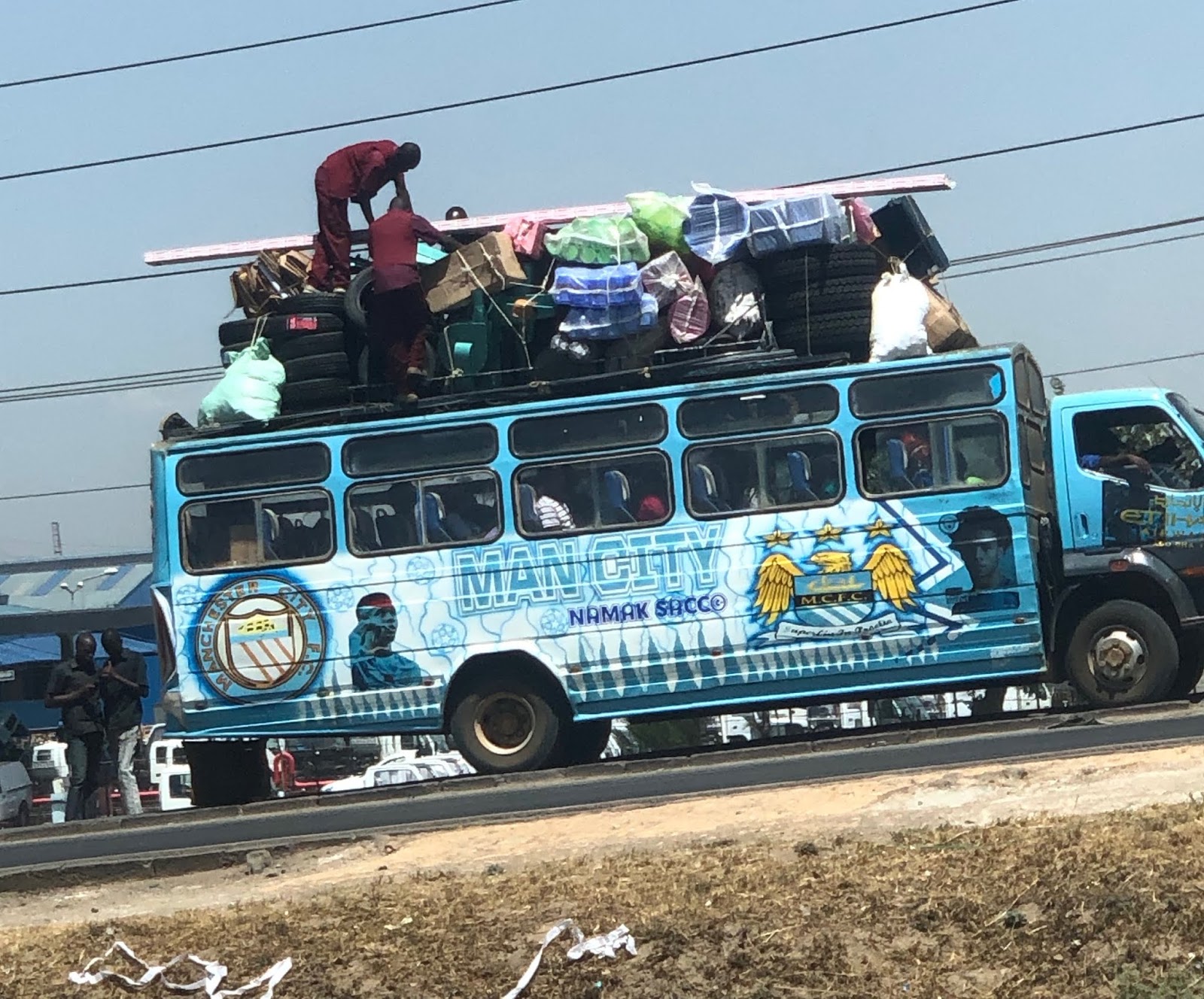
You know you are not in Kansas anymore when you see sights like this on the way into town from the airport.


And goods like these in the outdoor market.


Saturday saw Nicoletta's first visit to the Karen Blixen Museum.  It was my third time but I saw little details that I hadn't noted before.  I know they will show up in future books.


 We've had great meals in the garden next to our hotel...


...And one with my dear friends from Samburu: Sarah and Michael--who brought us Maasai gifts and a banner showing their dedication to the cause Sarah champions among the girls of her tribe.


As I write this, we have just come back from spending the morning visiting an orphanage for elephants and rhinos left without mothers.  Sometimes due to poaching.  Sometimes because they were separated from the herd.  One baby elephant fell down a well at age three months and was rescued.


We spent the afternoon touring at the Nairobi National Museum, where I 
photographed, BADLY but legibly, the entire exhibition on the history of Kenya.


We have many adventures still to come.  Stay tuned.