I’m getting this question a lot these days from outside of Greece. It shows understandable concern. The place seems in meltdown. Conventional political wisdom has bitten the
predominant political parties on far more vital parts than their collective
asses. Fringe parties are now mainstream
members of Parliament, and if no cohesive coalition is formed by Sunday, new
elections by mid-June seem inevitable.
It’s hard to imagine how the once dominant New Democratic and PASOK parties can better their positions through new elections without offering the electorate fresh leadership and new ideas. Then again, there’s always the chance that before new elections leaders of the emergent parties will demonstrate to voters that they are no better (or potentially worse) than the heads of the parties they seek to replace in power.
On the other hand, new elections could very well make things worse.
Greek political parties in order of number of newly elected members of Parliament:
 |
| New Democratic |
 |
| SYRIZA |
 |
| PASOK |
 |
| Independent Greeks |
 |
| Communist Party of Greece |
 |
| Golden Dawn |
 |
| Democratic Left |
I’m not offering my opinion on the subject. I’ll leave that to others, notably two distinguished
Greek journalists who expressed their views this week in commentaries for Greece’s
most prominent daily newspaper, Kathimerini:
Nick Makloutzis wrote “One
swing of the wrecking ball,” in which he reviews the decline and likely
ruin of the two main Greek political parties, and Nikos Konstandaras, in “Yesterday
strikes back,” discusses a potential “cycle of conflict that will only end
in catastrophe.” They are well worth
reading.
 |
| Nick Malkoutzis |
 |
| Nikos Konstandaras |
There is another bit of writing out there that is pertinent
to the sudden rise of extreme fringe groups who’ve successfully exploited anger
against Greece’s sizable immigrant population into parliamentary seats for
themselves, and raised articulated E.U. concern at the development.

This observation, though, was written two years ago as part
of a new mystery due out in a little more than three weeks:
“Every country in
Europe has its own sort of immigrant issues.
Ethnic stereotypes are a convenient, irresistible scapegoat for
political failings, especially in hard times, and no one wants to be the first
to point a serious finger at another country’s shortcomings in dealing with its
immigrants.
“But [Greece’s]
adversaries would love to switch the focus of the debate from our country’s
financial problems to our national character.
Paint us as indifferent to the plight of non-Greeks, an intolerant place
where only Greeks are treated as deserving of protection, and all others be
damned. It’s a volatile, irrational, and
emotional argument but one that could turn world opinion against us if it found
traction in the press. And then it would
no longer be just a question of denying us further bailout funds, but whether
or not to drum us out of the E.U.”
***
There had always been
refugees fleeing despots and turmoil in Greece’s region of the world, but when
Greece joined the E.U. in 1981 it was essentially a homogeneous land of less
than ten million. With financial prosperity
came Filipinos to serve in domestic jobs no longer done by Greeks and the fall
of the Soviet Union in 1989 brought a wave of Eastern European immigrants
seeking better lives, but it was after 2002 and the confluence of the euro
currency launch, America’s wars in Iraq and Afghanistan, and Greece’s all-out
building boom for the 2004 Athens Olympics, that the floodgates opened.
Romanians, Bulgarians,
Albanians, and Poles came to put their much needed construction skills to work
for pay far greater than any they could dream of back home, and Greece’s porous
island and mainland borders became an irresistible magnet for those fleeing
Turkey, Iraq, Afghanistan, Pakistan, Bangladesh, and what at times seemed all
of struggling Africa. They were the
metanastes—the foreigners who came to work or simply escape a life in chaos
elsewhere.
Greece’s population
was now almost eleven and a half million of which ten percent were estimated to
be immigrants. No one knew exactly how
many more were living hidden lives within the country, but with the abrupt
change in Greece’s financial fortunes virtually every lost job or criminal act
now seemed somehow blamed on the [foreigners].
No one had to tell Andreas how ugly the anger was brewing—on all sides.
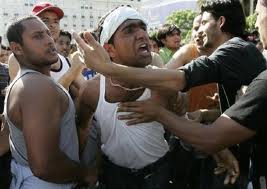

Yes, that’s my own Chief Inspector Andreas Kaldis amid
ruminations on what’s behind the horrific murders of immigrants and gypsies in TARGET: TINOS.
We shall see...
Jeff—Saturday