Showing posts with label Epiphany. Show all posts

Sunday, January 5, 2025

Epiphany in Florence

Annamaria on Monday

Since the Feast of the Epiphany falls on Monday this Year, I am taking license to rerun a previous post on the subject.  Here is what I and my friends in Florence will be celebrating. 


January 6th, the twelfth day of Christmas, is the traditional end of holiday celebrations in Italy.  These days, many Italians call the day by the name of the Christmas witch.


Santa Claus has taken over the role of delivering Christmas gifts in the rest of the world, but though the old man from the North Pole can be seen hereabouts, so also can the traditional Italian bringer of gifts—La Befana.


In Italian folklore, La Befana, flying on a broom, comes down the chimney and brings good children candies, fruits, and little gifts and bad children lumps of coal.  These days—Italians being a child-friendly race—the lumps of coal are actually very dark caramels.


The name La Befana is thought to be a corruption of the word “epiphania,” the name for the feast commemorating the visit of the three kings to the infant Jesus.  Those oriental visitors brought the newborn baby gifts.  And their legend figures in the lore of La Befana.  There are many version of her connection with the wise men’s journey to the babe in Bethlehem.  My favorite has her a loving mother whose child has died.  Following the star leading them to Jesus, the kings from the east pass her way.  Mad with grief, on hearing of the child they seek, she imagines that he is her son.  She too goes with gifts for the child.  Delighted to receive her, the infant Jesus gives her a gift in return.  She will be the mother of every child in Italy.  On the eve of January 6th every year, she goes to every house where there is a child and leaves gifts.  Like a good mother, she rewards the good children with sweets and admonishes the bad ones with lumps of coal.

Anthropologists trace the legend of La Befana back to new-year pagan celebrations of ancient Rome, during which gifts were exchanged and fertility and agriculture celebrated.  As you can imagine, those New Year’s feasts had a licentious and raucous character.  Here is Ottorino Respighi’s musical portrayal of the modern celebration in the Piazza Navona in which you will hear echoes of those riotous Romans of old.  

https://www.youtube.com/watch?v=GsLj3wlycPw


Detail of Gozzoli's gorgeous Adoration of the Magi in the Palazzo Medici-Ricardi

Here in Florence, the city celebrates La Befana with a parade in Renaissance costume.


I celebrated with friends at lunch in my favorite restaurant in the world.  Tortino ai carciofi, osso buco alla fiorentina, pera carmelatta.  EXQUISITE! 


The elegant gentleman in this picture, I am so sorry to have to say, has since left us. He took great pride in his native city and taught me a great deal about it.  Ti manco, Marcello.

Saturday, January 7, 2023

My Epiphany on Epiphany


According to Wikipedia (yes, I admit to being an unabashed fan), “An epiphany (from the ancient Greek ἐπιφάνεια, epiphaneia, ‘manifestation, striking appearance’) is an experience of sudden and striking realization.”
 
Well, I just had one.  No, not of the religious sort celebrated yesterday (January 6). I described that observance here a few weeks back, but don't worry, no need to search it out because I repeat the relevant portions below.  I'm talking about an epiphany brought on by my last four days glued to the TV watching the US House of Representative's produce a real-life version of Bill Murray's film "Groundhog Day." 
 

Through twelve separate but virtually identical vote results, the House failed to elect Kevin McCarthy as Speaker. Yet he and his backers stayed the course, and through an amalgam of yet to be disclosed deals made with opponents among his own party, on the 13th vote he substantially reduced the number of his own party members voting against him––but still lost.  Late tonight (Friday) he lost again––by one vote––for the 14th time.  Will he try again––after midnight––for a 15th, 16th, 17th....  We'll see.  
 
Without an elected Speaker there are no rules governing the House, including those carefully limiting what real time video may be shown to the public of its representatives in action on the floor of the House.  For the past four days we've been privileged to see in action the villains and the virtuous, the hustlers and the hustled, the pugnacious and the pugilists, the nose-pickers and the pocket pickers. 


My epiphany came in the form of an observation attributed to many (including Albert Einstein)...one most likely shared by many who've watched the unfolding madness in Washington.

"The definition of insanity is doing the same thing over and over and expecting different results."
 
So, with that in mind, let's move on to yesterday's holiday of the epiphany––which has the identical root in Greek—that for most Christians generally falls on January 6th and concludes the Twelve Days of Christmas.  The Greeks usually refer to it as the “Feast of Theophany” (“God shining forth” or “divine manifestation”) or “Ta Fota” (“The Lights”) as it celebrates the baptism of Christ in what is one of the three Great Feast days of the year, ranking only behind Easter (Paska) and Pentecost.  Understandably, it is also a big day for baptisms.

 
In many parts of the world a Greek Orthodox priest performs the “Blessing of the Waters.”  Traditionally, it’s done twice: Once, on the eve of the Feast (generally at a baptismal font inside the church), and the next day at a river, sea, or lake, where at the end of the service a priest tosses the blessed cross into the water—launching a host of young men in after it in hopes of retrieving the cross and receiving a special blessing from the priest that will bring a year of good luck to the successful diver.
 

Epiphany is also the day for expelling kallikantzari from your home through a blessing from the priest and the sprinkling of Theophany blessed holy water. Kallikantzari are half-beast, half human, bad-spirited gremlins that try to slip into your house through a chimney to wreak havoc and mischief amid your home, livestock, and food between Christmas and Epiphany.  

During that twelve-day period virtually every Greek in one way or another engages in some superstitious practice—like wrapping a sprig of basil around a small wooden cross and suspending it over a bowl of water—and seeks a blessing from a priest.  Ultimately, the goal is to expel the kallikantzari before they can do serious damage, like saw through the huge tree on which rests the foundations of the world. 

Where the kallikantzari go for the rest of the year to do their harm is anybody’s guess.  Though from the way things are going in Washington these days, perhaps someone should think about checking out the House of Representatives.


—Jeff

Tuesday, January 6, 2015

galette de rois

If you're looking for something after the holidays that's delish...try an Epiphany cake. Today is the Feast of the Epiphany and all over France you'll find galette de rois in the bakeries. My French neighbor Isabelle and I make it together every year. Whoever finds the charm in their slice, like a santon from Provence, becomes the Queen or King. 

Here's the recipe we'll be making for Galette des Rois ~ Cake of the Kings with a little history 

The French tradition of serving this frangipane-filled tart on the Twelfth Day of Christmas or Epiphany Day has biblical origins and is a reference to the biblical three kings. A fève - bean - is traditionally baked in the galette, which is sliced with a piece for every person present plus an extra slice called part du Bon Dieu (God's piece) or part de la Vierge (the Virgin Mary's piece).
Over time the fève was replaced with a tiny figurine. The person who receives the piece containing the fève is "crowned" king or queen for the day. The remaining piece, then called part du pauvre (poor man's piece), was traditionally shared with a needy person.
Don't worry about buying the puff pastry, Isabelle tells me everyone does, and Enjoy!

Puff Pastry Tart Filled with Almond Cream

INGREDIENTS

  • 1 package frozen puff pastry sheets, thawed according to package directions
  • 2 eggs
  • 1/4 cup almond paste
  • 1/4 cup sugar
  • 3 Tablespoons unsalted butter, softened
  • 2 Tablespoons flour
  • 2 teaspoons confectioner's sugar
  • 1/4 teaspoon vanilla
  • 1/4 teaspoon almond extract
  • 1 dried bean (lima or kidney beans work well)
  • Pinch of salt

    PREPARATION

    1. Preheat oven to 450°F.
    2. Butter a large baking sheet (not dark metal).
    3. In a food processor, purée the almond paste, sugar, butter and pinch of salt until smooth.
    4. Add 1 egg, vanilla and almond extract, then purée until incorporated.
    5. Add the flour and pulse to mix it in.
    6. On a lightly floured surface, roll out one sheet of the puff pastry into an 11.5 inch square.
    7. Invert an 11 inch pie plate onto the square and cut out a round shape by tracing the outline of the pie plate with the tip of a paring knife.
    8. Brush the flour from both sides of the round and place it on the buttered baking sheet. Put in the refrigerator to chill.
    9. Repeat the procedure with the second square of puff pastry, but leave it on the floured work surface.
    10. Beat the remaining egg and brush some of it on top of the second round. Score decoratively all over the top using the tip of a paring knife and make several small slits all the way through the pastry to create steam vents.
    11. Remove the first sheet from the refrigerator and brush some of the egg in a 1 inch border around the edge. Mound the almond cream in the center, spreading slightly.
    12. Bury the bean in the almond cream. Place the scored round on top and press the edges together.

    TO BAKE

    1. Bake the galette in the lower third of the oven for 13 to 15 minutes, until puffed and golden. Remove from oven and dust with the confectioner's sugar.
    2. Place oven rack in the upper third of the oven and return galette to cook for an additional 12 to 15 minutes or until the edge is a deep golden brown. Transfer to a rack to cool slightly.

    TO SERVE

    Serve the galette warm. Make sure everybody knows about the bean/charm/santon before eating!
    Cara - Tuesday


    carablack.com

    Saturday, January 5, 2013

    Eureka, Epiphany!


    According to Wikipedia (yes, I admit to being an unabashed fan), “An epiphany (from the ancient Greek ἐπιφάνεια, epiphaneia, ‘manifestation, striking appearance’) is an experience of sudden and striking realization.”

    Having just sent the final edits of my latest Chief Inspector Andreas Kaldis’ novel off to my publisher for printing, I suppose I could use one of those for what will be Andreas’ next adventure.  But this is not about that sort of epiphany.

    I’m talking about the holiday—which has the identical root in Greek—that for most Christians generally falls on January 6th (tomorrow) and concludes the Twelve Days of Christmas.  The Greeks usually refer to it as the “Feast of Theophany” (“God shining forth” or “divine manifestation”) or “Ta Fota” (“The Lights”) as it celebrates the baptism of Christ in what is one of the three Great Feast days of the year, ranking only behind Easter (Paska) and Pentecost.  Understandably, it is also a big day for baptisms.

    In many parts of the world a Greek Orthodox priest performs the “Blessing of the Waters.”  Traditionally, it’s done twice: Once, on the eve of the Feast (generally at a baptismal font inside the church), and the next day at a river, sea, or lake, where at the end of the service a priest tosses the blessed cross into the water—launching a host of young men in after it in hopes of retrieving the cross and receiving a special blessing from the priest that will bring a year of good luck to the successful diver.

    Epiphany is also the day for expelling kallikantzari from your home through a blessing from the priest and the sprinkling of Theophany blessed holy water. Kallikantzari are half-beast, half human, bad-spirited gremlins that try to slip into your house through a chimney to wreak havoc and mischief amid your home, livestock, and food between Christmas and Epiphany.  

    During that twelve-day period virtually every Greek in one way or another engages in some superstitious practice—like wrapping a sprig of basil around a small wooden cross and suspending it over a bowl of water—and seeks a blessing from a priest.  Ultimately, the goal is to expel the kallikantzari before they can do serious damage, like saw through the huge tree on which rests the foundations of the world. 

    Where the kallikantzari go for the rest of the year to do their harm is anybody’s guess.  Though from the way things are going in Greece these days, perhaps someone should think about checking out Parliament.

    Happy New Year, everyone—especially our newest MIE contributors, Caro and Lisa.  All the best in 2013 and far, far beyond.

    Jeff—Saturday

    Tuesday, January 4, 2011

    What the French are obsessing about: galette des rois and a book


    Picture lines outside the boulangerie in Paris, apartments ovens cranked high and almond frangipane filling poured onto butter dough. Bright children's eyes gathered around the table after dinner. Right now in France most everyone's celebrating the tradition of l'Epiphanie. It's a family affair, too. L'Epiphanie celebrates the day on which the three kings Gaspard, Balthazar and Melchior came to pay their tribute to the world-famous baby born just a couple of weeks before. In French those wise men go by the name of Les Rois Mages - the Magi - and their first names are totally coming back in fashion these days, let me tell you. Except maybe for Melchior, that's a tough one.
    Like many a Christian holiday, this one has lost its religious significance in most French families, gaining a sweeter, much more buttery one in the bargain: on the day of the Epiphany, families share one of these Galette des Rois, a flaked pastry pie filled with frangipane, a butter-rich, smooth mixture of crème d'amande - almond cream and crème pâtissière - pastry cream.

    The actual date to have the galette has gotten fuzzier and fuzzier: some families celebrate on the 6th, some on the first Sunday in January, but it's mostly considered fine to celebrate it all through the month of January.

    The thing about a Galette des Rois, apart from its deliciousness, is the family ritual that goes with it: the youngest child of the family hides under the table, an adult divides the galette in even slices, and the child calls out which slice goes to whom.


    Why all the fuss you ask? Aah, it is just this small thing that everyone wants to win : la fève is hidden in the galette.

    Historically a dry fava bean - hence the name - fève, was used. Now it's a little porcelain figure - often a clay santon. That figure used to have some kind of religious meaning but that, too, has gone the way of the dodo. Whoever gets the slice with the fève is named King or Queen for the day, gets to wear the golden paper crown that comes with the galette and glows with pride. Of course, in the south they like to be different and eat a Gâteau des Rois shaped like a ring-shaped brioche garnished with candied fruit.
    While the happy King or Queen - usually one of the children - is munching another slice of galette their parent or grandparents are probably reading a little tan book that's taken French publishing by storm. With a simple tan cover, handwriting in the foreground, and only 13 pages of actual text written by a semi-obscure 93 year old man it contains no sex, no jokes, no fine writing and no startlingly original message. You think, publishing disaster? No, a publishing phenomenon.


    Titled 'Indignez vous!' Cry out! (or Become Outraged, which I like) this slim pamphlet by a wartime French resistance hero, Stéphane Hessel, has and is smashing all publishing records in France. The book urges the French, and everyone else, to recapture the wartime spirit of resistance to the Nazis by rejecting the "insolent, selfish" power of money and markets and by defending the social "values of modern democracy".

    'Indignez Vous' which costs €3, has sold 600,000 copies in three months and another 200,000 have just been printed. The original print run was 8,000. In the run-up to Christmas, Mr Hessel's call for a "peaceful insurrection" not only topped the French bestsellers list, it sold eight times more copies than the second most popular book, a Goncourt prize-winning novel by Michel Houellebecq - the famous naval gazing philospher author.

    The extraordinary success of the book can be interpreted in several ways. Its low price and slender size – 29 pages including blurbs and notes but just 13 pages of text – has made it a popular stocking-filler among left-wing members of the French chattering classes. Bookshops report many instances of people buying a dozen copies for family and friends.

    But Mr Hessel and his small left-wing publisher who normally have print runs in the hundreds say that he has evidently struck a national, and international nerve, at a time of market tyranny, bankers' bonuses and budget threats to the survival of the post-war welfare state. The publisher also thinks that the success of the book might be an important straw in the wind as France enters a political cycle leading to the presidential elections of May 2012.

    In a New Year message Mr Hessel, who survived Nazi concentration camps to become a French diplomat, said he was "profoundly touched" by the success of his book. Just as he "cried out" against Nazism in the 1940s, he said, young people today should "cry out against the complicity between politicians and economic and financial powers" and "defend our democratic rights acquired over two centuries".

    Not everyone likes the book. Hessel takes up the cause of the Roma, the unpopular gypsies and their substatus in France. He's stirred some controversy with a lengthy denunciation of Israeli government policies, especially in the Gaza Strip. Mr Hessel, whose father was a German Jew who emigrated to France, has been accused by French Jewish organisations of "anti-semitism". But when hasn't controversy pushed a book into a bestseller?

    Mr Hessel was born in Berlin in 1917. When he was seven his family emigrated to France. He joined General Charles de Gaulle in London in 1941 and was sent back to France to help organise the Resistance. He was captured, tortured and sent to concentration camps in Germany. After the war, he helped to draft the UN's Universal Declaration of Human Rights in 1948.

    His small Montpellier-based publishing house Indigène, which commissioned the book, said Mr Hessel had revealed a "deep sense of indignation in France".

    "They dare to tell us that the State can no longer afford policies to support its citizens," Mr Hessel says. "But how can money be lacking ... when the production of wealth has enormously increased since the Liberation (of France), at a time when Europe was ruined? The only explanation is that the power of money ... has never been so great or so insolent or so selfish and that its servants are placed in the highest reaches of the State."

    The book's originality is the suggestion that an organised "Resistance" is now called for, just like in 1940. "We, veterans of the resistance ... call on young people to revive and pass on the heritage and ideals of the Resistance," the book says.

    Here's a sample of his messages of resistance

    * "I would like everyone – everyone of us – to find his or her own reason to cry out. That is a precious gift. When something makes you want to cry out, as I cried out against Nazism, you become a militant, tough and committed. You become part of the great stream of history ... and this stream leads us towards more justice and more freedom but not the uncontrolled freedom of the fox in the hen-house."

    * "It's true that reasons to cry out can seem less obvious today. The world appears too complex. But in this world, there are things we should not tolerate... I say to the young, look around you a little and you will find them. The worst of all attitudes is indifference..."

    * "The productivist obsession of the West has plunged the world into a crisis which can only be resolved by a radical shift away from the 'ever more', in the world of finance but also in science and technology. It is high time that ethics, justice and a sustainable balance prevailed..."

    I suggest we all act like the French right now; munch buttery almondy slices of galette de rois and get outraged.

    Cara- Tuesday

    Saturday, December 25, 2010

    A Greek Christmas Question


    Christmas in Athens' Constitution Square (Syntagma)
    “‘Twas the night before Christmas, when all through the house not a creature was stirring not even a mouse.”  NOT TRUE!  My magic mouse, let’s call him Mac, was scurrying all over the Internet trying to come up with something appropriately Christmassy for my distinct honor of writing the Murder is Everywhere Christmas Day post.  So, take that Clement Clarke Moore or Henry Livingston—whichever of you actually wrote the poem—times change. 
    A Christmas Tree and Christmas Boat
    kalanda

    Come to think of it, Greek Christmas is a perfect example of change.  Years ago in Greece, presents were not given on Christmas Day, Christmas trees were almost unheard of—though on some islands many would decorate a boat in their homes as a tree is today—and even the longstanding tradition of village children going from home to home singing kalanda to their neighbors has changed.  Still, though, at its heart kalanda remains the tradition it always was, but instead of being rewarded with sweets or fruits, the children play their little metal triangles and carol for euros.  Yes, “carol,” for the origin of that word is the Greek dance choraulein and it evolved over time, through the French, into caroling. 
    melomakarona
    christopsomo

    Christmas Day in Greece also means feasting.  Although almost any occasion in Greece seems justification for food, Christmas is a true feast day, second only to Easter (see below).  It’s the end of a forty-day fast period for the observant from meat, eggs, and dairy.  Christmas dinner always means large, sweet loaves of christopsomo bread, melomakarona Christmas honey cookies, and kourabiethes almond cookie treasures that invariably lose their powdered sugar coatings all over your clothes.  But here, too, there have been changes.  The main course is no longer strictly the roast lamb, pig, and goat extravaganza it once was.  Roast stuffed turkey has made big inroads.  
    The tallest Christmas tree in Europe

    Perhaps the signal sign of Greece’s attitudinal change toward Christmas is what happened a few years back in Athens.  The mayor decided to erect the largest Christmas tree in Europe in Constitution Square (Syntagma) directly across from Parliament.  I heard it was quite a sight, even if an artificial tree.  Not sure what’s up there this year what with the area around Parliament being rather busy these past few Christmas seasons with other sorts of goings on (see my last week’s blog).  

    So, here is my question: why does virtually everyone who writes about Greece and Easter say, “Christmas is not as important to Greeks as Easter.”  I have to admit I always thought the same way, but why?  It certainly isn’t that way in the United States.  In the Greek Orthodox faith Christmas and Easter are the big holidays (along with the Assumption of the Virgin on August 15th), so why does Easter seem more important than Christmas?  Most Greeks tell me they consider the two equivalent days from a religious point of view.  And therein may lay the answer. 

    Greek Easter is preceded by a week of serious religious practices and cultural traditions building up to a single climactic moment: the celebration of Christ’s resurrection at precisely midnight on the eve of Easter Sunday.  Ninety-five percent of Greece’s population is of the Greek Orthodox faith (or at least Eastern Orthodox) and that’s a lot of people firing up their enthusiasm toward sharing a single moment with the rest of their countrymen.
    Kourabiethes to munch on if you're bored.

    On the other hand, the only sort of buildup Christmas Day seems to share with Easter Sunday is that both end more than month-long fasts.  Yes, there are Twelve Days of Christmas, but they start on Christmas Day, and the observant days within that subsequent period, although important and filled with their own traditions, follow the day of Christmas rather than build up to it in the way Palm Sunday, Holy Thursday, and Good Friday lead up to Easter. 

    Greece's Santa Claus, jolly old Saint Basil
    Saint Vasilis (330-379)
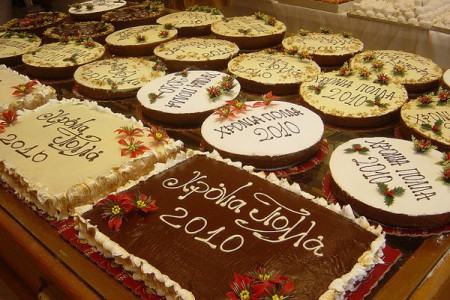
    On the other side of Christmas the Orthodox Church celebrates the circumcision of Christ and the name day of Saint Vasilis (Basil) on January 1st.  Santa Claus may have gotten his looks from Greece’s white-bearded patron saint of sailors, Saint Nicholas, but for Greek children their gift-giving Santa comes on Saint Vasilis’ Day.  And it is also the day when family and friends sit around the table and wonder which will be the one who finds the gold coin hidden in a piece of the vasilopita cake, for the one who does will have good luck all the year.
    An Athens selection of vasilopita cakes
    Epiphany in Tarpon Springs, Florida

     The Twelve Days of Christmas end January 6th on Epiphany, the day of Christ’s baptism.  It is another major feast day for the Greeks, and in many parts of the world a Greek Orthodox priest performs the “Blessing of the Waters” at a river, sea, or lake, then tosses the blessed cross into the water launching many young men in after it in hopes of retrieving the cross and receiving a special blessing from the priest that will bring the successful diver good luck for the entire year.

    Christmas skaters in Athens
    That’s two additional, significant upbeat holidays associated with Christmastime, yet Greeks still seem to hold a greater fondness for Easter time.  But if the explanation isn’t simply one of positioning—that Easter Day is the culmination of a celebratory season, while Christmas Day is the reverse­—what is the answer?
    kallikantzari

    Perhaps it’s tied into another aspect of those Twelve Days. For during that period virtually every Greek in one way or another engages in some superstitious practice—like wrapping a sprig of basil around a small wooden cross and suspending it over a bowl of water—or seeks a blessing from a priest, to ward off the kallikantzari, the half-beast, half human, bad-spirited gremlins who will slip into your house through a chimney to wreak havoc and mischief amid your home, livestock, and food.  BUT they only do so during the twelve-day period from Christmas to Epiphany.  

    Could it be that those who subconsciously believe in kallikantzari also harbor an unconscious thought or two at what mischief might be lurking in wait for them beyond Christmas Day?  I wonder.  
    A mischief maker

    But whatever the answer—likely something very different—to each of you and my extraordinary blogmates at Murder is Everywhere I wish Kala Kristuyenna and Xronia Pola (many years). 

    Ftew-ftew-ftew. 

    Jeff — Saturday