Showing posts with label Craft of Writing. Show all posts

Thursday, November 16, 2023

I LIED ON NANOWRIMO

Wendall-- every other Thursday

I cannot tell a lie. Actually, it turns out, I can.


I first attempted National Novel Writing Month—i.e. NaNoWriMo—years and years ago for three reasons. One, I heard a piece about it on NPR, two I had wanted to try to write a novel for thirty years and hadn’t had the nerve to do it, and three, my husband was going to be in England for the first two weeks of November.


Also, I always loved the logo...
 

Even though the idea of writing 50,000 words in a month, or even 10,000 words in a month, seemed absolutely impossible to someone who second-guessed themselves as much as I did, I decided to try.


And I astounded myself by actually writing more than the required 1667 words a day for the first few days. There was something about entering my word count and watching what it did to the graph they provided that was inspiring and invigorating. I wanted to get ahead of the curve. So the words piled up, I made progress. Actual progress. On a novel.


First title page of my first NaNoWriMo draft
 

It only happened because I couldn’t go back. I couldn’t revise. I couldn’t change my mind. And I definitely couldn’t delete anything—that would cost words. I could only go forward. I’d been a screenwriter for twenty years and I’d never done that before. It was a revelation. I kept thinking, if I can just write another hundred words, if I can just write another two hundred words, I’ll be ahead for tomorrow. It involved, of course, plenty of coffee, working in restaurants, and more than a little wine. But it worked. 


Sometimes the coffee worked. Sometimes the wine.
 

So, by the time my husband came home I’d already surpassed my 50,000 words, and by the end of that 30 days, I had 300 pages of my first novel, Lost Luggage. Back in those days, you actually had to submit your novel on the NaNoWriMo site, so that meant, for copyright protection, you had to “scramble” it to verify the word count. It looked like this:


Lost Luggage, scrambled.
 

Lost Luggage, published.
 

Granted, it was a hot mess, and it would take another year and a half to get it even close to something other people could see, but it existed. And I was hooked. It had been the thing I needed to, for once, get through a first draft without getting in my own way.


I have done the November challenge every year since, as well as an occasional “Camp NaNoWriMo” in April or July. I’ve used it to do first drafts of all my novels, as well as their rewrites. 


The beginnings of Cheap Trills.
 

To date, I’ve earned nine “completion” certificates, bought a variety of coffee vessels, gotten half price on Scrivener, and lots of other perks of “winning.”


The very first coffee cup I bought on my very first try.

A newer incarnation


As the years have gone by, of course, it’s transformed itself into something that’s much bigger—and hipper—than it was when my first time. I remember mentioning it at a Sisters in Crime LA meeting when I first started and no one had any idea what I was talking about. Now, almost every mystery writer I know participates. The National Chapter of Sisters in Crime does daily “write-ins,” writers post their word counts on Twitter, and it feels almost uncool not to participate.
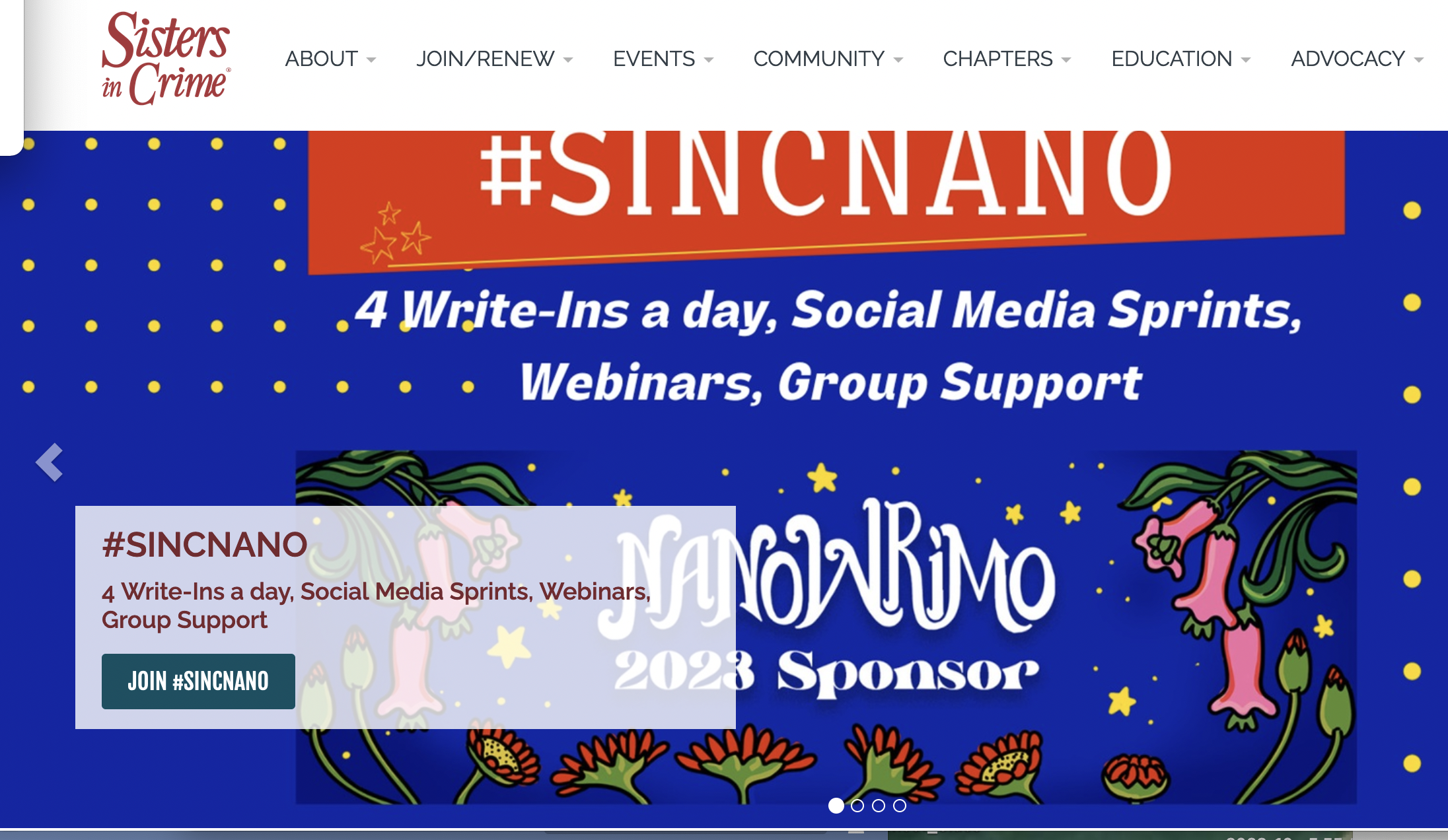
 

See what I mean???
 

So, this year, I signed up, registered my book, and took a deep breath, waiting for the November 1 start date.


Since Cheap Trills came out on October 30th, I was still in the midst of writing guest blog posts and trying to create very amateur graphics, so the first few days were a struggle. 


Marketing was never my strong suit.

Still, I managed to do the daily words. Barely. Then, the fourth day, I fell behind—only 500 words. And the next day, I got nothing done at all. And the next day, nothing again. And the next day, 200 words. The equivalent of nothing.


Suddenly, the graph was no longer my friend. How was I ever going to catch up, especially since I seemed to have no energy for writing? At all. My status page just sat there shaming me. The guilt! The embarrassment! After so many years of succeeding at the 50,000 word challenge, the idea of failing was devastating. How could this happen? How could I live with myself? Plus, all my “buddies” could see my word count. Did I just look like a lazy jerk?


On the sixth day, in a moment of weakness, I just added to my word count with words that didn’t exist. That I hadn’t written. For the graph. For my what I mistakenly thought was my self-respect. Flat-out lied. On NaNoWriMo.


The graphic illustration of an epic fail.

For the love of God!


The irony was not lost on me. It was horrible. I took the words off the next day, but the fact that I did it at all made me take a real look at myself, at my writing, and at what the hell I thought I was doing, anyway.


First, who was it I was writing for? Who cared about my word count? Anyone? Did anyone even care that I was writing a novel at all? I had always seen myself as a non-competitive person, so where had this ludicrous ego come from all of a sudden? Had it morphed with my crippling sense of responsibility, to rationalize such bad behavior? Was I horrified at myself, or just not willing to deal with the fact that, this year, I wasn’t up to it.


In the end, I realized the only person I needed to write for was myself. I was the only one I'd let down. Which meant I was the only person who could let me off the hook. So, in the end, I did. The new book is still burbling in my subconscious, where, right now, it belongs. And that’s okay. Novel writing is a long game. And it’s not all about the word count.


I still love you, NaNoWriMo, I just think we need some time apart.


---Wendall


You can hear Wendall talk about writing, movies, music, songbirds, and all things Cheap Trills on Baron R. Birtcher's THE WRITERS BAR here:

https://youtu.be/S32L679n08k


Sunday, July 10, 2022

Side-tracked

Tools of Mass Procrastination


Zoë Sharp


Confession time. I last worked in an office environment—as in working for somebody else—thirty-five years ago. All I had on my desk back then was an electric typewriter and a landline telephone. The answering machine still had tape cassettes in it. I got to work in the mornings, worked all day, and went home at five-thirty.


OK, it was not without its occasional moments of drama, like the time I was accidentally locked into the building one night and had to climb out of an upper-storey window and then scramble across rooftops to freedom. Or the time, one week into a new job, when the boss said, “Right, we’re off on holiday next week. If the bailiffs arrive while we’re away don’t let them take anything…”


But generally, the biggest no-nos were arriving late or sneaking off early. People didn’t even leave their desks to have a smoke. In fact, I used to work sandwiched between two people who both chain-smoked and would leave cigarettes burning in their ashtrays while they nipped out on some errand. They didn’t take kindly to me stubbing out the ciggies in their absence. My excuse was if I had to smoke passively while they were around, then I was damned if I was going to do it while they weren’t.


My how things have changed. (Eeh, I remember when all this were fields, etc.)


And when I set up in business on my own as a freelance photojournalist back in 1988 my word processor was an Amstrad 9512 that had no internal memory and required the insertion of a Start-of-Day disk to remember what it was in the mornings.


If there was a mouse anywhere near it, it would have looked like this:


I was pretty technologically advanced by owning a computer at all, I can tell you! Not to mention my Motorola brick mobile phone. (Groovy, man.)


Distractions were simpler in those days. They involved staring out of the window:


And a game of solitaire meant shuffling the deck before you began:


Early computer games were not exactly Fortnite:


But now we’re overwhelmed with daily distractions. If it wasn’t for rapidly encroaching deadlines, I could spend so long getting side-tracked every day that I could practically walk like a crab:



But that can sometimes be a good thing, and I thought I’d share with you some of my favourite time-wasting sites:


They Fight Crime!

“He's an immortal guerrilla boxer on the wrong side of the law. She's a mistrustful tomboy former first lady who dreams of becoming Elvis. They fight crime!” Random pairings to get your imagination going.


Internet Movie DataBase

Always on my favourites’ list for when I want to know obscure facts. For instance, did you know that Florian Henckel von Donnersmarck, director of The Tourist is 6’8¾”?


I’m hopeless at crosswords, but Sudoku, I can’t leave alone. The link goes to my favourite online version.


What is your Diva Pro Wrestling Name?

Mine came out Chieftess Star. How about you?


But just in case wrestling is not your thing, how about your Blues Name? Mine’s ‘Steel-Eye Lemon Money Davis’. Wow, I think I may keep it.


So help me out here—or sink me deeper—what procrastination aids do you use to while away the, erm, I mean to help you concentrate while you’re mulling over a storyline?


This week’s Word of the Week is hamartia, meaning a fatal flaw. From the Greek hamartánein, meaning to miss the mark or to err. It is most associated with Greek tragedy and refers to flaws or defects of character which bring about the downfall of a hero. It can also refer to random accidents beyond the hero’s control, with devastating consequences.


(Readers may decide for themselves which is the more apt interpretation in light of this week’s dramatic turn of events in UK politics.)

Saturday, August 17, 2019

Basic Building Blocks for Mystery Writers


Jeff—Saturday

Oh what a three weeks it’s been. I’ve been back from Mykonos hiding out at my farm for the month of August. The place looks greener and lusher than I can ever remember, though my impression is largely based on what I can glean of it through the lone window in my third floor garret—where I sit fingers glued to the keyboard.

It’s been weeks of fifteen-hour days (a) finishing the latest draft of the new book, (b) reducing a full-length manuscript to a 750-word synopsis (i.e., think in terms of taking a chainsaw to key plot points, characters and scenes), and (c) going back to rewriting that same manuscript. ARRGHHHH.

But I shall return to Mykonos in ten days. AHHHH.

Hopefully that introduction summons up sufficient sympathy for my plight to justify my running a post I wrote several years ago for a different blogsite. It’s based on the mystery writing course I taught at Washington & Jefferson College for pour souls out there looking to get into this glamorous, wild, and carefree writing life.

So, here is my “brief but spectacular take” on the inherently controversial subject of mystery writing’s basic building blocks, with observations borrowed from true experts on the craft whose names I no longer remember.
I look forward to enduring the slings and arrows of outrageous fortune…along with the strong opinions of those of you who may disagree.  
 

As you no doubt will recall, Snow White had seven dwarfs helping her create her story.  I’m no Snow White, and I’ve only got six to rely upon, but to me they’re just as dependable, even if not as cuddly. Permit me to introduce you to Characters, Dialog, POV, Plot, Setting, and Tension.

1.         Characters drive the engine of your story.  They convey what you want the world to know. They are the product of your innermost thoughts, your views of life, but to really get to know them you must spend a lot of time earning their trust. It’s an investment well worth it, for your characters are who will make you famous.  Readers remember characters far after the plot has faded, e.g., Dirty Harry, Harry Potter, Hamlet, Pudgy Wombat.

As for where to find those characters, I’d say look into the very core of your being for their essence. I know, that sounds all artsy-fartsy, but think of your heart as a storehouse of emotions and subliminal impressions collected over a lifetime of encounters.  As for character traits and appearances, I tend to pick those up through direct observation of passersby and jotting down notes. Accept that you’re a body snatcher, storing up parts and gestures to flesh out the souls of those characters you’ve found lurking about in shadowy places within yourself…and enjoy.

2.         As to how we bring our characters to life, my favorite building block on that score is dialog. Good dialog is like eavesdropping.  Read your dialog aloud. Does it sound natural, does it fit into the setting, and most importantly, does your dialog bring your character to life consistent with your vision of that character’s unique voice?  To grasp what I mean, I recommend reading poetry and great plays, as you’ll gain an appreciation of how cadences and rhythms bring dialog to life.  For those of you adventuresome enough to attempt the most difficult of all dialog—dialects—I recommend you read Peter Matthiessen’s Far Tortuga.  Once you’ve made it through its first 50 pages you no longer need dialog tags, for he’s masterfully caught your ear with a unique dialect for each of his characters—including the narrator.

3.         With that mention of narrators, we arrive at POV, more formally known as Point of View. POV is what holds all the other building blocks together.  Indeed, how could any of us have made it through Moby-Dick without Ishmael telling us the story from his POV?  One should never underestimate the value of a likable narrator.

Most writers choose between first person and third person points of view.  First person is harder to pull off because the reader knows no more than does the protagonist, and that can lead to some awkward devices straining to get information before a reader that the protagonist could not otherwise be expected to possess. Third person POV allows for greater flexibility, but lacks the immediacy of first person telling. And of course, there are some notable POV shifting authors.  Ultimately, it’s your book, expressing your POV on POV. 

3.         Which brings us to Plot. Everyone struggles with plot.  Stephen King suggests tossing your characters into situational conflicts and letting them figure their own way out, advice consistent with the classic admonition that you should never try to fit your characters into your plot.  Once you have a basic story line in mind, let the plot evolve through your characters. 

Yes, I’ve drawn a difference between plot and story.

Story is a narrative based on time, a series of events flowing chronologically (The King died, and then the Queen died.).  Plot is a narrative based on what caused events to happen, a series of events deliberately arranged to create dramatic significance (The King died, and then the Queen died of grief.).

The same story can be told using different plots. Queen died because she too was murdered, or because she partied too hard celebrating the King’s death, or her horse threw her and kicked her to death on the way to the King’s funeral.

Plot is what makes your way of telling the story come to life, so make certain your plots are vivid and continuous, and don’t leave any loose ends hanging out there to frustrate the reader—unless you mean to.

5.         Setting is my personal favorite of the six elements, which makes sense since my books are named for places all across Greece.  Still, that’s not in any way inconsistent with my belief that characters are what drive a mystery.  I say that because, in my books, settings are characters.  For some, setting is of little concern beyond serving as a generic venue for telling the story, so a particular location doesn’t matter beyond being a city of a certain size, a farm, an ocean, a manor house, or a boxcar.

But no matter the level of importance you attach to the setting for your work, always bear in mind that nothing turns off a reader’s faith in an author more quickly than a story setting Chicago on the ocean—barring a tale set in post-apocalyptical climate change America.

6.         And now we’ve arrived at tension, the emotional roller coater ride element so beloved by readers of our genre. Tension heightens interest by relying upon the same basic three-step process used by comedians in telling a joke: setup, buildup, payoff.   One simple way of achieving tension is to reverse the polarity of a scene.  If a scene starts out positive for the protagonist, have it end on a negative note. That keeps your reader turning the pages, which after all, is our goal.

Here’s an example.  At the beginning of the scene it’s dusk, and we find our hero racing his super-charged police cruiser across an empty, two-lane, West Texas badland blacktop highway headed for the kidnappers’ hideout; a place he’s discovered through two days of knuckle-busting, call-in-every-favor, no-time-for-sleep police work.  Our hero’s thoughts are focused on how he’s going to rescue poor Nell without any back-up, and we, his readership, have no doubt he’s going to do it.  At least not until three mule deer dart out of the brush directly in front of him doing nowhere near his cruiser’s 90 MPH.

Now, if you’ll excuse me, my garret calls.

—Jeff

Sunday, March 10, 2019

Crime & Publishment 2019

Zoë Sharp

At one time, the only way couples under the age of twenty-one, who’d been denied permission by their parents to marry, could tie the knot was to elope over the border from England into Scotland. Gretna, located just into Scotland, became the famous place for such couples to marry. The Mill Forge at Kirkpatrick Fleming, just two miles from Gretna itself, has become a favourite among favourites.


Today, though, it has another claim to fame. Over this weekend (March 8-10) it hosted the seventh annual Crime & Publishment crime writing course. Much information, fun, and it seemed, pink gin, was had by all!


Crime & Publishment (which is a bit of an inspired name for it) is organised at the Mill Forge by crime thriller author Graham Smith, who’s written 13 books in the DI Harry Evans, the Jake Boulder, and the DC Beth Young series. Graham also taught Crime Writing 101, as well as The Road to Publication, and took part in the 1-2-1 Surgeries on Saturday afternoon.

This is the second time Graham has invited me to the event to talk to attendees, this time on Getting Your Fight Scenes Right, which I extended to include a bit of info on common gun errors and car chases as well.

Graham played my crash-test dummy for the practical demonstration of some of the self-defence techniques, which he did without complaint, bless him. So, armed with a rubber knife, an old table fork and a magic marker, I showed the groups how their characters could get away from nasty situations and generally defeat the bad guys. It was entertaining while, I hope, also providing useful information.

While I was teaching half the attendees, Caro Ramsay, who happens to be an osteopath as well as the author of nine crime thrillers, was teaching the other half the ins and outs of Breaking Bones for Fun.

The following day, Doug Johnstone, Scottish crime author whose tenth novel will be out in May, talked on Creating Everyman for Everyone. Also, literary agent, Mark Stanton, known universally as Stan, from The North Agency, talked on Perfecting Your Pitch. Prior to being at The North, Stan worked for Canongate Press and the Jenny Brown Literary Agency. He also took part in the 1-2-1 Surgeries on Saturday afternoon and did the pitch sessions on Sunday morning.

I had the opportunity to sit in on Stan’s session, which was very interesting. He said he reads as much of the sample as holds his interest, then reads the synopsis to make sure it doesn’t take a weird left turn halfway through the plot. He particularly mentioned From Dusk Till Dawn, which starts as a classic heist movie, then takes a sharp sideways turn into a vampire movie halfway through.

When it came to writing the synopsis, which varies in word length from one page to 3000 words, depending on the agent involved, he reckoned that it was better to go for the one-pager, as it would fit most occasions. All it has to do is lay out the main arc of the story, without sub-plots, not even the names of all the characters. The kind of synopsis The North Agency is looking for, Stan told us, is a one- or two-line breakdown of chapters and the bare bones of what happens next in the story. An agent is looking for peace of mind, he said, that what they’ve read is representative. And he would want to know the ending, or spoiler alert in bold, if it’s a big twist ending as with Agatha Christie’s THE MURDER OF ROGER ACKROYD. And any sample of the book should be of the length the agency requests and must be the beginning of the novel, not bits from the middle.


Perhaps most surprisingly, Stan recommended brevity almost in the extreme for the covering letter or email, and provided some examples of what not to write unless amusing the agent is your intention.

As I write this blog, only the final pitch sessions with Stan on Sunday morning remain and then Crime & Publishment will be over for another year. With great camaraderie and good-humoured nights in the bar, it’s become a highlight of the calendar. Ten previous attendees have signed publishing contracts so far, often with the major houses. And although Graham tries to ring the changes with a lot of the instructors, there are some attendees who come back year after year. I can entirely understand why.


This week’s Word of the Week is opperchancity, which I had no idea was even a word until assured of that fact by Graham. It is a relatively new addition to the dictionary and is a cross between chance and opportunity, particularly meaning the kind of opportunity that happens once in a lifetime.

Upcoming Events

May 9-12
CRIMEFEST INTERNATIONAL CRIME FICTION CONVENTION—Mercure Bristol Grand Hotel, Bristol
Friday, May 10, 13:40-14:30Contemporary Issues: Reflecting How We LiveCandy Denman, Paul Gitsham, Cara Hunter, Amanda Robson, Zoë Sharp (Participating Moderator)Saturday, May 11, 11:20-12:10Ten Year Stretch: The CrimeFest Short Story AnthologyPeter Guttridge, Caro Ramsay, Zoë Sharp, Michael Stanley (Stan Trollip), Kate Ellis (Participating Moderator)Sunday, May 12, 09:30-10:20The Indie AlternativeBeate Boeker, Adam Croft, Barry Faulkner, Lynn Florkiewicz, Zoë Sharp (Participating Moderator)

And, just in:


Sunday, November 18, 2018

The Gateway To The Story: Opening Lines

Zoë Sharp

This is an update of a blog I originally wrote four years ago, although all the books mentioned are the latest publications by my fellow blog mates.


I’m fascinated by opening lines. It’s a question I always ask other writers: “What’s the opening line of your last/latest book?” and it’s amazing how often they can’t quite seem to remember, or maybe they’re just a little embarrassed to be able to quote it verbatim off the top of their head.

For me, nothing is harder to write than that first sentence. I’m reminded of the famous quote—can’t remember who originally said it—that goes: ‘After three months of continuous hard labour, he thought he might just have a first draft of the opening line.’ Always gets a laugh, but the terrible thing is that it’s not far off the truth.

I just can’t go forwards until I have a start I’m happy with. Maybe it’s because when I pick up a book by a new or new-to-me author, the first thing I read is the opening paragraph. It says everything about the pace, the style, the voice. It basically tells me if I want to go on with the rest of the story, almost regardless of anything else.

So far, I’ve been lucky and I’ve rarely been asked to change the start of a book. That doesn’t mean I haven’t done so, though. For both my first standalone, THE BLOOD WHISPERER, and the latest one, DANCING ON THE GRAVE, I added new prologues to tie the start of the book more firmly into both the backstory and the story to come, but in both cases, the opening chapter one remained the same.

When I co-wrote AN ITALIAN JOB with John Lawton, I penned the opening scene. It was Lawton who suggested I swap the order of the first two paragraphs, and I agreed with him, so, the story starts: 
‘The jolt of startling recognition had happened so regularly over the last twenty years it no longer surprised him, even though he knew most of the people he saw—those he thought he saw—were dead.’

Generally speaking, I’m pretty easygoing about edits. If my editor says something needs altering or cutting, and I don’t have a really good reason for that scene to stay, it goes. That came from years of non-fiction writing for magazines, where you couldn’t get away with lying full length on the floor and beating your fists into the carpet, wailing, just because somebody wanted you to cut half your deathless prose to fit around the pretty pictures.

But I hate it when people mess with the rhythm of what I’ve written for no good reason. I put commas in for their original purpose—to tell the reader when to pause, where to place the emphasis within a sentence so it reads with the same cadence as it had in my head when I wrote it.

A few years ago I did a short story for a particular magazine. It had to be to a specific length and I delivered it precisely 32 words over, which I thought was pretty close to target. The story was entitled ‘The Getaway’ and my original opening went:

‘Lenny Bright sat opposite the Holland and Seagrave Building Society in a gunmetal Honda Accord with the engine running. He hadn't taken his eyes off the front door for twenty minutes, and right at that moment he would have sold his soul for a cigarette.’

But when the magazine arrived, to my surprise the editor had changed the opening to:

‘Sitting opposite the Holland and Seagrave Building Society Lenny Bright kept the engine of his gunmetal Honda Accord running. He hadn’t taken his eyes off the front door for twenty minutes, and he would have sold his soul for a cigarette.’

Not a great deal of difference, I grant you, but enough to change the whole character of the opening, the pace, the style, everything. Lenny’s a getaway driver, as the title suggests, so it’s not his Honda, for a start. And somehow the ‘right at that moment’ seemed an important point to make about Lenny’s sudden craving for nicotine. Quite apart from anything else, it just reads WRONG to me, and I wish they’d asked me before they messed with it—or even told me beforehand that they intended to—but there you go. Argh!

When I was kicking around the idea for this post, I went and looked up the opening lines for my fellow Everywhere Murderers, and when you look at them all, one after another, you really get a feel for the eclectic styles of this highly talented group of writers.

Annamaria Alfieri—THE IDOL OF MOMBASA (Vera & Tolliver #2)
‘As always, the dhow approached Malindi harbor under cover of darkness on the night of the new moon. A tall African man stood in the bow of the boat.’


Cara Black—MURDER ON THE LEFT BANK (An Aimée Leduc Investigation)
‘Pale afternoon light filtered into Éric Besson’s wood-paneled office as Monsieur Solomon untied the twine that bound together a bulging old notebook. “We were prisoners together in a POW camp,” Solomon said, wheezing, as the lawyer took hurried notes.’


Leye Adenle—WHEN TROUBLE SLEEPS (An Amaka Thriller #2)
‘“Have you ever been on a private jet?” Chief Adio Douglas stretched his hand over Titi’s shoulder in the back of the Mercedes S-Class.’


Sujata Massey—THE WIDOWS OF MALABAR HILL (A Mystery of 1920s India #1)
‘On the morning Perveen saw the stranger, they’d almost collided. Perveen had come upon him half-hidden in the portico entrance to Mistry House.’


Caro Ramsay—THE SIDEMAN (An Anderson & Costello Thriller #10) 
‘Costello pulled her car up outside the big house. It looked cold and dead in the bright winter sunshine, rays glinted off the ivy-covered slates giving a sparkle to the bricks of the red chimneys.’


Michael Stanley—DEAD OF NIGHT
‘Michael Davidson wiped the sweat off his face, irritated that his hand was unsteady. He’d been following the white pickup for almost two hours.’


Zoë Sharp—DANCING ON THE GRAVE (A CSI Grace McColl and DC Nick Weston Crime Thriller)
‘It is a bad day to die…a perfect one to kill.’


Jeffrey Siger—AN AEGEAN APRIL (A Chief Inspector Andreas Kaldis Mystery #9) 
‘The northeastern Aegean island of Lesvos, a place of quiet beauty, storied history, and sacred shrines, had long drawn the attention of tourists, though never quite the hordes of off-islanders that descended each summer onto some of its much smaller, but far more notorious, Cycladic neighbors to the southwest.’


Susan Spann—BETRAYAL AT IGA (A Hiro Hattori Shinobi Mystery)
‘Hiro Hattori leaned into the wind that swept down the hill and across his face. He pulled his kimono tighter and glanced at the Portuguese priest beside him.’


All very different, all fascinating. They make me want to know more about all these stories, just from the opening lines. Not only that, but I’m intrigued to know if these were the original opening lines for each book? Were there lots of ideas kicked around? Did an editor disagree with your preference and you had to make a major change?

But what makes a good opening line? What’s your personal favourite as a reader? How do you decide on one as a writer? The openings of some of the most famous novels vary wildly, from the famous 'Call me Ishmael' of MOBY DICK to the incredible opening sentence from Montgomery’s ANNE OF GREEN GABLES, which weighs in at a hefty 149 words, beating Dickens’ positively lightweight opener to A TALE OF TWO CITIES by a solid thirty. Wow, people must have had the breath control of a whale in those days.

But it’s not just the opening lines that intrigue me, it’s what they represent. They are the jumping-off point for the whole tale. Books never start at the beginning of the story, and deciding exactly where to invite your reader to join you on that journey is an enormously difficult choice, because it’s vital they arrive at the right point to engage their interest, intrigue them, make them unable to leave that bookstore without your book clutched under their arm. But you can’t cheat, either. You can’t open the book with a situation so outrageous that, when the explanation’s finally revealed, it can never live up to the set-up.

When I wrote the opening for the soon-to-be-released prequel to my Charlie Fox series, TRIAL UNDER FIRE, it was one that came to me immediately and it never changed:

‘The pair of helos came in low and dark over the ravine. One minute they were a faint whump-whump in the distance, the next they were right on top of us. Two sudden, snarling silhouettes, each big as a truck, blotting out the stars.’

I always like to hit the ground running and, for me, that’s what this opening does. Sets the scene, the pace, and the danger, right from the start. It’s the rhythm of the words as much as the words themselves, and the alliteration in the last sentence was absolutely intentional. This story takes place way before Charlie became a bodyguard—back when she was still a regular soldier in the regular army. Back before she acquired her killer instinct.

I quite often go for flash-forward opening chapters with the Charlie Fox series, but this isn’t one of those. In fact, apart from a couple of flashbacks to show her home life, the story is fairly linear. It was quite a contrast with the current series book I’m working on at the moment, which hops back and forth over about a six-week period to explain how Charlie finds herself walking unarmed into an ambush on a quiet country road in New Jersey.

When I look back at the last time I posted on this subject, I find the sentence: ‘And boy, I hope I never enter one of those bizarre alternate realities where fictional characters spring to life, because if that ever happens I swear Charlie Fox is going to seek me out and beat the crap out of me for what I put her through, book after book.’

Things haven’t been any easier for Charlie in the intervening time, and the latest story isn’t exactly a day at the beach for her, either. But then, that would make life a little dull, wouldn’t it?

This week’s Word of the Week, is adoxography, meaning fine writing in praise of trivial or base subjects, or eruditely praising worthless things.