Sunday, October 8, 2023

When the Swiss were poor - Guest Post by Kim Hays

Several of us had the pleasure of meeting Kim Hays at Bouchercon in San Diego and hearing about her intriguing series set in Bern, Switzerland. She moved to Bern thirty-five years ago when she married a Swiss; by then, she’d also lived in the US, San Juan, Vancouver, and Stockholm. Pesticide (2022), her first police procedural featuring Swiss detectives Linder and Donatelli, was shortlisted for a CWA Debut Dagger and a 2023 Silver Falchion for Best Mystery. 

Bestselling author Julia Spencer-Fleming called Sons and Brothers (2023), the second book in the Polizei Bern series, “a must-read”, and Kirkus said it was, "A smart procedural that keeps its mystery ticking." The third book, A Fondness for Truth, will be out next year and already can be pre-ordered. 

In today's guest blog Kim tells us about a less savory part of Swiss history and how it links to the backstory of Sons and Brothers.

I write police procedurals set in Bern, Switzerland, where I’ve lived with my Swiss husband for over 35 years. Our apartment is a ten-minute walk from the bridge across the Aare River that takes us to the city's medieval center. On clear days, I can see the Bernese Alps spread out in a glorious panorama from the other side of the bridge.


Bernese Alps

No matter how much I love Bern, it’s an odd place to set murder mysteries. That’s because of Switzerland’s homicide rate. In 2021, only 42 “intentional killings” took place in this country of 8.8 million people, representing a rate of 0.5 cases of homicide per 100,000 residents. The United States, by contrast, had a 6.81 per 100,00 homicide rate, almost 14 times higher than Switzerland’s. The rates in France and the United Kingdom are double Switzerland’s, while Finland's is three times higher.

Bern's old city and the Aare River

Still, what enthusiastic mystery writer would let something like murder statistics stop her? After all, the crime rate in Three Pines, where Louise Penny’s Inspector Gamache has investigated so many cases, must by now be higher than that of Jamaica (52.1 per 100,000).

 Despite its low murder rate, Switzerland has its dark side. Think of banks hiding millions for dictators, oligarchs, and tax evaders; pharmaceutical companies overcharging for vital drugs; commodity traders exploiting the world’s resources. Several Swiss cities, particularly Zürich, are among the highest consumers of cocaine in the world. This last statistic has a lot to do with the fact that Switzerland also has the world’s highest average wealth per adult.

Glencore's Hail Creek coal mine
Glencore is a Swiss multinational commodity trading and mining company
Satellite image 2022 Maxar from Bloomberg

 I would be a bad Swiss citizen if I weren’t familiar with the faults of my adopted country, and I’ve only listed some of them. But what I’ve been most aware of over the past 35 years as a Swiss is how good my life has been. We raised our son in Bern, and I’ve never stopped admiring the quality of the public education and health care he received, the abundance of local sports and other free-time activities he had to choose from, and the easy access he had to these hobbies and also to playgrounds, parks, forests, and other safe places to play out of doors. When he couldn’t reach them on foot or by bike, he could take the tram or, as he grew older, the train.


One of Bern's many playgrounds

This is part of what Switzerland’s wealth buys its residents today—excellent schooling, medical care, and public transportation, plus safety.

 But it wasn’t always so. True, the country industrialized early, and its cities were relatively prosperous as far back as the early 1800s. But its mountainous rural cantons were poor for centuries, causing great waves of poverty-stricken Swiss to emigrate to North and South America during the nineteenth century. This rural poverty also created Switzerland’s reputation as an excellent source of soldiers because so many young men left home to earn their living as mercenaries. The Swiss were already hiring themselves out as fighters by the thirteenth century, and there were periods of the country’s history when every tenth man was serving abroad as a mercenary. Known for its neutrality today, Switzerland’s militant past is symbolized by the Pope’s Swiss Guard in their Renaissance-style uniforms.


Swiss Papal Guard
Newly Swissed, May 16, 2016

In Sons and Brothers, the second book in my Polizei Bern series, I address another sign of Switzerland’s long years of poverty: the system of contracting young children to work for farmers. For at least a hundred-and-fifty years, children were forcibly removed by local officials from their “unfit” parents and placed on farms as free labor. Many of these parents were single mothers, the children were sometimes as young as five, and the farmers were often neglectful, cruel, and even physically and sexually abusive. That this practice went on until 1970 is a scandal; so is the fact that the terrible plight of these Verdingkinder, as they are called in Switzerland, wasn’t officially acknowledged until early in this century.


Farm in Emmental

A similar system of putting children to work on farms existed in the US from approximately 1870 until 1920, although these American children had no parents and tended to work for only one season at a time before being sent back to their city orphanages. By the end of World War I, child labor had come to be seen as wrong, and the practice ended. In Switzerland, it continued for another fifty years.

 The placement of Verdingkinder on farms may have gone on for so long in Switzerland because local officials were on a crusade to improve Swiss society. Their goal wasn’t so much to find better homes for young children as to ensure children weren’t raised by parents the state considered immoral. Unwed mothers, mothers or fathers without a live-in spouse, families who were Yenish (i.e., part of a nomadic group common in parts of Western Europe), and even unconventional people whose neighbors complained about them might all have their children taken away from them, and there was nothing they could do about it. It was considered good for the country if “bad” people were kept from bringing up children who’d follow in their footsteps. That was one goal the officials often succeeded in since many Verdingkinder never saw their parents again.


Yenish trailer camp

Most of Sons and Brothers takes place today, not in the past, and only a few characters are former contract children. But parts of the book carry readers back to the early 1960s when youngsters were caught in the system. In Switzerland today, there is widespread awareness of what Verdingkinder endured; it is easy to find published interviews in which surviving adults describe years of cold, hunger, neglect, overwork, and sometimes abuse.


Inspecting a contract child's teeth
Paul Senn, 1940. FFV, Kunstmuseum Bern

What comes through most poignantly in these accounts is a terrible loneliness. In some households, the farming families paid by the state to look after these children never once called them by their names—or by any name. They were simply “Boy” or “Girl.” They didn’t eat with the family or sleep in a bedroom, and they were barely spoken to except to be put to work.

 Sons and Brothers shows the toll a life like this can take, even after sixty years.

For more information about Kim, her books, and Bern, take a look at Kim's website, www.kimhaysbern.com.


Saturday, October 7, 2023

An Existential Moment for Mykonos


Tee-shirt reads: I'm voting Andreas Fiorentinos

Jeff––Saturday


As many of you know, I have spent close to forty years on Mykonos among people I consider family. Over those years I’ve seen many changes take place on our island, even written three mystery-thrillers directly addressing changes I’d witnessed and many more I saw lying up ahead.


This past year has not been kind to Mykonos, what with searing negative press coverage and a widespread sense of an intolerable decline in the quality of life. Against that background, many see tomorrow’s election (Sunday, October 8th) for Mayor as a truly existential moment for Mykonos. Three candidates are running for Mayor: the current mayor, a past mayor, and my best friend, Andreas Fiorentinos. Obviously, I’m not impartial, so up until now I’ve refrained from formally adding my voice to the fray.


Still, I felt something MUST be said, and this past Wednesday the words came to me.  They aren’t my words, but those of Lefteris Sikiniotis, a native Mykonian and well-regarded blogger on all things Mykonian. He’s also a friend and terrific restauranter.  In a post put up on his blog three days ago—Mykonos let’s do it!–he sounds the alarm for why at this critical moment Andreas Fiorentinos is the candidate to elect.


Lefteris’ post originally went up in Greek, but I read it after Google Translate had had its way with it. In an effort to more fairly represent the graceful style of its author–while preserving his unique voice–I’ve tinkered with the Google translation to more fairly represent the intent of Lefteris’ piece. Beyond that it’s meant to reflect his thoughts and impressions.  To the extent Lefteris believes I strayed from his intended language I sincerely apologize…on behalf of Google as well as myself.


As for my take on Lefteris' post, I couldn’t agree more. What follows is his post.


Good morning to the whole team [supporting Andreas Fiorentinos for Mayor of Mykonos].


Today [October 4th] in Grypareio [Cultural Center] is the speech of Mr. Fiorentinos.


Mr. Fiorentinos completes his pre-election race with dignity, ethics, tempered tones, and telling NOT ONE LIE.


He, his admirable family, and his great cast of candidates, campaigned with modesty––no ridiculous posts, no videos full of lies––to tell us there is a different road available for the island to follow.


Mr. Fiorentinos has only good to show from his past participation in local government. He is hard-working, knowledgeable, has a huge circle of serious colleagues, speaks English that English-speakers understand, and possesses a knowledge of tourism that enables him to perceive risks, opportunities, bubbles, and clowns.


If he was in City Hall this year, our island would not have been dragged down in the media. There would be a press office replying to every bad post. He wouldn't hide, he would battle the media every day to defend the island's reputation and, after five months of silence from City Hall, he would not have come out to talk to us about the price of souvlaki as if this was the root problem of the ANTI-MYKONOS movement.


There are many capable candidates on his team, and I apologize if I don't mention them all. 


If Mrs. Eirini Gripari or Mr. Panteleimon Roussos were on the financial committee, much of past government waste would not have occurred.


Friend and doctor Zisis Asimomitis is greatly respected by his fellow Mykonians and deeply knowledgeable of local government.


Friend Ilias Aiginitis knows the problems of the fishermen's harbor and the sea as few others do. He has morals and positive energy, he's a fighter.


Neighbor Markos Santorinaios has given more time and effort than any candidate in any previous election. He has knowledge, he has compassion, he is a fighter, and an honest foe of those who would torment us.  He is an example to us all for his ethics.


We all know the Menardos brothers! It is an honor for me to have worked with Panagiotis at the beginning of his career. It was obvious he would go far simply because he respects what he does. He is a connoisseur of tradition, a fighter, a family man. A Mykonian who excels in the field of catering and ethical business.


Daktylidis Konstantinos is a modest family man who knows every stone, every step of our island, and its problems. He remembers when so much was so very different. He’ll fight to restore our dignity and reputation.  


Stavros Koutsothanas offers many things of substance in sports for our community, all without fanfare.


Papoutsas Aggelis, Xydakis Anargyros, friend Skaropoulos Fragkiskos, and all the other candidates are people who are running for office in order to help, not to take.


Ethics is what characterizes this team.


They don't have a liar on their ballot. They are united by the love of our island.


In conclusion, I want to make special mention of Mrs Alexandra Chanioti. She is the strongest woman of Mykonos. She just loves the place. She has a lot to give. She deserves more than any other candidate the support of the people of Ano Mera.


As a team, Mykonos let's do it! wishes you wholeheartedly good luck today and on Sunday.


Your presence honors our community and its potential for local government.


––Jeff

Friday, October 6, 2023

Life In The Fast Lane; A writer on tour

At the start of some moment in time, I suggested to somebody that I did a wee tour - just appearances at book shops, a wee chat, a bit of cake, sell some books etc. I think I would call it either being pro active or bonkers.
It seemed to involve a lot of ferries very late at night.

But first an update. The first event was at the wonderful book shop The Print Point in Rothesay. Karen, the owner, had put this up on Facebook, a card by Alex Clark Art. The artist had posted about his sadness at the loss of the tree. I think you can tell by the drawing, the way most of us in GB felt about that wee tree. Trees that are there when you are born, should still be there when you die.

The update of the tree is that the former tree surgeon's son who was arrested the day after the event has been released without charge. His father used to work on the estate and had recently been let go. That was only one story  that's doing the rounds.  Seemingly, it's a three mile walk to the tree and chain saws are heavy.
The next day, somebody else walked that distance with a sapling and planted it.
It was removed by the 'authorities'.

Better news is that a sycamore tree views getting cut down like that as a good hair cut and it will regrow better than it was before.

So there's a metaphor for life.


Old pic from the last time we did Print Point.
My October - I have a tour, a deadline for the first of November, a play to co-write for Oct 28th, a quiz to organise for Oct 27, a day job that has gone mentally busy - our busiest week in 36 years was the last week in Setember, and a birthday so big that people want you to think about things. Like pensions.

Oh and something involving ferries!

MJM accompanied me on the first leg of the tour to Print Point. Douglas had already been, they didn't want him back.

The Murmers is a creepy book that's gaining a lot of traction. It's about a woman who sees death when she looks at people who are about to pass. And what the rest of the family actually did to stop that curse being passed on.


The second gig was at Dunoon, which is not as island but it's a very long drive round. Another late night ferry home.

Mr Malone at Bute Museum considering the transport of his youth.

A non-devil devil stone.


A blurb about us this time around, taken from when we were there last time around.

And a huge cake that feeds 40 people. There were 47 there!

In the wonderful book shop in Dunoon, full of pens and books and art supplies and more books.
I'm pointing at the self help book....

Great display at the Museum

Annoying our great friend Denzil, always worth doing.....

A before event dinner!

Crammed audience!

Me trying to explain something......

The knife.... they trusted me with a knife!


Ahh, where we all belong... in a bookshop I mean, not on the shelf....

Caro


Thursday, October 5, 2023

EVIL GENIUS

 Wendall--every other Thursday

A lot of my screenwriting students struggle with creating antagonists, so I’ve spent time lately ruminating on some classic movie villains, to see what they have in common and what separates them. My conclusion is that most of them fall into one of three categories. 


The first type of film villain exudes a pure, almost cartoonish evil—think Margaret Hamilton’s Wicked Witch of the West in The Wizard of Oz, Heath Ledger’s Joker in The Dark Knight, Will Farrell’s Mugatu in Zoolander, Alan Rickman’s Sheriff of Nottingham in Robin Hood, Dan Ackroyd’s Grocer in Grosse Pointe Blank, Faye Dunaway’s Diana in Network, or Javier Bardem’s Anton in No Country for Old Men. They are all in their way grotesques and caricatures, but potent ones.


Who wasn't afraid of The Wicked Witch of the West?


The hair flip! The sneer!
 

These characters represent the darkest part of the Id—the part the Superego is supposed to control. Even though these characters are often written as over the top, this does not diminish their ability to be terrifying or to harm the protagonist. They will use anything to achieve their own ends.


The late Heath Ledger owns "over the top."
 

The other crucial aspect of the “cartoon” villains is that they are seeking to destroy the existing status quo and creating a new one in which they are more powerful/relevant/rewarded. 


Faye Dunaway won't stop until she runs the Network.
 

The second kind of villain represents authority and order gone mad. These villains are made of a colder evil and their goal is the opposite of the “cartoon” villain’s–-they are obsessed with maintaining the status quo and protecting their personal power.


Examples of this type include Louise Fletcher’s Nurse Ratched in One Flew Over the Cuckoo’s Nest, Hugo Weaving’s Agent Smith in The Matrix, Tommy Lee Jones’s Federal Marshal in The Fugitive, John Huston’s Noah Cross in Chinatown, Tilda Swinton’s executive in Michael Clayton, Bill Nighy’s Sir Bernard Pellingham in The Constant Gardener, James Cromwell’s LAPD Captain in LA Confidential, James Mason’s Kincannon in The Verdict, or Michael Shannon’s Strickland in The Shape of Water. This kind of villain also appears in comedies, in characters like James Atherton’s EPA agent in Ghostbusters or the millionaire brothers in Trading Places.


Least nurturing nurse, ever.

 
He doesn't care.

These villains are particularly dangerous, because they are usually in positions of power and can manipulate both the protagonist and those around them. They are part of the system and they understand how it works. So it’s much more difficult to fight this kind of cold evil, and, in the case of Cuckoo’s Nest, Chinatown, and The Constant Gardener, the authoritarian villain succeeds in thwarting (or destroying) the protagonist.


Money always wins.
 

The interesting thing I found in watching all these films is that the best “cartoon” and “authoritarian” villains usually only appear five or six times. Otherwise, they can overwhelm the story.  Perhaps we are worried about what they’re up to when they’re off screen?


However, the third type of villain, the “mentor antagonist,” is more ever-present.


"Greed is good."


Examples of these kind of antagonists include Michael Douglas’s Gordon Gecko in Wall Street, Denzel Washington’s Alonzo in Training Day, Jack Nicholson’s crime boss in The Departed, Judi Dench's school teacher in Notes on a Scandal, and to some extent Anthony Hopkins’s Hannibal Lecter in The Silence of the Lambs, though he has cartoon elements as well. 


Keeping Ethan Hawke off balance.
 

These mentor/antagonists can also operate to great effect in comedies, with characters like Shirley MacLaine's mother in Postcards From the Edge, or Meryl Streep's magazine editor in The Devil Wears Prada. 


Shirley MacLaine's actress mother is the quintessential mentor/antagonist.
 

In each case, the antagonist is initially someone the protagonist admires or they represent something the protagonist wants. Often the main character approaches the mentor, as in the case of Charlie Sheen’s Bud in Wall Street, Jodie Foster’s Clarice in The Silence of the Lambs, or Ann Hathaway’s Andie in The Devil Wears Prada.  


In my opinion, there is a consistent pattern of encounters in these stories. The initial “meet” involves humiliation—the antagonist verbally insults the protagonist and accuses them of being either silly, inadequate, or not worthy to even approach the ‘throne.’  But the insults are soon followed by praise or a vote of confidence and this dynamic alternates early in the story, constantly keeping the protagonist off balance. There’s usually a “honeymoon period” before the antagonist’s true agenda is revealed at the midpoint. 


The boss from hell.
 

This mentor relationship also involves at least one moment of vulnerability, where the protagonist sees the antagonist at a disadvantage or in a powerless position, which complicates the moral choices to follow.


Ultimately, though, the protagonist must either leave or betray the mentor relationship in order for them to complete their rite of passage.


These kinds of villains are more complex to write, but they are also the ones who most frequently win Oscars, so they are worth serious study.


I’d love your views on whether these categories apply to crime fiction as well.


--Wendall

Wednesday, October 4, 2023

Literary Lewes

 Sujata Massey


Cheryl Head signs her book for me


Last weekend, I packed my bags and headed to the beach at Lewes, Delaware. The weekend promised to be overcast, but that was no big deal: I was planning to spend my time in a library and museum. My kind of activities, but spent with hundreds of others who love history.

History is the raison d'être for the Literary Book Festival held last weekend in Lewes. It's the perfect setting, for starters. Lewes is the first town established in Delaware, which happens to be the first state signed up for the brand-new United States of America. It's a sweet beach town with a past as a hub for fish canning. Although the houses were charming, the smell in the air was not so much. 

As that industry dwindled, the choice of what to do next concerned the locals. While Lewes almost became an oil refinery town, more people preferred to concentrate on tourism. This choice secured the safety of the sweet wooden Victorian cottages everywhere and raised real estate values, because many people from the eastern seaboard have come to retire here. And where retired people go, libraries must be strong. The History Book Festival--said to be the only such celebration in the United States--is a joint project of community organizations, the public library, and two bookstores, Biblion in Lewes and Browseabout in Rehoboth. The festival features both historical nonfiction and fiction, a surefire way to meet almost everyone's taste. Although most of the people present were from Delaware, those of us at the festival from other states were thrilled by the small size and beautiful atmosphere of the town.


I've been a featured author before, and this year I was invited to put on my old journalist hat and do some interviewing. I sat with the highly successful young author, Lev AC Rosen, and he captivated us with tales of the secrets of GLBTQ life during the 1950s in San Francisco, which for a brief time had a thriving club scene, only to be shut down by Joseph McCarthy's witch-hunts. To paraphrase Lev, being gay in those days  was like living in a film noir episode, because around every corner, danger was lurking; nobody could be trusted. Lev's forthcoming book, Bell in the Fog, continues the adventures of Andy Mills, the private detective introduced in his first book set in 1950s San Francisco, Lavender House.


Interviewing Lev Rosen


The festival opened with a talk about how Abraham Lincoln skillfully created bonds with people with whom he had significantly different beliefs--and the positive outcomes that occurred due to empathy and trust. Steve Inskeep, the host of "All Things Considered," talked with Christina Thompson Schutt, the director of the Abraham Lincoln Residential Library Museum in Springfield, IL. Steve's new book about Lincoln is called Differ We Must. Both of them had stories from history that greatly expanded the existing image of the sober-seeming president who ended slavery in the United States.


James McBride, the National Book Award winning author, was one of the festival's brightest stars. He signed copies of his newest book, The Heaven and Earth Grocery Store, and spoke to a crowd of 700 festival-goers  at the local high school auditorium. 


I was fortunate to be a spectator at Cheryl Head's well-attended talk about her recent novel, Time's Undoing, which fictionalizes a true unsolved crime in her own family's history. The crowd was riveted as they heard her read a portion of her book that was thick with suspense, and she also shared terrific photographs from her grandparents' days in 1920s Birmingham, Alabama. 

With multiple talks going on at different venues, it was hard to decide where to prioritize. And Lewes was calling, with its beautiful walking and cycling trail. I made time for a quiet stroll by myself, and as if in sympathy, the rain held off. 

Most authors stayed in hotel rooms provided by the festival, but I was lucky to stay with my friend, a festival volunteer and former high school history teacher, Tammy Chincheck. Tammy has a beautiful 19th- century cottage surrounded by flower gardens. One of her dogs, a beagle named Cricket, was rescued from several years of life in a cage in a facility that bred dogs for research. Cricket was so happy and sociable--and like many beagles, utterly focused on food. Cricket's face was chosen for the dog image on the can for Rescue Ale, a small batch pale ale made by Solace Brewery in Northern Virginia. 

Dogs, friends, walking, and books! What could make a better weekend?


Monday, October 2, 2023

The Latest from Samburu

Annamaria on Monday


It's been six months since I posted an update on what is going on with the efforts to save pastoralist girls in the most marginalized area of Kenya.  Our goal: to defend girls against beading, FGM, and forced marriage. A lot has happened since my last blog on this subject.  And it is all good.

(Aside:Regular readers of MIE know the background story.  if you want to learn about the beginnings of that effort you can find a post here)

Six of our secondary school girls

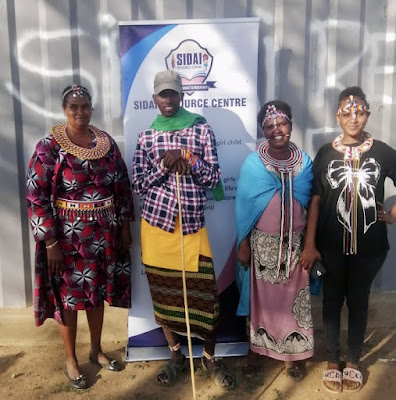
The Sidai girls are thriving!  We are now up to 48, eight of whom are in secondary school and have a safe place to come home to during school holidays.  Of great importance is Sidai's progress in changing the hearts and minds of the elder men who have, until now, perpetuated the brutal treatment of girls.   They have done so, not because they are evil, but because the practices have been an integral part of their culture for millennia.  They knew no other way.

Years ago, Sarah Lesiamito, the teacher who began the effort, took girls into her home to protect them.  Two of the girls, Shar and Sonia, had fathers who demanded to have them back and were angrily vocal about their rights as fathers. As Sarah reports it, "I told them that I was helping them raise their children."  The fathers went away mad, but - thanks to the Kenyan laws against such treatment, they were unable to take the girls back.  Years later, Shar returned to her village as a registered nurse, the only professional healthcare giver in the area.  Her father is now so proud of her achievements that he gave Sarah a goat.  A pastoralist man gave an animal to a woman!

That's Shar on the right.

When Sonia graduated first in her class from secondary school, her father too repented his early angry rejection.  He asked Sarah how she was able to do what she is doing.  She told him, "There is this woman in New York.."  He said, "When that woman in New York comes to Samburu, I will give her a cow."  This declaration has led to a great deal of hilarious conjecture about how I will transport the cow to NYC and how it might be taken up to my seventh-floor apparent.  Cow or no cow, there is this to rejoice over: Sonia is now in college, studying to be a community Healthcare Specialist. On school holidays, she is assisting Shar in providing health care to a community that lacks even a basic clinic.

The culture of the Samburu people is a gerontocracy of men.  Their acceptance of Sidai's work has reached a point where, this past summer, the elders went to Sidai, carrying bowls a milk, their sacred liquid, and chanted and blessed the Sidai installation, the dormitory and the library (the only such thing in the county)!  Here they are:


This social progress has happened because the Sidai Method for saving girls is fundamentally different from how other efforts ordinarily keep girls safe - by taking them out of the community where they were born.  Sarah keeps the Sidai girls in the area, where all the people can watch them thrive and achieve.

Water seekers

Just in the past few weeks, a new possibility has arisen.  To both Sarah and me, this opportunity feels magical.  By a series of mind boggling coincidences, I learned about an American nonprofit called the Samburu Project, which for the past fifteen years has dug wells in Samburu County as a first step in improving the lives of women and girls in communities like that of Sidai.  The sequence of events that led to this connection between Sidai and the Samburu Project began with a decision of a thirteen year old girl in Los Angeles to make a charitable donation.  This led to  seven incredibly unlikely steps that put the head of the well-digging effort in Kenya in touch with Michael Lenaimado, Sarah's husband.  Erich, that well-digger chief, just happens to be a member of Michael's coming-of-age group - a relationship that makes them blood-brothers for life. Marvelous!

Sometime in the next week, Erich is going to test the substrate near the Sidai Center.  If there is water beneath the ground, Sidai will be on its way to having a well, in a climate so dry that the women and girls spend a great deal of their lives searching for and carrying water.  According to Sarah, relief from that burden would be the greatest thing that could happen to the women of the area.

My thoughts will be focused on that prayed-for outcome over the next few days. Join us a crossing our fingers.

www.sidairesourcecentre.org