Sunday, March 5, 2023

Borrowed From The Bard Redux

Book titles taken from William Shakespeare


Zoë Sharp


I hope you will forgive me, with ever-present deadlines surrounding me, if I revisit a post I wrote originally back in 2016, with a few suitable additions.


Shakespeare was arguably the greatest writer in the English language. Next month sees the anniversary both of Shakespeare’s approximate birth, and his death. Both of these events are thought to have taken place on the same date in April – the 23rd, although exact birth dates were often not recorded at that time.


By the time he died, in Stratford-upon-Avon, he had written 38 plays and 154 sonnets, as well as a number of other works. He was only 52, although that was considered quite a good run in Elizabethan times, when the life expectancy of the average Londoner was 35.


Shakespeare’s work has been translated into every major living language, and his plays are constantly re-imagined for each generation, bringing new meaning each time. It could easily be said that the themes and schemes and tribulations of his characters are just as relevant today as they were 400 years ago.


His characters, words, and phrases have seeped into everyday life to such an extent that they are everywhere you look. And nowhere more than in the chosen book titles of other authors.


BRAVE NEW WORLD, Aldous Huxley

The title of Huxley’s 1932 science fiction classic is taken from lines spoken by Miranda to Ferdinand and his companions in The Tempest:


"O wonder!

How many goodly creatures are there here!

How beauteous mankind is!

O brave new world

That hath such people in it"


Macbeth has provided inspiration for many other writers when it comes to naming their work.


THE WAY TO DUSTY DEATH, Alistair MacLean
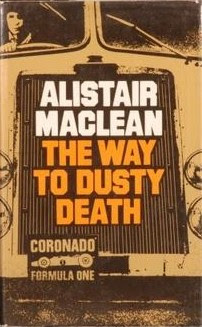
The title of MacLean’s 1973 novel comes from Macbeth’s soliloquy when he hears of the death of Lady Macbeth:


“She should have died hereafter;

There would have been a time for such a word.

— To-morrow, and to-morrow, and to-morrow,

Creeps in this petty pace from day to day,

To the last syllable of recorded time;

And all our yesterdays have lighted fools

The way to dusty death. Out, out, brief candle!

Life's but a walking shadow, a poor player

That struts and frets his hour upon the stage

And then is heard no more. It is a tale

Told by an idiot, full of sound and fury

Signifying nothing.”


WALKING SHADOW was the title of Robert B Parker’s 1994 Spenser outing, while THE SOUND AND THE FURY was used by William Faulkner for his 1929 novel.


DOUBLE, DOUBLE, Ellery Queen

The title of this 1950 novel comes again from the witches in Macbeth:


1 WITCH.

“Round about the caldron go; 

In the poison'd entrails throw.— 

Toad, that under cold stone, 

Days and nights has thirty-one; 

Swelter'd venom sleeping got, 

Boil thou first i' the charmed pot!”

ALL.

“Double, double toil and trouble; 

Fire burn, and caldron bubble.”


SOMETHING WICKED THIS WAY COMES, Ray Bradbury

Ray Bradbury’s 1962 dark fantasy takes its title from the second witch in Macbeth:


“By the pricking of my thumbs,

Something wicked this way comes. [Knocking]

Open locks,

Whoever knocks!

[Enter Macbeth]


Agatha Christie used a several Shakespeare quotes and references as titles of her novels, including from that same speech in Macbeth:


BY THE PRICKING OF MY THUMBS, 1968

SAD CYPRESS, 1940, from “Come away, death” a song in Twelfth Night

ABSENT IN THE SPRING, 1944, from sonnet 98 

THERE IS A TIDE, 1948, (later renamed TAKEN AT THE FLOOD) from Brutus’ speech in Julius Caesar


And the title of her famous play The Mousetrap, 1952, is apparently taken from Hamlet’s answer to Claudius regarding the play the court had just watched.


THE CASE OF THE GILDED LILY, Erle Stanley Gardner

Gardner took the title of his 1956 Perry Mason novel from a speech made by Salisbury in King John:


“Therefore, to be possess’d with double pomp,

To guard a title that was rich before,

To gild refined gold, to paint the lily,

To throw perfume on the violet,

To smooth the ice, or add another hue

Unto the rainbow, or with taper-light

To seek the beauteous eye of heaven to garnish,

Is wasteful and ridiculous excess.”


THE DOGS OF WAR, Frederick Forsyth

Forsyth took the title of his 1974 thriller from a speech by Marcus Antonius in Julius Caesar: 


“And Caesar's spirit, raging for revenge,

With Ate by his side come hot from hell,

Shall in these confines with a monarch's voice

Cry ‘Havoc!’ and let slip the dogs of war,

That this foul deed shall smell above the earth

With carrion men, groaning for burial.”


Currently, my work-in-progress novel has the working title NOTHING WE CAN CALL OUR OWN, taken from the monologue in Shakespeare’s Richard II, Act III, Scene II):


“Let’s choose executors and talk of wills.

And yet not so – for what can we bequeath

Save our deposed bodies to the ground?

Our lands, our lives, and all, are Bolingbroke’s,

And nothing can we call our own but death;

And that small model of the barren earth

Which serves as paste and cover to our bones.

For God’s sake let us sit upon the ground

And tell sad stories of the death of kings”


I’m sure there are plenty more I haven’t listed here. What are your favourite crime or thriller titles taken from Shakespeare quotes, or do you have a quote for which you have yet to find the right story to fit it?


My own favourite is actually a stage direction from Act III of The Winter’s Tale: EXIT, PURSUED BY A BEAR. I’m sure someone’s beaten me to it, but it’s a great title.


This week’s Word of the Week comes from Shakespeare, appropriately enough, and is Anthropophaginian, meaning one who eats human flesh, used in humorous context in The Merry Wives of Windsor:


HOST

“What wouldst thou have, boor? what: thick-skin?

speak, breathe, discuss; brief, short, quick, snap.”


SIMPLE

“Marry, sir, I come to speak with Sir John Falstaff 

from Master Slender.”


HOST

“There's his chamber, his house, his castle, his 

standing-bed and truckle-bed; 'tis painted about

with the story of the Prodigal, fresh and new. Go 

knock and call; hell speak like an Anthropophaginian 

unto thee: knock, I say.”


Events

In March, Zoë Sharp will be one of the Derbyshire authors taking part in Author Assemble. “This is a literary event, showcasing the work of authors who are local to the High Peak or who have supported and worked with the Buxton Crescent Heritage Trust. The aim is to bring writers from a variety of genres together under one roof, to shine a light on the former use of the Assembly Rooms as Buxton’s town library from 1972 to 1992—a time which many local residents remember fondly. We aim to give authors the opportunity to share their work with new audiences, give talks about their writing and of course sell their products. Attendees will also be introduced to the work of the Buxton Crescent Heritage Trust and enjoy some time inside the splendour of the Crescent’s Assembly Rooms.” Time and date: Friday, March 17 2023, 10:00 – 17:00 at The Assembly Rooms, The Crescent, Buxton, SK17 6BH. Speakers, signing, and stalls. More details to follow.


In April, Zoë Sharp will be appearing with Caro Ramsay and Sarah Ward at Ceredigion Museum in Aberystwyth as part of the Gŵyl Crime Cymru Festival. Their panel will be Event 6: Trade Secrets, 10:15 – 11:15 on Saturday, April 22 2023. “Writing a long series, has its own difficulties, as does writing under two names in two different directions. How do you keep track? What are the things you know from your other lives that you bring to your writing? Learn a few trade secrets from three of the best. Panellists: Caro Ramsay, Zoë Sharp. Chair: Sarah Ward. Close Up Reader: Nigel Williams.”


Saturday, March 4, 2023

Guest Blogger John Lawton: Begum the Beguine


Saturday–John Lawton in for Jeff


For those of you who don’t know John Lawton, believe me when I say, you cannot go wrong reading anything written by him. John is a gift to us all, a charmer and raconteur whose presence Barbara and I always enjoy. He’s a prolific, thoughtful writer who’s well earned his comparison to another John – Le Carré – and selection as one of only a half-dozen living English writers named in The Daily Telegraph’s ‘50 Crime Writers to Read Before You Die.’


 The floor is yours, John.


It’s not often I exercise my democratic right to pester my elected representatives — these days, that is; I was a professional, paid nagger in my 30s — but I’ve written to the pols in Westminster twice in recent years on the same issue: Shamima Begum.


Last week I wrote to the leader of what, emotionally rather than practically, has always been my party — I ‘grew up’ in Labour. My father was a Labour pol and I couldn’t begin to count the number of fekkin pamphlets I delivered on his behalf in the 1950s. If I am never remembered for my fiction, I might just make it into the history books as the kid who tried to brain a Foreign Secretary with a poker (I was three). But … I wrote to Keir Starmer and told him he’d lost my vote. Here’s why ….


Shamima Begum was trafficked to IS in Syria in 2015 at the age of fifteen. She was married off, had three children, all of whom died in refugee camps.

In 2019 the then Home Secretary, Sajid Javid, stripped Begum of her UK citizenship. She remains stateless. Like Sajid Javid Shamima Begum is second generation English, her parents being Bangla, his Pakistani. Javid had long had his eyes on the prize (10 Downing St.), ran for PM in 2019, and I am inclined to see his treatment of her as his statement of his ‘British cred,’ for which she is paying the price.


Today Shamima Begum is still in a refugee camp in Syria. Javid, having seen the wisdom of not running for office again (perhaps he took my email to heart), is an advisor to JP Morgan Chase, a company worth about $4 Trillion — no idea what his stake in that pot is, and it would be off the point even to ask. The point is this:


… any civilised country has a notion of the age of responsibility. In the UK the bar is set at an astoundingly low ten or twelve years of age, depending on which part of the UK, and the courts may not name minors accused of crimes, even upon conviction. The age of responsibility is different from the age of consent (16) and the age of majority (18). The National Society for the Prevention of Cruelty to Children defines a child as being someone under the age of 18, as does the UN:


Shamima Begum, at 15, was indoctrinated, trafficked and raped. At 23, according to the Court of Appeal and the Leader of His Majesty’s Loyal Opposition she is a threat to ‘National Security.’


Sir Keir ... this is bullshit. But, you too have your eyes on the prize, so … anything goes.


Have you heard of Alfred Zech? I thought not. But, this was him in 1945, age 12.


Note the medal, Iron Cross 2nd class, pinned to his chest by Artur Axmann at Hitler’s final public appearance — his 56th birthday.


In the film Downfall Zech is fictionalised as Peter Kranz, fighting with the Hitler Youth in the streets of Berlin, firing Panzerfausts at Soviet tanks — Zech actually fought on the eastern front and spent two years as a POW after the war. At some point he threw away his medal, less in disgust, it seems, than in fear of what reprisals it might bring. No charges were ever brought against Alfred Zech.


Perhaps the strangest fiction in Downfall is its almost pastoral ending — Peter Kranz escapes to the West on a bicycle, pedalled by Hitler’s secretary, Traudl Junge.


Junge became one of Hitler’s staff in 1942 at the age of 22.


She worked for Hitler for three years, and was in the bunker the day he shot himself. Junge was lucky enough to evade arrest until July 1945.


She had been a member of the Bund Deutscher Mädel, a wing of the Nazi party — membership, however, was compulsory.


Her interrogation was prolonged, but the Allies, specifically the Russians who held her, allowed for a notion of Youthful Indoctrination — I paraphrase, I am sure there was a more precise wording — and she was never charged with any crime. She was detained for five months.


I do not think I need to dot the T’s and cross the I’s.


But, bear with me … two more brief contrasts.


Did the British Government strip Oswald Mosley — Britain’s most notorious fascist — of his citizenship? No.


Did the British Government strip David Irving — a man convicted under Austrian law for holocaust denial — of his citizenship? No.


Shamima Begum? Yes.


Welcome to Britain, where your citizenship and your children’s lives are   gambling chips in the hands of self-serving pols. Now, Sir Keir, where did I leave that poker?


–John, in for Jeff

Friday, March 3, 2023

Homo Sapiens Irritabilus.


Having just come back from ‘the abroad’ where it was very hot. I was at the same hotel we had visited two weeks before lockdown happened, the one that has the writing desk in the middle of the room. I had a deadline for a tweak on a structural edit.

It was ideal until somebody at work got covid and we found ourselves running the business remotely, and without a roaming phone. The gift of Brexit just keeps giving.

There were very few Brits at the  resort and I had a great opportunity to do some PhD level people watching.  People are people all over the world, but there are some types that prevail no matter where you go or what you are doing – they will be there. Being annoying.

So, here’s some classifications of homo sapiens vacationus irritabilus.


The  Zsa Zsa Gabor; strive so hard to be individual, they all look the same. They overdo the botox (gives new meaning to the phrase, 'her face remained expressionless'). And the lip filler, they have lips like a kissing gourami.  Someday somebody will write a book and the description of the killer, or the E-fit of the killer, will be useless as they will ALL look like that. You know the look, eyes like a cat, lashes so long they have to tilt their heads back to lift their eye lids, the bulky cheeks of a hamster with mumps. And the gobsmacked mouth.

Done very subtly it’s fine. I know women who have had work done and they simply look ‘well’.  But the young woman who sat next to us at dinner had to lift her plumped up lips with her thumb in order to get the food from the fork into her mouth.

The limpets; they usually hunt in pairs. They sit next to you, no matter where you go. If the coffee shop, beach, bus, restaurant is empty, they will sit next to you. They have been known to ask  for bags to be shifted so they can sit closer.  I glare at them as the contemplate where to sit. They scan the room and pick their victim. I dare them to sit next to me. Alan let’s them sit, then gets up and walks away, picking up his coffee and his cake and taking it elsewhere. Limpets ignore all social conventions of personal space and that auto pilot that guides people to sit  in the midway slot  between two groups of other people. The limpet takes their chance to come out with their best opening gambit for a conversation. Brits tend to use ‘Weather’s nice innit.’  At that point most people bale out or say they don’t speak whatever language the limpets do. Getting up for the next course at the buffet and going back to a different table  for the next course is a good tactic. 

Once you have been caught by the limpets, your holiday can be ruined. 


The broadcaster; you’ve all heard them. They think they are witty. Their life has been more interesting than anybody else’s. They’ve been in the secret service, they make films, they’ve been abducted by aliens and everybody has to know. They hang around swimming pools, and always tend to sit right behind me on a plane during a long flight. The broadcaster has a new method of torture now in the mobile phone. They can talk for hours. And hours. At some point  around here I tend to start making notes and the broadcaster is going into a book, and will die. Slowly.


Mr Rohan/ Mrs Rohan; They wear Rohan shorts or trousers all the time, day or night. They are tall, slim people. The eat fruit for breakfast and never sweat. They tend to have a good camera round their neck, and they hill climb in sandals. They are machines. They tend to be Scandinavians.  They are never loud. They carry an air of calm about them.  They never have a lot of luggage and it will tend to be in a rucksack.  They could look like an extra in a yoghurt commercial. I'd like to be a Rohan but my fondness for chocolate is too strong.


Mr/Mrs Crimplene; found round the pool before anybody else. They have matching towels that have probably been ironed. They have wee clamps to keep the towel on the sunbed. They will eat an English breakfast no matter where they are, they speak loudly to people who do not speak English. They match as a couple, their clothes match. They’ll bring a wee bag down to the pool. They tear out the crossword page of a magazine and put it on a clipboard. They voted for Brexit then tut loudly as they wait in the long line at passport control. She got her hair done before going on holiday so her head looks like a wee football. He wears too much aftershave. By the end of the week, they are dark ochre. 


Popeye and Olive Oyl

Sunburn and tattoos. They do a lot of weights. They spend a lot of time in the gym. Or at the buffet. They have biceps on their biceps. They wear tiny vests and very short shorts. They can’t swim. Also, a weird range of haircuts; Mohicans etc. They are often very quietly spoken and go very soft when they see the hotel cat, asking it to roll over for tummy rubs.

You can expect to see them all in the forthcoming novels.


Thursday, March 2, 2023

Klara and other people


Michael – Alternate Thursdays

Kwei pointed out yesterday that exploring another culture in fiction is intriguing, but also can be challenging for readers from outside the culture. Two weeks ago, I wrote about the difficulty of understanding the thinking processes of animals. It turns out to be as much a philosophical problem as a scientific one. So how does a writer go about introducing characters that are not human at all? The cats who solve mysteries, the aliens of science fiction, the intelligent creatures of fantasy?


Treebeard, Tolikien Gateway

I think the answer is that they are actually all human whatever guise they come in, because those are the only characters we can hope to relate to. Of course, they are not “ordinary” humans. It is precisely their extraordinary nature that makes them intriguing and interesting. For example, take Treebeard, one of the Ents from Tolkien's The Lord of the Rings. The Ents are ancient, treelike, and, if they make up their slow and thoughtful minds to do so, they can move and cooperate against enemies. Their culture is very different from that of the Hobbits and both are very different from anything that has existed on Earth now or in the past, but their thoughts and discussions are still human ones. The reader becomes involved and starts to care about these characters. In the cases of Frodo and Samwise the reader cares very much.


Samwise and Frodo
They look human all right...

As a science fiction example, take Larry Niven’s Puppeteers in Neutron Star. These are strange aliens with their brains safely stored in the centers of their bodies. They are enormously risk averse, and as such build the best and safest spaceships. They keep the location of their home planet a secret. Nevertheless, they are charming and the reader likes them. They are alien enough to be different, intriguing, and somewhat unpredictable, but human enough so that we can relate to them. They went on to feature in a number of his novels.

Of course, there are bad guy aliens in Science Fiction that do not need to be human at all. We don’t need to relate to them, and it’s actually convenient for the author not to need to provide motive for the evil things they do. After all, they are aliens, right? Unfortunately, generally speaking those stories are not very interesting unless you’re a teenage boy who likes war stories. The good guys always win and are always humans, of course.


I used to read a lot of science fiction when I was younger, but perhaps I became tired of the aliens being humans after all. However, I could not resist Kazuo Ishiguro’s latest novel, Klara and the Sun. It's not described as science fiction, but Ishiguro’s protagonist is an android. That’s certainly not new for science fiction, anything but. Isaac Asimov’s robot mysteries with his three Laws of Robotics were written around seventy years ago. Ishiguro, however, makes Klara the protagonist and writes in first person, so she tells her own story. We know that Ishiguro can write wonderful human characters, for example, his butler in The Remains of the Day. He also writes beautiful clear, simple prose. (He did win the Nobel Prize after all.) So maybe he could write a genuine alien character?

The novel is set at some point in the future. The world is quite different from the way it is today—at least where the story takes place, but the author isn’t really interested in that anyway. The "AFs" are android companions for youngsters growing up in a rather isolated society—best friends for children who don’t have human companionship. There are allusions to the way the world is from time to time, but everything is processed and interpreted by Klara, and she is really interested in only one thing—the welfare and happiness of Josie, a girl with medical issues to whom she is friend and companion.

It’s obvious from the start that Klara is going to behave in as human a way as possible. After all, she is designed to be a companion for a human child. Does she have feelings? Ishiguro tries to address that, and it’s no spoiler that the answer is yes. And yet she is truly alien, mainly in that she doesn’t exhibit any selfish needs, other than perhaps early on when she wants to be “chosen” by Josie as her companion, and she deliberately discourages another child from selecting her. While the focus is on the relationship between Klara and Josie, and how Klara tries to help Josie overcome her medical issues, the novel has a broader canvass including Josie’s separated parents and their needs. It is the fact that Klara doesn’t appear to have any of these human needs that convinces one that she is, after all, an android. Yet the steps she takes to help Josie and her family are highly empathetic. By the end, probably we care more about Klara than we do about Josie. There's morality in this novel as well as emotion.

So Klara is human, too. (It never occurred to me to refer to Klara as "it" in this post.) But she is also genuinely different, and I think that's a triumph in itself.

Wednesday, March 1, 2023

African Crime Fiction by AI and the “other" way

I was going to write about the history of African crime fiction in contrast to African-American crime fiction, but then I discovered that it was too much to put in one post (I dread readers’ eyes glazing over with too much material). So, it might end up as two or three parts. I’ll start with African crime fiction, which Michael Sears and I have often spoken about.

Then, another thought struck me: could I come up with a satisfactory post using Artificial Intelligence (AI) and thereby save some time? (Admit it, it does take time to do a good post). Anyway, here’s what I found.

History of African crime fiction by AI

Chat.openAI generated several versions of this topic (you can generate any number you wish). One of the better ones follows:

"African crime fiction has a rich history that spans several decades. The genre emerged as a form of social and political commentary on the continent's unique struggles with colonialism, post-colonialism, and ongoing conflicts. Below is a brief overview of the history of African crime fiction:

  1. Pre-colonial era: Prior to European colonization, African storytelling traditions included tales of crime and punishment. These stories were often used to teach moral lessons and reinforce community values.

  2. Colonial era: During the period of European colonization, crime fiction began to emerge as a genre in African literature. One of the earliest examples is "The Palm-Wine Drinkard" by Nigerian writer Amos Tutuola, published in 1952. This book combines elements of traditional African folklore with modernist writing techniques and explores themes of crime and punishment.

  3. Post-colonial era: In the decades following independence, crime fiction continued to grow in popularity in Africa. One of the most influential African crime fiction writers of this period was South African author James McClure, whose "Kramer and Zondi" series explored the complexities of apartheid-era South Africa.

  4. Contemporary era: Today, African crime fiction continues to thrive, with writers from across the continent producing gripping, socially relevant works. Some notable contemporary African crime fiction writers include Nigeria's Nnedi Okorafor, whose "Who Fears Death" explores issues of gender and violence in post-apocalyptic Africa, and South Africa's Deon Meyer, whose "Thirteen Hours" is a fast-paced thriller set in Cape Town.

In addition to exploring issues of crime and justice, African crime fiction has also served as a means of showcasing the continent's diverse cultures, languages, and perspectives, and has contributed to the ongoing global conversation about the nature of crime, punishment, and justice.”

I wholeheartedly agree with that last paragraph. Well said! However, the AI-generated content has significant misstatements. Correct: Deon Meyer is indeed a South African crime/thriller writer with a longstanding body of work, but I would hesitate to call THE PALM-WINE DRINKARD a work of crime fiction. Although I won’t discuss that book in detail, reviewers perceive it arguably as science-fiction, realism, fantasy, or some combination. Likewise, Nnedi Okorafor’s works are (correct me if I’m wrong) probably more science-fiction and magical realism than crime fiction as we like to think of it. So, I’m not terribly impressed with the AI rendition.

History of African crime fiction by conventional search engine

I was a little surprised that I didn’t find an article or blog titled “History of African Crime Fiction” as such, although our own Michael Sears notes in a blog:

Africa has a long tradition of excellent crime fiction both from international writers who set their books here (for example, Agatha Christie’s 1937 Death on the Nile and Elspeth Huxley’s three Kenya murder mysteries also written in the 1930s) and from African writers, such as South African James McClure, who surgically deconstructed apartheid-era policing in South Africa with his Kramer and Zondi mysteries, winning the CWA Gold Dagger Award for his debut novel, Steam Pig.

Like the AI-generated account, Michael gives James McClure his due.

A poster for DEATH ON THE NILE in Thailand
(Shutterstock)


The development of the African crime novel

One of the most comprehensive and academic examinations of African crime fiction is from my friend Dr. Karen Ferreira-Myers in her article,* AFRICAN CRIME FICTION: THE WORLD AS IT IS OR THE WORLD AS WE WOULD LIKE IT TO BE? Karen is at the University of Swaziland where she is the Modern Languages and Linguistics Coordinator for the Institute of Distance Learning. Karen makes it clear that African crime fiction is a relatively new phenomenon and points out that although the crime fiction is growing in importance in Africa, it has for a long time been poorly received. This has been a concern for me as well, but it’s clear from my Ghanaian Instagram followers and requests for my novels in Ghana that the situation is improving.

Some of the African attitude to the African crime novel may have been inherited from the colonial powers, e.g. France and the Francophone African countries don’t regard crime fiction as “true literature,” whatever that means. Karen notes that in the 1980s and 90s that several Senegalese authors including Modibo Keita and Assé Gueye and Cameroonians such as Jean-Pierre Dikolo produced crime novels. In Agence Black Bafoussa by Congolese Achille F Nagoye, the murder victim is an African living in France. Other crime novels came out of Angola, e.g. José Eduardo Agualusa and Pepetela.

African crime novels provide entertainment, but the African flavor might intrigue or baffle the Western reader. Karen relates some of the observations of Nagoye and Abasse Ndione that distinguish the African crime novels.

  • Omens
  • Human sacrifices during witchcraft rituals
  • Occultism, witchdoctors, and healers
  • “The strong presence of the irrational in a genre that sings the praises of reason upsets the system of the crime novel (Braceleret, 2007)
One can add to this list the bungling and corrupt performance of African governments and police services, something I do relentlessly in my novels and will probably never cease to do. But it’s not a monolith, because for example, as Michael and Stanley’s novels show, the Botswana authorities are a lot more modernized and efficient than those of Ghana, which just can’t seem to get their s**t together. Mind you, it’s great material for stories!

African crime fiction: the dream and reality

South African crime novels like those of Deon Meyer or Jassy Mackenzie write tough with the harsh, unforgiving reality of murder and other violence. There are no dreams here. In a softer, sweeter version of crime fiction, Alexander McCall Smith gives the reader a look at African society that is far more sanguine,  maybe even genteel, as Mma Ramotswe solves the cases that come to the No. 1 Ladies Detective Agency.

Back to AI
It’s clear from the above that AI has a long way to go. Besides technical details and facts that it can get wrong, it lacks nuance and the ability to go in-depth with a topic. This may change, of course, but for now, we still have to crawl through the literature available on the internet the old-fashioned way. There is no quick fix. Yet. 

*Karen Ferreira-Meyers, « Le polar africain », Afrique contemporaine 2012/1 (No

241), p. 55-72.DOI 10.3917/afco.241.0055


                                                            ~~~
