Sunday, January 15, 2023

Welcoming 2023 With Tokyo's Giant Gundam Robit

 -- Susan, every other Sunday

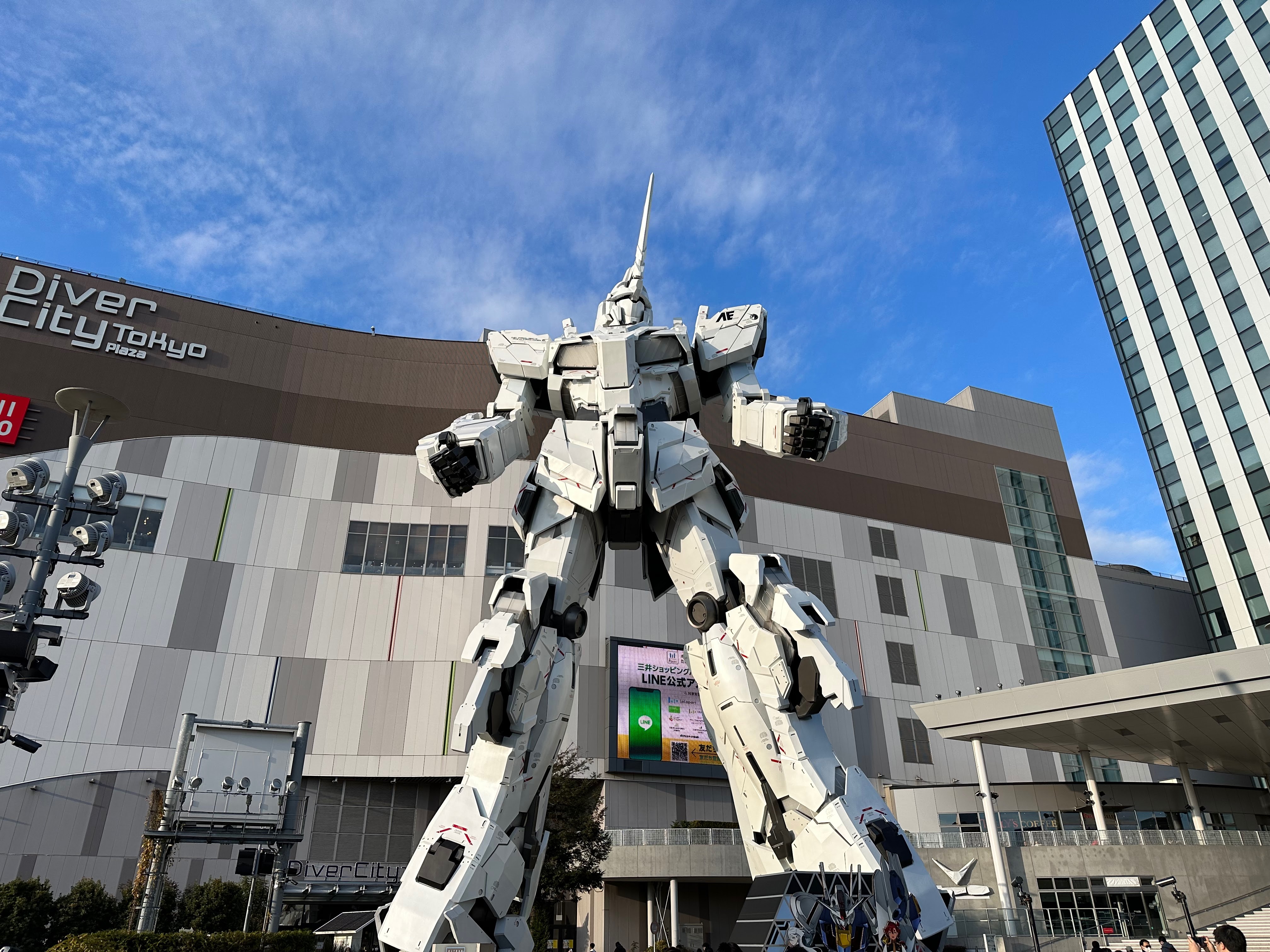
For my first post of 2023 (the Year of the Rabbit, on the Chinese Zodiac Calendar), I thought we'd take a virtual trip to one of Tokyo's most beloved attractions: the giant Unicorn Gundam at Diver City Center, in Odaiba.


Odaiba is an artificial island (technically, a group of islands) in Tokyo Bay. Originally, the islands served as a military fort (the literal meaning of "daiba" (台場) in Japanese) designed to protect Tokyo against attacks from the sea - specifically, from Commodore Perry and his famed "Black Ships" (which I blogged about here last year).

Redevelopment of the islands into a shopping and entertainment district began in the 1980s, although the area didn't really take off until the Yurikamome Monorail opened for business in the 1990s--and its status as a tourist destination was cemented in 2012, when the first "life-sized" Gundam statue was installed outside the Diver City Shopping Center.

In 2020, the original gundam was replaced by the current version, a 19.7-meter "Unicorn Gundam" modeled after the RX-0 Unicorn Gundam, the suit that lent its name to the Mobile Suit Gundam Unicorn films and novel.


Techspeak aside...it's a REALLY BIG ROBOT


"Gundam" is short for "Mobile Suit Gundam" - a popular Japanese anime TV show (and manga/graphic novel series) featuring massive, mechanized military "robots" piloted by humans - in space. 

The Unicorn Gundam at Diver City

While the concept sounds a little like it was invented by a toddler hyped up on halloween candy and carbonated drinks (GIANT FIGHTING ROBOTS! FIFTY FEET TALL! WITH LASERS FOR EYES AND GIANT SWORDS! AND THEY FLY! IN SPACE!) the Gundam franchise has endured for more than forty years, and remains one of Japan's most beloved series.


Rumors said the Tokyo gundam statue was going to be dismantled yet again, after the opening of the Gundam Factory Yokohama--which has an even larger life-sized gundam that really walks. (Sadly, that installation is temporary too, and scheduled to close in March 2023.) 

Standing watch over Diver City

However, two years on, it's still here, with no sign of an imminent departure.

On weekends, the stage behind and to the right of the gundam is home to live JPop performances - which, as you can see, draw quite a crowd. 


JPop at Diver City near the Gundam

The Diver City center itself is home to a wide range of shops and restaurants (as the pun in the name implies), including a Gundam Base that sells memorabilia and treats based on the Gundam franchise.  It's a fun place to walk around, or shop, or even just go and eat.

My pick: the gyukatsu (beef filet, panko breaded and deep fried) set below. The covered bowls contain rice and soup, and the small bowl to the left of the beef and cabbage slaw near the top is an onsen tamago - a Japanese-style soft-boiled egg.


After dinner, it's time to head back outside to catch one of the Unicorn Gundam's regular shows. The robot transforms from "Unicorn Mode" (the peaceful mode) to combat "destroy" mode several times a day - and after dark, the transformation includes some pretty cool light displays.


Unicorn Gundam at Night

As a self-proclaimed history nerd, I spend most of my time immersed in the history, and historical culture, of Japan - but one thing I love about this country, and Tokyo in particular, is the immense diversity of options for everything from food to entertainment.

Welcome to 2023!

And since my resolution for 2023 is to lean more heavily into joy of all kinds, wherever it can be found, that also means spending more time investigating the wild, weird, wonderful aspects of my adopted country--from tasty treats to giant robots.

So far, I'd say the year is off to a pretty good start.


Saturday, January 14, 2023

The Red Hot Mama's Return


Jeff — Saturday

A dozen years ago I wrote about my favorite nightspot on Mykonos, one that brought together the myriad sorts contributing to Mykonos' 24/7 in season lifestyle.  For over thirty years, tourists, locals, yachters, Broadway and West End performers, flocked to the Montparnasee Piano Bar amid the narrow lanes of Little Venice, at the edge of the sea looking out across a bay toward Mykonos’ signature windmills.
 
 
Montparnasse Piano Bar, Mykonos, Greece
Little Venice at sunset

Steve Allen and Jane Meadows
 
It served as the Aegean’s “La Cage au Folles,” sans dancers, for there it was all about cabaret.  And if you thought that guest from the audience who did a song or two seemed familiar, you may be right, for between sunset and two in the morning—when everyone went off to continue the night in the island’s ‘til sunrise clubs and discos—the Piano Bar was a must stop for visiting musical theater folk.

Nikos and Jody, Proprietors


The Piano Bar was the creation of Nikos Hristodulakis and Jody Duncan, and they were behind the bar every night, amassing more stories than O’Henry.  It took a while to persuade them to share some tales with me, and this was their first one.  Alas the Piano Bar closed a few years back, and the island has never been the same.
 
What drew me to repost this tale today, is the face that popped up on my TV screen this week--the subject of their first post, "Red Hot Mama Phyllis Pastore!"  I knew Phyllis still had singing engagements and did any number of TV commercials (see top photo) as well as voice overs, but I hadn't seen any of her acting roles until she appeared as Denise Manfredi, a character in  Sylvester Stallone's TULSA KING series on Paramount.  Seeing Phyllis in all her glory gave me a warm and fuzzy feeling all over--especially since she wasn't singling me out in  a routine she'd toss at me every night I walked into the Piano Bar as (good-natured) revenge for a misstep I made in describing Her Eminence in one of my early books...an error that I struggled to rectify over the next books.  Seeing her current role, I certainly hope she's forgiven me. :)
 
So, here's the story of a true Red Hot Mama, as told by a blond Jody leaning over the bar and ignoring the dark-haired Niko making faces behind him.
Mykonos' Grand Diva, Phyllis Pastore

The place was dead.  It emptied out right after Phyllis’ midnight set.  That happens sometimes.  No matter, it will fill up for her one o’clock gig.  Everybody loves her here.  Some say they come to Mykonos “just to see Phyllis.”  And she believes them.  She should, she’s the Grand Diva of the island when it comes to cabaret and loves to accessorize her songs with props­–none more famous than her bright-yellow foam rubber, McGuire sisters’-style wig and trumpet-shape, silver kazoo.  The kazoo is reserved for her nonpareil performance of “Dr. Jazz,” the Dixieland staple written by Joe “King” Oliver in 1926 and covered by such other notables as Jelly Roll Morton and Harry Connick, Jr.—but none with quite the style of our Phyllis.

So, there I am talking to one of the waiters, and thinking about what kind of mischief I could get into to kill time, when he asks if Phyllis is going to do Dr. Jazz in her next set.   That got me to thinking about Dixieland, which led to thoughts of New Orleans, and on to the subject of…Tabasco!

The scene of the crime
Phyllis was outside the front door talking to some fans, so I told the waiter to grab the kazoo from her basket of props in front of the piano.  With one eye on the door I soaked the mouthpiece in Tabasco and had it back in the basket before she was back inside the bar.  Now it was only a matter of time.  I couldn’t wait to see her face.

But as the set wore on no one shouted up a request for Dr. Jazz and Phyllis hadn’t even glanced at the kazoo.  This was not looking good.  How could I get her to sing?  I used the old standby.  Cash.  An anonymous written request accompanied by 500 drachmas to the piano player for Phyllis to perform Dr. Jazz guaranteed that kazoo would soon be heading toward her lips.

By now I couldn’t restrain myself and had shared my brilliant plan with several regulars sitting at the bar [“With me too,” says Niko waving from behind].  To be honest, most were horrified and thought it childish…but if the shoe fits… Besides, even the most critical were fascinated at how Phyllis would respond.  After all, she was Italian.  And not a word of warning went out from the crowd.

So, on went the wig, and out came the lyrics for Dr. Jazz, “Hello Central give me Dr. Jazz…” At the point where the lyrics took a break and the piano player took over, Phyllis did as she always did, told the audience that she wanted to be part of the band and picked up her kazoo.

I’m in stitches, almost convulsions.  Here it comes.  The eruption is about to blow, we’re all going to be dead for sure, but what a way to go….  You guessed it, absolutely nothing happened.  Tepotah.  Phyllis played her kazoo as she always did with not even a twitch of discomfort across her angelic face. 

"Curses, foiled again!"
When she’d finished, she calmly and deliberately put the wig and kazoo away, picked up the microphone and said to the packed house, “When I’m in Mykonos I stay with Jody and Niko.  Well, one of my roommates, no doubt the nasty blond one, must have thought it would be funny to pepper up my kazoo.”  She cleared her throat.  “Would someone please tell him that, yes, it did burn my lips, but there was no way I was going to give him the satisfaction of a reaction.  At least not now.  Please tell the convulsing gentleman behind the bar that, payback will be hell, and he’d best sleep with one eye open for the rest of his practical joking life!”
Good conquers evil

That took place more sleepless years back than I care to remember and I’ve matured since then [please take notice of Niko in the background rolling his eyes], so I wish to make a (Tabasco free) peace offering to our still dear friend and performing star.  For the first time anywhere Niko and I are revealing our “ultra-secret” recipe for Phyllis’ favorite cocktail, the Montparnasse Piano Bar Chocolate Martini.  Ours is clear—not one of those dark and creamy concoctions you find elsewhere—so it passes as a regular martini, but one taste and you’ll never go back to the others.

Montparnasse Piano Bar Tail #1, the Chocolate Martini:
Start with a chilled martini glass and roll the lip in powdered cocoa or chocolate.
Fill a martini pitcher or mixing glass halfway with ice.
Add 3 ounces of Vodka, along with 1 ounce of White Crème de Cacao (both clear spirits).
Stir well and strain into the rimmed martini glass.
Drop in a chocolate covered almond as a final treat at the end, but no fingers allowed, you must drink your way to the bottom. 

Thanks, fellas...and Phyllis.

–Jeff


Friday, January 13, 2023

Reading on Target.


A tidy part of the TBR mountain
The Bouchercon Pile


I’ve noticed on Social Media a trend to set a book reading target at the beginning of the year. It tends to sit somewhere between 200 and 300 books to read in twelve months. There was rather a thought provoking article in a sensibilish paper that asked the simple question, why do people do this?

I’d like to add another question; how the hell do they have the time? And, what are they not doing and reading instead? Is there someone else always two feet behind them picking up the slack of what they are not doing. 300 books a year is a lot of man hours. As a writer do you want your book to be wedged in at number 47 and then ticked off a large list as 'read'. Or would you wish it to be savoured? Are the two things incompatable?

When I was wee, there were no books in the house as we couldn’t afford them. ( I do believe we should write in here "our recollections may vary". "Did I tell you about the time my sister left me out in a thunderstorm when I was three?" "And then my dog pushed me, and I tripped over the dog bowl?" "Do I get a million pounds for that?" Sorry, there was an interlude of sarcasm there.) While we never had any books in the house we would go to the library once a week on my dad's bike, and maybe looking back on it, I was the one who was very keen to go, more so than my dad and sister.


Now I tend to buy more books than I read – I mean I like buying books more than I have time to read the books than I buy. And I like mooching about book shops, especially if they sell pens and notebooks.

On holiday – a rare holiday when I’m not using the holiday to reach a deadline, then I will devour books. The more I’m enjoying a book the slower I’ll read it. If I’m reading it to review or for an event I can whizz through them pretty quickly. Certainly a 350 page hardback would be a two day job if I was reading it all day.

The article made me look at my reading habits – at the moment, half an hour before I go to sleep and that’s it. My writing habits consume the rest of my freetime. And I tend to be reading friends' books to give a little quote for the back. I can’t actually remember the last time I sat down and read a book that was my choice to read.

I suppose we should be grateful for those who consume 300 books a year as they are obviously buying 300 books a year, but maybe they are involved in some swap system with their friends. It doesn’t matter as long as the books are being read and enjoyed. But are they? Or is it the aforementioned tick box exercise?


How much of the books do you actually absorb if you are reading it that fast? Many believe that setting a target and reading for pleasure are mutually exclusive. The article also provoked a heated debate – doesn’t Social Media always - about how much of the text a fast reader actually takes in. I know there is a skill in skim reading, but is that what the author actually wants you to do?

I can see a benefit in setting a target in a sense that it might force you to put some time aside to settle in to a comfy chair with the faithful hound and enjoy a good read.

At the moment I’m reading a pre published pdf of a book that’s so beautifully written that I go to sleep wanting to stab the author, so I can steal their words. It's an excellently written book – they told me it’s a very bad book but it's mercifully short. It's difficult to tell the length of it as I’m reading it, for my sins, on my phone. Not recommended.

I must have hundreds of unread books in my house in case I’m ever short of a good read. Or we have to endure a nuclear winter. Whatever comes first.

And there is no ‘spare’ room on any of my book cases for THAT book. See what I did there.

My other half has just read this blog and commented that I’m not going to live long enough to get round to reading all those books I possess. Who needs that kind of negativity!

Caro


Thursday, January 12, 2023

I'm back --- briefly!

 Stanley – Thursday

Jeff twisted my arm last week to ensure the Thursday slot didn't go empty while the MIE writers were interviewing candidates to take my place on every other Thursday. I agreed as long as it could be a reprise of an earlier blog.

One of the fascinating aspects of being an African and writing about Africa is the everyday blending of African and Western beliefs. It appears in all our Detective Kubu books. In the latest book, A Deadly Covenant, we incorporate a belief that is widely held in sub-Saharan Africa. Here is the original blog.
___________________________________________


I’m finding it very difficult to know what day of the week it is. I have been in formal lock down for a week and informal closer to three weeks. Every day is like every other day. There is something mesmerizing about it.

The silver lining – other than avoiding the virus – is that I have time to write. Not that it comes easily with all this time on my hands. No! Time slips by as I sit by myself, mind disengaged. However, I occasionally shake myself out of my lethargy and try to get words on paper.

The current book Michael and I are working on is set in the northwest of Botswana on the banks of the Kavango River just before it spreads out into the magnificent Delta. It never ceases to astonish me to see the verdant paradise that is the Okavango Delta embedded in the Kalahari Desert. You can drive along a road and on one side there will be water and reeds and trees and birds, while on the other side there is nothing but sand and a few scrub plants struggling for survival. The divide is that abrupt.

Since water is crucial to people’s existence in this area, we dug around to see what local beliefs existed concerning water. Are there water gods? Are there ceremonies to ensure water abundance?

Out of this emerged Mami Wata, the water spirit.

I’d never heard of Mami Wata, yet she is widely acknowledged in most of sub-Saharan Africa. Mami Wata is usually female, frequently taking the form of a mermaid, often with a serpent wrapped around her with its head between her breasts. She is often depicted as having a mirror, which symbolically is meant to represent this side and the other side, or the real world and the spiritual world.


Headdress from Sierra Leone 
Not surprisingly, she takes on different names in different places. However, the name Mami Wata or minor variants appear everywhere.

Intrigued, I started reading about her.

As with many beliefs from areas with few written records, there is little consistency. She takes on different forms in different places, and her powers differ from one place to another. She is respected and feared, and has a balance between a dark, divine, mysterious, and angelic existence.

Mami Wata appears in the oral histories of early African societies. The Dogon’s creation myth tells the stories of Mami Wata and traces her existence to more than 4000 years ago. Mesopotamian myths also tell of the great water goddess in their story of creation. There she was known as Mami Aruru - the creator of life.
African cultures believe the etymology of her name is Coptic. In the Ethiopian Coptic language, the word “mama” was used as a description of truth and wisdom and the term “uat-ur” meant ocean water. Another definition of the name traces to the early Sudanese society where the word wata referred to a woman. The name is often linked to a single entity but represents the strongest and most significant of all water spirits that exist.

However Western scholars have a different perspective, probably due to the obvious incongruities. First, the name: it is thought that it is pidgin English for Mama Water. Second, the mermaid shape also smacked of Western influence since many old sailing boats had a mermaid prow.

As far as I can see, all African cultures regard her as the guardian of water, and some cultures don’t fish or swim on certain days to give her a chance to rest.

I wonder if this is a place of worship or just exterior decoration.
She is regarded as providing spiritual and material healing to her worshippers.

For women, she is a giver of fertility and protector of women and children.

However, she has a nasty side too. With a number of variations in story, she seduces men then demands that they remain faithful to her. If they comply, she promises them great wealth and success. If they don’t, death or failure.

Man being seduced.
Worship of Mami Wata is so widespread in West. Africa that a church has emerged to worship her. Wikipedia has the following to say about the Mati Wata priesthood:
In the coastal region from Benin, Ghana and Togo Mami Wata is most prominent deity. An entire hierarchy of the Mami Wata priesthood exist in this region to officiate ceremonies, maintain the shrines, conduct healing rituals, and initiate new priests and priestesses into the service of various Mami Wata deities. 
On February, 15, 2020 at 9:00 AM in the city of Cotonou, Benin, Hounnon Behumbeza, a high priest of Vodou and Mami Wata. was officially appointed the Supreme Chief of Mami Wata. As an indication of how revered Mami Wata is in the region, Hounnon Behumbeza's coronation as Supreme Chief of Mami Wata was broadcast live on various television news programs, and featured in local newspapers. The coronation was attended by hundreds of priests from around the region, and the highest dignitaries of Vodou and the Mami Wata tradition. Also in attendance were Benin Republic's minister of culture and several local government officials.
Hounnon Behumbeza, Supreme Chief of Mami Wata

Priestesses
It has been fascinating reading about Mami Wata. I had no idea beforehand that she even existed, let alone that she had such a widespread following.

Where we are in the book, Kubu is heading off to the banks of the Kavango River to meet Mami Wata. As pantsers, we can't wait to see what happens.

You can listen to renowned South African trumpeter, Hugh Masakela play his Mami Wata song here.

And you can watch a bizarre short video about Mami Wata here.

And you can visit her Facebook page here.

Wednesday, January 11, 2023

A Scribbler's Gratitude

 Sujata Massey


The greatest joy of writing, for me, is completing a manuscript. But a small dessert arrives sometime later. After the rewrite, cover design, and copy-editing, a call comes from the publisher for any acknowledgments to add to the book. The process should go down like ice cream, but it gives me a case of brain freeze. 


My biggest fear is forgetting to thank someone I’ve spoken or emailed with before, during, or after the course of writing. You see,  each novel has at least two years of writing and research involved. I reach out to others with questions that must be answered for the sake of the book’s realism.  For instance, the questions I sent to police historian Deepak Rao of Mumbai led to wonderful in-person conversations while I was onsite doing research for THE BOMBAY PRINCE. When he heard that I sought the backstory of the city’s first Jewish woman doctor, he connected me with Sifra Lentin, a historian in Mumbai who is a living archive for the Bene Israel community of Maharashtra. A phone chat with Sifra led to lunch at the Royal Bombay Yacht Club—and then many more emails as I set to work on the following book, THE MISTRESS OF BHATIA HOUSE. 


Sifra, Deepak and me at the RBYC in 2020


I also want to appreciate the people who help me on an ongoing basis with my series, whether they are family members, other writers, or experts in various areas. Jehangir Patel, the longtime editor of Parsiana magazine, has been greatly accommodating of my questions and helpful with information on Parsi history and culture. Because I’m writing about a woman lawyer in 1920s Bombay, I send questions about how the courts and laws worked to Mitra Sharafi, the Evjue-Bascom Professor of Law at the University of Wisconsin Law School. Her academic book, Law and Identity in Colonial South Asia; Parsi Legal Culture, 1772-1947 inspired some of the predicaments in my series. She is renowned in her field . . .


Renowned! I am slipping into acknowledgments language without being able to stop myself! But how does one avoid clichés when it comes to praising truly brilliant people and also sharing one’s gratitude?? You can say ‘thank you,’ ‘grateful for,’ ‘appreciate’ only so many times on the same page without making it a giant run-on paragraph. 


Jehangir Patel at the Ripon Club, 2020 


Acknowledgments can't leave out the people in the publishing process. I thank everyone I can think of on the publishing team, as well as my longtime literary agent, Vicky Bijur. 


My acknowledgments usually wind up being a few pages long. Probably it’s because I include some explanations about real people and events that might be in the novel. And it’s also true that I’m sentimental. THE SLEEPING DICTIONARY’s acknowledgments kicked off with me crediting my parents for taking me out of elementary school to go with them to India for a winter. That book’s acknowledgment section (almost four pages) is followed by a bibliography containing over thirty references. I’ve heard from some readers that they’ve hunted down these books, which is thrilling. Deceased and little-known authors deserve to be credited and enjoyed. 


At the start of my career, my books were published by a company whose style was to run the acknowledgment in the very front of the book. I didn’t realize until later that this method of early sharing could give away a plot spoiler. I’m very pleased that my current publisher, Soho Press, always runs the acknowledgments in the back.


Okay, I'm not the only writer who turns the acknowledgments section into a short story. Many authors with US publishers trend toward passionate and lengthy acknowledgments. Conversely, if you review novels published in the United Kingdom, you’re less likely to find an acknowledgment, or at most, a paragraph or two of thanks. I suspect this has a lot to do with the traditions of publishing in that country. And perhaps the long acknowledgments by American writers have to do with our nation's stereotyped effusive culture.  


Now that I’ve mused about acknowledgments, I’m going to start writing the one that's due this week. Perhaps:


This book was made possible through the help of many . . .


Tuesday, January 10, 2023

Ngā mihi o te tau hou

The joy of reading - me reading to my daughter and her 2-year-old cousin about goddesses and legendary women, during my first festive season without my father.

Craig, once again every second Tuesday. 

Kia ora and gidday everyone.

I hope you've all had a wonderful festive season with friends and family, and a good start to 2023. After a longer-than-expected hiatus dealing with the final months of a terminal illness in my close family, I'm very glad to be back writing at Murder is Everywhere. "Ngā mihi o te tau hou" as the indigenous people of my home country say. 

Greetings for the new year. 

After a planned two-week trip back home to Aotearoa New Zealand in early October that turned into a little over three months spent there, today I've returned to London and am looking ahead to what 2023 may bring. It's been a tough time as you'd imagine, in several ways expected and not, but my heart is full of love and gratitude too. 

A sunrise walk along Waikuku Beach to mark my parents' anniversary - good bookish t-shirt on there too, for any Michael Connelly fans.

As I've said to several friends and relatives over the past few weeks, my father's passing was the best version of a very bad thing. It's amazing how even in the hardest times, there can be plenty to be thankful for. I've had three months of 'my cup being filled', as one friend put it, while being back home, so even though it's all drizzly and wintry here in London now, I'm looking forward to what 2023 may bring. And feeling like even if there are bumps and bruises along the way - as each year can bring - there'll be plenty of good and great moments too. Some of the things that helped me in recent months included nature, creativity, exercise, storytelling, and time spent with good people.

Feeling connected to people and our world, things bigger than ourselves.

Clear eyes, full heart, for the Friday Night Lights fans.

I didn't mean to get too philosophical this first post back, so here's a few snapshots from my spring and summer (northern Fall/Autumn and Winter) in Aotearoa New Zealand, and a few bookish thoughts. Kia ora rawa atu (thanks heaps) too to the Murder is Everywhere team - Jeff, Stan, Annamaria, Michael, Zoe, Caro, Ovidia, Sujata, Kwei, Susan - who were very understanding about everything I had going on. Books people are pretty great, in general, and the crime fiction community is often particularly welcoming, supportive and collegial overall. (From my experience at a range of books and arts festivals over the years). 

Jo, owner of the award-winning Page & Blackmore bookshop in Nelson, NZ, with DARK DEEDS DOWN UNDER, my first crime fiction anthology as an editor. 

Sunrise in the Bay of Islands in late December. The awe we can get from being in nature helps me appreciate life and put plenty of things in perspective. 

Hanging out with some wonderful book peeps after Nelson Arts Festival in October, including Māori filmmaker turned crime writer Michael Bennett (centre) and my old Waimea College drama pal Doug Brooks (back), who chaired Michael in a fun panel about screen and page storytelling

After not seeing each other for 10 weeks, Miss Seven and I enjoyed lots of exploring and adventuring and plenty of beach walks and sea, river, and pool swims in Nelson/Tasman, Auckland and Northland during the festive season.

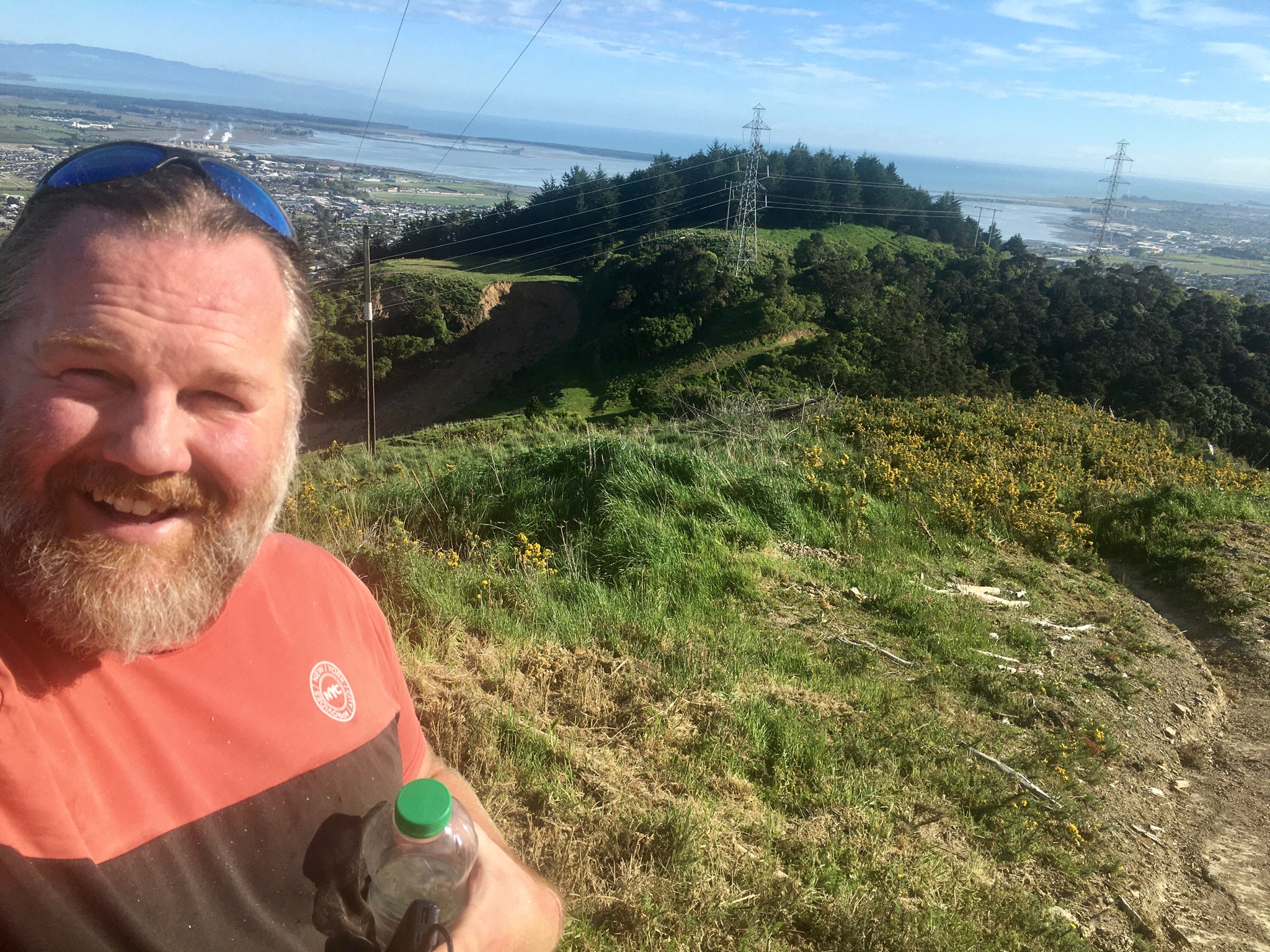
A view across my hometown following a dawn walk up trail on a 'wee hill' behind it that I later realised was higher than anything in southern England. I think I miss the views of the mountains as much as the sea, living in London.

A classic 'real fruit ice cream' at Mapua Wharf - local boysenberries blended into ice cream, or in this case frozen yoghurt. Yummy! 

I think that's enough of the holiday snaps from a non-holiday visit back home. Thanks for reading. I'll be bringing plenty more bookish stuff your way, as well as general Australia and New Zealand-related content and other storytelling thoughts, here at Murder is Everywhere in the coming months. 

Oh PS, happy US publication day to my pal Michael Bennett, an extraordinary Māori filmmaker and award-winning author whose debut crime novel BETTER THE BLOOD is released in hardcover and e-book in the United States today.

Michael's debut crime novel in good company at McIntyre's Books in North Carolina

As far as I'm aware, it's the first novel starring a Māori detective that's written by a Māori storyteller (we've had Māori authors write psychological thrillers or amateur sleuth tales before, and Pakeha - European descent - Kiwi authors write books with Māori detectives before. The latter akin to Tony Hillerman writing his excellent Navajo series.) So that's kind of momentous - it's great to see more talented indigenous writers bringing their keyboards and perspectives to crime fiction. But more than that, it's just a great read, as Publisher's Weekly and many others have been raving about pre-release, exploring modern life for indigenous peoples and ongoing impact of colonization through a page-turning thriller with a fabulous lead, Detective Hana Westerman, who struggles to balance duty and heritage - and single motherhood of a precocious teenager. Give it a go, booklovers.

Whakamihi (congrats) Michael. 

Until next time. Ka kite anō. 

Whakataukī of the fortnight: 

Inspired by Zoe and her 'word of the week', I'll be ending my fortnightly posts by sharing a whakataukī (Māori proverb), a pithy and poetic thought to mull on as we go through life. 

He tini ngā whetū e ngaro i te kapua iti
(Many stars cannot be concealed by a small cloud)

A starry sky above the Church of the Good Shepherd near Lake Tekapo in New Zealand's South Island - we used a similar image for the cover of DARK DEEDS DOWN UNDER


Monday, January 9, 2023

State of Publishing in USA

Annamaria on Monday

As it did to almost every aspect of life on our sacred planet, Covid dealt a severe blow to the already reeling USA publishing industry. Many already-struggling small publishers went completely dark.  Even the big five - Penguin Random House, Macmillan, Simon & Schuster, Hatchette, and HarperCollins – began to lay off their staff.  In the meanwhile, it seems, everyone who had six chapters of a novel in the bottom drawer of a bedside table sat down and used the lockdown to complete the book and quickly submit it.  In the face of lower staff levels, a tsunami of queries have overwhelmed the inboxes of editors.  "I have never seen anything like it," a book agent told me.


Even before the pandemic, the industry had made some ill-advised decisions.  With the introduction of eBooks and their greater contribution to the bottom line, publishing executives convinced themselves that print books were pretty much a thing of the past.  On this assumption, dominos began to fall.  The number of printers shrank.  Paper supplies quickly dwindled.  But people still wanted REAL books.  Then, with the virus still in the future, came the publication of Michele Obama's Becoming.  This event exposed the folly of those executive decisions.  Obama's book started with a print-run of 2 million copies. Given the reduced printing capacity, this demand took up just about all the available presses and paper.  When the first printing quickly sold out, there was a scramble to re-print to keep up with the demand. We can only imagine what this did to first-time authors' scheduled launches.

Just a few days ago, I chatted with a fellow historical mystery writer who declined an invitation I had extended.  His excuse?  His publisher had moved up the due date for the manuscript of his next book, because the cue of books waiting to be printed is now so long that they have to get his book in line two months earlier than was formerly required.


Meanwhile, the public's preference for print has persisted.  
Actually, since the early 2000s, the time the average American spent reading books had been slowly climbing for the first time in decades.  Then with lock down, it skyrocketed.  Many many people started buying books. And perhaps it was all those talking heads on TV or colleagues on their zoom calls, all showing book cases in their background.   Print book sales are stetting records. And, mirabile dictu, small independent bookstores have begun opening all over the country, with many of them becoming integral parts of their communities. This part is the good news, very good news.

But publishing is still facing major challenges.  Publishers of all sorts are loath to raise their prices, but given the smaller supply, the price of printing and paper have gone way up. Shipping costs even more so.  Shipping a container, which holds about 35,000 books used to cost $2500.  It now costs $25,000.  This will further screw up the economics of the industry, already terribly challenged in the post-Amazon world.

Speaking of containers, here's a crazy story I heard from someone whose client's book was involved. A shipping company carrying the container with the print-run of that first book was caught in the debacle at the Suez Canal, which I am sure you've all heard about. Anyway, the shipping company decided that they couldn't wait the month it would take for their ship to get through the canal, so they redirected it to Cartagena. In Cartagena there were goods to be picked up. But there wasn't enough room on the ship for all the new cargo; they had to jettison some containers on board. That first-time author's novel, all the copies of it, went to the bottom of the sea.

Perhaps misery really does love company, because this makes the challenges I am facing right now relatively bearable.

Let me end with a trend I think we will all like. According to the "On the Media" podcast (which was the source of much of the info above), there is a new trend in book covers, away from the gloomy colors that have dominated recently and all those meaningless, weird shapes and blobs. The publishers seem to be going now for bright colors and attractive artwork. That'll be a relief, for sure!