Tuesday, February 20, 2024

India Underfoot: A Rerun

Sujata Massey

I'm still in India but packing up to go from the Kerala backwaters to another region. Therefore, I am sharing a post from 2018, when I traveled throughout India and found myself mesmerized by the beauty of floors. 


It’s too easy to twist your ankle while walking through India. Streets and sidewalks have irregular surfaces, and there are many distractions, ranging from speeding cars and motorcyclists creating their own laws to horses and goats.

So I only feel like my footing is truly firm indoors, and I am always glad about the safety of a smooth tile floor.

In Fort Cochin, Kerala, I stayed in the historic Brunton Boatyard, a hotel built on the grounds of a Victorian shipyard. The narrow red clay tiles on the first floor appear to be strictly business. These tiles have an industrial look and are still holding up after centuries of heavy rolling carts—and now, suitcases.


Nineteenth century Indian royals, on the other hand, used tiles in a grand manner that they’d seen themselves on European tours. Palace tile that I’ve seen is typically giant blocks of pure black and white marble. Not especially original—but very silky underfoot. When I checked into a guest room in Shiv Nivas, a hotel housed in the old guest wing of Udaipur’s City Palace Hotel, the floors felt cleaner than anything I’d ever stepped on, and probably a lot of it had to do with the contrast in air temperature and marble’s natural chill. Before the days of air conditioning, floors were an important cooling element.


In Calcutta, zamindars (landowners) had magnificent homes in North Calcutta built throughout the eighteenth and nineteenth centuries. When I visited a friend who lived in such an aging treasure, I marveled at the veining in the fine marble tiles in the bedrooms.


The most joyful tiles that I’ve seen to date are the encaustic (hand-made cement) tiles from the late 19th and early 20th century in Western India. The first encaustic tiles used in India were Minton Company tiles exported from England.  The British government wanted Indians to buy their tile (as well as most other products) from England. Wanting to suit freedom-minded Indians who still wanted modern tile floors, a Parsi businessman, Pherozeshah Sidhwa, started Bharat Flooring Tile Company in Maharashtra in the early 1920s. These tiles had tremendous patterns crafted to exacting standards, and the backs of the tiles had a map of undivided India stamped on them.


Bharat Tiles are firmly cemented in some of the favorite places I’ve stayed in India, like the Royal Bombay Yacht Club, above.


Wilson College in South Bombay, pictured above, is full of original detail. The school was founded by a missionary, and I don’t know if the tiles are Indian or English.

I’ll make an educated guess that these encaustic tiles in Mahatma Gandhi’s Bombay residence are Bharat Tiles. After all, Gandhiji was the founder of the Swadeshi movement encouraging Indians to buy Indian-made products.


When I recently traveled to Ahmedabad, in the western state of Gujarat, I stayed at the House of MG, a boutique hotel carved out of a grand old residence of the textile merchant, Mangaldas Girdhardas. Mr. Girdhardas expanded his original 1924 residence to have two large wings for his sons and their families. The original wing has black and white marble tile floors; the sons’ sides have brilliant, geometric-patterned encaustic tiles.


When I toured Ahmedabad, I visited more historic havelis, such as the one above, and saw plenty of vibrant cement tile. By now I’d noticed that the prominent colors for all these tiles were golds, reds, and blacks. Yet that color scheme did not determine decorating. Indians decorate in many color schemes atop the harvest-colored floors.

It’s heartening that Bharat Flooring Tile Company managed to create such an industry disruption in 1920s Bombay that the British themselves paid to have many public buildings fitted out with Bharat tiles. And the company lives on today under the same name. They have reissued old patterns and seen them go into old buildings undergoing restoration and new restaurants.

From the British colonial days through independence, Indian tile floors are too tough to show evidence of all who’ve stepped on them. Yet I feel that history surround me every time I go through a door into a hotel or school with a patterned tile floor. 


Sunday, February 18, 2024

Samburu is Beautiful


 Annamaria on Monday

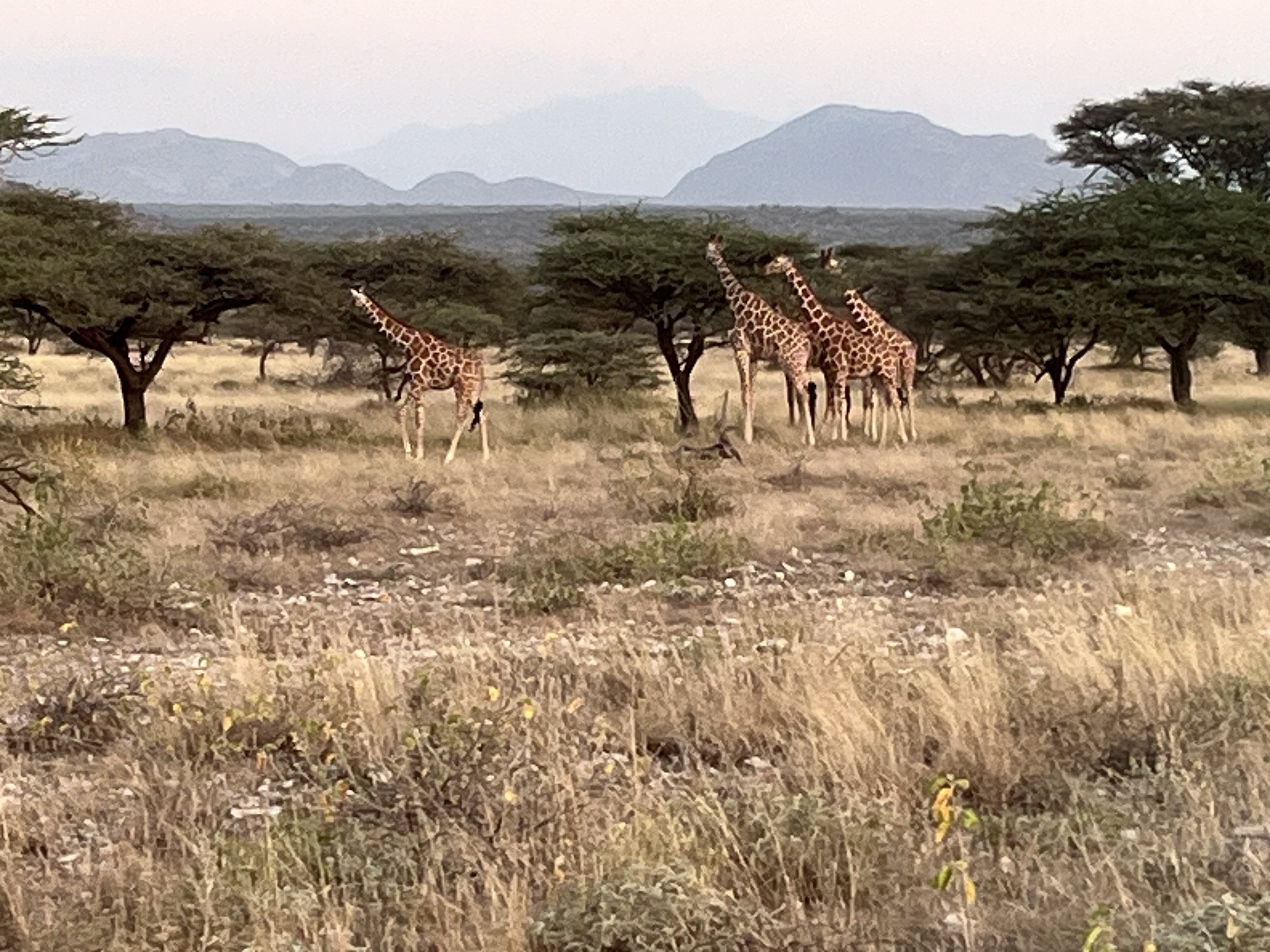
These are busy and wondrous days for me.  Here are some snaps of the gorgeousness of Samburu. More posts are coming up, but for now…

Above, the welcoming committee when we arrived at the Sarova Shaba Game Lodge within the confines of the Samburu National Reserve.  Here is a peek at what we saw on our first game drive:


A bad photo of a bustard, included to give me an excuse 
to post this:


“The bustard’s an exquisite fowl

With minimal reason to growl.

He escapes what would be

Illegitimacy

By grace of a fortunate vowel.”

Stay tuned!

Saturday, February 17, 2024

Happy [Belated] Valentine's Day, Oh Love of My Life


Happy Valentine's Day.


If you don't know to whom I'm addressing this post, I'm at least in the clear with you.  Or so I hope.  You see, today being Friday [when I'm writing this] means I'm in Seattle -- a big shout out to Ingrid Thoft who surprised me at my Third Place Books event last night. Or is it Chicago?  No, that's tomorrow [Saturday].  I'm so confused, which turns out to be my alibi for neglecting to send a card, much less flowers, to my Valentines on Wednesday when I was in Los Angeles [I think.]

Okay, enough with the grovelling. Now's the time to appease, by discussing the non-candy and flowers history of the Day.
 
 
Since this is a site hosted by crime writers, you might think I’m about to plunge into a discussion of the most famous bloody Valentine’s Day ever, February 14, 1929.  That’s when members of Al Capone’s South Side Gang—some dressed as cops—lined up seven men affiliated with Bugs Moran’s North Side Gang inside a garage and shot them dead as part of a war for control of organized crime in Prohibition-era Chicago. 


But you’d be wrong, for this piece is about hearts and flowers.  No, ye cynics, not bullets through the heart and flowers for a funeral, but those bouquets you give to your beloved on the 14th of February—or risk consequences unmentionable in civilized society.

Yes, chocolates (a rumored aphrodisiac) and cards (did you know the first card was written in the form of a poem from a royal prisoner in the Tower of London to his wife?—even he knew forgetting was not an option) are also big Valentine’s Day favorites, too, but this is about flowers.

Charles, Duke of Orleans and first Valentine's Day card sender

But first a bit of history on how lovers became so obsessed with VD—hmm, any wonder why that acronym never caught on?

One legend says it began during a time of religious persecution in third century Rome, when Emperor Claudius II outlawed marriage for soldier-age young men.  Single men fought better, he thought. [Ed. Note: With great will power I resisted inserting a joke here.] 


A young priest thought that unfair, and kept performing marriages in secret.  When Claudius discovered the priest’s violation of his edict, the Emperor sentenced him to death.  While in prison, the priest befriended and healed his jailer’s blind daughter, and before being put to death—on February 14, 270—sent a letter to her signing it “From Your Valentine.”

Yep, Valentine was his name, and the legend goes on to say that in 496, after Valentine had been sainted, Pope Gelasius declared February 14th as a day to honor his memory as the patron saint of happy marriages, engaged couples and young people.


That’s disputed though, for some claim the date corresponds to the Roman fertility celebration of Lupercalia held between February 13th and 15th, and others claim it relates more to the period on the ancient Athenian calendar dedicated to the marriage of Zeus and Hera.   You knew I’d work the Greeks in here somewhere.

Lupercalia by Beccafumi

But it’s undisputed that the romantic love connotation to Valentine’s Day began in the 14th Century with this simple line by one rather influential writer:
 
Translation available via Glasgow

Still, it wasn’t until the early 1700s that flowers became a tradition on Valentine’s Day. That’s generally attributed to Charles II of Sweden’s introduction to Europe of the Persian custom of the “language of flowers.”  Each flower had its own meaning, a sort of secret code between the sender and recipient.


And with the rose symbolizing passion and love, it’s no wonder roses are the number one best seller every Valentine’s Day (257 million in the US in 2014).  But there are other flowers finding their way to Valentines, and for those of you wondering just what your beloved may have meant by those flowers that arrived at your doorstep Wednesday, here’s a list of meanings. http://www.theflowerexpert.com/content/aboutflowers/flower-meanings

Just don’t shoot the messenger.

By the way, Valentine’s Day isn’t a big deal in Greece.  No reason to be, Greece gave Eros to the world.  Now it’s only looking to get some love back in return.

Happy Valentine’s Day, Barbara, Karen, Jennifer, Gavi, and Rachel. Okay, Jon, Terry, and Azi, too. And of course to….


Jeff—Saturday

Jeff’s Upcoming In Person events:


Saturday, February 17, 2:00 p.m. CT
Hellenic American Women’s Council
Lincolnwood Public Library
Author Speaking and Signing
4000 Pratt Avenue
Lincolnwood, IL

Wednesday, February 21, 6:00 p.m. ET
Mysterious Bookshop
Author Speaking and Signing
New York, NY

Friday, February 23, 7:00 p.m. ET
Mystery Lovers Bookshop
Author Speaking and Signing
Pittsburgh, PA

Thursday, February 29, 7:00 p.m. PT
Vroman’s Bookstore
Author Speaking and Signing
Pasadena, CA

Saturday, March 9, 3:00 p.m. CT
Murder By The Book
Author Speaking and Signing
Houston, TX


Friday, February 16, 2024

Of Discs and Flossing


 The book!  With the dog's front paw for decoration

I’m at that brain dead stage when the book has gone off, cover copy is done, cover is done and all seems to be well with the world. I promise myself I’m not going through that again, I’ll never write another book. 

That stage lasts for approximately 24 hours and then a wee idea pops into my head. 

At time during that edit process, I did begin to wonder if English was my first language. But then spoken English is very different to written English.

Stan once asked on a panel what the word was with the most definitions, and the word was 'set', which got me thinking how words evolve and indeed change their meaning. 

Or their intended meaning, depending on who is receiving it. 

This has obvious consequences when one country might use a word as a term of affection, and another English speaking country it's an extremely abusive term. There's a few words than Eng uk and Eng Am, are definately not interchangable.

As racial abuse in Scotland exists in the person who overhears it, that can be problematic.

A friend of mine’s husband was recently arrested because he called his neighbour an 'English bam'. It was a relatively lighthearted exchange between two friends and neighbours over the fence and about the rugby but somebody walking past reported him. He was arrested. The charges were dropped 24 hours later, but it produced a lot of paperwork and is totally nonsensical.

I blame she who can decide what eye she cries with.

So if beauty is in the eye of the beholder then is the meaning in the ear of the receiver. In Caroline Taggart's New Words for Old she has 200 pages of words that have changed their meaning. 

Cookie being one, spam being another. It meant spiced pork and ham to me? 

But one of the words she looks at is 'disc' and I would always spell it disc whereas the other half always spells it disk. And that’s because one of us is an osteopath and the other one a computer geek. It derives from the ancient Greek word for 'to throw', but the word I could find was 'Ballos' and variations therein....

 And then that has become discus which we are all familiar with as a track and field event. That object referred to by the word disc will be flat and circular, but  the  object itself will change.  Gramaphone records, compact discs, the shell of some small beasties, hard disks, floppy disks and it my case intervertebral discs – annullar fibres of tough fibrous material and inside the ball of compressable rubbery material called the nucleus polposus. The weight bearing and shock absorbing of that structure is incredible, but to patients with a  tear on the annullar bit and with the rubbery bit leaking out- a slipped disc in common parlance- a herniated or prolapsed disc to us depending on the degree - I always say 'the jam is leaking out the doughnut' as they writhe in pain.

The pain from a herniation that's irritating the sciatic nerve is worse than passing a kidney stone.

Any way,  guess the good thing about data disks are they are circular so they spin well round a central point while being flat and therefore easily read.

There’s a very famous book called the Mill on the Floss and the floss in that is a river. George Elliot and lots of restrained passion in the hay.

And then there’s a character is Ulysses who carries dental floss in his pocket. The word floss comes from silk – the rough silk that goes around the cocoon of the silk worm. And original dental floss was made from silk. And the word floss has been swept along even though now all dental floss is synthetic.

However if we speak to a 'young person of today' and ask them what flossing was, they would probably start jiggling around, waving their arms and legs about like a toy windmill with the batteries running down. And that kind of flossing is a good way to disrupt your intervertebral disk.

Floss, as well as dancing can mean the opposite of relax; if somebody is a bit flossed up, they are a tad hyper. Why does that make me think of racehorses getting a sweat on in the paddock?

To floss in the states ( is it true?) is to show off wealth in an ostentatious way. No danger of us crime writers doing that!

Anyway, here's another picture of the book that provoked this blog. This is the dog's rear paw, she was bored and like any good criminal, she quickly left the scene


Wednesday, February 14, 2024

Squiver

Michael - Alternate Thursdays

Lumas
Photo: Marsel van Oosten

Marsel van Oosten
Knysna is the home to one of the world's leading photographic artists. Marsel van Oosten was born in Rotterdam, where he grew up and made a success in marketing. He loved the images that formed part of his campaigns, especially those that supported conservation. He became a keen amateur photographer himself, but as time went on, he realized that he wanted to become a professional photographer and artist, that that was his real passion. He and his wife, Daniella, closed their agency, and planned a year of wildlife photography around the world to start the new venture. They called it Squiver - a made up word. Marsel asked Daniella to estimate the costs of such a venture, and it was way beyond anything they could afford. Then Marsel’s marketing background kicked in. He hit on the idea of producing a book focusing on top rank lodges and venues around the world – a book that the lodges would pay to be included in. The project took off, and their first book was Wild Romance covering lodges and venues across Africa. You can still grab resale copies for around $250(!) Marsel’s career as a photographer had taken off.

Looks good to me!

Since then he has collected first prizes in International Photography Awards, three times; in 2015 he was Travel Photographer of the Year; and in 2018 he was Wildlife Photographer of the Year.

I was privileged to hear him speak and enjoy his stunning visuals at a U3A meeting here in Knysna. He showed us many of his truly amazing pictures, starting with the elephant at Victoria Falls which adorns the cover of his more recent book Mother. He explained that this was a case of being in the right place at the right time. No one else has a picture of an elephant peacefully feeding at the brink of the magnificent falls because no one else was there at that moment. Indeed, he continued, the impact of the animal is not that it's a great or even particularly interesting picture of an elephant, but that it gives scale. The impact of the falls is so much greater because we can appreciate its vastness by comparison to the size of the animal.

Inside Mother
by Marsel van Oosten and Daniella Sibbing

Every wildlife photographer needs a bit of luck, but Marsel's real satisfaction comes from planning a wildlife picture in advance. Looking for the perfect setting. Finding the perfect angles and lighting. And then waiting patiently for an animal simply to appear in the right place. Here is a great example. He liked the shapes of the trees. All it needed was the right animal. Given enough patience, sooner or later you may get the shot. Or you try again.

The trees - and Marsel - waited patiently for the elephant...
Photo: Marsel van Oosten

In fact, for Marsel, planning is everything. Perspective is important. He’ll dig a hole in the ground so that he can photograph a rhino from ground level. Or a lion. 

Rhinos from ground level
Photo: Marsel van Oosten

Photo: Marsel van Oosten

Photo: Marsel van Oosten

Oh, and here are a couple of tigers, and these are not from a trip to India. It turns out that, yes, there are tigers in Africa. Tiger Canyon (https://tigercanyon.com/) is a tiger conservation area in the Karoo in South Africa where tigers have been introduced in the wild as a backup to the wild ones in other parts of the world. The idea is similar to zoos having groups of a rare species to save it from extinction. But zoos can’t preserve a predator’s wild sociology and hunting strategies. Tiger Canyon can and does. A similar philosophy has white rhinos in Australia.

 Marcel always wants to try something new. Take a look at this video clip of Namibian Nights:

https://wanderlust.video/namibian-nights-from-marsel-van-oosten/

Marsel and his wife have been all over the world, and they can manage their professional activities from anywhere, but they decided to settle in Knysna. They've  built a magnificent home overlooking the Knysna estuary. The timing was good. Covid arrived and restricted their travel and their opportunities to run photography tours, but it gave an opportunity for them to write Mother: a tribute to Mother Earth, unfortunately currently sold out.

To really appreciate Marsel’s art, visit his website https://www.squiver.com/about/ 

And read about his wonderful photography tours…

Tuesday, February 13, 2024

Dragons Dragons Everywhere--

 Ovidia-every other Tuesday

Happy Year of the Dragon, everyone!

Singapore welcomed the Year of the Dragon last Saturday with a mix of tradition and technology, in a 10 minute show named The Legend Of The Dragon Gate--


Featuring 1,500 synchronised drones along the Marina Bay Sands Waterfront, the show lasted ten minutes with many people staying out to watch despite the rain. 


I didn't make it there myself, but from all accounts it was pretty striking. 

The Chinese dragon is considered a celestial creature, able to control the wind and water as well as confer strength, good luck and wisdom.

However, this year is the year of the wood dragon--a creature apparently more introverted and self sufficient than his more fiery brethren.

I've started the dragon year a bit more quietly too, thanks to some dental procedures, a bad reaction to antibiotics, the death (not a surprise but still unexpected) of a much loved and respected teacher... and just to round things out, I fell while out walking (stepped on a pine cone concealed in wet leaves) and did something to my left knee.

Now I can walk fine as long as I keep the knee pretty straight. But sometimes after bending it, I can't straighten it out without pain. Walking down or up stairs has become a step-match process, and during this morning's attempt at yoga I think I spent more time trying to re-straighten my knee than actually practicing!

Luckily the teacher was understanding, saying he has two other students who get locked joints in certain positions, and it'll pass!

But not surprisingly I've not been doing much else.

I have more dragon pictures, though. Dragons are everywhere in Singapore right now. In the supermarket--


where he looks like he's warning you off the vegetable display!

If you were born after the Lunar New Year in 1940, 1952, 1964, 1976 or 1988 you might be a dragon. Considered by many to be the most auspicious zodiac sign, there's often a spike in the number of births in dragon years.

At the Art Science Museum--


 With a bit of help from technology here!

And of course in the Lunar New Year street processions--


The street processions are the closest to what I remember of the lunar new year celebrations of my youth.

And for today's children there's a surfeit of dragon dolls and dragon cakes,


Cute, though not exactly what I'd call cuddly.

Bruce Lee was born in the dragon year (1940) so though his given name was Lee Jun-fan, he was generally known as ęŽå°é¾ or 'Little Dragon Lee'.

And I'm now storing my current knitting project in this red dragon box that will last much longer than the Chinese New Year goodies it came bearing!


But best of all the Year of the Dragon is supposed to bring auspicious opportunities to all, and seen as a good time to start new projects. 

So if there's a project you've been thinking of starting on, why not grab some of the newly launched dragon energy and jump into it now?

Sunday, February 11, 2024

On the Road Again

Annamaria on Monday

I am on my way to Kenya and Zanzibar with a stop first in London. This past Saturday started with a good-bye to my favorite breakfast in Florence. 


By late afternoon, my friend Nicoletta and I had checked into our hotel in the Henson section of North London. 


We spent Sunday visiting with family and the city where right is wrong and left is right. 


Lester Square was full of folks out to celebrate Chinese New Year:  the beginning of 2024, the year of the dragon! 

It’s late on Sunday now, and I am now out of steam.  


WISHING YOU HAPPY 2024
MAY THE DRAGON BRING YOU 
HEALTH, HAPPINESS, AND PROSPERITY