Friday, July 23, 2021

The Good, the Bad, and The ?


Jeff–Saturday


What is good, what is bad, and whatever is else is a matter of perspective.  For example, the photo at the head of this post is of Giannis Antetokoumpo, the newest member of the pantheon of Greek gods.  That is, if you’re Greek and/or a fan of the new National Basketball League Champion Milwaukee Bucks. 


The “Greek Freak,” as this 26-year-old-phenomenon has been called, was born in Athens to undocumented Nigerian immigrant parents, and together with his brothers (two of whom also play for NBA teams) helped support their family by hawking watches and sunglasses on Athens streets. If you want to know more about his remarkable story, this is a good place to start.


On the other hand, if you happen to be a fan of the Phoenix Suns –who lost to the Bucks in the championship finals–you might have a less laudatory opinion of this Greek King of Basketball.   


The same holds true when it comes to choosing your perfect vacation spot.  “Different strokes for different folks” could well have coined by a publicist for the Greek islands experience.


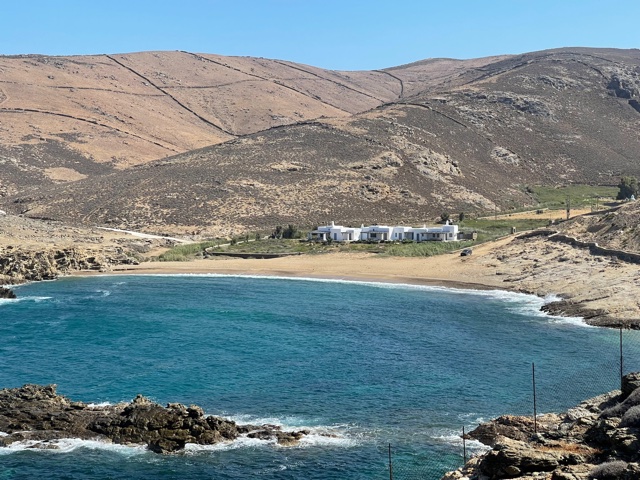
Conspicuously absent from the following photos of my recent jaunts over the past couple of weeks, are any of Mykonos’ world class beach bars and clubs that attract so many during the day, and of its equivalent late-night venues offering similar draws at night.


It’s not that I’m against them—or avoid them—it’s just that, at the moment, they’re not operating at full throttle, and it seemed unfair to draw them into a discussion of this sort while incapacitated. Instead, I’m focusing on alternative beach experiences available on Mykonos, as well as one I found on the neighboring island of Tinos.


All of this has been done, of course, as part of my in-depth, relentless research for the next Andreas Kaldis book.  At least that’s my story…and I’m sticking to it.


The Super-rich long ago discovered Mykonos.


But there are other discoveries to be made.


There are the packed beaches


And the unpacked.


And then there’s Tinos’ most undiscovered beach…at least to me.


But above it all, it’s about finding joy no matter where you may be.


We wish you all a safe and joyful summer holiday.


–Jeff


Jeff’s upcoming events

Wednesday and Thursday, August 11& 12
Fish & Olive Gallery—Halki, Naxos Island, Greece
European presentation of A Deadly Twist on the island where it is set
Learn more

Thursday, August 26, 5:00-5:50 p.m.
Bouchercon 2021—New Orleans, LA
New Orleans Marriott—La Galeries 2, 2nd Floor
Moderator, Mystery of Crafting Thrillers Set in Foreign Lands

Friday, August 27, 11:00-11:50 a.m.
Bouchercon 2021—New Orleans, LA
New Orleans Marriott—La Galeries , 4-5. 2nd Floor
Panelist, Thrillers in the World of Politics


Castles In The Air

 This house has been causing a bit of a stir round these parts. Mainly because crime writers keep putting it on Facebook ( well, me and my pals ) with grand thoughts about what to do with it.

Buying houses in Scotland is a closed bid business.  All bids have to be in by a closing date,  the price is  listed as 'offers over'.  At 12 noon on the day of the closing date, the bids are all opened and the highest bidder gets it, unless the vendor says otherwise. I wasn't the highrest bidder to buy the house I am in now but I was the highest that wanted to keep it as a house and not for refurb into flats. Or, the other higher bid was subject to planning permission and if the council did not permit it, then everybody would have been back to square one.

We can also say Fixed Price,  first person  to offer that price gets it, subject to the vendor agreeing enter dates etc.

It's better than the English system where one bid can be bettered by A N Other right up to moving date or contract exchange, and the whole chain breaks down.

But back to this property and daydreaming.

It's offers over £620 000.  Cheaper than a two bedroomed flat in Edinburgh. About the same as a four bed house in the posh bits of Glasgow.

It's about 1 hour 30 minutes from Glasgow Airport.... and just look at that view!

If I retired tomorrow, sold the business, I'd buy it and life in the motorhome while the builder got going. I'd sell the rights to channel 4 to film it. I'd invite you all over ( loads of room for isolation  and writing !) and we'd all be on the tele, doing a DIY extravaganza.


More details and photos at  Frank Knight   house for sale in Kilberry, Tarbert, Argyll and Bute, PA29 - EDN012188851 | Knight Frank


I mean,  how could you not.   I think Michael Stanely could be in charge of stocking, and testing the wine cellar.


Ok, dead things on the walls but we could have a rest home for disabled donkeys and a lama farm.

I first thought that the price was so cheap there might not be a road, but there it is!

An old wall of photographs.  I think the house was in the same family for about 300 years. Imagine the history just on the wall.

???


A bedroom, no rot around here


Nice venue for cocktails  or a dram of the evening after a hard day of giving writing tutorials.
Or lama catching.


This is at the end of the garden, paddleboarding paradise.
Full wet suits required!

The cottage which is fully inhabitable.

Interesting....

The kitchen in the cottage,,,

The stair way in the main house, made for murder mystery weekends,

The old nursery, the  old rocking horse, It's all rather poignant...

mmmm, that would appear to be some damp,  and some rot.

wild water swimming anybody?

I've flicked through all the pics and can't see any obvious  radiators so we might need to burn paper drafts of bad novels.
Mine would keep us going for a few years....

I thought Barbara could use this as a studio; lovely light ( about three days a year)

Heaven. There's nobody about.
And maybe close enough to movingh water so  less midges.


Bits falling off but nothing a paintbrush, a  hammer and a million pounds won't fix.

The estate. Lamas. Ponies. Crime Writing.


Anybody?


Caro Ramsay ( saving her pennies hard)

Thursday, July 22, 2021

The week that was

Michael - Thursday


Last week South Africa was plunged into turmoil that could have been an existential threat to democratic South Africa. The damage to property and the economy has been estimated to be as high as two billion dollars, hundreds of shopping centres (and smaller shops) were looted and subsequently destroyed, roads were blocked and infrastructure damaged. This hit us as the third wave of delta-driven covid was peaking and the economy was already reeling from the new lockdown and the resulting blow to the tourist and hospitality sectors. In two provinces many vaccination centres were forced to close. Apart from anything else the looting will be a super-spreader event. At least many people wore masks – probably more to stop themselves being identified than to stop the spread of the virus!

Looted shops burning

The looting of shops and robbing of automatic bank machines was mainly in the historically black areas of the country. As usual, it was the poor who suffered the most and continue to suffer. Major roads were blocked by burning tires – later burning trucks – and communications infrastructure was attacked and damaged. The Gauteng and KwaZulu-Natal (KZN) provinces, which experienced almost all of the damage, suffered shortages of goods largely trucked from the coastal ports in KZN. Fuel refineries ran out of raw materials and a shortage of petrol and diesel resulted. Dairy farmers flushed milk down the drain as there was no way of getting it to the consumers.

Now that calm has been restored, supplies are moving again, and we’re picking up the pieces, the question everyone is asking is why this happened. Like everything in South Africa the question is complex, and I don’t pretend to know the answers. But here are some of the issues.


IMPRISONMENT OF JACOB ZUMA

Ramaphosa (left) and Zuma (right)
Friends no more

The previous president has been playing a variety of games to avoid giving testimony to the commission investigating state capture during his kleptomaniacal term. After multiple adjournments, delays, and warnings, he was finally told that he’d be arrested for contempt of court unless he gave himself up by midnight on Wednesday two weeks ago. After much ranting about politically motivated persecution and dire warnings, he did so at 11:30pm.

Despite his lifestyle and the looting of state coffers he and his cronies carried out, he is still a loved and respected leader in some circles. He was on Robben Island with Nelson Mandela, so his struggle credentials are as good as it gets. He is a Zulu leader, and the Zulus have a proud and warlike history and are the majority tribal group in KZN. Also, there is a faction in the ruling ANC that misses the rich pickings of the Zuma era and fears their own accountings.

Undoubtedly, Zuma’s arrest was the spark. But it wasn’t the cause.


HUNGER


The economy here has picked up since the first covid whammy, but it had been knocked from a low base with official unemployment at more than a third of the workforce. Youth unemployment is over 70%. The new lockdown hit the winter school break (the previous one coincided with the longer summer holiday season) and knocked the stuffing out of what was left of the hospitality industry. International tourism has been essentially dead for eighteen months.

Smaller shops suffered as badly as the big chains in the looting, with everything stolen and often the infrastructure destroyed. Many were run by women making a meagre living to support their families. The big chains will claim on insurance, write off a few million, and start reconstruction. The small businesses are wiped out with no hope of recovery except uncertain government support.

One woman leaving a grocery store with a big bag of cornmeal and a large sack of oranges told a reporter, “I’m not a bad person. I just need this food for my children.” Yes, there were reporters there interviewing looters. Where were the police?


POLICE AND GOVERNMENT REACTION


Initially the police reaction, especially in KZN, was tentative to say the least. There was some muttering about not escalating a bad situation. The president spoke of concern for people’s feelings, of the hurt and anger of their erstwhile hero's arrest. Well, the bad situation escalated pretty quickly without any help. I saw live TV coverage of a shopping mall being cleaned out. The looters did have a problem. It wasn’t the police, it was the huge traffic jam that ran back for miles as people tried to reach the mall for their share, simply parking in the highway outside, grabbing what they could carry, and then returning and driving off so that someone else could take their place.

CRIMINALS AND GREED

Talk about greed!

Yes, of course. Get someone else to open the can, then help yourself to much of the contents. Opportunistic thieves were clearly a big factor.

THE PLOT

The government is now adamant that the looting and rioting was orchestrated. Ostensibly to protest the arrest of Zuma, it was part of a multifaceted plot to overthrow the democratic order in South Africa and to replace it by a group not yet identified but possibly including part of the old Zuma gang.

I’m always suspicious of conspiracy theories – apart from anything else, they provide an easy way for leaders to direct blame at shadowy groups of villains and away from their own failings. George Orwell wrote about this stuff in his novel 1984. His totalitarian regime had a single person to hate, which was even better. Even if he didn’t exist. Particularly if he didn’t exist!

However, there are some issues that are suspicious. Why attack cell phone towers? Nothing to loot there and hardly an obvious way to express dissent. Closing the N3, the main artery between the major population centres of Gauteng and the ports of Durban and KZN, makes some sense in the context of protesting about the arrest. However, people were seen arriving to loot in busloads. In buses? Who ever heard of looters being “bussed to work”? Certainly, social media was used to advertise events and protest actions, all ostensibly protesting about the Zuma incarceration, but all leading to looting and infrastructure damage.

The government announced that twelve men were behind the orchestrated uprising. (The Gang of Twelve sounds familiar.) One was immediately arrested, but released shortly afterwards. Hmm. Gang of Eleven doesn’t have quite the same ring.


AND SO?

People come together to protect what's theirs

I imagine that there is something in all these factors. But as so often in South Africa, there was a silver lining that may be the most important part. People rallied round, not only to help clean up the looted businesses, but to protect their own infrastructure from the looters. People of all races, tribal groups, walks of life, worked through the police forums to be guards and lookouts and simply be there for each other. Even the minibus taxi associations, not always known for their respect for the rule of law, made it clear that they would play their part and did so convincingly.

As a black young leader in the border town of Volksrust put it, “This is ours here. We won’t let them destroy what we have.” He was referring to the town’s small shopping centre. No one touched the shops and they continued to operate normally.

Somehow, we always get it back together and carry on.


Wednesday, July 21, 2021

Travels in Nigeria

Kwei--Wednesday


I'm writing this blog in Niger, having left Nigeria. At the moment I'm in Agadez, some six hundred miles from Niamey, the capital, so this is a retrospective look at my Nigeria tour.

Rules of taking photos in Nigeria
  1. Don't take any photos/videos.
  2. Don't take any photos/videos.
  3. Don't take any photos/videos.
If you break these rules, you can be sure some kind of official in a uniform of some kind (not necessarily the police) will magically appear and wag his finger at you (99.99% are male.) Having said that, there are ways to get around these rules:
  1. Take a photo that includes yourself or someone you're with.
  2. Deserted--no one around, like in a forest.
  3. Ask someone if you can snap a pic--theoretically you stand a 50-50 chance, but practically only 30% is in your favor.
  4. "Ninja" style--what I call Indirect Media Capture (IMC) or Indirect Visual Capture (IVC)--in other words, secret, some would say downright sneaky, which can be risky and should be attempted only by the most skilled practitioners.
To be fair, Nigeria isn't the only place where photographs and videos are not allowed in museums or other public places. It occurs all over the world including the most prominent and famous international landmarks.

Benin City
With centuries-old buildings, Benin City is not a recent creation; for example this church, Holy Aruosa Cathedral, is said to be the oldest church in Africa, founded in 1506.

Holy Aruosa Church, said to be the oldest church in Africa
Holt Aruosa Cathedral (Image: Kwei Quartey)

People of any religion are welcome here, but the distinguishing feature of the congregants at this church is that they have a direct connection to God, and don't pray through an intermediary, like, say, Jesus Christ.

There are multiple statues dotted around Benin City (not to be confused with the Republic of Benin), many of them paying homage to ancient kings and queens, as in the example below.

Benin City statue of princess and companion
I don't remember which princess this is (Image: Kwei Quartey)
The Kingdom of Benin is one of the great dominions of West Africa, establishing itself in the 900s. Starting from the 1400s, the kingdom was extremely powerful for some two hundred years, with the decline coming to its nadir in 1897 when the marauding British--who else?--invaded and made a right mess of things.

Entirely by serendipity, during our stay in Benin City, we ran into a Mr. Akenswau, who is a cousin of The Edigin N’Use, His Royal Highness, Ekpen Kelvin Edigin, whose royal lineage dates as far back as 1170. Off the cuff, Akenswau arranged a meeting with HRH that very afternoon. We were rather ill-equipped for the visit, since we technically should have presented HRH with some gifts on our arrival, but we made up for it later.

If you're visualizing HRH as a wizened old man bent over with age, you're mistaken.
Ekpen Kelvin Edigin is a young, hip, and erudite man with a great social media presence. I tried to be cool, but I admit I found myself a little bit awestruck. However, HRH is unassuming and easy to talk to.

We discussed a wide range of topics with him--including the clear and present danger of Nigerian disunity.

With HRH Ekpen Edigin of Benin City
With HRH Ekpen Edigin at his home (Photo permitted by HRH)
Speaking of antiquities, the Benin City National Museum is well worth a visit, full of treasures of the early empire and the stories behind them. Sadly, some of the pieces in this museum are replicas, because the thieves who stole them, particularly the British colonials, still hold onto them in institutions like the British Museum, which I will therefore not visit again.

Kwei Quartey standing with tour guides in Benin City, Eso State, Nigeria
With my guides Jude, Evans, and Confidence (L→R) in front of the Benin City National Museum (Image via K.Quartey)

We also visited a brass and bronze works where everything is handmade by artisans. No cheap made-in-China knockoffs here. The furnaces used are incredibly hot and reach an extremely high temperature for the melting and molding to take place. Imagine spending the whole day working at these furnaces.

Hot furnace used in an artisan bronze and brass works (Image via Kwei Quartey)
With my guides, sweating near one of the furnaces

Here's an example of one brass (copper + zinc) piece I bought depicting the head of one of the kings of the Benin Empire.
                    Bright brass head of a Benin king
Handmade brass head of Benin King (oba) Image: Kwei Quartey

Lagos
One of the most superb places we visited was the Nike Art Gallery in Lagos. That's not "Nike" as in the shoe company. It's named after the founder and owner Nike Davies Okundaye, and it's pronounced Nee-KAY. With a total of 35,000 pieces on four floors, it's arguably one of the largest and best collections in West Africa.

Multiple floors of paintings at the Nike Art Gallery
Every space of every floor is filled with paintings (Image: Kwei Quartey)

View from the top of Nike Gallery
Dizzying view from the top floor (Image: Kwei Quartey)


Many paintings and sculptures at Nike Gallery including a bull of mosaics
Some of these works are by Nike herself (Image: Kwei  Quartey)

Nike spent years in the USA and became well known and respected there. Amazingly, she spent time in SoCal, my neck of the woods, and participated in the yearly Pomona Fair. If you are in Lagos, you must not miss this art gallery.

Abeokuta
The name means "under the rock." The state capital of Ogun State in southwest Nigeria, the city is located on the east bank of the Ogun River near a collection of rocky outcrops. The most massive of them, the Olumo Rock, provided shelter and protection for Egba people fleeing the crumbling Oyo empire. It sits at 137 meters (450 feet) above the ground and offers a spectacular 360 degree view at the apex.

Another must-see in Abeokuta is the Olusegun Obasanjo Presidential Library (OOPL), a sprawling complex named after arguably Nigeria's most consequential president from 1999 to 2007, after his having been the nation's military leader 1976-1979. There's a lot to view at the OOPL. Just when you think you've seen it all, there's another large room or pavilion.

Standing on the staircase of the main hall at the Obasanjo Presidential Library
On the stairway of the main hall in OOPL with C. Aguiyi (Image via Kwei Quartey)

And then it was off to the New Afrika Shrine of performer and great political activist, Fela Kuti, widely credited with being the creator of the Afrobeat style of music. The Shrine is the only location in Nigeria you can smoke marijuana, and during the weekly concerts on Thursdays, the air is appropriately filled with clouds and the seats with happy people.
Shrine objects at the New Afrika Shrine (Image: Kwei Quartey)

There is also some rather liberal marijuana consumption at Kuti's three-story home, where you can get a picture of his bedroom at a price.

Here's a short IVC of some of the visual treasures of the home. I could tell you how I do it but then I would have to immediately kill you.
They may never let me back into Nigeria after this.

And finally, to end, here lies the great Fela Kuti, brilliant musician and passionate political activist.
The Fela Kuti Tomb on the grounds of his home (Image: Kwei Quartey)

This tour of parts of Nigeria was taken with ucomeafrik.com, which provides tours of other West African countries as well. Reach them on Instagram, @youcomeafrikprivateguide.

Regarding security issues, if you stay in your hotel like a good little boy or girl, and you stick with the guides when you are out, you will be just fine. They do not visit risky areas, and no, you do not need an armed guard--unless you're a head of state or something similar.