Sunday, July 21, 2013

Making Paper


Recently I took a trip to Guizhou, one of the poorest provinces in China, but perhaps one of the most beautiful. I found it so inspiring that I set a chunk of my most recent book HOUR OF THE RAT in Guizhou. I went with my friend Richard (aka The Peking Duck), with whom I've had the pleasure of traveling a number of times.

We went to a number of villages during our stay in Guizhou, but one of the more interesting was Shiqiao, where the speciality is paper-making.

We'd actually stopped first at a cave site some distance away. "This is a good place in the summer," Mr. Ou, our driver, told us. "It stays cool in here."


There were various ramshackle structures made of wood, some holding cloudy water and grayish white fibrous tangles whose composition and potential function I could only guess at. Mr. Ou did his best to explain, but at first I wasn't getting it.

After a while I finally figured out that "shu pi" was not, like, leather something something, but tree bark, and that they were making paper.


After the cave, we made our way to Shiqiao Village. Many of the families here are engaged in paper-making, and each family makes its own. Here are a few photos of the process:


We stopped in at one of the larger operations. I found out later that this is a paper-making cooperative, created to preserve traditional Miao methods, an effort that has made this household the wealthiest in Shiqiao.

They had a storefront of sorts, shelves with stacks of handmade notebooks and sketchbooks and larger sheets of drawing paper, a graying PC and a ledger book on a small desk. Famous artists come here from the big cities to buy their paper, Mr. Ou told us.

"You can try it!" the proprietor, Mr. Wang, urged us, holding out an ink brush. He had sheets of paper laid out on a long table, where other visitors had scrawled their names and countries of origin.

"I have terrible handwriting," I warned. Which is true (I'm left-handed, for one). But I also used to do a lot of art back in elementary and junior high. It was about my best subject.

So, I wrote my name, and for some reason, using the ink brush, I was able to do it neatly, in a sort of grandiose way.

Mr. Wang loved this. So did our female host (I am assuming Mrs. Wang, but I don't actually know for certain). "Draw something!" they urged me.

Well, okay. I drew a cat.

Our hosts seemed to think that this was pretty amazing. I was just glad that I'd managed to draw a recognizable feline.

We went upstairs for lunch. Not a formal restaurant, but an area where guests and tourists could be served. I know that Guizhou is incredibly poor in terms of per capita income, and I'm sure that we didn't see anything close to the real poverty that must exist there. But I have to wonder, a little, because some things about the lifestyle here are pretty amazing. The wooden houses, for example. Basic, yes. But airy, pleasant and in their own way, beautiful.
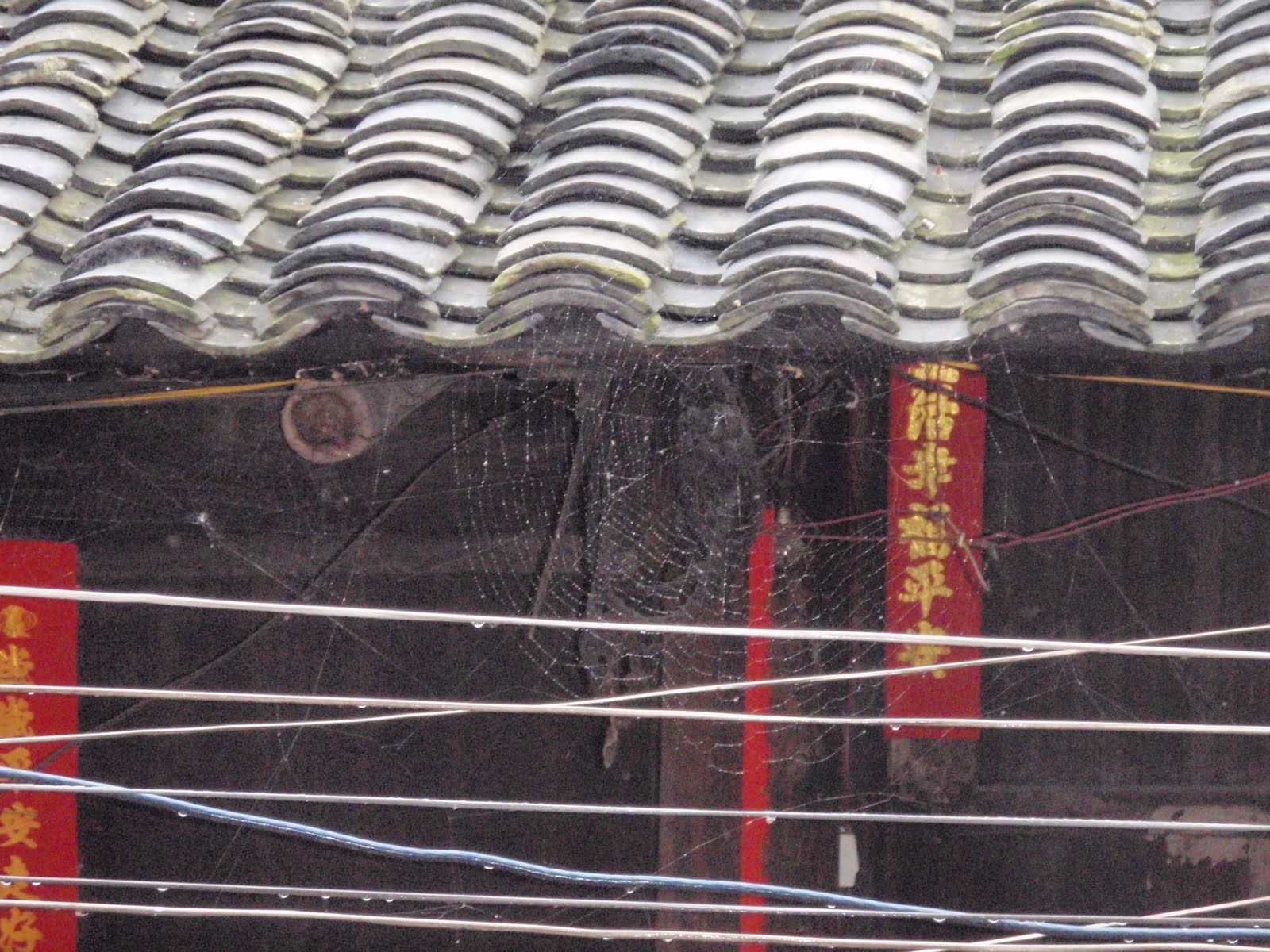

I was heartened to see that in all the villages we visited, new houses were still constructed in this traditional architectural style—hardly any incursion of white tile disease.

Would I want to be a peasant farmer, working terraced rice paddies in my bare feet, behind a water buffalo? Not so much. And I don't want to overly romanticize a way of living that requires a lot of very hard work and doesn't have a lot of the "mod cons," the connectivity and stimulation, that I myself would not want to do without.

But the incredibly gorgeous landscape, the clean, fresh air, the festivals and celebrations...surely these are worth something on the scale of a good life. When I consider the environmental devastation in so much of China, I wonder if in the long run, the inhabitants of Guizhou will finally benefit from their poor, stunning homeland...

This paper-making household is a regular stop on the slowly developing tourist circuit. There was a group of French people who came in after us for lunch (the French, we were told, are the most numerous Western travelers in Guizhou), about ten of them, with a guide.

                     (Mr. Ou, our driver, and Mrs. Wang (?), papermaker and one of our hosts)

After a round of homemade wine (yum!) and a few bites of lunch (simple but delicious, one of the best meals I had), the proprietor came upstairs, beaming, carrying a mounted square of blank, handmade paper. "After lunch, you can write your name and draw the cat again?" he asked. "And we can put it on the wall!"

I agreed, a little embarrassed, and told myself I'd better go easy on the rice wine.

Submitted for your approval...my goofy cat:


In return for my efforts, Mr. Wang gave me one of their notebooks. I'm looking at it now, at the beautiful, soft paper made by hand. I'm thinking, maybe I should buy myself an ink-brush, and learn how to draw something other than a cat...

Saturday, July 20, 2013

A Debt of Gratitude to Harry's Mom


The one on the left still rules.

I planned on taking the past week off.  Just play with my grandkids, enjoy Mykonos in July, do nothing but chill.  Not to happen. A request from my publisher for a “brief” contribution to its in-house author website on the subject of “Practical Advice on Setting up a Book Tour or Signing,” took up the weekend (check out the photo of two silver-haired MIEers headlining the post).  I’m really not complaining.  After all, it’s the least I could do now that my publisher has agreed to announce that Jeffrey Siger is actually only a pen name. My real name is Jesus Christ.

No disrespect intended, but that’s just about the only name I can conceive of possibly driving J.K. Rowling off the top of worldwide bestseller lists before Christmas.  Unless you’ve been locked up incommunicado in a cave for the past week, if you’re reading this blog you undoubtedly know that Harry Potter’s creator saw her first crime novel, The Cuckoo’s Calling, published in April under the pen name Robert Galbraith. It received terrific reviews (no surprise there) but sold only 500 copies of 1500 shipped until some lawyer for Ms. Rowling (presumably her soon to be ex-lawyer) told the secret to his wife’s best friend (interesting story possibility there, Ms. Rowling) who leaked it on twitter, leading to the grand denouement in The Sunday Times this week.


It is said that Ms. Rowling is very “disappointed” at the behavior of her attorneys who swear there was no promotional motive whatsoever behind the leak and that their client was thoroughly enjoying her anonymity.  Whatever the case, and I tend to believe Ms. Rowling, mystery authors everywhere owe her a distinct debt of gratitude for several reasons. 

First, for letting the world know what it’s truly like for virtually everyone but she to be a mystery writer: Even if you publish a book that reviewers love, selling it to the public is a whole different thing.   Second (though absolutely not the situation with my publisher), for sticking a big moutza (see my post of two weeks ago) in the face of every publisher who, as a matter of routine, blames the book rather than inept or non-existent promotion for underperforming sales.  And, third, for giving many of us the satisfaction of bragging to the world that, for one small moment in time, our book sales actually out performed J.K. Rowling’s!

Which brings me to the point of all this.

I’ve tried to keep it quiet but Edward Snowden has learned that my new book coming out September 3rd, Mykonos After Midnight, is actually the secret life story of Jacqueline Kennedy Onassis as told to Princess Diana through Shirley MacLaine. And if you don’t believe me just ask my editor, Edgar Allen Poe.  Order now, before the rush.
 
My chance at my book appearing on the same page as J.K. Rowling's.

 Jeff­—Saturday

Friday, July 19, 2013

Boleskin House, The home of the Wickedest Man in the World.


'Do what thou wilt shall be the whole of the law.'
 Aleister Crowley 

Crowley is known by many names; The Beast of Boleskine, The wickedest man in the world, Great Beast 666 and The Other Loch Ness Monster. He was an infamous occultist, a mystic and the master Satanist of the twentieth century, claiming that 'ordinary morality was for ordinary people'. He was a bisexual who took a lot of drugs and had a lot of sex. He once owned a insignificant looking house on the hillside near Loch Ness and both he and the house have been absorbed into folklore, with a little help from the Led Zeppelin guitarist Jimmy Page.
                                            
Crowley bought Boleskine House in 1899, but superstition surrounding the house goes back much further. A carriage once fell off the bridge nearby killing the occupants - a bride and groom. Their ghosts are rumoured to roam the hillside, looking for each other in eternity. Local dogs used to run around with bones in their mouths - not surprising as the graveyard had no walls. This is real Edgar Allan Poe stuff.
                                     
And then there are the rumours that Crowley summoned the Loch Ness Monster for its famous photograph in 1934. Ok so that photo was a fake but we won't let fact spoil a  good blog. He is a man surrounded by very strange events and has many labels attached to him,  including rape and sexual acts that may or may not have involved minors. Or do we just prefer to distort the reality of what he was, so that we can think of him as the 'most evil man in the world.'
                                       
Crowley was born into a wealthy family, with a private income so could devote all his time to the pursuit of the higher self or Satan. He was actually a chemist with an interest in alchemy. As a young man he joined the Hermetic Society of the Golden Dawn, an organisation that helped to shape western occult beliefs and in the late 1890's he was looking for a house to perform a ritual from the Book Of Sacred Magick of Abra-Melin the Mage. Boleskin house was ideal, secluded and possessed a north door where Crowley could build a terrace  to cover  in fine sand ( to monitor the footprints of spirits as they come and go.) The ritual was to last six months, its aim to evoke the lords of darkness. He got the Loch Ness monster instead. Interestingly his diary states that he refuses to use these powers for evil. But public opinion held another view - rumours of locals going mad and trying to kill each other, local animals dying of starvation, a local butcher accidently chopping his hand off after speaking to Crowley.
The problem was that Crowley halted the ritual half way through to go to Paris and that has led to Boleskine House becoming a portal to the other world. When Crowley returned to the house he wrote in his diary about changes to the house; even on the brightest of days he had to use lights, the darkness inside was 'physical', the long hall was inhabited by ghostly shadows. Crowley left soon after for New York.
The house has changed hands many times since then, the various owners have reported terrible luck. Animals starving to death, people going to jail,  suicides. One ex soldier shot himself in the head and his housekeeper was  greeted at the door by the family dog with a part of a skull in his mouth. So the portal to the other world story grew.
Crowley was declared bankrupt in 1934. When he died of respiratory infection at 72, he was a heroin addict. His last words were, sometimes I hate myself.
                                         
The house has become notorious. Jimmy Page, Led Zepplin guitarist and occult enthusiast,  owned the house for  nearly 20 years. In Rolling Stone magazine in the mid 70's he describes how the bad vibes got to him.
Quoted from Rolling Stone magazine:-“There were two or three owners before Crowley moved into it. It was also a church that was burned to the ground with the congregation in it. And that is the site of the house. Strange things have happened in that house that had nothing to do with Crowley. The bad vibes were already there. A man was beheaded there, and sometimes you can hear his head rolling down. I haven't actually heard it, but a friend of mine, who is extremely straight and doesn't know anything about anything like that at all, heard it. He thought it was cats bungling about. I wasn't there at the time, but he asked the help, 'why don't you let the cats out at night? They make a terrible racket, rolling about in the halls,' and they said, ‘The cats are locked in a room every night.” Then they told him the story of the house. So that sort of thing was there before Crowley got there.
When the interviewer went on to clarify that Page himself never had contact with the spirits, Page cut in with, “I didn’t say that. I just said I didn’t hear the head roll.” He went on to tell the interviewer that he preferred not to discuss the issue further. Though never actually residing in the building for long periods of time, Page instead had it lived in by a long time school friend by the name of Malcom Dent. Malcom describes the living situation as a constant and “definite feeling of a strong presence trying to get into you.”

 Despite this, Malcom lived, and raised a family in the house, while simultaneously ignoring as much of the strange activity as possible and fending off the weirder groups of Crowley devotees who would creep onto the property at all hours of the night. Jimmy Page sold Boleskine House in 1992, and it was, for a time, used as a bed & breakfast. Either the strange occurrences in the building have since settled, or the latest batch of property owners have been decidedly quiet about the activity.

Part of the fantasy sequence in the Led Zeppelin concert film, The Song Remains the Same
was filmed on the mountainside directly behind the house.

Reading around about Crowley, in the middle of the  day and never alone, a few interesting facts emerge. Statements like “I have been accused of being a ‘black magician.’ No more foolish statement was ever made about me. I despise the thing to such an extent that I can hardly believe in the existence of people so debased and idiotic as to practice it.” He was a strong  advocate for children’s rights in his time. Moreover, he was unequivocal that abuse of anyone’s rights is contrary to his religious philosophy of Thelema. “… acts invasive of another individual’s equal rights are implicitly self-aggressions. … Such acts as rape, and the assault or seduction of infants, may therefore be justly regarded as offences against the Law of Liberty, and repressed in the interests of that Law.”

Even the 'fact' that he died alone in poverty seems to be untrue. Until the day he died he had regular visitors to his lovely house overlooking the white cliffs  he had climbed as a boy. I'm happy to believe that his death was accompanied by a gust of wind and a peal of thunder. 'It was the gods greeting him’ said his companion.
He probably was a heroin addict, but in those days he would have been prescribed it, no doubt becoming addicted like anyone would.
                                         
Much of what is written about him, and maybe much that he wrote about himself  is entertaining fabrication. He might not be the wickedest man in the world, but he was a great self publicist.

Oh and there is also a persistent rumour that he was the father of Barbara Bush. I doubt that one too.

Caro GB

Thursday, July 18, 2013

We would like your feedback!


The MURDER IS EVERYWHERE blog has been appearing for nearly four years.  There have been 1253 blogs, including this one, and about 1,200,000 page views.  The blog now enjoys over 30,000 page views a month.

For this, we all thank you, the readers.

Maintaining a blog for this long is hard work, but we all enjoy it very much, although there are times when we cuss the blog deadline because of other life events.

Now we think it is time to ask you to tell us what you think.  Please take a few minutes and give us some feedback.

There are 8 questions below.  Please answer any or all of them.  You can type the number of the question you are answering, or just tell us what you think.

1.  The eight authors of Murder Is Everywhere write about different places, not always just where they set their books.  Do you like this or would you prefer they stayed in their respective countries?

2.  The eight authors have different opinions on many topics.  Do you enjoy reading about their opinions on topics other than writing and their books?

3.  If an author expresses an opinion that you disagree with on a topic such as religion or politics, would that make you less likely to read the Murder Is Everywhere blog?

4.  Are there topics you would like to see us address more often?  Less often?

5.  We all have guests blog for us occasionally.  Do you enjoy these?  Would you like to see more or fewer of these?

6.  One way we measure our success is by how many comments we get.  What can we do, if anything, to make you comment on our blogs more frequently?

7.  How often do you read the blog?

8.  Any other comments?

On behalf of my blog mates, I thank you for being part of our writing lives, and thank you in anticipation for your feedback.

Stan - Thursday

PS.  I cannot let this opportunity pass without wishing my hero, Nelson Mandela - Madiba - a comfortable birthday.  It is difficult to know how to react to his current, prolonged illness.  I just hope he is not suffering.

Wednesday, July 17, 2013

Iceland's reather tame Rodney King Incident


Last week the following clip was the talk of the town in Iceland. We have been experiencing a really rainy summer so people need something to talk about so as not to have to discuss the weather. It is too depressing.

The clip is taken out of a window late night – do not let the daylight fool you – capturing party revelers wander around aimlessly on what is supposed to be a pedestrian street. Along comes a police van – the driver a bit grumpier than most. The van’s procession is halted by a very drunk woman standing in the middle of the street – which as mentioned is pedestrian. And let the games begin.


The errors this cop makes are many. For one instead of waiting for the drunken woman to pass the van, which she eventually would have, he sort of knocks the van’s mirror into her. This appears to be done on purpose. Being drunk this annoys the lady and she turns to argue or stare down the driver, probably the latter since she appears a bit too drunk to qualify as any kind of orator. Now the cop adds insult to injury by using the door to push her out of the way.

Now the lady makes a mistake – a seemingly unbalanced cop that has shown a willingness to hit you with his car = leave. But she does not. Instead she spits on him. Not nice and particularly stupid. But the cop’s reaction to this is way out of line in almost everyone’s agreement here. He jumps out of the car and proceeds to arrest her in a particularly heavy handed way, in particular considering the difference in size and strength as well as the pretty unfortunate fact that this is part of the job. It sure beats being shot at as is the case in many other countries.

Now the worst part. Namely, the reaction to the whole debacle by the Icelandic police association. Instead of saying something about stress and fatigue or whatever would have sounded normal, they turn around and say that there is nothing wrong with the way the woman was handled. If anything it is a good example of how to do it as this is the style of arrest they teach in the police academy. They learned it in Norway according to the announcement. Apparently this is the Norwegian arresting method. No one from Norway has stepped forward to contradict this or support the statement. The conclusion of the police which followed was that the bench is to blame – it was unfortunately placed for arresting purposes. Not exactly Sherlock Holmesian type deduction now is it?

There was also an attempt at mustering up some sympathy by saying the man could have become infected from the spitting and that he was worried he might have contacted a serious disease. This was squashed by a doctor at the emergency ward saying that on one ever had been infected with anything from spitting in Iceland. Nice try though.

The policeman was eventually sent on leave – paid leave – when it came to light that he had been given two prior warnings regarding his behavior. One of the warnings related to an incident where his girlfriend was arrested for drunk driving and he tried to interfere and the other something to do with his temper.

Most policemen in Iceland are great people. It is too bad that they do not distance themselves from the black sheep in their midst. This being said, I am not really in a position to judge this particular guy aside from what one sees in the clip – maybe he was tired or having a horrible day. It happens to most of us. However, I have never seen anyone dragging a coworker across the floor or running into them on purpose in the car park at work. But then again spitting on people is a non-occurrence there as well.

The police would have been better off by saying they took this seriously and would provide the guy with counseling or something to that effect. Then their recent bid for getting tasers would not have been electrocuted by the public and the media. Talk about bad timing.

Yrsa - Wednesday

Tuesday, July 16, 2013

Old School still the best school?

.

I grew up reading the John le CarrĆ© novels my father had on his bookshelf - The Spy Who Came in From the Cold, Smiley's 
People and many, many more. In fact they're now on my bookshelf.  Years later, I discovered Eric Ambler (the grandfather of the espionage novel) but that's another story.  Le CarrĆ© it could be argued illuminated the Cold War espionage tactics and we’ve milked it ever since.  Dead letter drops, the brush pass, chalk marks, phone numbers written on rolled up cigarette papers, match box exchanges at cafes,  Mission Impossible style - self-destructing stuff. Fast forward and we've gotten to satellites, the internet and electronic surveillance and all that has become a page in history. 
Or maybe not. How did Bin Laden hide so long? How do spies perform successful covert operations these days with video surveillance cameras all over and GPS tracking? What's a spy to do?
Do we go back to using typewriters per Vladmir Putin? After all this NSA dustup and with Snowden still in transit in his Moscow terminal -  Monsieur Putin has just authorized his FSO, a part of FSB, which used to be the KGB, to buy 20 East German typewriters and use paper for ‘sensitive’ communication. This was newsworthy. Come on, doesn’t the Kremlin, somewhere in it’s bowels or in the old Lubyanka prison have a few in storage? 
It reminds me of a conversation in Paris with our dear Leighton Gage a few years ago. Leighton and I had done a reading at Shakespeare and Co then went out for dinner at a bistro across from Gare du Nord. Joining us was one of Leighton's family members - and I promised then not to reveal any more about his position/ job and exploits except to say it dealt with international associations + global security - of which he said I could quote him - and this was several years ago after wine and excellent moules frites at the bistro - I NEVER use the internet or email in my work. Not even ever. All communication is person-to-person, or written and then destroyed. We talk and walk in the street/park/on a bridge away from CCTV cameras and where we can’t be bugged in our conversation. It’s simple, not lightning fast like a text, but secure. The safest way is to stay off the grid. I  know if someone doesn’t show we revert to a pre-arranged back up plan and if that’s blown I can follow the link in the chain to see who’s compromised the operation. Simple and effective...if A + B are bye-bye it’s got to be C the rotten apple. The human factor. Humans can betray, lie, cheat, steal, blackmail and reveal secrets during pillow talk but they do anyway on a laptop, non?
During World War I a lot of these techniques were implemented, possibly invented by spies like Mata Hari and they continued in the Second World War. Few people had landlines, there were less cars and the effective sabotage and resistance in France used person to person communication only. Meetings were held in cafes, restos and museums which always had a back exit. Churches - we’ve seen this in old movies - were perfect for a brush pass. One female Resistant told me she used the space behind the confessional to relay papers after her daily attendance at Mass. Clandestine printing presses operated in cellars and basements powered by yes, people peddling bicycles to generate electricity for the press and lighting. Quiet and underground. And very Green, non?
So all these old school spy techniques are coming back in vogue. Staying off the grid. Which is a lot harder these days - can you rent a hotel room, buy a plane ticket, rent a car, w/o a credit card? Hard but it can be done. It’s amazing to think of the high priced property bought in Silicon Valley these days with millions in cash. Do the Silicon Valley types know something we don’t?
 Watch out for all that used carbon paper,Vladmir. 
Cara - Tuesday
PS I'm reading John Le CarrƩ's latest book, A Delicate Balance, highly recommended and he knocks it out of the park imho - one of his characters often refers to old school techniques + uses an old dinosaur tape recording machine...very funny for those of us who appreciate that Monsieur le CarrƩ is making fun of his old school roots.


Sunday, July 14, 2013

On the road with technology...

Dear Murderous Ones,

I'm reporting to you from faraway, exotic Redondo Beach, where my hotel's Internet service has up and died on me. I am about to begin the trek to South Pasadena for a Sisters In Crime meeting, where I hope to track down an Internet connection and post something further. Wish me luck. It's a long and treacherous drive...

Lisa...Sunday...Courtesy of her iPhone