Friday, October 21, 2011

Justice for the 96


On Monday, the House of Commons staged its first ever debate into the Hillsborough Disaster.  The moment that Steve Rotheram, Labour MP for Walton, got to his feet to deliver one the of the most powerful parliamentary speeches of modern times was a major step forward for the campaign groups and families of those who died, who have been seeking justice since the disaster took place 22 years ago. He ended his speech by reading out the names of the 96 young men and women who had the life squeezed out of them on a balmy spring afternoon in Sheffield.

For the people of Liverpool mainly, but also the fans of Liverpool Football Club across the globe, the spectre of Hillsborough looms large. It is awful enough that so many people died doing something so quotidian as going to watch a football match. It is awful enough to know the reason they died was entirely down to police incompetence and could easily have been avoided. But the pain is exacerbated by two things: firstly, the fact that no one has ever been brought to justice for the calamitous crowd control errors that directly caused the unprecedented loss of life. Secondly, that there are people out there in the world of football and beyond who cleave to the erroneous idea that it was Liverpool fans' behaviour that in some way contributed to the tragedy.

It wasn't. The video I've linked to above explains more eloquently than I can what happened that day, the mistakes that were made and the many questions that still need to answered. All that needs to be said is that an exhaustive inquiry by Lord Justice Taylor stated clearly that fan behaviour was not a cause of the tragedy; neither were fans without tickets in any way a factor; nor were any gates forced open. Taylor said the accident was a result of several factors, but could mainly be attributed to the failures of South Yorkshire police to carry out their jobs. Again, the video explains how they failed in their duty.

Yet the myth has persisted that Liverpool fans in some way caused the tragedy. In part this is a legacy of the 1970s and early 1980s and the hooliganism that bedevilled the sport, which meant that fans were effectively caged in on terraces like animals. When the crush came as cataclysmically as it did on the Leppings Lane End, there was simply nowhere for the fans to go or escape to. Taylor's report did away with fences and standing terraces, to be replaced by all seater stadiums. Many long-standing fans think something has been lost, in terms of atmosphere, but no one dies at a football match anymore. It's a price worth paying in my opinion.

The poor public image of football fans allowed more insidious myths to take root. In the immediate aftermath of the disaster, it allowed the police to cover up their culpability and transfer the blame directly on to the fans of themselves. Who, after all, were the public going to believe? The police or a bunch of fans (especially when you spread untruths about them being a drunken mob or trying to scam their way in.) Those police lies and distortions were leaked to the press, and spoken openly by the Press Secretary to Mrs Thatcher, and the Home Secretary. The popular idea took hold that it was drunken Liverpool fans, many of them without tickets, who stormed into the stadium, breaking down a gate and charging heedlessly into then overcrowded pens. It was all subsequently proved to be utterly untrue by Taylor but the myth had taken hold.

Most reprehensibly of all, Rupert Murdoch's The Sun ran this front page, probably the most obscene in British newspaper history:
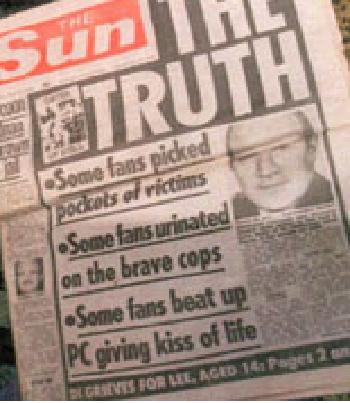

The Truth? They were outright lies and smears, entirely without basis. Quite the contrary, while many policemen, as has been revealed in statements released later, stood around bewildered, dazed, unable to comprehend what was happening, the fans dragged those that they could to safety, turned advertising hoardings into makeshift stretchers and did all they could to save and revive then dying, while the official effort was woefully inadequate.

The Sun is still the biggest selling daily newspaper in UK, shamefully. Though it barely sells a copy on Merseyside. It has tried to apologise, but until it carries a front page saying 'We Lied', which is what Liverpool manager Kenny Dalglish (currently enjoying a second stint as boss) counselled when the paper tried to rectify it's mistake and save its plummeting sales and asked for his advice, few people in Liverpool will listen.

Thankfully, the editor of The Sun, the man who was directly responsible for the headline and presentation of that Sun splash, Kelvin McKenzie, has been subsequently cast into the journalistic wilderness for his catastrophic error of judgement, living in ignominy, a pariah because of his stubborn unwillingness to admit to his error and concede his story was a malicious concoction which did the arse-covering bidding of the establishment by switching blame in the popular mind from those who were actually responsible to those who weren't.

McKenzie
Except he isn't. To the eternal shame of the journalistic industry - and it makes me sick each time I think of it - McKenzie, a reprehensible man in every way, is still held in high regard. He has never apologized for his front page smears. Instead, he still cleaves to the proven lie that it was ticketless fans who caused the disaster. For this he has been rewarded with a column in a national newspaper, where he spews his witless, hateful right wing each week, and as a hired right-wing rentagob on our TV screens, a tabloid apologist - despite being the one man who has done most to sully the tabloid ethos. His regular presence on our screens, across our airwaves, and in our newspapers is an outrage given his lack of contrition. Yet among many hacks, many, to their eternal discredit, at the BBC, where he pops up most, like an unflushed turd, there is an 'It's just Kelvin' attitude which ignores the enormous hurt he caused, and his presence still causes, and treats him as some loveable rogue rather than a loathsome bully and a proven liar.

The debate on Monday encouraged the Government to release all documents in its possession - minutes of cabinet and other meetings for example - to help those campaigning for the real 'truth' to understand what was done to cover up the details of the disaster and exonerate those who were to blame. It won't, as some believe, reveal why the disaster happened. We already know why it happened and what caused it. But hopefully the documents, to be shown first to the families, will shed more light on the events that killed their loved ones, and help erase the dangerous myths that many still cling to. The Government did not oppose the debate and the documents will be released in full. It is a huge step forward.

But it's only a step. In his speech (and here's a link to the transcript) Rotheram called McKenzie 'despicable' and a group of MPs have tabled a motion asking him to be forced to come before a select committee and explain his disastrous front page, reveal its sources (though we know- it was the police and a Tory MP) and try and justify his preening indifference to those he has hurt and apologise unreservedly for the distress he has caused. That would be another significant step.

Then, ultimately, with the myths vanquished and ignorance defeated, the families will be able to launch successful criminal proceedings against those responsible and get the closure they desire and so palpably deserve.

Justice for the 96.

http://www.hfdinfo.com

Dan - Friday


Thursday, October 20, 2011

I could have been speaking Portuguese!

Bartolomeu Dias
South Africa is a member of the British Commonwealth, along with 53 other nations, surprisingly including two that have had no historical ties to Britain, namely Mozambique and Rwanda.  Before Whites settled, South Africa was inhabited by the KhoiSan and Black tribes (mainly in the north and east).  In 1652, Jan van Riebeeck settled at what is now Cape Town to establish a vegetable garden to supply the ships of the Dutch East India Company en route to the East for spices.
But it could have been different.

It could quite easily become Portuguese and a cousin to Brazil.I've always been surprised that it didn't.
In 1488, Bartolomeu Dias was the first known European to round the Cape - he called it Cabo das Tormentas.  King John II of Portugal later renamed it Cabo da Boa Esperança - Cape of Good Hope.
In 1497 Vasco da Gama also rounded the Cape and established that the route could be used to gain access to the spice producers of the East.  Until this time Venice had monopolized the spice trade through a combination of sea and overland through the Middle East.  This discovery led to a massive Portuguese influence in the East.

Dias routs around the Cape
It is unclear why the Portuguese did not establish a settlement at the Cape - the harbours were good and the climate excellent.  They established settlements in what is now Mozambique in 1505, on the Island of Mozambique among other places.  And it was only in 1575 that they created at settlement at Luanda in what is now Angola.  But they left the southern tip of Africa alone.

Vasco da Gama
One argument of why this happened is because of what happened to another famous Portuguese explorer and colonist - Francisco de Almeida.  In 1503 he was appointed Viceroy of India and left Portugal two years later with an impressive fleet.  He subdued most of the east coast of Africa, including Zanzibar, then accomplished the same in eastern and southern India.  By early 1509, the Portuguese had control over the area, with the Ottomans and Egyptians returning home.  This gave the Portuguese a monopoly over the spice trade for over 100 years.


Francesca de Almeida
In December 1509, De Almeida set sale for Portugal and stopped in Table Bay at the Cape for water and replenishment.  After some friendly trade with the local Khoi, De Almeida allowed some of his men to go to the Khoi encampment to steal cattle.  While this was happening, De Almeida and other men looked on.  Unfortunately at the same time the ships were moved to a point where they could get fresh water.  The Khoi sensed that the Portuguese had no way to return to the boats and attacked.  Eventually 64 seamen were killed including De Almeida.  He was buried at the Cape.

A carrack as used by De Almeida
After this slaughter, Portuguese seamen had a very negative attitude towards the Cape, this possibly being the reason why no further efforts were made to use the Cape as a refreshment station.  Nothing of importance happened at the Cape for nearly 150 years, when the Dutch established their gardens under Van Riebeeck.

And so, if it were not for De Almeida's stupid decision to allow his men to stea cattle, I would be writing this in Portuguese.

Tim-tim


Stan - Quinta-feira

Wednesday, October 19, 2011

Frankfurt Book Fair

The Frankfurt book fair is the biggest book exposition in the world, attracting 7500 exhibitors from over 110 countries. It is open for five days, during the first three only those from the industry attend but on the last two that always land on a weekend it is open to the general public.

The publishers, agents and others attending for business are running around to attend meetings and it is not uncommon to hear of people with 80 appointments in their agenda over the three business days. International publishing rights and various things contractual are agreed and shaken on.

For the author the book fair is a both an impressive yet harrowing experience. You get the feeling that the book will live, in some form at least and that the book industry is standing quite strong despite the miserable economy most countries now face. But you also feel pretty small as the titles on display outnumber the stars in the sky. In addition, the authors’ part in the book fair takes second or third place to the wheeling and the dealing and they are for most part in the way of the ongoing commercial matters that need to be concluded.

At the opening of the book fair the head of the German publishing association made a speech that in most part regarded e-books. Turns out that in Germany they have a political movement called the Pirate party that fights for the abolishment of copyright, something of great worry to the German publishers, quite understandibly. In the last municipal elections this party won just over 8% of the votes in Berlin and they are expected to do quite well come the federal elections. This is not the only country with a Pirate party I am told, these have also to managed to win seats in various elections elsewhere, namely in Sweden, Switzerland, Czech Republic and in Spain. In 2009 the Pirate party had the third most members of all political parties in Sweden although I am not sure how popular they are in the other countries mentioned.

To be fair, the pirate parties have other things on their agenda than abolishing copyrights but as the name implies this is one of their main selling points.

There is a generation or two out there now that is used to getting a lot for free that used to cost money – namely news, information and entertainment, available in abundance for free on the internet. I really don’t know how this works really, i.e. do the advertisements on the news media pages really pay enough to keep this rolling or is it being paid for in most part by subscribers to the paper edition?

And one thing of interest, how is it that google is worth so much when all it does is send you to pages that others set up mostly for free? Should google pay these per entrance off their search engine?

So that is it for now. Aside from being in Frankfurt for the book fair I have also been at the Manchester Literature festival which was very nice. The hotel I stayed in was next door to a convention center which was holding a hairdressers’ convention so the hotel was full of hairdressers and beauticians. Now, I have been to crime writers conventions and engineering conventions, the participants of which do not hold a candle to the happy hairdressers. There was less oxygen in the air within the hotel than perfume.

Yrsa - Wednesday

Tuesday, October 18, 2011

In France it's complicated


"They killed our cook, threw her body down the well and stuck her head on the fence post." This was uttered by my friends mother years ago as we sat at the wooden table over a long lunch with her family in the French countryside. "The Algerians took our house, my father's factory. We escaped." My friend's mother was a Pied Noir, a French national who lived in Algeria all her life until the Algerian Revolution. Her story never left her - she loved Algeria where she'd been born but hated the FLN the rebel nationalists. And in France when you talk about Algeria it's complicated.
Yesterday marked the 50th anniversary of the Algerian Massacre when Paris police ignored the values of liberté, egalité, fraternité and slaughtered up to 200 peaceful protesters in cold blood around iconic national monuments, including the Eiffel Tower and Notre Dame Cathedral. On the evening of 17 October 1961, at the height of the Franco-Algerian war, tens of thousands of Algerian protesters, including women and children, from around Paris gathered at various landmarks to demonstrate against what they considered a "racist and discriminatory" curfew imposed against them.
The mobilisation had been organised by the Paris wing of the Algerian National Liberation Front (FLN), an organisation that was fighting for Algeria's independence from France and had been accused of carrying out attacks on Paris police that left a dozen dead.It was intended to be a peaceful demonstration, but Maurice Papon, the Paris police chief, ordered his officers to stamp out the protests. As the Algerians gathered, the police acted swiftly and brutally, firing on protesters and arresting an estimated 11,500 who were herded on to buses and taken to makeshift detention centres where many claimed they were beaten and held for days without food. Claims that officers had beaten protesters and dumped them into the Seine appeared to be confirmed when bodies were washed up on the banks of the river.

Papon was awarded the Légion d'Honneur by President Charles de Gaulle the same year as the Algerian killings, and went on to hold a number of senior official posts.In 1981 details emerged of his part in the deportation between 1942 and 1944 of 1,690 Jews from Bordeaux, where he was secretary of police, , but it was not until 1998 that he was convicted of crimes against humanity and stripped of his decorations and titles.
The Algerian war, which started in 1954, ended in Algeria's independence from France in 1962.
The most memorable – and vicious – atrocities saw policemen herding panicking crowds on to Paris's bridges, where many were tossed into the Seine. Normally a romantic symbol of the most popular tourist city in the world, the river became a watery morgue for scores of victims, whose lifeless bodies were washing up for weeks afterwards.
Others died in police stations, or in nearby woods, where their mutilated bodies testified to truncheon and rifle-butt injuries. The officers had been incensed by an illegal protest by 30,000 men, women and children organised by the National Liberation Front (FLN) – the main Algerian nationalist group in their country's war of independence with France.
Fifty years will seem like a long time to many of the young French Algerians who mark the anniversary today, but in many ways it seems very recent. Maurice Papon, the Paris police chief who instigated the killings, only died four years ago, aged 96; and some of his unrepentant and unpunished henchmen still remain at large.
Like Papon, many of the killers had been Nazi collaborators who learned their crowd control methods from the Gestapo. They were experts at disinformation too: the official death toll after Papon's self-proclaimed "Battle of Paris" was initially three, before being revised to a vague "several dozen" almost 40 years later.No judicial inquiry ever took place, with many French still blaming Algerian in-fighting and terrorist attacks for the deaths. Papon was finally brought to justice for crimes against humanity – but only for those he committed during the second world war. President Charles de Gaulle, and then successive governments, ensured he was never indicted for what he did to the French Algerians of Paris.

Most now live in the blighted housing estates which dot the outskirts of the capital. These banlieues grew out of the immigrant worker shanty towns which became recruiting grounds for the FLN in the 50s and 60s. Police felt they could control "insurgents" better on the estates, and they are still overflowing with young people from north Africa.As during the nationalist war, French Algerians are still encouraged to stay out of tourist Paris. Curfews are regularly imposed on the estates, with armoured vehicles filled with paramilitaries moving in during disturbances. When particularly heavy rioting broke out in 2005, the then interior minister, Nicolas Sarkozy, imposed a state of emergency. Like the curfews, it was based on Algerian war legislation from 1955.
Up to 40% of young French Algerians from the estates are currently unemployed. Without money or prospects, some have turned to crime, helping to swell a prison population estimated to be up to 70% Muslim. Many resemble the angst-ridden, alienated young Algerians who took to the streets in 1961. They are the grand-children of these victims
Yesterday François Hollande, the Socialist Presidential candidate remembered and threw a rose in the Seine. I don't know what my friend's mother was remembering.
.
Cara- Tuesday

Monday, October 17, 2011

Guest Author James R. Benn


Leighton here.
I very much enjoy reading books about WWII, both fiction and non-fiction.
And Jim Benn's novels have become great favorites of mine.


He just published A Mortal Terror, his sixth in the Billy Boyle series.
And like all of his others, I highly recommend it.
Here's Jim:


Armed Services Editions

The Second World War produced many fundamental societal changes in addition to the world-wide destruction. The war signaled the end of empires, the beginning of women in the workplace on a large scale basis, and brought the United States to the center of the world stage. It also caused advancements in medicine and technology that far outstripped what had been thought achievable during the Great Depression scant years before.
One great change that is not widely understood is near and dear to those of us who write for a living: reading. World War II changed the reading habits of a generation, and that generation went home after the war with powerful notion that having books close at hand was a good idea. Paperbacks, especially.
Paperback editions were a relatively new idea when the war broke out. Penguin Books was launched in Great Britain in 1935, followed by Pocket Books in the U.S. in 1939. While many thought the wartime rationing of paper would send the publishing industry into a tailspin, the opposite was true. Publishers geared up paperback printing on cheap paper, fueling the demand for a quick, inexpensive escape from factory shifts, the boredom of troop transports, and other wartime activities. Travel restrictions meant more people at home, and paperbacks were good company.
Publishers began to encourage readers to share their paperbacks with servicemen once they were done. The American Library Association and the Red Cross organized book donations, distributing books to military installations in the U.S. via their Victory Book Campaign.  This effort was overwhelmed by the demand and logistical problems. Books were not a standard size, and often the titles donated were cast-offs of little interest.
In 1942, the Council on Books in Wartime was formed. It was a non-profit organization of publishers, booksellers, librarians and authors dedicated to the idea of “books as weapons in the war of ideas”.


The Council got to work quickly, deciding to print the books in a standard “pocket” size on pulp magazine presses.  On average, the books cost six cents to produce, and were given free to troops overseas and in stateside hospitals.  It was the greatest free giveaway of books in history. Patriotic publishers took reduced profits and split the penny per book royalty with the author. It was a worthwhile investment.


“They were extremely popular. I always had two or three in my pack in addition to the volume I was reading. They were a god send,” a World War II veteran of the European Theater of Operations recently told me. By the end of the war, 123 million Armed Services Editions were in circulation, with 1,322 titles represented. They were everywhere, at field hospitals, on troop transports, replacement depots, USO centers, on giant aircraft carriers and invasion landing craft. One G.I., reading Candide on board a vessel bound for the Normandy beaches, said “These little books are a great thing. They take you away.”


There were classics like Moby Dick, westerns by Max Brand, and mysteries by Agatha Christie and other popular authors.


Six short years after the first paperback was published in the United States, what was thought of as an experiment had become a established fact. Paperbacks were here to stay, and hundreds of thousands of young men whom might never have otherwise read a book to completion were hooked on the reading habit.  Long hours of inactivity and travel caused many to turn to the Armed Services Editions, which were so popular that a reader often would tear the binding in half so a pal could start it while he finished.


While the reading tastes of servicemen and women closely mirrored the reading public back home, there were some favorites. Any title that hinted at raciness—The Lively Lady, or The Star Spangled Virgin—were greatly in demand, although bound to disappoint the sex-starved G.I.  Perhaps the most popular title was the best-selling A Tree Grows in Brooklyn, which was the first ASE title to be published in a second edition. Author Betty Smith received hundreds of letters from servicemen who thanked her for reminding them of what waited for them at home, and showed what they were fighting for.


Some scholars conjecture that the resurgence of interest in the work of F. Scott Fitzgerald in the late 1940s was due in no small part to the ASE print runs of his titles.  Veterans returning home and attending college under the G.I. Bill brought with them an awareness of literature they would not have had without the ASE program.
The seed of reading had been planted. The book had been transformed from being thought of as an expensive hardcover that would sit on the shelf, to a mass-produced media that could be carried anywhere, shared with friends, talked about, even ripped in half. The generation that grew up in the Depression and could often not afford hardcovers now reveled in access to reading material. Books had become ubiquitous. It was a massive cultural shift, and publishers and authors continue to reap the benefits today.
The Armed Services Editions are one of the many questions about World War II I never thought to ask my father when he was alive (picture below).  But I do recall him often sitting at the kitchen table, a cup of coffee at his elbow, reading a book. Histories and mysteries were his favorites. Now I have to wonder, did Sergeant Harold J. Benn pick up the reading habit in uniform, carrying dog-eared ASE paperbacks in his pack?  I’d like to think so.


Sunday, October 16, 2011

Picture This


This is Saturn, with the Sun directly behind it, illuminating the rings -- a perspective never before seen by human eyes.  The photo was taken a few months back by the astonishingly successful Cassini probe.  Today I'm abandoning all pretext of conforming to the theme of this blog; this isn't about murder or crime-writing, or even Thailand.  It is, I suppose, about everywhere.

One of the gifts of the online world that I hear praised least often is the continual flow of beautiful images it brings us, with just the slightest amount of effort on our part.  There's Saturn, up there.  Here's beauty on a much smaller scale, the world of earthly insects. . .

. . . or an extravagantly camouflaged seahorse. (These are all worth clicking on, to see them bigger.)

Everyone's seen tigers, and everyone's seen water, but have you ever seen this before?

Oh, you have not.  And if you have, what about this?

One of the thing the Internet has done for us is to create a sort of global Aladdin's cave for beauty and creativity of every kind.  The world is jammed full of talented people.  Su Blackwell lives in England and makes sculptures from books.  Here's the Mad Hatter's tea party from (and made from) Alice in Wonderland.

 Work by a woman in Russia who calls herself Valeria, and who takes photographs in the tradition of Old Masters still-life paintings . . .

. . . and an Australian painter named Jeremy Geddes, who brings Old Master techniques to modern, dreamlike images, such as "Perfect Vacuum."  (Note that the window is breaking inward.)

Oh, this could go on forever.  Let's just finish with some star circles, one of the miracles of time-lapse still photography.  The star that's "holding still" in the center is the North Star.
If you come across anything beautiful send it to me, okay?

Saturday, October 15, 2011

Oh Lord, Won't You Buy Me a Big-Screen TV...


And a HD-3D-Internet one at that.  I feel so guilty. 

All these years I’ve hummed that classic Janis Joplin’s melody as a sort of subconscious sub rosa protest at what I saw as obsessive, conspicuous consumption all about me.  Of course I’m not including in that the absolute necessity for my having a top of the line new MacBook Air to hammer out words, because one should always have access to a portable computer capable of countering Iranian launch codes or engaging galactic evil in warfare to save our planet. Sorry, that example is a bit redundant.
 
But I have an admission to make.  This week in NYC, I took the plunge and bought a new TV (make that two).  It’s been almost fifteen years since I purchased my last one.  And I couldn’t tell you the make of that old TV if you water-boarded me to a loop of The Absolutely Positively Real Wives of Orange County.  

All I know is that when I described what I had been calling my TV to a salesman at one of those big appliance stores he called it an “Annie Log,” or something like that.  Then he said I didn’t have a flat, which I didn’t take as all that perceptive since I don’t even own a car here. 

Considering my propensity for mating with appliances for well beyond their useful lives, I decided it probably best that I learn a bit more about the available field before taking the big step.  So, I turned to the good book for guidance.

No, not the one so many American political groups are battling to claim as their own personal publication; the other one, Consumer Reports.  When I am in need it delivers me.  Or rather tells me who will deliver what I need. 

Since the next time I buy a TV (or two) there’s a good chance Heaven Can Wait will be available for viewing on the original Cloud Network, I decided to opt for one(s) with cutting edge features.  I figured that should keep me relatively current with technology for at least a month, maybe two.

But where to buy it?  Thank God for my zillion megahertz portable computer.  It whizzed me across the Internet to a virtual purchasers’ heaven.  Deals were everywhere.  So guess where I bought it (and its little brother)?  From the American bricks and mortar retailers’ number one nemesis, Amazon.  That place has extraordinary prices on everything, including massages and out-on-the-town nights (delivered separately I presume). 

Okay, so maybe the rest of the planet already knew that, but what do you expect from someone who’s been living under a rock on a Greek island all these years?  Let’s show a little compassion, imagine how I suffered for my ignorance.  Forced to find massages and party nights on my own, think of all the Greek television I missed.  Those innumerable soccer games, C-grade movie reruns, screaming matches by uninformed political commentators, and Turkish-based soap operas showing what life is all about in the minds of their producers. 

Now, thanks to Amazon, I’ll not only have a new TV (plus one) but the time to watch American Football, insightful cable TV news programs, classic films, and serialized sagas based on life in foreign places (See, ­Id., Orange County).  Who needs Greek television, we’ve got it all here!

There is a caveat to this Amazon love fest.  If you order a really big TV (or two) and are not equipped or proficient enough to install it yourself, the cost of hiring someone to do it for you may chew up whatever you saved over that bricks and mortar, installation included, price.  I’m only saying that to alert you, not to suggest that I would have made such a stupid miscalculation (twice).

Now, if you’ll excuse me, I must figure out how to program my remote(s).  Hmm, any six-year-olds out there available to lend me a hand with that?

Jeff—Saturday