Showing posts with label university of the Witwatersrand. Show all posts

Thursday, May 11, 2017

Breaking news - 250,000 years old

Michael - Thursday

On Tuesday we met Neo, which is the Sesotho word for a gift. Neo is a new addition to the Homo naledi family that made big news about eighteen months ago, when a team led by University of the Witwatersrand professor Lee Burger announced the discovery of a new member of our genus at a cave in the Cradle of Humankind complex near Johannesburg. That made a very big stir at the time and led to a feature article in National Geographic which supports the work. My blog about the details of the find and how it came about can be read HERE.

Neo's remarkably complete skull. Photo John Hawks.
Neo is a remarkable individual. Most of his skeleton remains and can be reconstructed. And his skull is almost complete which will allow experts to recreate his face quite accurately. And there's another important fact about him, but we'll come to that later.

Lee Burger at
the announcement
Photo The Citizen
Murder is Everywhere is motivated by mysteries, and the original discovery left us with plenty of those. In the first place, the specimens found in the Dinaledi chamber of the Rising Star complex of caves had a strange combination of features from both Homo and Australopithecus. The skull is really small—the brain was about the size of an orange—yet adult individuals were comparatively large at around five feet and a hundred pounds. The hands share many of the features of our own, yet the fingers curl and the shoulders slope which is more characteristic of the Australopithecines who were probably tree climbers. The feet are quite similar to ours and the legs are long, suggesting that naledi walked and ran in a similar way to us, and spent much time on the ground. This intriguing combination of features of the two genera led to excited speculation that naledi might be the bridge between them. That would imply an age of something like two and a half million years.

Then there was the mystery of how the fossils had accumulated in the Dinaledi cave in the first place. There was no sign of them being transported by water, carried by animals, or that the cave had ever been open from above. And the cave is very hard to get to - on one occasion Lee Burger spent an hour trying to get out of it and had to be dragged up from above by his arms. Also this was not an isolated individual but a number of individuals of various ages. Was it possible that they brought their dead to this cave for burial? There has never been any evidence that any species but ours does that. It was a controversial theory. In particular, the apparently ancient morphology of naledi made that implausible. And after all, it was possible that the structure of the cave systems had changed markedly over the millennia.

The two cave structures. Diagram Marina Elliot
The announcement on Tuesday where Neo was introduced to his admiring relatives, albeit distant in time as well as genetics, solved the first mystery, and Neo gave a big push towards solving the second. The remains of Homo naledi are around a quarter of a million years old—about a tenth of the age originally suspected. No less than six different techniques were applied over the last eighteen months and gave consistent results. The sedimentary rocks that formed the caves are recent and since they didn't form around the fossils, that gives an upper age. And direct dating of several fossil teeth using the Uranium-Thorium technique confirmed that the age must be between 230 and 330 thousand years old.

The fact that the species is so modern, makes the burial theory much more plausible. But there is still another factor. Neo is from a different cave from the one originally discovered more than a hundred yards away. And that cave, too, contains several individuals of different ages including one young child. Some random natural process concentrating a number of skeletons in one cave was unlikely, doing it twice is almost impossible.

Comparison of a sapiens and a naledi skull of roughly the same age

Two hundred and fifty thousand years ago is like yesterday for a paleontologist. It means that when Neo walked the earth he had neighbors. Us. Amazingly it seems that (at least) two species of Homo lived in southern Africa at the same time. Even more intriguing, this is the time period where 'modern' behavior like burial and self-adornment and the making of complex tools developed with Home sapiens. So, indeed, it is quite possible that naledi learned to dispose of their dead in a ritual way from us.

Or did we learn it from them?

____________________________________________

Murder Is Everywhere
Author Recognitions and Events


ANNAMARIA ALFIERI

Thursday May 25, 6PM
Orinda Books
Orinda, California.

Wednesday May 31
Janet Rudolph Literary Salon:
"The History of Hot Places: Clashes between Colonialism and Local Cultures”
Joint appearance with Michael Cooper


CARA BLACK

Murder in Saint Germain, Aimée Leduc’s next investigation, comes out June 6, 2017.

MICHAEL STANLEY

Dying to Live (Kubu #6) to be released in May in UK & South Africa and in October in USA

May 17
18:00 – 20:00
Orenda Road Show (Stanley)
Waterstones Picadilly (London)

May 19-21   
Franschhoek Literary Festival (Michael).

Saturday May 20        
Panel 11:30 – 12:30:
One Voice, Two Authors with Alex Latimer and Diane Awerbuck

Sunday May 21
Panel 11:30 – 12:30:
The Author as Chemist with Joanne Harris and Ekow Duker

May 18-21   
Crimefest in Bristol UK (Stanley)

Thursday, May 18
Panel 14:40 - 15:30:
What Are You Hiding? - The Dark Side Of Human Nature 

Friday, May 19
Panel 12:30 - 13:20
Panel: Power Corrupts - Who Can You Turn To?

June 13
South African launch of Dying to Live 18:00
Love Books, Melville, Johannesburg

Thursday, October 27, 2016

Whither South African Universities

Michael - Thursday

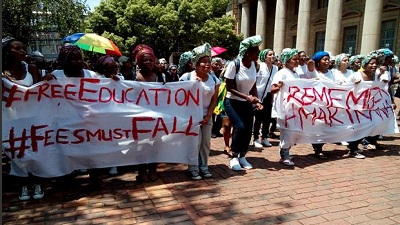
Protest at the University of Cape Town
The last months have seen a concerted push by students around the country in the Fees Must Fall campaign. Initiated at the end of last year in response to the large fee increases proposed by the universities, it was successful in getting the government to agree to fund part of the increase and the universities to eat the shortfall. Somewhere along the line, the demand changed from no increases, to reducing fees, and finally to free tertiary education.

Protest at the University of the Witwaterstand
I’ve been a staff member in one form or another at the University of the Witwatersrand in Johannesburg for 44 years, so I have a lot of myself invested in the institution and its future is of real concern to me. It has transformed dramatically over those years from a largely segregated institution where 90% of the students and almost all the staff were white, to a university three times the size with a multiracial and multinational staff body and a student body whose racial makeup pretty well reflects that of the surrounding Gauteng province that it serves. It also hosts many international students, mainly from Africa. It does stronger research and has better students and courses than it did in the eighties.

The current scenes of police all over the campus supporting private security personnel and massive student protests remind some people of the demonstrations against the apartheid government in the eighties. But the comparison is wrong for a variety of reasons of which the most important is that then the university and the students were on the same side. Although the university has tried to align itself with the students by declaring that it’s in favor of “free, quality, decolonialized higher education”, the students are too savvy to fall for that. If that’s so, they say, then join our protest. Close your doors until the government agrees to exactly that. Our university has refused to do so—90% of staff and 75% of students want to finish the academic year and write the final exams.

Small groups of students (and others) break up classes, damage property, set fires and throw stones. I have to say that I’m disgusted by much of the violent protest. Sometimes it consists of bullying—often targeting on female staff and students. Fire extinguishers have been used to break up classes. A cleaner subsequently died from the fumes. Firecrackers of the most explosive type are hurled into classes. A student of one of my colleagues was burned in three places on her leg. Buses and cars have been vandalized and destroyed. This week a fire was started on a bus transporting 15 students. Thankfully, it was spotted, the bus stopped, and the students evacuated; they could all have died. That isn’t robust protest, it’s nothing short of terrorism.

And what is the government doing while all this is going on? The president too has urged the students that he hears them, that he’s on their side, that their aim of free higher education is just and reasonable and one the government supports. So there's no need for violence, no need for protest aimed at wrecking the academic year. Another stakeholder trying to get on the right side of the students by supporting what he has no intention of delivering. (He has other things on his mind.)

Protest at Parliament
How “just and reasonable” are the student’s demands? Free higher education is almost certainly unaffordable in South Africa which is beset by needs from poverty, healthcare, primary education, through to crushing unemployment, to say nothing of the president’s new mansion. But fees have increased rapidly ahead of inflation, and bursaries are inadequate for the total of fees, living, and other costs. Furthermore, sometimes students are denied bursaries on the grounds that their family income is too high. Yet that calculation takes into account the income of siblings who may have their own financial stresses and have no obligation and no intention of supporting a brother or sister at university. The administration of the national loan scheme is hopeless, with students sometimes being excluded because their loan payments are delayed. Banks also loan students money but they want it back! (People in the US are well aware of how that may play out.) The students don’t need platitudes, the system is broken and they need it fixed.

Also there is another aspect. When asked at his recent book launch to comment on the student unrest, Athol Williams, a self-made man by any standard, said that it reflected a deep disillusion of South Africa's youth who feel failed by the new South Africa. That goes way beyond the issue of fees. 

It’s the universities that will be the meat in this sandwich, being squeezed between student demands and government priorities and ineptitude. Research will decline, good staff will go elsewhere. Well-healed students will take themselves off to private universities as they have with private secondary schools already. Take the ‘h’ out of the first word of this blog's title.

Still, violent student protests have occurred throughout the world. Sometimes things are achieved, sometimes not. Yet the universities have survived. I hope.

Thursday, August 18, 2016

Wither the Universities?

Michael - Thursday

From time to time I’m asked by people I meet how things are going with South African universities. Have standards fallen? They know that I’m still a part-time professor at Johannesburg’s University of the Witwatersrand (Wits). I don’t want to speculate about what motivates these worries, but recent student protests and wrangling with the government have certainly brought them to the fore, and I hear these concerns from black acquaintances as well as white ones. My answer is that as far as my subject area is concerned (mathematical sciences), I feel standards have risen, research is stronger than ever, and graduate students are as good as before and there are far more of them. Whatever failings we’ve seen in government primary and secondary education in this country (and there are many), the government has been supportive of quality tertiary education and research, especially in the science, technology, and health areas.

This week a report came out from one of the organizations that rates universities worldwide and tracks established universities' relative positions in the top 500 in the world from a research perspective. Only 34 countries made the 500 cut and, although all these types of ratings can be criticized on a variety of fronts, if we accept their criteria and look only at relative position over time, the situation for South African universities is encouraging. 
University of the Witwatersrand
Shanghai university ratings
The graph shows the relative position of my university over the last 13 years. Starting in 2003 just making the cut, and then being in the 300-400 position range (not terrible in view of the number of institutions worldwide and the quality and funding of many of them), we have now moved to the top university in Africa at 203. This seems to indicate either that Wits has improved as a research university or that many others have weakened. I believe both are true. What’s more a further four South African universities also made it onto the list.

Minister of Education
Blade Nzimande
So does this indicate that all is well? Hardly. The universities here are currently facing what may well be the biggest threat since the previous government segregated them by race and thus subsequently largely isolated them from the rest of the world. The current threat comes from an unlikely quarter. Our own students. And they have a lot of arguments on their side that will not be alien to people in the US and many other countries.

Fees Must Fall protest at Wits
Last year’s student demonstrations were sparked by an ill-considered announcement before the end of year examinations of fee increases ranging between 9% and 11%. This in an environment where inflation was running at around 6%. Of course the local currency was weak and many academic requirements – books, journals, equipment - were escalating at very much higher rates. This sparked the Fees Must Fall campaign that led to mass student protests, some not so peaceful. Last year I wrote about it here. The protests escalated to government level (where they really belong) and the solution was a zero fee increase for 2016. The government promised to fill the revenue gap. It filled part of it.

A year has passed. The government is talking about an inflation-related increase, too little for the universities. The students want free tertiary education for all who qualify academically. The left wing EFF (which became king-maker in the elections of a week ago - see Stan’s post here) has cheerfully adopted a policy of free quality education at all levels. They know they won't have to fund it. Students have already closed two university campuses for several days, and have threatened to close them all for a year if necessary to achieve their demands.

Jonathan Jansen, Vice Chancellor at the University of the Orange Free State, points out in an article in the Herald Live - Demise of Universities Near - that there are three choices: Free education and the government foots the bill. This is pretty well universally accepted as unaffordable in terms of South Africa’s economy and priorities. Or a well thought out plan that allows all qualifying students to attend university, but involves payment either now (if they can afford it) or later in some reasonable way. (Yes, we have heard of the student loan trap in the US, for example.) The third option is that we stagger from year to year with zero fee increases and the government supplying more of the budget, but with the cake shrinking over time.  Another zero fee increase this year will see some universities closing programs and retrenching staff. As Jansen puts it: “What happens in the next week or two can determine whether your children and grandchildren will have respectable universities to go to in the future, or any university at all.” And he goes further: “When a country loses its universities, it loses self-respect.”

Really, it’s the people of South Africa who must decide what they want in terms of tertiary education. The sad thing is that the public seems uninterested, content to see it as an issue to be sorted out between the students, the universities, and the government. As for Jansen himself, he's heading for Stanford. 

Watch that graph turn sharply downward over the next few years.

Thursday, October 22, 2015

Student Protests

Michael - Thursday


Wits students protesting the fee hikes this week
This week has seen an eruption of student unrest in South Africa that has led to student injuries, tear gassings and arrests.  Roads were blocked and cars overturned.  Staff have been threatened.  Students have clashed with police leading to tear gassings, student injuries, and arrests.
Blocking roads
This was quite normal in the late eighties and early nineties when the student protests were directed at the apartheid government and usually had the implicit support of academics.  Often they led to violent responses by the police.  At least at Wits University no one was shot, although many students were injured in various ways.
Protest at Wits
With the change of government, there was a period of calm.  But structural problems remain and they are no longer just black and white.  Now the issue is more focused on the haves and the have-nots.  The struggle now is more a class struggle and it is no longer directed at the government; now it is directed at the universities themselves.  Wits University has been closed for the whole of this week.

The first rumblings of what the students described as a plan to decolonize the universities arose over monuments that seemed unconnected with South Africa’s apartheid past.  They are, but they are not unconnected with South Africa’s colonial past that was just as unsavory.  The United Party governments that preceded the hated National Party government were pretty well as racist as their successors, they just didn’t institutionalize it in the same way.  Young people in South Africa are now looking at both the present and the past.  They point to the disproportionate number of white academics and the universities’ elitist approach.  They are highly dissatisfied with the performance of the current government in terms of jobs, service delivery, restitution of land, and uplifting the poor.  They are not wrong.  These are hard problems and take time, but seeing government ministers and many others – black and white – enjoying super-luxurious living doesn’t sit well.  

Demand to move the Rhodes statue
Looking back to colonial times they demanded to know why a statue of Cecil John Rhodes graced the University of Cape Town.  Yes, he gave the university land and money, but, they ask, who did he steal those from in the first place?  That’s a fair question.

Not only students had turds for Rhodes!
And fall it did...
After much soul searching and gnashing of teeth, the statue has been moved elsewhere.  Many English speaking South Africans are scandalized.  Many white Afrikaans speaking South Africans are no doubt delighted at the demise of the British imperialist, while they shake their heads at the antics of the students that included flinging dog turds at the statue. 

The flashpoint this week was the decision by universities around the country to increase tuition fees next year by over 11%.  Inflation is supposed to be around half that, but that doesn’t really describe the increase in university expenses in a meaningful way.  Many research costs are based in foreign currency (equipment, books, conferences) and the rand has weakened 20% over the year.

At a rushed meeting at the end of last week it was decided by the universities in consultation with the minister that the fee increases will be capped at 6%.  As far as I can discover, no one has explained how the extra 5% is going to be made up.  (I did receive a memo today indicating that tea and coffee would no longer be supplied in the common room; that should go quite a way to help!)

The students were not impressed.  Their response was that they could not afford any increase, in fact they demanded that tertiary education should be free. The demonstrations moved to parliament house where the finance minister was giving a downbeat assessment of the economy and the budget for next year.  Twenty-three students were arrested.

Protest in Cape Town
The students believe that their predecessors brought down the apartheid government by these tactics.  The ANC government and the universities better not treat this lightly.

Thursday, September 17, 2015

A New Man – The mystery of Homo naledi

Artists reconstruction of Homo naledi from the skeletons found
Last week, University of the Witwatersrand anthropologist Lee Berger announced the discovery of a new species of hominid – Homo naledi.  It followed his remarkable discovery of Australopithecus sediba some years before, but this discovery is widely regarded as still more significant and surprising.

A selection of the remains

Naledi – a star in the Sesotho language – is an extraordinary creature, somehow mixing features of Australopithecus and Homo.  The skull is really small—the brain was about the size of an orange—yet adult individuals were comparatively large at around 5 feet and 100 pounds. The hands share many of the features of our own, yet the fingers curl and the shoulders slope which is more characteristic of the Australopithecines who were probably tree climbers.  The feet are quite similar to ours and the legs are long, suggesting that naledi walked and ran in a similar way to us, and spent much time on the ground.  If you would like to read a much more in depth account, Homo naledi makes the cover of National Geographic next month and you can preview the article HERE.

So then is naledi claimed as the so-called ‘missing link’ between Australopithecus and Homo?  Is South Africa—indeed Johannesburg!—truly the ‘cradle of humankind’?  The answer is no, or at least not yet.  The missing piece of information is age.  So far no one has been able to determine the age of the fossils from the Cave of Stars.  And the age options for naledi are truly fascinating.

Researchers at the Dinaledi cave
If nadeli is more than 3 million years old, then Australopithecus was just a side bar; Homo had evolved from something else already. Naledi would probably be our ancestor. Yet the similarities of certain features to each genus suggest rather an age of between two and two and a half million years and then naledi could indeed be the link between the two genera. And if naledi is younger still—less than a million years, say—then there were at least two very different species of Homo living in Africa at the same time.

The discovery of the fossils was made about two years ago almost by accident at a cave near the Cradle of Humankind some 30 miles north west of Johannesburg.  Two amateur speleologists were exploring a popular cave system and one came upon a hidden tunnel dropping steeply downward. The two of them were looking for something new and exciting, and decided to take on this chimney.  At the bottom they found a treasure trove of fossil hominid remains.

Lee Berger and his new friend
I said the discovery was almost by accident, but Professor Berger had gone to a lot of trouble to get the word out to keep an eye open for interesting fossils in the area, and that made the link.  The two cavers brought him their news and pictures, sparking off the discovery of the largest collection of hominid fossils ever found in Africa. Realizing he had to act quickly, Berger assembled a team of volunteers who were brave enough and slender enough to get into the chamber.  He called them his cave astronauts and all of them are women. Already more than 1500 individual fossils have been collected and come from at least fifteen different individuals of various ages.  Also amazing is that the fossils are almost exclusively human, apart from a few birds and rodent-like creatures.  This is not a cave full of victims of some predator; the bones are unmarked by teeth. And there is no sign of a river washing the fossils into the cave as then there would be an appropriate mix of other materials.  No, these creatures are alone in the dark.  How did that happen?
Watch Lee Burger giving a fascinating summary HERE.

The Dinaledi 'astronauts'
For all the excitement about a new man, the most fascinating part of the whole story is that naledi apparently disposed of its dead; indeed the Dinaledi cave seems to be a graveyard.  Until now there has been no suggestion that any species other than Homo sapiens took pains to remove the bodies of the dead from the natural environment, certainly not by following a difficult route into a hidden chamber to leave them there.  But the scientists have considered every other reasonable possibility and rejected it by careful argument.

“When you have eliminated the impossible,” Sherlock Holmes once observed to Watson, “whatever remains, however improbable, must be the truth.”  Professor Berger rather charmingly misquoted this at the press announcement as “When you have eliminated all the probable, you are left with the impossible.”  Various people have vehemently agreed with that judgement!  On the one hand, some scientists have rejected his conclusions and insisted that there must be other explanations, while at the other extreme the whole scenario is rejected by creationists with one even describing the discovery as a white racist plot designed to keep black people at a subhuman status. (How this argument could possibly be made is beyond me; indeed the Wits Vice Chancellor, Professor Habib, pointed out at the press announcement that the implications of all humans arising from a common ancestor emphasises our similarities not our differences.)

But in the scientific community there seems to be no disagreement that we have just met an ancient member of our genus, never before even suspected.  And the mystery of when they walked the earth remains.


Michael - Thursday

Thursday, September 6, 2012

The night I danced with Bobby Kennedy


When I was a student in the 1960s at the University of the Witwatersrand (known as Wits) in Johannesburg, I became involved with the anti-apartheid movement.  For all my life from when I entered high school, I could never quite understand two aspects of South African life.  The first was how people could justify treating people of different colours so differently from themselves.  Apartheid applied mainly to Blacks, but also to an ever-increasing extent, to South Africans who had Indian, Chinese, or Malayan heritage, as well as to people who were of mixed blood (called Coloureds, in South Africa).

The second puzzlement was how the Whites could expect the current situation to remain in place.  It didn’t take a rocket scientist to figure out that suppressing 75% of the population and restricting the rights of another 10-15% was not a viable long-term strategy.  Yet most Whites either believed that it was or found it inconvenient or uncomfortable to wonder about it.
My family, in a conservative sort of way, was always against the Nationalist government, and for the most part, against apartheid too.  My mother was a member of one anti-apartheid group – the Torch Commando – and worked for the Progressive Party in our constituency, helping to send Helen Suzman to parliament many times.  My aunt, Jean Sinclair, founded a woman’s group – the Black Sash – that proved to be a thorn in the government’s side both or its consistent opposition to any law that discriminated and its steadfast provision of advice and support to those hurt by apartheid.

But it was the education system that really first caught my attention.  It made no sense to me that any government could, as a matter of policy, deny access to decent education to anyone, let alone the majority of the country.  So when I went to university, I joined the National Union of South African Students (NUSAS) and started to become involved in an effort to change things. 
Apartheid supporters - probably Special Branch police. Left sign reads "Send NUSAS leader and hangers-on to jail". The other reads "Keep your land clean, South Africa, from NUSAS and Communists".
In between playing cricket, rugby, and field hockey, I protested, marched, and wrote.  I edited the newspaper of the Johannesburg College of Education, called Campus, where I tried to draw the attention of future white teachers to what was happening in the education system in the country.  But, in reality, I probably had little impact on anyone.

However, there was one benefit to being editor.  I received invitations to events and, as I was also one of the photographers, I had the ability to wander around.  

It was one such invitation that led me to dance with a star.
Invitation signed by Bobby and Ethel Kennedy
In 1966, the president of NUSAS, Ian Robertson, invited Bobby Kennedy to visit South Africa to energize the opposition to apartheid.  I suspect it was to everyone’s surprise that he accepted.  I also suspect that the government was pressured by the USA to allow him to come.
Kennedy made five major speeches in his brief visit to South Africa.  The first, at the Day of Affirmation at the University of Cape Town on June 6, 1966, is regarded as one of the best speeches he ever made.  I attended his last speech on June 8, 1966, at Wits University.  It was the most political speech of his visit, probably because it was his last.  My invitation put me in the front row.  Although I do not have the article I wrote, I do still have some photographs I took.  The prints are worn and I can’t currently find my negatives to reprint them.
After the speech, there was a party at the home of Clive and Irene Menell.  Both were very active in the fight against apartheid.  Clive was a founder of the Urban Foundation in 1977, an organization created to improve the lot of black South Africans in Soweto and other urban areas.  

Despite government restrictions that made multiracial gatherings very difficult (for example, it was illegal to serve alcohol at multiracial gatherings), the after-party was mixed.  The atmosphere was electric – the enthusiasm that Kennedy’s presence and speeches had unleashed was incredible.  So what did we do?  We couldn’t drink, so we danced – not couples, but groups, lines, circles.  And Bobby and Ethel Kennedy danced with us.  And it was absolutely amazing.  For a moment we were free.
At the after-party
1966 is a long time ago.  But I remember Kennedy’s speech at Wits, and I remember vividly the emotions that flowed during the after-party dancing.  I’ll remember them for the rest of my life.

You can read or listen to Kennedy’s South African speeches at http://rfksafilm.org/html/speeches/speechrfk.php.

Stan - Thursday

Thursday, November 24, 2011

Murder is Everywhen

I was intrigued this week to see a newspaper headline poster announcing: ‘120,000 year old crime mystery’.  While the police have a lot of dormant cases here (and everywhere else, I expect), this seemed to be excessive.  Once home I hastily searched the internet for the crime (it’s too retro to actually buy a copy of the newspaper) but came up with nothing.  It was at my university that I discovered the real story.

Fossil skull showing healed fracture (from the paper)

The University of the Witwatersrand has a first rate hominid research unit.  Most of the work revolves around the Australopithecus hominids discovered in an area not far from Johannesburg.  (A recent important find was described in http://murderiseverywhere.blogspot.com/2010/04/sediba-natural-spring.html )

But interest isn’t exclusive to southern African hominids, and Prof. Lynne Schepartz from the School of Anatomical Sciences has been involved in a ‘forensic’ investigation of the 120,000 year old ‘crime’ which took place in what is now Maba in China.   What they discovered was a hominid skull exhibiting a healed fracture.  (So it was attempted murder at best.)  The nature of the fracture suggested that the skull’s owner had been kyboshed with a blunt object leaving him with a severe head injury which nevertheless healed.  The interesting issue is whether this was an accident or deliberate.  From careful CT scan analysis and comparison with modern cranial injuries, the scientists decided that it was likely that the person had been attacked.  The article appeared this week in the Proceedings of the National Academy of Sciences:
http://www.pnas.org/search?fulltext=maba&submit=yes

Detail from CT scan (from the paper)
 
Why is that interesting?  After all, most animal species fight over territory, mating, or even if in a bad mood. Usually animals don’t kill each other, but it certainly happens.  I suppose if we think of murder as the result of fighting outside the accepted cultural norms, then it becomes more of a human thing, although there will be examples from other species also.  The main difference here from animal attacks is that a weapon was used and that supposes at least some degree of premeditation.

Caveman by Tayyar Ozkan
So what was the cause of the dispute?  Of course there's no way of telling 120,000 years on, but probably it was pretty much the same as one of the reasons we have today.  Jealousy, greed, anger, madness.  Maybe this wasn’t an isolated attack, maybe it was a group battle.  Then, of course, it falls into the culturally acceptable category, mores the pity.

In any case the victim was lucky to survive.  And that is one of the most interesting aspects of the study.  It's likely that the victim would not have lived unless he received support and care from his group over a period of some time.  He may have suffered amnesia, and certainly he was in no shape to go hunting.  So the violence cloud has a silver lining.

But if this was premeditated interpersonal violence as the authors suggest, then it goes back a long way in our family tree.  Personal violence isn't any sort of phase we’re going through.  If murder-mystery writers go out of business, it will be because no one is reading their books and not because murder is a thing of the past.  Murder really is everywhen.

Michael - Thursday