Showing posts with label signal hill. Show all posts

Thursday, January 13, 2022

Is there light at the end of the tunnel?

Stanley - Thursday

Like everyone I know, I'm sick and tired of the pandemic, the trauma it's brought to so many families, and the idiocy it has encouraged to surface. So I decided to push back and show how life is going on near the source of the damned omicron variant - Cape Town. My blog for today was going to be about one iconic Cape Town tourist attraction, namely paragliding from Signal Hill over the houses and apartment buildings of Sea Point onto the beautiful Esplanade along Table Bay.

I was up at 0600, then, coffee cup in hand, headed to the launch point high above the Sea Point buildings.  A beautiful day: 20C (about 70F), barely a cloud in the sky, and a gorgeous drive below the striking Lion's Head mountain that soars over 650 metres (2100 feet) above the city. A perfect day for the adventure of a lifetime - not that I was going to parasail, rather I was going to watch others do it and relish the fact that life was returning to normal.

The drive from my flat to the launch point

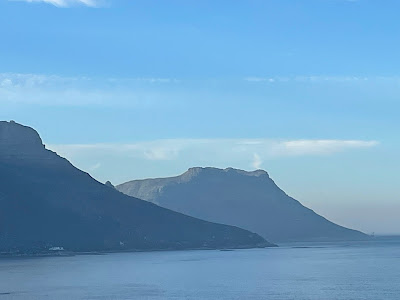
Three of the Twelve Apostles, which line up behind Table Mountain

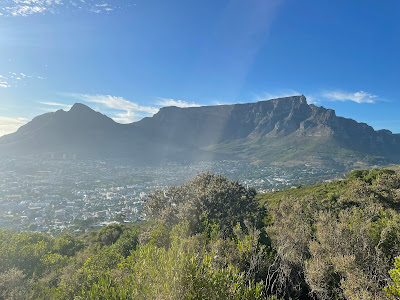
At the top of the Kloof Road forest, I popped into the sun with Table Mountain looming nearly 1100 metres (3600 feet) in front of me.

Table Mountain with Devil's Peak to the left.

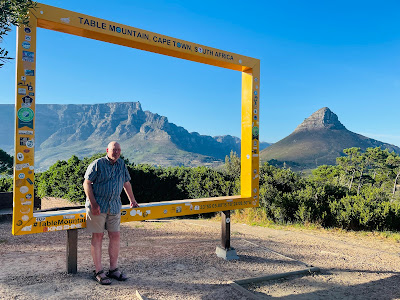
I continued driving below Lion's Head until I reached the launch point. Spectacular views!

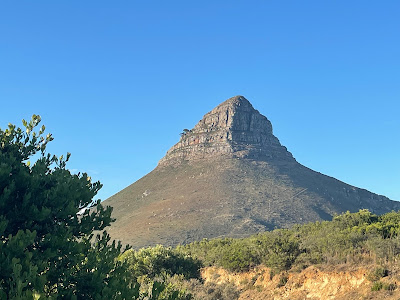
Lion's Head


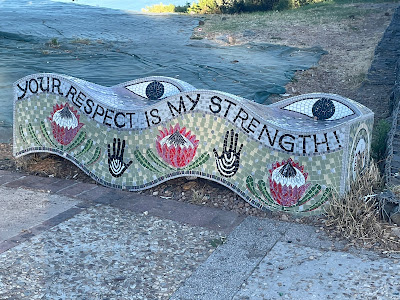
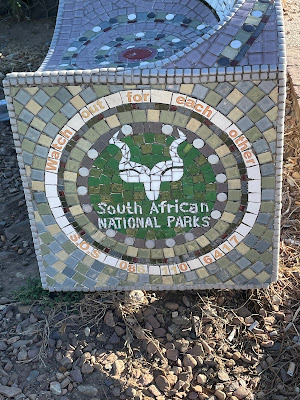
Table Mountain National Park motto


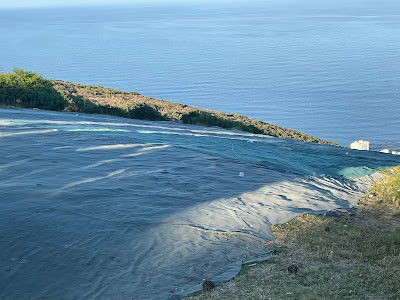
I wandered over to the launching area, a specially-prepared permanent runway for paragliders.


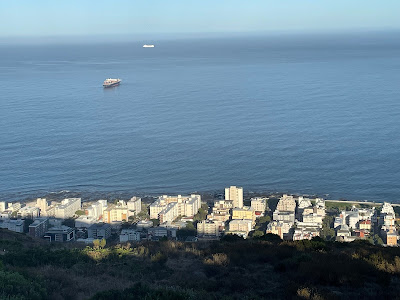
The rather daunting view down. Gliders fly over these buildings and land on that thin strip of grass on the other side. Wet if you go too far; not good if you land short.


I was ready! 

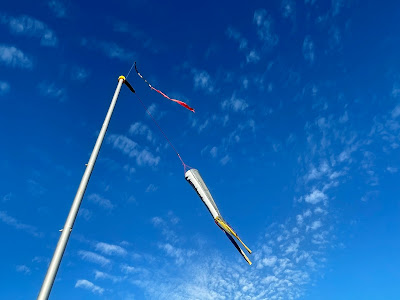
However, I was surprised that there were only a few glider operators sitting under the trees, with a few anxious first-timers nervously chatting to each other. Then I looked up and saw the windsock.


The wind was from the wrong direction - southwest instead of west or northwest. That meant there was a tailwind, which makes it impossible to lift the wing before take-off. No wonder everyone was sitting down. Waiting for the wind to shift. 

After an hour and a half, I decided it was time to leave. So I did and went for a walk in the beautiful Greenpoint Park with its banks of blue agapanthus plants.


So, I will return to the launch point to chronicle the famous Cape Town paragliding when the wind is favourable. Meantime I'll enjoy seeing life slowly returning to some semblance of normality.

Thursday, February 9, 2017

A rare tradition - 1200 BANG


Traditions in a young country like South Africa are generally relative few and far between, except for ones that have been imported, such as having traditional Christmas meals, despite the heat, surrounded by little fir trees appropriately decorated and sprayed with artificial snow.  And we don't have groundhogs.

However, there is a tradition in Cape Town that has been going for over 200 years.

The tradition is the firing of a cannon on Signal Hill at precisely noon every day except Sundays and public holidays.

The noon cannon fires.
Prior to the take-over of the Cape by the British in 1806 after possibly the shortest war in history (see my blog Short battle – Long Impact), the firing of cannons in Cape Town signaled the arrival of ships requiring provisioning.  This allowed farmers living relatively far from and out of sight of Table Bay to know when to bring their produce to the docks.

As other means of communication evolved, this form disappeared.  The provisioning cannons fired their last blasts in early 1900s.

Cannons were also used from 1806 to allow ships’ captains to determine the time accurately – an important component of being able to determine longitude.  The cannons used were originally Dutch 18-pounder, smooth-bore muzzle-loaders protecting the Castle in Cape Town.  When the British took over, they replaced the Dutch cannons with more modern British one, and relegated them to being signal cannons.

Every day a cannon would be fired at exactly noon.  Because the speed of sound is relatively slow, captains measured the time, not by the when they heard the cannon (several seconds later), but by when they saw the puff of smoke.  Originally the cannons were near the centre of Cape Town, but were eventually moved to the top of a nearby hill because it was easier to see the smoke.  The hill to which they were moved is now called Signal Hill.

The navy is responsible for preparing the cannon for firing.

The red flag BRAVO being raised to warn of impending gunfire
Since 1864, the Noon Gun has been fired from the master clock of the oldest timekeeper in South Africa, the South African Astronomical Observatory.  As far as I can find out, there have only been two times when the cannons misbehaved.  One day in June 1895, the gun fired at 1030 rather than 1200 when a spider interfered with the relay used to remotely fire the gun.  The cannon was refired at noon.

And on Friday January 7, 2005, both the main gun and backup gun failed to fire, owing to a technical difficulty.  This was the first time in 200 years that the noon cannon failed to fire.

The main and back-up cannons.
Despite tens of thousands of firings, there have been very few mishaps.  The one I like the best happened during the time of horse-drawn traffic, over a hundred years ago.  When the cannon was being loaded, the rammer used to tamp the charge into the muzzle was accidently left in the barrel.  When the cannon was fired, the rammer sailed into the downtown area of Cape Town killing a horse.

I play golf just below Signal Hill.  It is always a pleasure to hear the bang at noon.

However the best way of enjoying the Noon Gun is to go to the Lions Battery on Signal Hill, half an hour before noon.  You can enjoy the magnificent views of Cape Town and Table Bay and listen to a brief history of the tradition given by a naval personnel.

View from Lion's Battery on Signal Hill
Talking of bangs, if you follow Signal Hill’s twitter account (@Signal_Hill_Gun), your twitter account will get a BANG every day at noon, Cape Town time!

Thursday, January 23, 2014

Table Mountain's tablecloth

Table Mountain in Cape Town is one of the world’s most recognised and iconic mountains.  Rising 1000 metres (3500 feet) out of the Atlantic Ocean, with a 3-kilometre (1,8 mile) flat top, it overlooks Table Bay (in which Robben Island is situated).  One of the surprising aspects of the mountain is that it faces north.  Most people unfamiliar with the area believe, since it is nearly at the southern tip of Africa, that it faces south.

Looking at Table Mountain from the bay, on the right there is Signal Hill (where at noon every day a cannon fires to signal the time) and Lions Head, so named because from some angles it looks like a male lion crouching.  On the left is Devil’s Peak, higher than Lion’s Head, but not as high as Table Mountain.

Painting of Table Mountain by William Hodges (1772) from about Captain Cook's Ship HMS Resolution

Table Mountain from Bloubergstrand (Blue Mountain Beach)


Running back from Table Mountain to Cape Point and the Cape of Good Hope is a range of mountains known as the Twelve Apostles rising steeply out of the sea.

Despite its very rocky disposition, the Table Mountain area is home to over 2200 plant species, more than that of the United Kingdom.  The National Botanical Garden, Kirstenbosch, lies on the side of Table Mountain, and is one of my favourite parts of the city.

One of the amazing things about Table Mountain is that one minute it can be standing proudly with clear blue sky above it, and the next minute a layer of cloud can pour over the top, giving the impression of a dynamic tablecloth. 

New York Times photo of its 2014 #1 travel destination with the tablecloth spilling over the mountain

The tablecloth from the Victoria and Albert waterfront


The whole process is pretty spectacular to watch.

The tablecloth is beautiful, but can be very dangerous to unwary hikers on the mountain, because it can become so dense that it is very difficult to find one’s way back to the cable-car station.

A weatherman will tell you that the tablecloth is formed when a south-easterly wind blows up against the mountain, lifting moist air abruptly, cooling it rapidly, causing condensation.  When these orographic clouds (as they are called) reach the edge of the mountain on the other side, they descend and warm up, and the cloud disappears.

The San peoples who inhabited the area long before any Europeans or Blacks arrived called Table Mountain Camissa – the place of sweet water – and attributed the tablecloth to their mantis god smothering a fire with a kaross, which is any animal hide, usually a sheep’s, with its hair left on.

This is certainly an appealing explanation, and I can see a San family clustered around a fire, listening to grandpa telling the story of why the cloud appears and disappears.

But neither the weatherman’s nor the San’s stories are correct.  The real story is as follows.

In the 18th Century, during the time of the Dutch East India Company’s tenure in what is now Cape Town, there was a fierce pirate in the area – at least he thought he was fierce.  His name was Van Hunks.  Everyday, when he wasn’t pirating, he would walk up the hill to the east of Table Mountain, called Windberg (Wind Mountain).  He had a favourite tree, very ancient and gnarled, under which he would pull out his pipe and smoke, gazing over beautiful Table Bay and, presumably, planning his next dastardly attack on Cape Town’s upper class.

Van Hunks


He was a proud man and boasted that he could out-smoke anyone.  No one took up the challenge.

Until one day, when he arrived at his usual spot, there was a man, dressed all in black, hat pulled down over his face, sitting where he always sat.  I can only assume that Van Hunks was a little miffed.  And even more so when the stranger challenged him to a smoking contest, goading Van Hunks with taunts.

Of course, Van Hunks took the challenge.  

They divided the tobacco into two large piles and sat down to smoke.  They smoked, and they smoked.  And they smoked some more.  For hours and hours, covering Table Mountain with white fumes.

Eventually the man in black, frustrated that Van Hunks was still going strong, wiped his brow in frustration and accidentally knocked off his hat, revealing a pair of horns.  Poof!  He vanished in a puff of sulphuric smoke.  Van Hunks was the winner.

And that is why the mountain that was once called Windberg is now called Devil’s Peak.

And every time the southeaster blows, the devil returns for a rematch, once again causing the mountain to be covered in a white cloud.  The devil never wins, but keeps coming back for more.

[As an aside, for those of you who haven’t read any of Deon Meyer’s books, I heartily recommend Devil’s Peak and its wonderful, love-him, hate-him protagonist, Bennie Griessel.]


Stan - Thursday