Showing posts with label father's day. Show all posts

Saturday, June 14, 2025

Zoë Sharp Returns for Father's Day

Saturday–Jeff

Tomorrow is Father's Day, and in an effort to honor fathers everywhere, I've taken it upon myself to rerun a Father's Day homage put together some years back by our beloved blogmate, the incredible Zoë Sharp. In it she explains the origins of the holiday and then proceeds to describe the non-fiction books she'd purchased as gifts for her father.  It's an incredible collection of irresistible topics still as relevant and intriguing today as when Zoë first gifted them to her Dad. But don't take my word for it.  Here's Zoë's post, titled back then as "Father's Day, A Stack of Ideas."


Today is Father’s Day, something that originated in the United States in the early years of the last century. It seems that two women independently came up with the idea. One was Grace Golden Clayton, in Fairmont, West Virginia, who suggested such a day in 1908, to honour 361 men killed in a mine explosion. In Spokane, Washington, on June 19thtwo years later, a woman called Sonora Smart Dodd celebrated her father, a Civil War veteran called William Smart, who had raised six children after his wife died in childbirth. Ms Dodd felt that it was time fathers were as equally acclaimed as mothers.

William Jackson Smart, in whose honour the first Father's Day was held
Lobbying for the third Sunday in June to be made a national holiday started up almost immediately, and in 1924 President Calvin Coolidge recommended such action was taken. However, it wasn’t until Lyndon B Johnson signed an executive order in 1966 that the date was designated, and not until 1972, under Nixon, that the date was officially recognised.

Father’s Day has since been taken up around the world, although the date varies enormously, with Iran using March 14th, and Thailand December 5th.

Although the holiday has now become incredibly commercialised, I confess to always trying hard to find suitable gifts for my father, and what better pressie than books? I know in Iceland there is such a precedent at Christmas, where they have the Jólabókaflóð which means the Christmas book flood. The idea is that you gift books on Christmas Eve, and the remainder of the night is spent reading.


Well, I think I may have caused a minor book flood at my parents’ house during this last week, as my Father’s Day selections arrived. My father, having no sense of occasion, didn’t even wait until Saturday night before he began tucking in.

A man reading. ( Not my father.)
He’s not easy to buy books for, as he’s not really a reader of fiction, preferring interesting non-fiction instead.

Getting recommendations for just the right kind of books is always tricky. He likes biographies, providing they have a scientific or medical slant. He does not follow any sport except Formula One, and comments that in recent years this once hair-raising spectacle has become somewhat processional

The Monaco Grand Prix just wasn't the same after
the introduction of the new safety regulations...

For Father’s Day this year, the first one I found for him was Radical Technologies: The Design of Everyday Life by Adam Greenfield. ‘Everywhere we turn, a startling new device promises to transfigure our lives. But at what cost? In this urgent and revelatory excavation of our Information Age, leading technology thinker Adam Greenfield forces us to reconsider our relationship with the networked objects, services and spaces that define us. It is time to reevaluate the Silicon Valley consensus determining the future. Having successfully colonised everyday life, radical technologies—from smartphones, blockchain, augmented-reality interfaces and virtual assistants to 3D printing, autonomous delivery drones and self-driving cars—are now conditioning the choices available to us in the years to come. How do they work? What challenges do they present to us, as individuals and societies? Who benefits from their adoption? In answering these questions, Greenfield's timely guide clarifies the scale and nature of the crisis we now confront—and offers ways to reclaim our stake in the future.’

The second one was The Infinite Monkey Cage—How to Build a Universe by Prof Brian Cox, Robin Ince, and Alexandra Feacham. ‘Professor Brian Cox and Robin Ince muse on multifaceted subjects involved in building a universe, with pearls of wisdom from leading scientists and comedians peppered throughout. Covering billions of concepts and conundrums, they tackle everything from the Big Bang to parallel universes, fierce creatures to extra-terrestrial life, brain science to artificial intelligence. How to Build a Universe is an illuminating and inspirational celebration of science—sometimes silly, sometimes astounding and very occasionally facetious.’


Next up was The Science of Everyday Life: Why Teapots Dribble, Toast Burns and Light Bulbs Shine by Marty Jopson. ‘Have you ever wondered why ice floats, how the GPS on your mobile phone works (and what it has to do with Einstein), or why woollen jumpers shrink in the wash? In this fascinating scientific tour of household objects, The One Show's resident scientist Marty Jopson explains the answers to all of these, and many more, baffling questions about the chemistry and physics of the stuff we use every day.  Always entertaining and with no special prior scientific knowledge required, this is the perfect book for anyone curious about the science that surrounds us.’


And finally, Do No Harm: Stories of Life, Death and Brain Surgery by Henry Marsh. ‘What is it like to be a brain surgeon? How does it feel to hold someone's life in your hands, to cut through the stuff that creates thought, feeling and reason? How do you live with the consequences when it all goes wrong? Do No Harmoffers an unforgettable insight into the highs and lows of a life dedicated to operating on the human brain, in all its exquisite complexity. With astonishing candour and compassion, Henry Marsh reveals the exhilarating drama of surgery, the chaos and confusion of a busy modern hospital, and above all the need for hope when faced with life's most agonising decisions.’


In a similar vein, I recently sent him a copy of Accidental Medical Discoveries: How Tenacity and Pure Dumb Luck Changed the World by Robert W Winters. ‘Many of the world’s most important and life-saving devices and techniques were often discovered purely by accident. Serendipity, timing, and luck played a part in the discovery of unintentional cures and breakthroughs: A plastic shard in an RAF pilot’s eye leads to the use of plastic for the implantable lens. The inability to remove a titanium chamber from rabbit’s bone leads to dental implants. Viagra was discovered by a group of chemists, working in the lab to find a new drug to alleviate the pain of angina pectoris. A stretch of five weeks of unusually warm weather in 1928 played a role in assisting Dr. Alexander Fleming in his analysis of bacterial growth and the discovery of penicillin. After studying the effects of the venom injected by the bite of a deadly pit viper snake, chemists developed a ground-breaking drug that works to control blood pressure. Accidental Medical Discoveries is an entertaining and enlightening look at the creation of 25 medical inventions that have changed the world—unintentionally. The book is presented in a lively and engaging way, and will appeal to a wide variety of readers, from history buffs to trivia fanatics to those in the medical profession.’

Earlier still, on the recommendation of FaceBook friends, I got him Cod: A Biography of the Fish That Changed the World, by Mark Kurlansky. ‘The Cod. Wars have been fought over it, revolutions have been triggered by it, national diets have been based on it, economies and livelihoods have depended on it. To the millions it has sustained, it has been a treasure more precious that gold. This book spans 1,000 years and four continents. From the Vikings to Clarence Birdseye, Mark Kurlansky introduces the explorers, merchants, writers, chefs and fisherman, whose lives have been interwoven with this prolific fish. He chronicles the cod wars of the 16th and 20th centuries. He blends in recipes and lore from the Middle Ages to the present. In a story that brings world history and human passions into captivating focus, he shows how the most profitable fish in history is today faced with extinction.’

Another such recommendation was The Moth: This Is a True Story by Catherine Burns and The Moth Group, with an introduction by Neil Gaiman. ‘Before television and radio, before penny paperbacks and mass literacy, people would gather on porches, on the steps outside their homes, and tell stories. The storytellers knew their craft and bewitched listeners would sit and listen long into the night as moths flitted around overhead. The Moth is a non-profit group that is trying to recapture this lost art, helping storytellers—old hands and novices alike—hone their stories before playing to packed crowds at sold-out live events. The very best of these stories are collected here: whether it's Bill Clinton's hell-raising press secretary or a leading geneticist with a family secret; a doctor whisked away by nuns to Mother Teresa's bedside or a film director saving her father's Chinatown store from money-grabbing developers; the Sultan of Brunei's concubine or a friend of Hemingway's who accidentally talks himself into a role as a substitute bullfighter, these eccentric, pitch-perfect stories—all, amazingly, true—range from the poignant to the downright hilarious.’

And lastly, Elephant Company: The Inspiring Story of an Unlikely Hero and the Animals Who Helped Him Save Lives in World War II, by Vicki Croke. ‘Billy Williams came to colonial Burma in 1920, fresh from service in World War I, to a job as a "forest man" for a British teak company. Mesmerized by the intelligence, character, and even humor of the great animals who hauled logs through the remote jungles, he became a gifted "elephant wallah." Increasingly skilled at treating their illnesses and injuries, he also championed more humane treatment for them, even establishing an elephant "school" and "hospital." In return, he said, the elephants made him a better man. The friendship of one magnificent tusker in particular, Bandoola, would be revelatory. In Elephant CompanyVicki Constantine Croke chronicles Williams's growing love for elephants as the animals provide him lessons in courage, trust, and gratitude. But Elephant Company is also a tale of war and daring. When Imperial Japanese forces invaded Burma in 1942, Williams joined the elite Force 136, the British dirty tricks department, operating behind enemy lines. His war elephants would carry supplies, build bridges, and transport the sick and elderly over treacherous mountain terrain. Now well versed in the ways of the jungle, an older, wiser Williams even added to his stable by smuggling more elephants out of Japanese-held territory. As the occupying authorities put a price on his head, Williams and his elephants faced his most perilous test. In a Hollywood-worthy climax, Elephant Company, cornered by the enemy, attempted a desperate escape: a risky trek over the mountainous border to India, with a bedraggled group of refugees in tow. Elephant Bill's exploits would earn him top military honors and the praise of famed Field Marshal Sir William Slim.’

So, what are the non-fiction book you’d recommend for those with an inquiring mind? What was the last terrific non-fiction book you read? And what did you find that was suitable for your patriarchal parent this Father's Day?

Another man reading. (Also not my father.)
This week’s Word of the Weekis hermeneutic, meaning interpretive, thought to be a Latinised form of the Greek hermeneutikos, of or for interpreting, from hermeneutes, interpreter, and hermeneuein, to interpret (usually languages) into words, or to give utterance to.

Thanks, Zoë.
––Jeff

Thursday, October 31, 2024

The Boy from Shopton

 Wendall -- every other Thursday

Last week was the 5th anniversary of my father's death, so I thought I would re-post this tribute to him. Miss you, always, Grady.

Until four years ago, Father’s Day was one of my favorite days of the year. My late dad, Grady Thomas, never really liked a fuss, but on Father’s Day, as far as I was concerned, he just had to put up with it. 


My dad, the audiologist, monitoring me, which he never did in life.
 

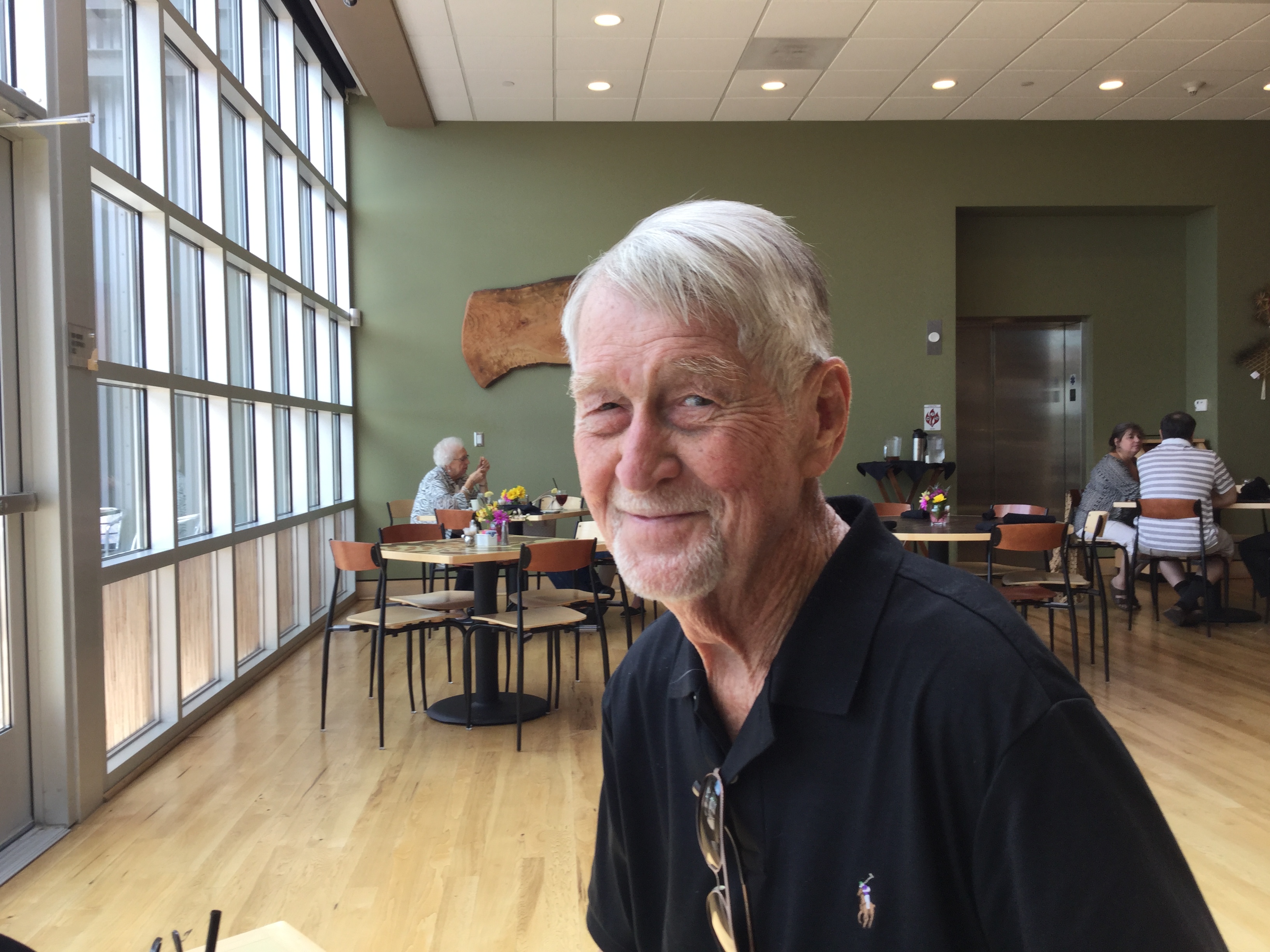
I didn’t get to spend as many of those holidays with him as I wish I had, but I’ll always be grateful I was able to take him out to lunch on Father’s Day the year before he passed away, when these pictures were taken. 


Father's Day lunch


Now, the day is bittersweet. I miss his advice, I miss his wit, I miss the smell of Sir Walter Raleigh pipe smoke curling through every room in the house. 


This is the look I got when I mentioned one of my hare-brained schemes.
 

My Dad was a natural athlete and a great singer. He was even part of a traveling quartet called the “Gospeleers.” He loved liver and onions. And thunderstorms. 


High school football. But baseball was really his game.
 

One of my most vivid memories is sitting on his lap on our screened in porch and hearing the suck of his pipe between claps of thunder. He was never without his pipe, even in his last days, where he snuck out of his medical facility so he could smoke in the parking lot with my brother and sister.


Dad with pipe, 1960s

Dad with pipe, 2019

I keep one of those pipes on my desk and wear the silver bracelets engraved with Lost Luggage and Drowned Under he and my step-mother gave me when I published my first two books. 


You'll never find me at a reading without these

In many ways, I take after him. I have his squinty eyes, his passion for music, movies, and driving, his need for regular bouts of solitude, and a penchant for “pantsing,” in work and in life.


Off to rent Sargent York or Patton, AGAIN
 

One of the last conversations I ever had with him was about fate and opportunity. He grew up the youngest of six on a farm outside Charlotte, N.C., with no running water or electricity, but complete with an outhouse (as a child, he was famous for locking neighbors in and making them sing to get out...). He told me that the whole trajectory of his life, which he thought he would spend as a minor league baseball player or a mechanic, came down to his willingness to veer off course and say yes to random opportunities. 


This is a kid who would lock someone in an outhouse

I loved how he—the scientist that he was—saw the patterns of the last eighty years which had led him from that outhouse not only to the first college degree in his family, but to a PhD.


As kids, we don’t always know about our parents’ accomplishments. And Dad was never one to brag about what he was doing. I don’t think I appreciated the full picture until I was well into my forties. Among other things, he was the first clinical audiologist in the state of North Carolina and became the Head of the Speech and Hearing Department at the UNC Medical Center. He was Chairman of the Medical Advisory Council for OSHA, and his expertise on  the vestibular system led to frequent work with NASA investigating causes of space sickness. He worked in diving medicine as well, and is listed in Who’s Who in American Science.


I did know, however, that he was a generous, hilarious, tolerant, and kind man, and that’s what I remember, more than any accolades.  


Always cracking me up

He was great at the “Dad” stuff. He sat by my bed when I was sick, taught me to ride a bike and to drive, bought me my first transistor radio and my first album—The Monkees’ Pisces, Aquarius, Capricorn, and Jones, Ltd. But more than that, he always encouraged me to be independent and to do what I loved. When I decided I wanted to play the guitar, he got me my first inexpensive one, then told me he’d pay for half of the serious, Guild G-37 I really wanted, if I worked for the rest. After I did three hundred hours of babysitting (!), he kept that promise. 


Only a great dad would involve himself in this nonsense
 

And when I got my first paying gig at 15, at a pizza joint that served beer, my mother said I was going to hell. Dad came and ran the soundboard. He was like that for my whole life, no matter what I got up to.


Before he died, I’d encouraged him to write down at least some of his experiences growing up and, although it is unfinished, the few pages of his memoir, The Boy from Shopton, are precious to me and say a lot about him, and a lot about my grandparents as well. There were a few things I didn’t know, like this.


For a while, his nickname was "Flash"
 

“In order to get the job at the A&P, I had to have a Social Security Card. I went to the Records Dept. in Charlotte to get a copy of my birth certificate, but they could not find it. They had a Richard Grady Thomas with the correct parents and birthday, but no William Grady Thomas. As I have indicated earlier, I was born at home. My mother gave our family doctor, Dr. Richard Querry, the name she wanted on the birth certificate. Dr. Querry told my mother that he was going to name this boy after himself. Of course, mother thought he was kidding, but for the first twelve years of my life I was Richard Grady Thomas. It was terribly expensive to have my birth certificate changed, a whopping 50 cents.”


And this story says so much:


“In March of my sophomore year in high school I turned 16 years of age. My brother-in-law, Hudie Moser, took me to the Driver's License Bureau and I got my driver's license on my birthday. That evening I took the family car out to visit some friends. Neither my mother nor my father asked where I was going or when I would be back. I knew to stay out of trouble and when to return home. As indicated previously, my mother and father tended to teach by example instead of threats.”


Last time I saw my Dad, still cracking me up
 

My Dad was the same. He trusted us to follow his example, and that has made all the difference. Families are complicated and these kinds of holidays can bring up feelings we might not welcome or that we stuff down most of the year. Thankfully for me, I’m happy to remember Grady anytime. 


--Wendall

Tuesday, June 18, 2024

Memories and Musing Paths Not Taken

It was Father's Day last Sunday--that's my excuse to post this ancient photo of me with my (late) dad and mum.


I remember telling my dad when I was nine or ten years old that I wanted to be a writer.

Why?

Because the girls in my class used to ask me to tell them stories at recess.
I remember one about the loud, angry woman who had a pastry shop down the hill from Mount Sophia where our school was.
In my story, her (delicious) 50 cent curry pies were made with the tongues of dogs and cats, and her $1 pies were made with the tongues of children--that's why she never talked to primary school students like us, because she wanted to preserve young tongues for her special pies.
But (and I still like this twist) our Principal secretly went to talk to her and Loud Angry Aunty agreed that she would only cook the tongues of students from our school who lied to her.

After the squeals and giggles came the dilemma: what if Loud Angry Aunty caught you eating one of her plain curry pies and asked 'how is it?' and it had no taste (because no tongue); do you tell the truth and make her angry or do you lie to her and let her Cut Out Your Tongue?

FYI that last question was delivered At someone and when that Someone started to cry I knew the story 'worked'.
(Sorry, H!)

I thought telling stories would be a good way to earn a living, but somehow my father wasn't equally convinced,

'You'll become a doctor' he said.

This photo is evidence I tried Med School for a while. Here I'm with some course mates in front of a Rubber Plantation upcountry, on a break in Malaysia.


And yes, I'm thinking of setting the next book in a rubber plantation. How does 'The Rubber Tree Mystery' sound?

It was Jeff's last birthday post that made me think about paths not taken. Dropping out of Medicine felt like the right thing for me then and now. The only time I've wondered was when first my mother then my father got sick and I wondered if I might possibly have made a difference if I'd taken a different path...

But of the twelve of us (including the photographer) in front of the plantation a lifetime ago, four died before reaching their 60's--despite access to the best (presumably) Medical care Singapore has to offer.

I doubt I could have made a difference to them or to my parents. And I've had a wonderful time on my chosen path so far, even / especially the sections I would label 'Adventures' (Thank you for the definition, Patti!) .

Another of those friends is now a neighbour and, since a stroke made it difficult for him to, I get to walk his dog sometimes,


This furry sweetheart brings me so much joy!

And so does this slightly less cuddly one I spotted last week...

I love mudskippers for their adaptability and for how they hop, skip and climb mangrove trees. They're literally 'fish out of water' but seem perfectly comfortable adapting to their environments!
If I had a spirit animal, it would be the mudskipper!

And now, like the mudskipper, I have to decide whether to go for a long walk on land or go out on the water today--it's not raining but there are definitely some clouds not too far out--


Or I could just stay here reading and writing--which seems to be where I end up, no matter which path I choose to start out on!

Between life and death there is a library, and within that library, the shelves go on forever. Every book provides a chance to try another life you could have lived. To see how things woul be if you had made other choices.
Matt Haig--The Midnight Library

Sunday, June 17, 2018

Father's Day: A Stack of Ideas

Zoë Sharp

Today is Father’s Day, something that originated in the United States in the early years of the last century. It seems that two women independently came up with the idea. One was Grace Golden Clayton, in Fairmont, West Virginia, who suggested such a day in 1908, to honour 361 men killed in a mine explosion. In Spokane, Washington, on June 19thtwo years later, a woman called Sonora Smart Dodd celebrated her father, a Civil War veteran called William Smart, who had raised six children after his wife died in childbirth. Ms Dodd felt that it was time fathers were as equally acclaimed as mothers.

William Jackson Smart, in whose honour the first Father's Day was held
Lobbying for the third Sunday in June to be made a national holiday started up almost immediately, and in 1924 President Calvin Coolidge recommended such action was taken. However, it wasn’t until Lyndon B Johnson signed an executive order in 1966 that the date was designated, and not until 1972, under Nixon, that the date was officially recognised.

Father’s Day has since been taken up around the world, although the date varies enormously, with Iran using March 14th, and Thailand December 5th.

Although the holiday has now become incredibly commercialised, I confess to always trying hard to find suitable gifts for my father, and what better pressie than books? I know in Iceland there is such a precedent at Christmas, where they have the Jólabókaflóð which means the Christmas book flood. The idea is that you gift books on Christmas Eve, and the remainder of the night is spent reading.


Well, I think I may have caused a minor book flood at my parents’ house during this last week, as my Father’s Day selections arrived. My father, having no sense of occasion, didn’t even wait until Saturday night before he began tucking in.

A man reading. ( Not my father.)
He’s not easy to buy books for, as he’s not really a reader of fiction, preferring interesting non-fiction instead.

Getting recommendations for just the right kind of books is always tricky. He likes biographies, providing they have a scientific or medical slant. He does not follow any sport except Formula One, and comments that in recent years this once hair-raising spectacle has become somewhat processional

The Monaco Grand Prix just wasn't the same after
the introduction of the new safety regulations...

For Father’s Day this year, the first one I found for him was Radical Technologies: The Design of Everyday Life by Adam Greenfield. ‘Everywhere we turn, a startling new device promises to transfigure our lives. But at what cost? In this urgent and revelatory excavation of our Information Age, leading technology thinker Adam Greenfield forces us to reconsider our relationship with the networked objects, services and spaces that define us. It is time to reevaluate the Silicon Valley consensus determining the future. Having successfully colonised everyday life, radical technologies—from smartphones, blockchain, augmented-reality interfaces and virtual assistants to 3D printing, autonomous delivery drones and self-driving cars—are now conditioning the choices available to us in the years to come. How do they work? What challenges do they present to us, as individuals and societies? Who benefits from their adoption? In answering these questions, Greenfield's timely guide clarifies the scale and nature of the crisis we now confront—and offers ways to reclaim our stake in the future.’

The second one was The Infinite Monkey Cage—How to Build a Universe by Prof Brian Cox, Robin Ince, and Alexandra Feacham. ‘Professor Brian Cox and Robin Ince muse on multifaceted subjects involved in building a universe, with pearls of wisdom from leading scientists and comedians peppered throughout. Covering billions of concepts and conundrums, they tackle everything from the Big Bang to parallel universes, fierce creatures to extra-terrestrial life, brain science to artificial intelligence. How to Build a Universe is an illuminating and inspirational celebration of science—sometimes silly, sometimes astounding and very occasionally facetious.’


Next up was The Science of Everyday Life: Why Teapots Dribble, Toast Burns and Light Bulbs Shine by Marty Jopson. ‘Have you ever wondered why ice floats, how the GPS on your mobile phone works (and what it has to do with Einstein), or why woollen jumpers shrink in the wash? In this fascinating scientific tour of household objects, The One Show's resident scientist Marty Jopson explains the answers to all of these, and many more, baffling questions about the chemistry and physics of the stuff we use every day.  Always entertaining and with no special prior scientific knowledge required, this is the perfect book for anyone curious about the science that surrounds us.’


And finally, Do No Harm: Stories of Life, Death and Brain Surgery by Henry Marsh. ‘What is it like to be a brain surgeon? How does it feel to hold someone's life in your hands, to cut through the stuff that creates thought, feeling and reason? How do you live with the consequences when it all goes wrong? Do No Harmoffers an unforgettable insight into the highs and lows of a life dedicated to operating on the human brain, in all its exquisite complexity. With astonishing candour and compassion, Henry Marsh reveals the exhilarating drama of surgery, the chaos and confusion of a busy modern hospital, and above all the need for hope when faced with life's most agonising decisions.’


In a similar vein, I recently sent him a copy of Accidental Medical Discoveries: How Tenacity and Pure Dumb Luck Changed the World by Robert W Winters. ‘Many of the world’s most important and life-saving devices and techniques were often discovered purely by accident. Serendipity, timing, and luck played a part in the discovery of unintentional cures and breakthroughs: A plastic shard in an RAF pilot’s eye leads to the use of plastic for the implantable lens. The inability to remove a titanium chamber from rabbit’s bone leads to dental implants. Viagra was discovered by a group of chemists, working in the lab to find a new drug to alleviate the pain of angina pectoris. A stretch of five weeks of unusually warm weather in 1928 played a role in assisting Dr. Alexander Fleming in his analysis of bacterial growth and the discovery of penicillin. After studying the effects of the venom injected by the bite of a deadly pit viper snake, chemists developed a ground-breaking drug that works to control blood pressure. Accidental Medical Discoveries is an entertaining and enlightening look at the creation of 25 medical inventions that have changed the world—unintentionally. The book is presented in a lively and engaging way, and will appeal to a wide variety of readers, from history buffs to trivia fanatics to those in the medical profession.’

Earlier still, on the recommendation of FaceBook friends, I got him Cod: A Biography of the Fish That Changed the World, by Mark Kurlansky. ‘The Cod. Wars have been fought over it, revolutions have been triggered by it, national diets have been based on it, economies and livelihoods have depended on it. To the millions it has sustained, it has been a treasure more precious that gold. This book spans 1,000 years and four continents. From the Vikings to Clarence Birdseye, Mark Kurlansky introduces the explorers, merchants, writers, chefs and fisherman, whose lives have been interwoven with this prolific fish. He chronicles the cod wars of the 16th and 20th centuries. He blends in recipes and lore from the Middle Ages to the present. In a story that brings world history and human passions into captivating focus, he shows how the most profitable fish in history is today faced with extinction.’

Another such recommendation was The Moth: This Is a True Story by Catherine Burns and The Moth Group, with an introduction by Neil Gaiman. ‘Before television and radio, before penny paperbacks and mass literacy, people would gather on porches, on the steps outside their homes, and tell stories. The storytellers knew their craft and bewitched listeners would sit and listen long into the night as moths flitted around overhead. The Moth is a non-profit group that is trying to recapture this lost art, helping storytellers—old hands and novices alike—hone their stories before playing to packed crowds at sold-out live events. The very best of these stories are collected here: whether it's Bill Clinton's hell-raising press secretary or a leading geneticist with a family secret; a doctor whisked away by nuns to Mother Teresa's bedside or a film director saving her father's Chinatown store from money-grabbing developers; the Sultan of Brunei's concubine or a friend of Hemingway's who accidentally talks himself into a role as a substitute bullfighter, these eccentric, pitch-perfect stories—all, amazingly, true—range from the poignant to the downright hilarious.’

And lastly, Elephant Company: The Inspiring Story of an Unlikely Hero and the Animals Who Helped Him Save Lives in World War II, by Vicki Croke. ‘Billy Williams came to colonial Burma in 1920, fresh from service in World War I, to a job as a "forest man" for a British teak company. Mesmerized by the intelligence, character, and even humor of the great animals who hauled logs through the remote jungles, he became a gifted "elephant wallah." Increasingly skilled at treating their illnesses and injuries, he also championed more humane treatment for them, even establishing an elephant "school" and "hospital." In return, he said, the elephants made him a better man. The friendship of one magnificent tusker in particular, Bandoola, would be revelatory. In Elephant CompanyVicki Constantine Croke chronicles Williams's growing love for elephants as the animals provide him lessons in courage, trust, and gratitude. But Elephant Company is also a tale of war and daring. When Imperial Japanese forces invaded Burma in 1942, Williams joined the elite Force 136, the British dirty tricks department, operating behind enemy lines. His war elephants would carry supplies, build bridges, and transport the sick and elderly over treacherous mountain terrain. Now well versed in the ways of the jungle, an older, wiser Williams even added to his stable by smuggling more elephants out of Japanese-held territory. As the occupying authorities put a price on his head, Williams and his elephants faced his most perilous test. In a Hollywood-worthy climax, Elephant Company, cornered by the enemy, attempted a desperate escape: a risky trek over the mountainous border to India, with a bedraggled group of refugees in tow. Elephant Bill's exploits would earn him top military honors and the praise of famed Field Marshal Sir William Slim.’

So, what are the non-fiction book you’d recommend for those with an inquiring mind? What was the last terrific non-fiction book you read? And what did you find that was suitable for your patriarchal parent this Father's Day?

Another man reading. (Also not my father.)
This week’s Word of the Weekis hermeneutic, meaning interpretive, thought to be a Latinised form of the Greek hermeneutikos, of or for interpreting, from hermeneutes, interpreter, and hermeneuein, to interpret (usually languages) into words, or to give utterance to.