Showing posts with label bushmen. Show all posts

Thursday, August 29, 2024

Bouchercon Hiatus - The Name of the Lion

 Michael - Every other Thursday

Every year Murder Is Everywhere has a hiatus for Bouchercon, and we repost a favorite blog. I've chosen this one before. The San or Bushmen people have played an important role in many of our books and made a big impression on both of us. Since the San cultures and languages are fading over time, it's important to go back to documentation from the era when the cultures were still alive and able to be studied. That's why the Bleeks' work is so valuable. 

Wilhelm Bleek
Dorothea Bleek
Between 1870 and 1880, two linguists – Wilhelm Bleek and Lucy Lloyd recorded the stories and beliefs of five /Xam Bushmen or San.  By that time, the Bushmen of the southern region – south of the Orange River – were in decline, and it was clear that the /Xam culture would soon be gone.  Bleek had several of the /Xam live with him at his house in Cape Town and learned their language.  This was a remarkable feat for two reasons – firstly at that time there was essentially no written version of the language and its dialects, and secondly its structure involved the frequent use of five clicks each changing the meaning of what followed in the context.  The linguists had to develop a character set to represent these (and other) features of the language.  Thus the five special clicks are written /, //, ≠, ! and Θ.  The names of the five /Xam teachers who shared their customs and beliefs with Bleek and Lloyd in their own language (with the Western names they were given) are /A!kuηta (Klaas Stoffel), //Kabbo (Oud Jantje Tooren), Diä!kwain (David Hoesar), /Haη≠kass’o (Klein Jantje Tooren) and ≠Kasiη (Klaas Katkop).  The material was compiled in extensive notebooks.  Some forty years later one of Wilhelm Bleeks daughters – Dorothea Bleek – first published them.

One of the /Xam teachers
The interest in what is recorded for the ordinary reader is in the picture that it gives of a vanished culture and its beliefs.  The /Xam lived in semi-arid savannah conditions and shared the environment with all the big game for which Africa remains famous.  Of these none was more awesome and terrifying than the lion. Even today sitting in the (relative) safety of an open Land Rover in a game reserve, few things are more awe-inspiring than a lion roaring a few yards away.  And the casual glances they give you with big yellow eyes as they walk past seem to say, “You have the upper hand now, but things may be different later.”


Perhaps it's hardly surprising that the Bushmen attributed powers to lions that went way beyond their daunting physical prowess and co-operative hunting skills.  Lions understood human speech.  Owls and crows spied for them.  Worse still, they had swarms of flies which they could send out to listen to what people said and report back.  Thus, children in particular where warned to be careful not to insult a lion; it was best to euphemistically refer to “hair” ("Hair" was here, see there are "Hair’s" footprints) or to indicate the same with one spread open hand.  Then the flies wouldn’t know.  (Presumably flies don’t have enough intelligence to bring to learning such matters.)  Not only would owls report to the lions on where people where, they could also make the sun set quickly – taking away the light people needed to fight or escape.

It's hard to imagine living not only in nightly danger from these large predators, but also endowing them with demon-like powers.  Yet, with great courage, the /Xam would sometimes steal part of a lion’s kill, maybe even driving off an animal or two to do so.  But there is a do-as-you-would-be-done-by moral to that tale.  It was understood that part must always be left for the lions, otherwise they would track the thieves to their homes and demand a human in compensation.

Diä!kwain told the story like this:
            “Our parents used to say that if the lion did not find food at the place of the kill, he would be angry and say to himself, ‘Just you wait a bit; because you seem to have carried off all my food, I will do as you have done to me, I will follow your footprints, I will go and seize one of your men in his sleep and eat him.  For you seem to have forgotten that I, too, am hungry.”
(Customs and Beliefs of the /Xam Bushmen, edited by Jeremy C Hollman, Wits University Press.)


These stories and the many others that Bleek and Lloyd labored to understand and record, give us an insight into a time and a way of life that is now gone, in South Africa at least.  

I think we owe them a debt of gratitude.

IF YOU"RE AT BOUCHERCON, CATCH UP WITH STAN TOMORROW!

Sunday Bloody Sunday - Crime Fiction as Social Commentary: Exploring the ways crime novels can, covertly or overtly, tackle the social issues of our day.

Friday, August 30, 2024: Time: 8:00-8:30 AM: Room: Canal CD

Stanley Trollip/Michael Stanley - moderator

Robert Rotstein, Lisa Black, Julie Carrick Dalton, Michael Bennett, Jeffrey Siger

________________________________

Look What You Made Me Do: Bad guys - the heroes of their own story.

Friday, August 30, 2024: Time: 12:30 – 1:20 PM: Room: Bayou AB

Bruce Johnson - moderator

Dana Haynes, T. Jefferson Parker, Tod Goldberg, Stanley Trollip (Michael Stanley), Brad Taylor


Wednesday, August 30, 2023

The Name of the Lion

Michael - Alternate Thursdays

Every year Murder Is Everywhere has a hiatus for Bouchercon, and we repost a favorite blog. I've chosen this one before. I hope some of you will still find it of interest. Normal service will be resumed next week.

Wilhelm Bleek
Dorothea Bleek
Between 1870 and 1880, two linguists – Wilhelm Bleek and Lucy Lloyd recorded the stories and beliefs of five /Xam Bushmen or San.  By that time, the Bushmen of the southern region – south of the Orange River – were in decline, and it was clear that the /Xam culture would soon be gone.  Bleek had several of the /Xam live with him at his house in Cape Town and learned their language.  This was a remarkable feat for two reasons – firstly at that time there was essentially no written version of the language and its dialects, and secondly its structure involved the frequent use of five clicks each changing the meaning of what followed in the context.  The linguists had to develop a character set to represent these (and other) features of the language.  Thus the five special clicks are written /, //, ≠, ! and Θ.  The names of the five /Xam teachers who shared their customs and beliefs with Bleek and Lloyd in their own language (with the Western names they were given) are /A!kuηta (Klaas Stoffel), //Kabbo (Oud Jantje Tooren), Diä!kwain (David Hoesar), /Haη≠kass’o (Klein Jantje Tooren) and ≠Kasiη (Klaas Katkop).  The material was compiled in extensive notebooks.  Some forty years later one of Wilhelm Bleeks daughters – Dorothea Bleek – first published them.

One of the /Xam teachers
The interest in what is recorded for the ordinary reader is in the picture that it gives of a vanished culture and its beliefs.  The /Xam lived in semi-arid savannah conditions and shared the environment with all the big game for which Africa remains famous.  Of these none was more awesome and terrifying than the lion. Even today sitting in the (relative) safety of an open Land Rover in a game reserve, few things are more awe-inspiring than a lion roaring a few yards away.  And the casual glances they give you with big yellow eyes as they walk past seem to say, “You have the upper hand now, but things may be different later.”


Perhaps it's hardly surprising that the Bushmen attributed powers to lions that went way beyond their daunting physical prowess and co-operative hunting skills.  Lions understood human speech.  Owls and crows spied for them.  Worse still, they had swarms of flies which they could send out to listen to what people said and report back.  Thus, children in particular where warned to be careful not to insult a lion; it was best to euphemistically refer to “hair” (“Hair" was here, see there are "Hair’s" footprints) or to indicate the same with one spread open hand.  Then the flies wouldn’t know.  (Presumably flies don’t have enough intelligence to bring to learning such matters.)  Not only would owls report to the lions on where people where, they could also make the sun set quickly – taking away the light people needed to fight or escape.

It's hard to imagine living not only in nightly danger from these large predators, but also endowing them with demon-like powers.  Yet, with great courage, the /Xam would sometimes steal part of a lion’s kill, maybe even driving off an animal or two to do so.  But there is a do-as-you-would-be-done-by moral to that tale.  It was understood that part must always be left for the lions, otherwise they would track the thieves to their homes and demand a human in compensation.
Diä!kwain told it like this:
            “Our parents used to say that if the lion did not find food at the place of the kill, he would be angry and say to himself, ‘Just you wait a bit; because you seem to have carried off all my food, I will do as you have done to me, I will follow your footprints, I will go and seize one of your men in his sleep and eat him.  For you seem to have forgotten that I, too, am hungry.”
(Customs and Beliefs of the /Xam Bushmen, edited by Jeremy C Hollman, Wits University Press.)

These stories and the many others that Bleek and Lloyd labored to understand and record, give us an insight into a time and a way of life that is now gone, in South Africa at least.  


I think we owe them a debt.


_________________________________________________


Thursday, September 22, 2022

A little gem

Stanley - Thursday

This week I'm heading out of town for several book events - as one does when there's a new book to be revealed to the world. 

I have just returned from Cumberland, Wisconsin, which is about an hour and three quarters drive north east of Minneapolis. It is the first time I've been there, and I certainly hope it is not the last. I gave a talk about A Deadly Covenant at the Thomas St. Angelo Public Library, which had been recommended to me by a member of my book critique group, Barbara Deese.

Without her recommendation it is unlikely I would have known about it.


Cumberland has a population of approximately 2,200 people and is often called the Island Town because it is set on an island in the middle of a series of lakes in Western Wisconsin in the middle of farm country. As an aside, Wisconsin is known for cheese, beer, and dodgy politicians.

Cumberland. few decades ago

Cumberland Opera House

I didn't know what to expect as I drove up to the library. All my contacts had been enthusiastic and professional. But a library in a town with such a small population? 

I was very pleasantly surprised. The library was gorgeous. The original building was erected in 1906 with a grant from Andrew Carnegie, a man who needs no introduction. Recently a new addition was built to house the expanding library, funder largely by a half-million dollar grant from the Thomas St. Angelo Foundation. 


Thomas St. Angelo was a state representative of the Republican Party. When he died, he wanted much of his money to go to educating people. Hence the gift to the library.

My event was lively with plenty of question, mainly about Bushmen. I had brought my Bushman hunting artefacts to show off, since Bushman play a big role in our latest book.

This is one of the wonderful aspects about rural America, and indeed about rural areas in many countries - there are gems to be found. And the Thomas St. Angelo Public Library is one of them. Tomorrow I head farther north to the Spooner Public Library, Wisconsin, another gem in rural Wisconsin.

What makes these gems even more endearing is that both libraries have patrons who are big Kubu fans.


Thursday, August 8, 2019

A walk with the Bushmen of the Okavango

Michael - Thursday


Most people think of the Bushmen as a nomadic people of the Kalahari, adept at living in the harshness of that arid environment. Actually, in the past the Bushmen were widespread over southern Africa, with strongholds in many parts of the region. Wonderful Bushman rock art is found in the Drakensberg along the eastern escarpment, in the Cape, Namibia, Botswana, and many other locations where suitable rock formations and caves are available. Not all Bushmen were nomadic either. Some groups lived more or less sedentary lives, hunting their home range as well as growing crops. An example is the Bushmen tribes of the Okavango delta in Botswana. Their migration was with the rise and fall of the water. Fishing was an important source of food, although they apparently learnt the technique of the dugout canoe mokoros from other neighbouring tribes.

Okavango from the air
I wrote about the Okavango and the wonderful visit that we paid to Bushman Plains Camp there in The Okavango delta. But I didn't say much about our hosts. One of the important features of the camp is that the concession is owned and managed by a group of the local Bushman people who live not far away. The guides have the remarkable talents and understanding for the bush that enabled their people to survive there in the past. Hunting was hard. Certainly, it’s easy enough to see the tracks of a Lechwe antelope in the mud near the water, but when it reached the surrounding baked mud and grassland and thicker bush, it’s a different story altogether. Our tracker would spot things that none of us could see even when he pointed them out. It’s true that the two game-viewing vehicles would communicate by radio, and the guides knew where animals were likely to be, but their ability to find them was uncanny.

These were educated men and women who spoke excellent English and had guiding and other qualifications. One had worked as a geologist for a period of time. When asked what had brought them back from the comfortable lifestyle of modern Botswana, the answer was, “Because we love it here.”

One afternoon our guide, Taylor, appeared in a hide loincloth and announced that that afternoon we would walk with the Bushmen. I was a little dubious. Nothing, it seems to me, is as embarrassing for both parties as people acting out a past they’ve left behind as an entertainment for tourists—and that, of course, was what we were. Tentatively, I asked what the theme of this walk was going to be. Taylor looked me in the eye. “Many people,” he said, “write and talk about the life of the Bushmen. Yet the Bushmen don’t tell their own story. Here we tell the story of how it was then, how it still is in places. It will end, but we will remember. And we hope the people we teach will remember too.”

Taylor on the left uses a fly whisk of Wildebeest tail hair to point something out.
Ya Ya looks a bit puzzled by the whole affair.
He then introduced us to Ya Ya, an elderly man from the local village. While Taylor had Bushman features, his ancestors had clearly mixed with the other African tribes that lived in the area. In contrast, Ya Ya was almost a stereotype of a Bushman, diminutive, with a face like a walnut. “Ya Ya speaks no English,” Taylor told us. “But he will walk with us, and I will interpret.”

Taylor saw this Spotted Eagle Owl deep in the shade branches.
Did he know it rested there? Perhaps, but then again perhaps not.
From time to time, Taylor stopped and explained many things to us, the uses of plants, the tracks we came upon, and features of the kit he and Ya Ya wore.

Here Taylor points out Ya Ya's headdress of a local red bean.
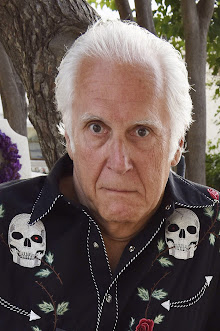
For decoration, of course, but also the beans bring luck.

Taylor discussing the arrow.
He also has an ostrich eggshell water gourd and a hunting bag.
Like all the Bushmen we've met or read about, the traditional hunting approach was with a bow - Taylor carried his over his shoulder - and a detachable arrow with a poisoned tip. Taylor told us that the bow was not very powerful, and that the arrow might well catch on a branch and pull out of the animal as it ran through the bush. To avoid this, the shaft detaches from the head, drops to the ground, and can be recovered later, while the poison remains.

I asked about the poison because it seems to vary between tribes and areas. Some use snake venom, some highly poisonous plants, and some a beetle lava that lives underground. In the case of the Okavango, the poison comes from the caterpillars of the monarch butterfly that's common in the area.

“What about lions?” someone asked, a little nervously.
“You must look hard,” Taylor replied with a small smile.


As the sun went down, Ya Ya sang us songs of the animals in the bush, imitating their movements.
It was a magical and moving afternoon.

Thursday, May 12, 2016

//Kha - The Name of the Lion

Michael - Thursday

It's Wednesday morning and I'm sitting in my hotel room in Reno about to head for the the airport for a flight to Los Angeles and then London, where I'll join Stan tomorrow evening for the Orenda Book event at Waterstones Bookstore in London.  We head off to Crimefest after that.  I'm really looking forward to linking up with Orenda's great group of authors, to say nothing of blogmates, and others.

There's just one problem.  I've just realized that I'll be on a plane when I should be doing a blog.  This confusion may have resulted from the idea of going to London from Johannesburg via Nevada.  I think I was confused about direction. And time. Long story.  

Stan and I are just finishing a short story set in New Xade in the Kalahari in Botswana, and of course that makes me think of the original Xade and the ancient culture of the Bushmen of the past.  And that made me think of stealing a blog from the past...

Wilhelm Bleek
Dorothea Bleek
Between 1870 and 1880, two linguists – Wilhelm Bleek and Lucy Lloyd recorded the stories and beliefs of five /Xam Bushmen.  By that time, the Bushmen of the southern region – south of the Orange River – were in decline, and it was clear that the /Xam culture would soon be gone.  Bleek had several of the /Xam live with him at his house in Cape Town and learned their language.  This was a remarkable feat for two reasons – firstly at that time there was essentially no written version of the language and its dialects, and secondly its structure involved the frequent use of five clicks each changing the meaning of what followed in the context.  The linguists had to develop a character set to represent these (and other) features of the language.  Thus the five special clicks are written /, //, ≠, ! and Θ.  The names of the five /Xam teachers who shared their customs and beliefs with Bleek and Lloyd in their own language (with the Western names they were given) are /A!kuηta (Klaas Stoffel), //Kabbo (Oud Jantje Tooren), Diä!kwain (David Hoesar), /Haη≠kass’o (Klein Jantje Tooren) and ≠Kasiη (Klaas Katkop).  The material was compiled in extensive notebooks.  Some forty years later one of Wilhelm Bleeks daughters – Dorothea Bleek – first published them.

One of the /Xam teachers
The interest in what is recorded for the ordinary reader is in the picture that it gives of a vanished culture and its beliefs.  The /Xam lived in semi-arid savannah conditions and shared the environment with all the big game for which Africa remains famous.  Of these none was more awesome and terrifying than the lion. Even today sitting in the (relative) safety of an open Land Rover in a game reserve, few things are more awe-inspiring than a lion roaring a few yards away.  And the casual glances they give you with big yellow eyes as they walk past seem to say, “You have the upper hand now, but things may be different later.”


Perhaps it is hardly surprising that the Bushmen attributed powers to lions that went way beyond their daunting physical prowess and co-operative hunting skills.  Lions understood human speech.  Owls and crows spied for them.  Worse still, they had swarms of flies which they could send out to listen to what people said and report back.  Thus, children in particular where warned to be careful not to insult a lion; it was best to euphemistically refer to “hair” (“Hair" was here, see there are "Hair’s" footprints) or to indicate the same with one spread open hand.  Then the flies wouldn’t know.  (Presumably flies don’t have enough intelligence to bring to learning such matters.)  Not only would owls report to the lions on where people where, they could also make the sun set quickly – taking away the light people needed to fight or escape.

It is hard to imagine living not only in nightly danger from these large predators, but also endowing them with demon-like powers.  Yet, with great courage, the /Xam would sometimes steal part of a lion’s kill, maybe even driving off an animal or two to do so.  But there is a do-as-you-would-be-done-by moral to that tale.  It was understood that part must always be left for the lions, otherwise they would track the thieves to their homes and demand a human in compensation.
Diä!kwain told it like this:
            “Our parents used to say that if the lion did not find food at the place of the kill, he would be angry and say to himself, ‘Just you wait a bit; because you seem to have carried off all my food, I will do as you have done to me, I will follow your footprints, I will go and seize one of your men in his sleep and eat him.  For you seem to have forgotten that I, too, am hungry.”
(Customs and Beliefs of the /Xam Bushmen, edited by Jeremy C Hollman, Wits University Press.)

These stories and the many others that Bleek and Lloyd laboured to understand and record, give us an insight into a time and a way of life that is now gone, in South Africa at least.  


I think we owe them a debt.


Monday, October 10, 2011

talking to the Boys - Kalahari Bushman sandals make for walking


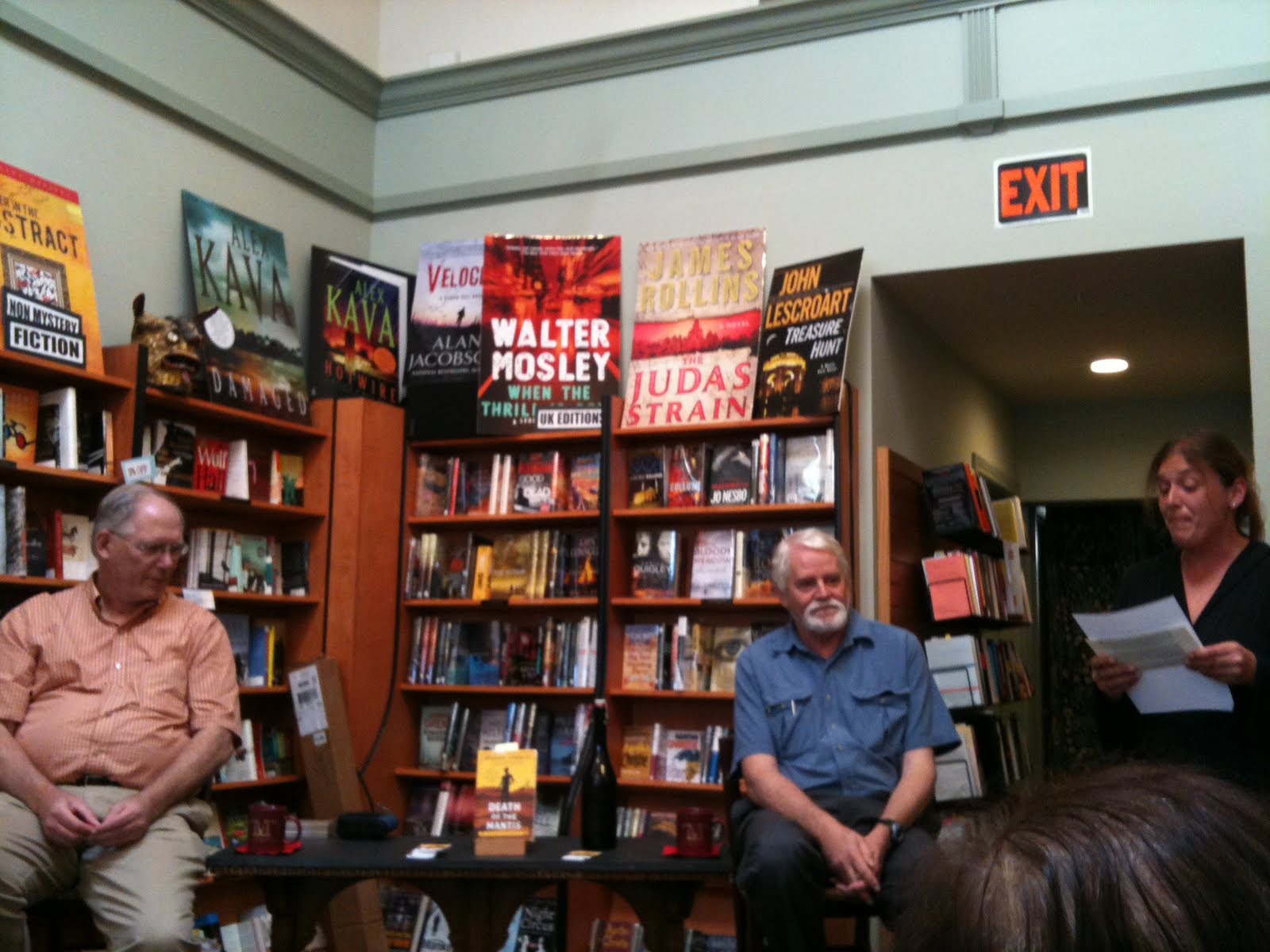
It's like a Bouchercon Redux. On Sunday, Stan, Michael and I sat in the Viennese Kaffeehaus next to M is For Mystery in San Mateo, Ca after their talk on Kubu's latest investigation, Death of the Mantis. Lovely cover. Last time we blogmates met up was a few weeks ago at the Bcon bar with Yrsa, who's at the Frankfurt Book fair right now, Leighton, who's pasta'ing it up in Rome or Palermo, Jeffrey, who might or might not be back in Greece, Tim, who's I don't know where and Dan, in our thoughts, in London. Take that back, Stan and I danced at Bcon at the party. He twirled me so much on the floor to Max Allan Collins 60's rocknroll band I got dizzy. Light weight me begged off and sat down.
Stan and Michael gave an incredible presentation: even sharing a Bushman's travelling kit used in the Kalahari desert. Stan and Michael explained several of the Bushman's tools and weapons.
The Bushman kit, Stan figures is 75-100 years old, the container is leather from an antelope. It carries a bow and unusual arrows, hunting knife, a knobkierie - not pictured but like a carved wood bang on the head thing - resembling a golf club used to finish off a large antelope after the poisoned arrow's venom starts taking effect, Bushman sandals above which saw a lot of wear in the Kalahari. A flyswitch from a wildebeest tail, a carved container that once held poisonous beetle larvae to dip in their arrow heads. Also, at campfires in the Kalahari Bushmen made music by filling beads, broken ostrich shells, seed pods and coccoons into rattle shakers.
Today, of the surviving 150-200,000 Bushmen in South Africa, Stan would call no more than 200 of them nomadic. Who would dig for water if there's a spigot he asks. Arguments to keep that nomadic way of life in all it's aspects would be a sentence in present day, Stan added, discounting the old colonial view of the noble savage. Stan bought the Bushman kit forty years ago after visiting a curio shop in Capetown where he'd met an Afrikaans mercenary. Later in Jburg the mercenary sold him the kit and intimated he'd taken a large vehicle and drove thru Central African areas picking up artifacts. A genuine piece normally handed down in the tribe could be bartered by Europeans for a bottle of scotch or handful of bills. Priceless artifacts which cost the white man nothing. Michael and Stan feel ambivalent about the art they've collected and have wondered whether it's better to bring it back where it belongs or donate to a museum - but ask themselves would the art be appreciated or would people care?
There's a link to all this and more at:
http://www.detectivekubu.com/Mantis/home.html

But over capuchino and espresso I asked these busy boys what it's been like on the road with this book tour, their thoughts, any philosophy or world shaking insights they'd like to share. I put them on the spot.
So in answer to the first question Stan replied about their 20 city Midwest and West coast tour, 'Exciting, exhilerating tiring and expensive.' Michael's response was 'The Capuchino's are good here.'
Now almost at the end of their tour Michael - an avid birder - is looking forward to Kakadu, a National park in Northern Australia after this. He says he's earned some R + R without cell phones or the web. Stan's going to back to South Africa and straight into bush. Sounds like they're going incomunicado. Or looking for a story.
Cara - Tuesday

Thursday, January 27, 2011

Tsodilo


Michael and I have just emerged from a torrid several weeks of responding to our UK editor’s suggestions for the third Detective Kubu mystery, Death of the Mantis.  The suggestions were excellent and have improved the book.  Of course, there was a short deadline because she wants to bring the South African edition out in May.
Death of the Mantis has as its back story the plight of the bushmen in the Kalahari.  However I’m not going to discuss that in this blog – perhaps later, after the current set of lawsuits has run its course. 
In our book we have created a fictitious place in the middle of the Kalahari, which we call The Place.  It is revered by Bushmen, who regard it as the most important religious and cultural site in their world.  In the real world, there is a similar place in the Kalahari, that the Bushmen regard as the birthplace of Mankind. 
The Male hill
It is called Tsodilo, and comprises four hills that rise abruptly out of the desert in northwest Botswana.  The largest hill is called The Male by the Bushmen.  It is the highest point in Botswana at 1,400 metres above sea level, rising 410 metres above the surrounding desert.  Then there is The Female; then The Child.  The fourth hill has no name, although it is thought to be the Male’s first wife, whom he left for the taller Female. 
The Female hill
The Tsodilo hills area was proclaimed a UNESCO World Heritage site in 2001.  The preservation is only 10 sq. km in extent (about 3.6 sq. miles).
There are probably two reasons for this proclamation.  First it has seen human habitation for 100,000 years.  The original inhabitants were probably the Bushmen, who are generally acknowledged as being the First People of the Kalahari.  There have also been a number of Black tribes, such as the Hambukushu, who have lived in and around the hills.  All of them regard the hills as sacred.
The Bushmen believe that the gods made mankind at Tsodilo.  They point to the knee-like impressions on The Male – the most sacred of all places - where the First Spirit knelt and prayed after creating men and women.  They believe that their ancestors and gods live in the caves and overhangs of The Female.  Similarly, the Hambukushu believe that their tribe and its livestock were put on earth at Tsodilo by their god, Nwambe.  They point to the hoof prints in rock on The Female in support of their belief.
The second reason for the proclamation of Tsodilo as a World Heritage Site is the stunning rock paintings – over 4500 in all.  Although I have not been able to find consensus as to their age, guestimates range from the oldest being 20,000 years old to being 2,000 years old.  It is probably one of the two or three richest sites on the planet for such art.
It is not only the number of paintings that is remarkable, but they frequently are of a different style than other sites, the nearest of which is 250 kms away.  When I went there, the most stunning painting I saw was that of two whales next to a penguin.  One whale is spouting.  The nearest ocean, the Atlantic off Namibia, must be 1000 kms away, across some of the most inhospitable and demanding terrain.
A penguin and two whales


The older paintings are in red, and the later ones sometimes in white – an unusual colour for rock art.  The red ones are made from red ochre extracted from hematite, which is plentiful in the area.


A common image at Tsodilo is of men with semi-erect penises.  I have read, but not verified, that it is typical of Bushman men to have a semi-erect penis as their everyday lives.  Some people think that the figure paintings represent a trance dance, which results in an altered state of consciousness in which, the Bushmen believe, the dancer can heal the sick and control the natural and supernatural.  The dancer can also communicate with the ancestors.

Bushmen with semi-erect penises


The highly controversial Laurens van der Post visited Tsodilo (The Lost World of the Kalahari).  In it he tells of when his party ignored the advice of his Bushman guide and killed a warthog and steenbok in sight of Tsodilo, which upset the spirits of the hills.  When they reached the hills, a camera inexplicably kept jamming, tape recorders stopped, and the party was attacked by bees.  These things only came to an end when Van der Post buried a written apology to the spirits below one of the spectacular rock faces.
I know Tsodilo is far off the normal tourist routes, but it is one of the special places on earth.  It is intensely spiritual, as well as providing a fascinating glimpse into the past.  If you visit southern Africa, I recommend that you put it on your itinerary.
Stan - Thursday