Showing posts with label Women explorers. Show all posts

Monday, April 10, 2017

Alexandrine Tinne': African Explorer

Annamaria on Monday


This comes under the heading of books I am tempted to but will never write.  The thing about this heroine is that I admire a lot of what she did, but so many different possibilities emerge from her story that I have trouble imagining her as a person.  I think you will see why.


Born in 17 October 1835 in The Hague to a Dutch aristocratic family, Alexine (as she called herself) was educated at home--next door to the Dutch Royal Library.  She spent a lot of time there, pouring over charts and journals of explorers and developing an obsession for the "blank spaces" on the maps.  Her father died when she was only ten, leaving her the richest girl in the Netherlands.


As she matured, she remained uninterested in a life in high society.  Instead, she decided to spend her daddy's fortune on exploration.  Like (ahem) many other little girls, she fell in love with geography at an early age, in her case inspired by souvenirs of her father's travels.  Wanderlust overtook her and her mother in 1862.  They and her aunt, the went to Khartoum and on up the White Nile, where no European women had ever gone.  There, they began to experience the illnesses that plagued their travels ever after.  Over the next three years of Africa exploration, a male geographer accompanying them, her mother, and two Dutch maids died of various maladies.  Alexis, herself plagued by eye infections and gout, returned to Khartoum to find that her aunt and a third maid--who had stayed behind--had also died.
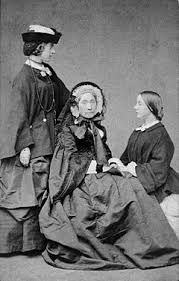

In 1865, her brother John traveled from Liverpool to convince her to go home.  She would have none of it.  She sent him back to Liverpool with much of her ethnological collection of materials and plant specimens.  John took Mamma's corpse back to Europe to be buried in The Hague.  He donated Alexandrine's collected materials to the Liverpool Public Museum.


Alexine, meanwhile, moved to Cairo, living in Oriental fashion and taking side trips to Algeria and Tunisia.  Her next destination was a fateful one: to cross the Sahara and explore the Touareg  territory.


She set out on her own, made it as far as Murzuq, but on her way to Ghat, fate caught up with her.  She and two Dutch sailors traveling with her met their deaths on the first of August 1869.  They were murdered, some say by Touareg tribesmen.


A trial four or five months later revealed that she was cut with a sword in her neck and on one of the her hands and that she was then left to die.  They never found her body.  The most plausible rationale for her murder was intra-tribal strife rampant in the area.  Testimony said that one side sought to discredit the other making their territory look dangerous.


Some of the invaluable materials Alexine collected were destroyed during World War II bombing raids, incredibly both in Liverpool and in The Hague.  Many survive--some of them in a Museum in Stuttgart.


So if you were going to make Alexandrine Tinne' a fictional heroine, what kind a person would she be?

Monday, December 1, 2014

Gudrid Thorbjarnardóttir, a traveling woman


On that marvelous bus tour that we took with Yrsa last week, I learned about the first European woman to come to North America—or Vinland as she and her fellow Norsemen called it.  With Yrsa’s permission to horn in on her territory, I am going to report what some quick research yielded about life of Gudrid Thorbjarnardóttir.  Most of what I report here comes out of “The Saga of Eirick the Red” and The Saga of the Greenlanders,” which—if one pieces them together and takes a few liberties with exactly how many husbands she had—will give us an idea of Gudrid’s life.

For a long time, Gudrid’s story was thought to be pure myth, even after the discovery of the Viking longhouse in Newfoundland.  It wasn’t until 2001, and the discovery of her house in Iceland, precisely where the sagas said it was, that historians began to take seriously the reports of her adventures.  Viz—


Born in Laugarbrekka, Iceland in 980, Gudrid grew up to earn the nickname Vidforla, the Far-Traveler.  She may have traveled more miles than anyone—man, woman, or child—during her time. 
The sagas tell us that her first love was a young man named Einar.  But her father refused his permission for them to marry because Einar was the son of a slave.  Oh, the dishonor!  But then Papa went broke and the to avoid the scandal of that, he took his daughter and along with thirty others followed Erik the Red to Greenland. Half the company died of plague along the way, but Gudrid and her daddy made it and there she married a Norwegian, who also promptly died. 

Lief Eiriksson, Lief the Lucky, soon showed up, planning a trip to Vinland, now Newfoundland.  Gudrid, at that point a widow, married Lief’s younger brother Thorstein and went along on the journey, but an illness devastated the ranks of the settlers and Thorstein died. 

Here is where the sagas take a paranormal turn.  Thorstein came
back from the dead and told Gudrid that she would go to Norway and then back to Iceland, that she would marry again, to another merchant, that she would travel south on a pilgrimage, and that she would eventually return once more to Iceland and found a church.  Gudrid, in fact, did has the ghost predicted, but with a big detour.


In Norway, she married the merchant Thorfinn Karlsefni and promptly convinced him to take a party of settlers back to Vinland.  They got together a group of sixty men and five women, some livestock, and crossed the sea.  In Vinland, Gudrid gave birth to the first European child born in the New World—Snorri Thorfinnsson.  Thorfinn and Gudrid soon took their baby back to Greenland.

After Thorfinn died, Gudrid converted to Christianity, made that pilgrimage to Rome, where she may have met the Pope.  By this time, Snorri was married and settled in Iceland.  On her return from Rome, she returned to be near him, built a church, and lived out her days as a nun and an anchoress. 

A Scottish writer, Margaret Elphinstone wrote a novel about Gudrid—The Sea Road.  Nancy Marie Brown’s The Far Traveler: Voyages of Viking Woman gives a nonfiction account of the life of this remarkable woman.


Hooray for traveling women!

Annamaria - Monday


Monday, March 10, 2014

Mary Gaunt, Explorer, Novelist, Travel Writer


The British men who explored Africa during the nineteenth century have been well memorialized here on MIE.  But not all Britain’s intrepid adventurers were male.  One of them is a heroine of mine and is my subject today.

Mary Eliza Bakewell Gaunt was born on the 20th of February 1861 in Chiltern, Victoria, Australia.  Her father, a county court judge, was unusual for a man of his era.  He supported his daughter’s desire for an education and travel.  Ordinarily, then and perhaps even now, fathers who had no sons would encourage such a daughter, but if they had male heirs, they expected their girl children to be proper ladies.  Mary had brothers, but her father favored her.  She, therefore, did not grow up to be her era’s ideal woman.  But she is my idea of exactly that.


In 1881, Mary was only the second woman ever to enroll in the University of Melbourne.  However, after only a year there, she jettisoned academic life to pursue her ambition of becoming a writer.    She wanted to make her own money “as a means of locomotion.”  Wanderlust was the passion of her life.

Based on her memories of her childhood in the goldfields, she immediately started writing travel articles.  Her first novel was published in 1884, the same year in which she married a widower, Dr. Hubert Lindsay Miller, another modern-minded man, who supported her going on with her writing and using her maiden name—a lot to say for a Victorian gentleman.  During their brief marriage she published a book of short stories and two novels.


When Dr. Miller died in 1900, Minnie, as she was known, took her modest widow’s pension of £ 30 per year and absconded to London in pursuit of expanded publishing opportunities.  At first, she struggled to establish herself as a writer (has that EVER been easy?).  Then, as soon as her stories began to sell, she took off for parts unknown: France, Italy, and most notably as far as I am concerned, West Africa.  Her first trip there in 1908 was along the Gold Coast, now Ghana.


In 1910, her publisher commissioned another African trip to explore the old forts along that same coast.  In her words she packed “a cabin trunk of pretty dresses, rose trimmed hats, gloves, photographic equipment.”  When she landed, she set off with a retinue of bearers.  In 1911, Alone in West Africa was published in London.


If you want, you can download a free copy here:

A woman after my own heart (yours too, I think, Lisa), she next ventured to China—Peking in 1913 and then north by mule cart to the Hunting Palace of the Manchus at Jehol (now Chengde).  She wrote her A Woman Alone in China while staying in a rented temple in the hills above Peking.  But then she had to give up her goal of returning to Western Europe by the old silk road.  She went back the way she came, across Siberia to Finland.

Chende


Two more travel books and several novels and short stories later, she took a sojourn in Jamaica and then she settled down and had the good sense to do it in Bordighera on the Italian Riviera.  When she was seventy-nine, World War II drove her from her home.  She escaped to France, leaving most of her possessions behind.  Mary Gaunt died in Cannes in 1942.

Bordighera


Bordighera, according to Monet


Mary Gaunt was never praised as a great stylist.  Her prose is clear, concise, and energetic.   Her novels are not deep character studies, but she told her stories with verve.  In other words, her books are like her:  full of locomotion.        


Annamaria - Monday