Showing posts with label The Meaning of Life. Show all posts

Saturday, October 24, 2020

How to Find the Meaning of Life


Jeff—Saturday


Like many of us, I’ve been able to scratch out time from my busy pandemic social calendar to sit back on my front porch and contemplate the meaning of life. 


Cue the violins.


For half of most years I live on a Greek island where temporal things matter.  Big time.  The island’s very existence depends on nurturing a sense in the hearts and minds of the hordes drawn there each summer that our very being is defined by what we possess or consume. The right table in the right restaurant, the right row of beach beds on the right place on the right beach, the right watch, the right late night club, the right bikini—or the right bikini wearer—all matter in the eyes of those who keep track of the things that determine your position in the governing pecking order.


Then I thought about other places I’ve lived: big, medium, and small cities, farm and academic communities, chic apartment buildings and shacks.  They all use different measures, but inevitably the same dynamic is at work everywhere.  Perhaps it’s what you do, where you live, where you (or your children) go to school, what you wear, what you drive, what courses you teach, your publisher, what ranks or distinctions you’ve obtained, but in some way or another they factor into the calculations of those who keep track of your position in their particular pecking order.


And I’m talking now about decisions made once the broader categories of race, religion, ethnicity, political party, and gender have been resolved.


Let’s face it folks, we live in world where categorization is a fact of life.  Jeffrey the writer occupies a different position than Jeffrey the New York City lawyer.  Annamaria the chef, a different position than Annamaria the stripper. Caro the comic a different position than Caro the sincere (okay, so my examples aren’t perfect).


The bottom line is, to be truly free you must be happy in your own skin doing what you want to do.  There will forever be persons out there judging you by their standards, and if you invest in playing by their rules, you will end up living someone else’s view of your life instead of living your own.   


A word of warning to those who might think this is a curse of the capitalist class:  Anarchists can be just as ruthless—if not more so—in determining the status of their adherents in the “anti-isms” rankings of their disparate pecking orders.


As Davy Crockett once said, “Be true to yourself and you shall not fear from any man [or woman…other than Annamaria or Caro, of course].” 


Now that we’re all comfortably settled back into our own skins, it’s time to take the next step in our personal quests for the meaning of life.


It begins with this question:  Why do so many of us think that what comes easily to us, must come easily to everyone else?


The natural corollary to that sort of thinking is that what comes so effortlessly cannot possibly be as meaningful as what does not.  For example, some know precisely what colors and patterns work well together, while others can’t even match black shoes with black socks.  Some can whistle a complex tune with perfect pitch, while others can barely blow their noses. Two unique skills, each too often taken for granted by its possessor.


Then there are writers who breeze through complex narrative portrayals, all the while dreading the eventual paragraphs of dialog to come.  And the artist genius with pen and ink that shrinks at the thought of touching oil to canvas. They, as well as those tortured by the opposite dilemmas, all thinking that what comes so easily to them is not as valued by society as that which does not.


I’m not meaning to suggest that one should not work hard toward mastering the more difficult aspects of one one’s chosen craft, but in seeking to master a skill set you find difficult, do not do so to the neglect of enhancing your natural gifts.  In other words, play to your strengths. 


Yes, we all admire and respect those who persevere and succeed in mastering the most challenging aspects of their work, but what of the many who lose patience in the struggle, become frustrated, and simply give up, sacrificing the potential of their natural gifts in the process.


Each of us has gifts meant for us to develop, nurture, and exploit.  If we pursue what we think is more valued by society, to the neglect of what we’re blessed with, we’re playing into the strengths of those who possess the very gifts we lack.  Our energies should be directed toward successfully competing through our strengths.


It’s like a five-foot-tall natural born jockey who, instead of racing, chooses to compete against seven-foot giants in basketball.  The outcome will assuredly be as unsatisfying for the jockey, as it would be for a seven-footer who decides charging for the finish line astride thoroughbreds is a better choice than heading for the hoop in a pair of Air Jordans.


Bottom Line: “Play the cards you’re dealt.”  But play them well.


That’s all from the front porch for this week. 


Cornets please.


—Jeff

Monday, December 10, 2018

EM Forster, HG Wells, Tom Stoppard, and the Meaning of Life


Annamaria on Monday


Where to begin?

Chronologically perhaps. But my chronology—not theirs.


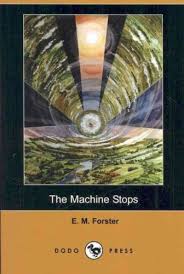
Somewhere around fifty years ago, while living in Brooklyn Heights and working on Wall Street, I was on a packed subway—going to work, standing up.  The train stopped somewhere under the East River.  It was summer, and the NYC subways were not air-conditioned in those days.  Sweltering! This incident was a common occurrence, and that day it lasted much longer than usual.  It would not have been at all memorable, but it sticks in my mind because of the book in my hand and the story I was reading—“The Machine Stops” by E. M. Forster.  That fiction, published in 1909, seemed, at that moment, to have everything to do with what I was experiencing.


If you don’t know the story, you can find it here:


It tells of a futuristic society in which the bulk of the human population live in tiny cells under the surface of the earth, where a machine takes care of all their needs.  It provides music and entertainment.  And the means to communicate with people half a world away through what reads (in this hundred+year-old story!) a whole lot like our FaceTime.  Food also comes through the machine (FreshDirect, perhaps?).    The main characters are a rebellious young man and his mother.  He wants to fight the machine.  She believes—as most people in the story do—in the omnipotence of the Machine.  Then the machine stops.  (Like the subway train I was on!)  And to survive, the people in Forster’s story have to fight their way to surface to survive.  You can see why I never forgot any of this.


The story is a masterpiece of what was science fiction a hundred years ago.  Scholars believe that Forster wrote the story as a response H.G. Wells’ The Time Machine, in which there is a clash is between good and evil.  Forster, instead, foresaw a future where the central conflict would be between mankind and machines.


Where Wells comes into my thinking today is not with The Time Machine, but with his War of the Worlds.  That brilliant novel imagines machines long left buried underground by aliens.  The creatures from outer space return to dig up their technology and wreck havoc on humanity.  The Martians lose that war, defeated—not by human beings, however brave. It is the earth’s microbes that infect the invaders and kill them. The humans, therefore, survive.

Microbes cast as the saviors of humanity!


Of late, my beloved science section of The New York Times has published a few articles about research into the actions of microbes on humans.  We have known for some time about how they can cause disease.  But nowadays, it’s looking as if the flora in our guts might have as much to do with our behavior as does our upbringing or the rules of our religions.  Data has begun to show that the microscopic critters in our intestines might be the source of happiness, optimism, crankiness—all manner of motivational emotions. Certainly, they play a huge role in digestion, taking the food we eat and turning into new substances that profoundly affect our wellbeing—for good or for ill.  Which microbes we have in our guts determines what chemicals go into our bloodstreams and therefore into our brains.  This little creature takes in carrots and gives you Zoloft.  That one turns carrots into Valium.  Or something like that. 


Which brings me to this past week, when I had the pleasure and the privilege of seeing Tom Stoppard’s latest play, The Hard Problem at the Mitzi Newhouse Theater at Lincoln Center.  The main conflict in his story is between scientific researchers who hold two opposing prejudices.  Some believe that the brain is all we humans have, and in a more or less mechanical way, it determines behavior.  Others of Stoppard’s characters hold that there are greater forces, outside our human “mechanical” brains and the lust for self-interest.  They believe in God, for instance.  Or altruism.  Or coincidence as an active determinant of human connection.  Forces not explained by the mere clicking of synaptic endings.


In the midst of the play’s action, one of the characters describes the role of microbes that live in cows. As is always the case, when my brain comes up against Tom Stoppard’s, I have a really hard time keeping up.  I wish I had the script to go by in describing what the woman in the play said.  Stoppard may have gotten this part of the story from an actual occurrence from nature, or maybe he made up something that only sounds real.    Anyway, what the actress said went something like this:  a microbe that lives in a cow needs to stay in the cow to reproduce.  But it comes out in the cow’s poop.  To get back inside the cow, the microbe infects an ant and lays its eggs inside the ant. The “diseased” ant then finds itself compelled to relentlessly climb up and down blades of grass and in the process leave some of the eggs at the top of the grass, which the cow then eats.


I think I have this part of the play right.  It all went by very fast in the theater.  But—the point certainly was that the microbe is doing some pretty fancy maneuvering to get what it wants: back inside the cow.  Real or fictional (or botched up by me), the process sounds quite plausible, given the strange ways in which all kinds of critters on this planet control one another.

And it is especially fascinating since scientists are toying with the possibility that microbes, might—in some extremely complicated ways—be in charge of us.


Where do you think we humans all fall in this story?  Are we the cow?  The ant? Or the microbe?

Are we controlling the machines?  Or are they controlling us?  

Most important: Will the microbes be able to save our planet?