

I’m back in Greece. Correction. I’m back on Mykonos.

Greece is teetering on the edge of bankruptcy, while Mykonos
can’t believe its good fortune. Each day
stories abound in the world press of politicians newly in charge of Greece’s
fate engaged in some new esoteric dance with the country’s creditors (IMF, EU,
ECB) in the hope of drawing Greece out of its half-dozen-year crisis of
austerity and no growth.

And if you spent time in central Athens amid its shuttered
shops and homeless you’d understand the reason for their concern.
But not on Mykonos, for if you left a refrigerator-size cardboard box on virtually any street in the old town, someone would probably try to open an upscale boutique or bar inside it. The place is booming. Long vacant spaces are now filled with Athenian businesses and glitzy international brands seeing Mykonos as the best place in Greece to make money.
But not on Mykonos, for if you left a refrigerator-size cardboard box on virtually any street in the old town, someone would probably try to open an upscale boutique or bar inside it. The place is booming. Long vacant spaces are now filled with Athenian businesses and glitzy international brands seeing Mykonos as the best place in Greece to make money.
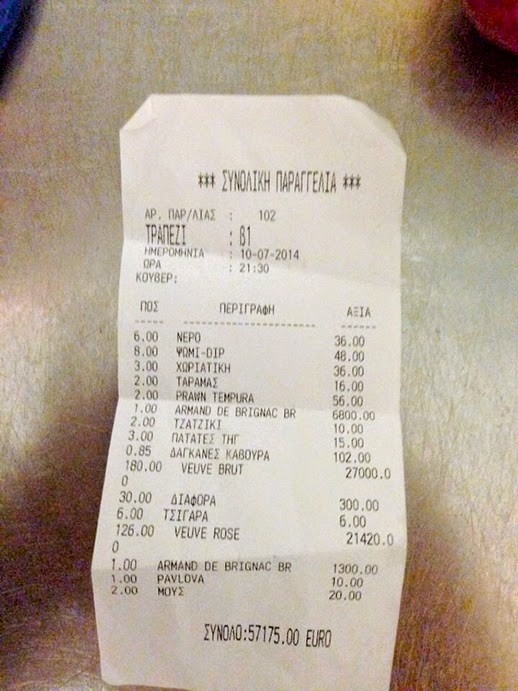 |
| A 57,175 Euro bar bill |
Big name international clubs and restaurants are flocking
here because word is out that Mykonos attracts throngs of high-end
international tourists searching for a VIP experience without concern for
price. The island already offers Europe’s
#1 and #3 ranked champagne sellers, and names like Buddha Bar, Hakkasan
Restaurant, and Toy RoOm Club are opening elaborate operations to get in on the
action.
 |
| All champagne |
None of that should come as a surprise to anyone familiar
with the island—and I’m not saying that because I’ve raised it in my books. The island’s future is simply no longer in the
hands of the Mykonians, whether or not they see it. Too much off-island money and power have
taken hold.
I’m not suggesting what’s happened is bad. To the contrary, in light of all that’s confronting Greece, how could it not be a good thing? But the island is a decidedly different place from just a few years back—and from virtually all of Greece that surrounds it. To me the die is cast, the Rubicon is crossed, old Mykonos is no more.
I arrive at this startling pronouncement of cosmic change without the benefit of an oracular reading, but rather through a variation on Dostoevsky’s observation “the degree of civilization in a society can be judged by entering its prisons.”
Specifically, I submit that the degree of Mykonos’ development as a society can be judged by entering its newly renovated Flora Super Market.
I’m not suggesting what’s happened is bad. To the contrary, in light of all that’s confronting Greece, how could it not be a good thing? But the island is a decidedly different place from just a few years back—and from virtually all of Greece that surrounds it. To me the die is cast, the Rubicon is crossed, old Mykonos is no more.
I arrive at this startling pronouncement of cosmic change without the benefit of an oracular reading, but rather through a variation on Dostoevsky’s observation “the degree of civilization in a society can be judged by entering its prisons.”
Specifically, I submit that the degree of Mykonos’ development as a society can be judged by entering its newly renovated Flora Super Market.

Yes, supermarket. For
years the terms “super” and “market” when used in combination on Mykonos represented
an aspirational goal more than a reality.
But slowly things changed. The
stores got larger, the stock more international, but still nothing like what
we’d consider a “supermarket” in the US.
That is, until this past winter when a shift of tectonic plates occurred in the Mykonos grocery world. The island’s largest supermarket chain (three stores) remodeled its main store to more than double its size and rival Las Vegas casino decor in the process.
That is, until this past winter when a shift of tectonic plates occurred in the Mykonos grocery world. The island’s largest supermarket chain (three stores) remodeled its main store to more than double its size and rival Las Vegas casino decor in the process.


When I stepped through the front door I did a literal double
take. The place is now a showcase of
steel, glass, sculpture, video, and deejay driven pump-it-up music. Aisles of candy, cookies, chips, condoms, and
cigarettes stand close by the door. Beyond
those diversions a corridor passes by a glass enclosed room filled with
hundreds of wines, then by rows of just as varied a selection of beers and
liquors, and opens into the market’s new area dominated by unique architectural
elements and a mammoth video screen on the far wall looming above the butcher
area.

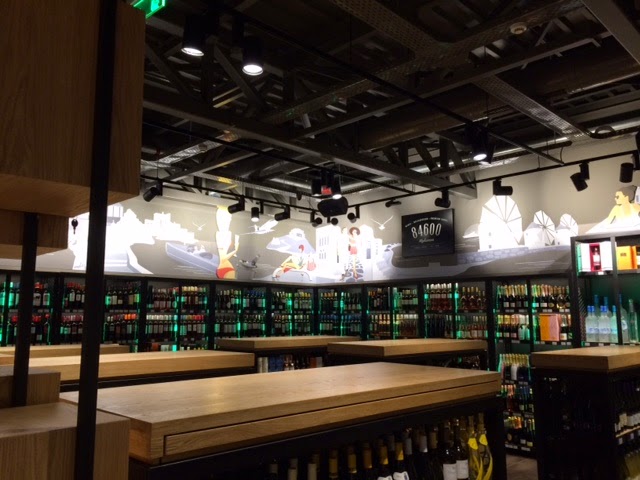


I’m sure it makes customers used to partying at one of the island’s
all night clubs feel right at home as they order their half-kilo of salami…uhh,
make that prosciutto.
To me this supermarket epitomizes the current state of the island. It represents a lot of things, perhaps most significantly how far Mykonos has come from its one-time position as among the poorest places in Greece. Mykonians suffered austerity and deprivations in World War II far beyond what most of us can imagine, but they emerged dedicated to bettering their lives through hard work and improvisation. It was folks like the still risk taking founder of Flora supermarkets who led Mykonos’ charge to new-found prosperity.
To me this supermarket epitomizes the current state of the island. It represents a lot of things, perhaps most significantly how far Mykonos has come from its one-time position as among the poorest places in Greece. Mykonians suffered austerity and deprivations in World War II far beyond what most of us can imagine, but they emerged dedicated to bettering their lives through hard work and improvisation. It was folks like the still risk taking founder of Flora supermarkets who led Mykonos’ charge to new-found prosperity.

Some may not be happy with the changes those efforts have brought
to the island, but Mykonians—as was their right—chose to set course toward an
inevitable outcome. They have now
arrived. Trust me on that.
Dostoevsky told me it’s so.
Dostoevsky told me it’s so.
Jeff—Saturday





