Kwei--Wednesday
 |
| Making equine friends at the Agadez animal market (Photo: Kwei Quartey) |
Getting oriented
During the flight to Niamey, I thought I might practice my rusty high-school French by striking up a conversation with one of my seat mates, who was from Niger. My tongue certainly needed some limbering up.
I landed late afternoon. Designed by Turkish company SUMMA, Niamey's new Diori Hamani Airport is only two years old. I snapped a pic as I emerged from the aircraft, but my ninja technique was imperfect and an official caught me red-handed and wagged her finger at me.
 |
| The new, glistening Niamey Intl Airport |
Customs and immigration weren't a big deal, and a mysterious Nigerien official helped me whizz through without incident. I was going to give him a tip, but he had vanished as suddenly as he had appeared. I wonder who he was.
Coming out of the airport into the balmy dusk, I spotted my Niamey guide, Abba Djitteye, of Timbuktu Explore Traveler, waiting for me. He had taken care of my Niamey transport and accommodation arrangements. On the way to the hotel, I was looking around for all the danger I had been reading about on the Internet concerning Niger (see my previous blog), and was frankly stunned at what the reality was.
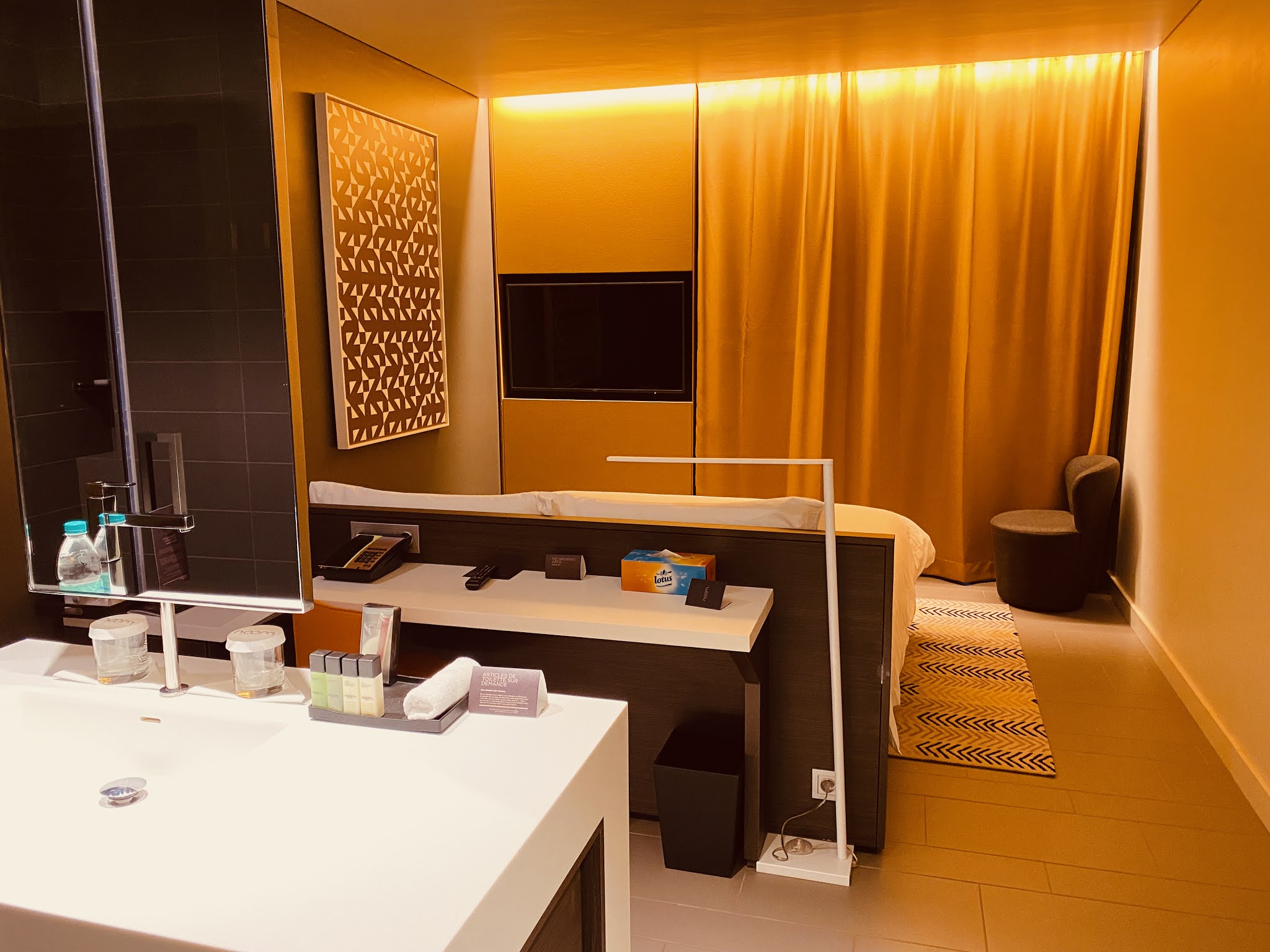
I spent only one night at the Niamey Noom, a lovely 5-star hotel, leaving for Agadez early the following morning. It wasn't a direct flight and made several stops to pick up passengers on the way. My Agadez guide, Ibrahim Alhassane, an enthusiastic young man with a bright smile and easy laugh, was there to meet me at Agadez's tiny airport. Within minutes of my arrival, I realized that cars were few and far between. How was I going to get to my hotel with my luggage? In one of these:
 |
| Tricycle taxi cab (Photo I. Alhassane) |
Was there actually room for three adults and a suitcase? Yes, in Africa, all things are possible.
The hotel, Auberge Azel, was reportedly the best in Agadez, "where the American ambassador stays when he comes here," I was told. Auberge was no match for Noom, but this is something one must get used to while traveling in Africa: in small towns or cities, hotel accommodations may not rise to the standards of the large metropolises.
 |
| Ochre walls surrounding the Auberge Hotel compound (Photo: Kwei Quartey) |
The material and color of the ochre is quite classic in Agadez and elsewhere in Niger. They are often starkly beautiful. After some confusion between the kitchen staff and me over the menu (I was trying to figure out which items were vegan), I retired to bed.
Beginning the research
The 2022 Emma Djan novel, LAST SEEN IN LAPAZ, will tackle the difficult and tragic phenomenon of West Africans trying to migrate to Europe as they flee from famine, drought, poverty and persecution. The migrants hail from Mali, Guinea, Sierra Leone, Burkina Faso, Benin, and Ghana, but the majority by far are Nigerians--male and female
 |
| West African migratory routes to Libya and Europe (modified Shutterstock map) |
Reaching Agadez is the first stage of the migration. Then it's on to Libya by a perilous journey across the Sahara to Libya. The idea is to leave Libyan shores and get to Italy. Other routes include Morocco via the Strait of Gibraltar to Spain, or Algeria to Spain. The real outcome is often far from the goal: sometimes the migrants get stuck in North Africa for a year or more because they don't have enough money to proceed farther.
Ibrahim had arranged for me to talk to some migrants in Agadez. But before we got to that, he had to set me straight on one issue. No way would we be going around town in tricycle taxis--they were so slow, might as well ride a tortoise. I needed to join the majority who used the single most important mode of transportation in Agadez: the motorcycle. "Okay," I said sheepishly.
 |
| The charismatic Ibrahim (Photo: Kwei Quartey) |
Like other men in Niger, Ibrahim wears a veil and headrest not for any religious reasons, but as protection from the sun, sand, and wind. I tried one of these veils but found it made me feel even hotter than I already was in the 100-degree weather. I was drinking gallons of water as I was sweating buckets. Ibrahim? Not even the faintest veneer of perspiration anywhere.
So, climbing onto the rear seat, off we went on his motorbike, which I must say was pretty nifty. Ibrahim dodged the potholes with ample dexterity as I got used to the sensation of being on a motorbike. The most important requirement is to trust the rider.
Talking to the migrants
Before meeting the contacts, we dropped in on a refugee camp run by the International Organization of Migration (IOM) in Agadez. At the time, the camp was empty, but the guard, who knew Ibrahim, let us look around. There wasn't much to it. The IOM has branches all over the world, and they concern themselves primarily with repatriating migrants.
Later on, Ibrahim took me to another part of town where I spoke to four male returnees from Libya: a Nigerian, Guinean, Beninese, and Gambian. They had all had different experiences, some more harrowing than others, but there were a few takeaways:
- The desert crossing is a desperately dangerous affair with threats of banditry (outlaws attacking and robbing the convoy of trucks); physical and sexual abuse by smugglers; severe dehydration and death.
- The convoluted web of agents, smugglers, "connection men," and madams, and who among these gets paid is confusing and riddled with inconsistencies, lies, and brutality. For example, a migrant soon discovers that the money they started out with is insufficient to make the whole journey. The only way to get that money is either to work as a prostitute, or in some more conventional setting (but finding work in places like Agadez is easier said than done).
- The very worst thing to happen to you is to be accosted or captured by the Libyan forces and then sent to a detention center, which, I can confidently say according to the accounts I heard, is hell on earth. The four young men I spoke to described unspeakable acts of cruelty and murder in their respective detention centers.
Their different accounts also raised questions about the IOM itself, some describing brutal treatment inflicted by IOM custodians as bad as that meted out by the Libyans. The Guinean man said he had no confidence the IOM could help him and because of the fear of being assaulted in the camp, he refused to stay. I've incorporated much of what I learned into my novel.
Ibrahim then took me to an area of the city where prostitutes commonly work. There was a slight misunderstanding when one of the young women thought I was there to avail myself of her services. Instead, we tried to talk to her and her two Nigerian companions about the story of their journey to Europe and how it had stalled, but in spite of the tip I gave them, they were not as forthcoming as I had hoped--certainly not as helpful as the young women I had met in Lagos.
Sheep, goats, cows, donkeys, and camels
I couldn't have claimed to have visited Agadez without going to the livestock market. Nigeriens are meat eaters. In this landlocked country, especially in Agadez and similar desert towns, fish is not popular. It's served primarily in restaurants and hotels that cater to expatriates. Therefore, beef, goat, and mutton are the usual accompaniments to the Nigerien staples of rice and millet. I understand that some Nigeriens also eat camel meat, but camels and donkeys are primarily sold as beasts of burden. (It's almost painful to watch a donkey placidly pulling an overloaded cart while already saddled with piles of merchandise on its back.)
It was at this market where I met my donkey friend above. I approached the camels, but one of them didn't seem to like me, and since I've had little to no experience with camels, I kept my distance.
 |
| Keeping a respectful distance from the camels (Photo: Kwei Quartey) |
Into the desert
One morning, about halfway through my trip to Agadez, Ibrahim announced exuberantly, "Tomorrow, Inshallah, we go to desert, to Azel, my hometown. You meet my family."
"Oh, um, yah," I stammered. "Well, if you say so," while thinking, hold up--how far into the desert? Were we talking sand dunes and mirages?
So the next day, round about three o'clock in the afternoon when the sun was perishingly hot, Ibrahim came to the hotel to pick me up, having hired an SUV plus driver. As I approached said SUV, I realized this wasn't some vehicle out of a slick SUV commercial, this SUV looked more like the kind of ancient, battered but indestructible Land Rovers the British brought to the African bush. At the wheel was a young guy (everyone is young in Niger) whom Ibrahim introduced as Mohammed.
I got in, noting with some alarm that the four windows were down. "Uh, is there air-conditioning?"
"Air conditioner?" Mohammed said. "No air conditioner."
You've got to be kidding, I thought.
Now, we pause the video for reflection. At that point, I could go one of two ways: (1) positively assert myself and refuse to ride to the desert without a/c when the temperature was around a 100 degrees. Don't I deserve better than this?
(2) go with the flow and not be an obnoxious, entitled American.
I went with the flow. Mohammed had probably already been paid and getting the SUV may not have been that easy in a poor town with very few cars, and lastly, well, this was Agadez; I couldn't expect it to be Pasadena, California.
My hope that the air coming in through the SUV windows would help cool me down turned out to be the height of wishful thinking. The air was hot, dry, and stinging. Neither Ibrahim nor Mohammed had a drop of sweat on them as I was slowly suffocating in the back. Ibrahim looked back at me. "Oh," he said with concern, "you don't look happy at all."
"Maybe because it's about a thousand degrees in here. Celsius."
The terrain was rocky sand with hardy scrub. There wasn't actually a road. Mohamed just knew where we were going. Whenever a truck came in the opposite direction, everyone waved at each other.
The trip was about one hour. Ibrahim selected our campsite and then took me around the area, which I now realized was what we would call an oasis.
 |
| A dried (but not dead) river bed (Photo: Kwei Quartey) |
During the rainy season, this becomes a mighty river.
 |
| A deep well for crop irrigation (Photo: Kwei Quartey) |
 |
| Fine-looking squash (Photo: Kwei Quartey) |
Ibrahim introduced me to his uncle, a farmer growing several crops, including dates.
When we got back to camp, Ibrahim lit a fire magically without matches, and began cooking dinner. Since he knew I was vegan, he had specially prepared a bean stew for me. I was famished, and it was excellent. Before eating though, we had mint tea.
Ibrahim then busied himself getting the campsite ready for the night. He had brought along a folding cot exclusively for me.
 |
| Splash of color in the tawny landscape (Photo: Kwei Quartey) |
"Very nice," I said. "What about the tent?"
"Tent? No tent."
A night under the stars
Ibrahim had claimed that the desert turned very cold at night. I said, "I don't believe you."
"You'll see," he said.
I bet him 2000 CFA (about four USD) that I would not find the weather even remotely cold. On my deluxe cot, I lay awake and gazed at the legendary stars in the dark sky. There was zero ambient light. Complete darkness. I saw the Milky Way and my favorite constellation, Orion. Now, if only I could get some sleep.
Every so often, a breeze would stir, but it was hot and dry. It wasn't until about 2 AM that it cooled some. "So much for the cold night," I muttered. I managed to sleep for some four hours, waking before six. Ibrahim had shrouded himself in a sleeping cloth to shelter from the "cold" while I was shirtless and sweaty. He still owes me 2000 CFA.
We packed up and just as I thought we were about to leave, Ibrahim and Mohammed sat down on a picnic blanket.
"Aren't we leaving?" I asked.
"We're gong to have some tea," Ibrahim said, "and then we go."
"Tea?" I said. "No tea, no tea! There's no time for tea. Come on, chop-chop, we gotta leave right now before the weather gets too hot. And plus, I have work to do back at the hotel. Let's go!"
Ibrahim jumped up. "Yes, boss."
But Mohammed shot me a look that said in the Hausa equivalent, "Chill out, bro. Life isn't that serious."
The final night
Ibrahim made a big deal of taking me to a restaurant the last night I was in Agadez. Because Ibrahim knew the restaurant owner, he was going to personally shop for vegetables and then take them to the restaurant to be prepared as a fresh salad. I found the gesture very touching.
 |
| It was a marvelous salad. Besides mint, there was another flavor I could detect but not identify. |
Early the next morning, Ibrahim took me to the airport and waited around with me for the flight to be called. I was glad he was there to smooth out any misunderstandings between the officers and me. It always helps to have a local with you. It's like a shield. I got on the flight, but later on, the plane developed engine trouble and never made it to Niamey. The answer to what actually happened comes in the next blog.
 |
| Ibrahim and me at the Auberge Hotel |