
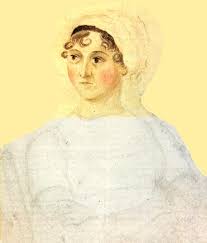
My head is so completely occupied with my work in progress that I can hardly tear myself away from the manuscript to fix myself a meal and keep my regular appointments. The book is at that point where the arc of the story is in place, and I am cleaning up the language and adding a bit of vibrancy (I hope) to the imagery. I love this part of my job so much that, right now, I don't want to be doing anything else. But it is Sunday afternoon, which is blog production time here Chez Patrice. It is also Mother's Day in the USA. Hence:
Let's talk about mothers in fiction, it's safer that way. A psychological truism, after all, is that mother-daughter relationships are the most fraught and complicated on the planet.
Disclaimer: I am going to talk about my fictional mothers and Jane Austen's fictional mothers. In no way do I mean, by this, to put myself in a class with Jane. It's just that hers and mine are the fictional mothers I know best.
Let's start with hers. They are, by and large, an unattractive bunch. I mean as mothers. They are all quite beautiful, but even the best of them leaves something to be desired.
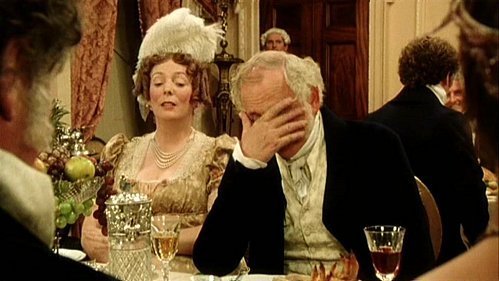
Mrs. Bennet
Lizzie's mama is, to my way of thinking, the worst of the lot. She is silly, crass, and negligent of anything about her five daughters, except for their marriageability. She has done nothing to inform her daughters' minds, to help them develop their talents. Even by early Nineteenth Century standards, she leaves their education to chance and cares only about their clothes and good looks, and what kind of marriage bait they will grow up to be. In Pride and Prejudice, even Lady Catherine de Bourgh comes across as a better mother than Mrs. Bennet. Her two oldest girls turn out very well despite her bad example. One wonders how they managed to blossom as they did under the tutelage of such a weak-minded woman.

Lady Bertram and Mrs. Price
The two mothers in Mansfield Park don't add up to one good one. Lady Bertram hardly every stands up straight. She is completely incapable of doing anything more complicated than petting her dog. Her sister, Fanny Price's mother back in Portsmouth, has made a very bad choice of husband and spends the rest of her life suffering in poverty and slovenliness. The best she can do for her daughters, two of them anyway, is to send them off to be raised by her sisters in Mansfield Park--the aforementioned shadow of a woman Lady Bertram and the otherwise childless and insufferable Aunt Norris. Fanny, too, somehow grows up to be a reasonably stable adult woman despite the lack of a decent role model.

Mrs. Dashwood
The mama of the Elinor, Marianne, and Margaret is the best of the mothers Jane created. Less than ideal, she is at least something approaching a functioning adult. She sits, like her second daughter Marianne, squarely on the Sensibility part of the spectrum. Her lack of practicality forces her eldest daughter, Elinor to grow up what today's psychologists would call a parentified child. Were it not for Elinor 's good Sense (with a capital S) the family would not have survived much past the girls' father's death in the first chapter of the book.

Austen's other heroines--Emma Woodhouse, Ann Elliot, and Catherine Morland--don't have mothers at all. Emma's and Ann's have died before the story begins. I think Catherine's has too, but I have to admit that I have not read Northanger Abbey in enough years that I can't remember why the mother of the heroine in that story is absent.
All of this makes me wonder what Austen's own mother must have been like. Perhaps it is unfair to judge her by her daughter's fictional mamas, but certain as I am that a novelist's characters come out of her unconscious, I am suspicious.
There are two mother-daughter pairs in my City of Silver, one in Invisible Country, and one in Strange Gods. None of my fictional mothers is perfect, but even the most flawed of them--Inez's mother in City of Silver--has an understandable condition. When I think about my fictional moms, I see, to some extent, my own mother and my grandmother in them--their strengths and their flaws. Quite a number of my female characters have mothers who have died--perhaps because my own mom died, far too young, when I was only 36.
Most of my readers know that Annamaria Alfieri is my pen name and that I chose it because it is my mother's first name and her mother's maiden name. My female forebears never had my opportunities. They had their flaws, but I took their names to honor them and because I forgave them their shortcomings.
Here they are. They made me what I am today.
 |
| Maria Sabina Alfieri |
 |
| Annamaria Pisacane |





